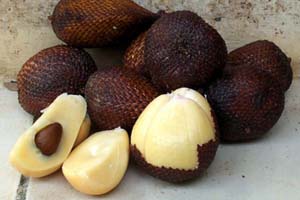
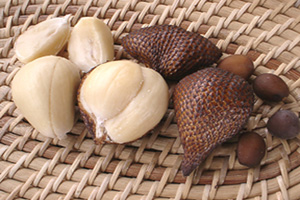
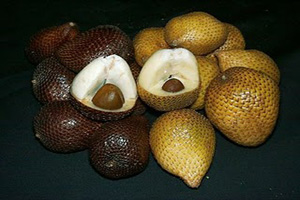
Salacca zalacca/Salak Fruit scientifically known as Salacca zalacca is a species of the palm tree (family Arecaceae) native to Java and Sumatra in Indonesia. It is cultivated in other regions as a food crop and reportedly naturalized in Bali, Lombok, Timor, Malaysia, Maluku, and Sulawesi. The fruits grow in clusters at the base of the palm and are also known as snake fruit due to the reddish-brown scaly skin. The fruit inside consists of three lobes with the two larger ones, or even all three, containing a large inedible seed. The lobes resemble and have the consistency of, large peeled garlic cloves. Salak fruits mature five to seven months after pollination. The tree produces fruits all year round but usually peaks around May and December in Indonesia. Harvesting takes place at fruitage of 5-7 months. Fruits are recommended to be harvested before they are fully ripe, by severing the bunch using a reaping knife.
Salak Fruit Quick Facts
Name:
Salak Fruit
Scientific Name:
Salacca zalacca
Origin
South Sumatra and southwest Java
Colors
Brown to orangey-brown, yellow
Shapes
Sub globose to ellipsoid drupe, 15–40 per spadix, measuring 5–7 cm by 5 cm, tapering towards the base and rounded at the top.
Flesh colors
White
Taste
Sweet and slightly acidic
Calories
368 Kcal./cup
Major nutrients
Iron (48.75%)
Vitamin B2 (15.38%)
Vitamin C (9.33%)
Carbohydrate (9.31%)
Calcium (3.80%)
Health benefits
Good for Pregnant Women, Cure Nearsightedness, Maintain Stamina, Promote Overall Body Health, Control Blood Sugar Level, Helps in Weight Loss, Memory Booster, Maintain Cardiovascular Health, Good for Stomach, Eye Medicine
Salak scientifically called Salacca malacca is a fruit native to South Sumatra and southwest Java as well as other parts of the world and belongs to the Arecaceae family. It is cultivated in other regions as a food crop and reportedly naturalized in Bali, Lombok, Timor, Malaysia, Maluku, and Sulawesi. The fruits grow in clusters at the base of the palm and are also known as snake fruit due to the reddish-brown scaly skin but the inside is sweeter than honey, sour like pineapple, and incredibly juicy. Its flesh is slightly acidic, giving your tongue a citrus-like tingle. Apart from Salak fruit, it is also known as edible-Fruited Salak Palm, Edible Salacca, Salak, Salak Palm, Snake Fruit, Snake Palm, and Snake- Skinned Fruit. Salak Gula Pasir, Salak Bali, and Salak Yogyakarta are a few of the most popular varieties of Salak fruit that are grown worldwide because of their delightful taste and wonderful appearance.
Brazil: Fruta Cobra Thai: Sala Burmese: Yingan Malaysia: Salak Danish: Salak Portuguese: Fruta Cobra (Brazil) Dutch: Salak Sundanese: Salak Finnish: Salaki Swedish: Salak German: Salakpalme Lithuanian: Valgomoji salakpalmė Indonesia: Salak Spanish: Salaca Japanese: Sarakka Yashi Russian: Салак Javanese: Salak Polish: Oszpilna jadalna Chinese: Ke Shi Sa La Ka Zong French: Palmier Salak Komi: Салак
Plant Growth Habit
An evergreen, acaulescent, very spiny, tillering, usually dioecious palm
Growing Climate
Thrives under humid tropical lowland conditions. Salak is usually grown under partial shade as it grows and performs better than in full sun.
Soil
Cultivated on mineral soils such as well-drained clayey loams, sandy loams and lateritic soils.
Root
Superficial, not deep
Stem
Subterranean stolons, with a short, 1–2 m high, 10–15 cm diameter, erect aerial part bearing the leaves.
Leaf
Pinnatipartite, 3–6 m long. Leaves, leaf-sheaths, petioles and leaflets have numerous long, thin, blackish spines. Petioles are very spiny and 2 m long. Leaflet segments are unequal, linear-lanceolate, with narrowed base, concave, apex caudate and acute, 20–70 cm by 2–7.5 cm.
Flower
Paired in axils of scales; male flowers with reddish, tubular corolla and 6 stamens borne on the corolla throat and a tiny pistillode; female flowers with tubular corolla, yellow-green outside and dark red inside, a trilocular ovary with short 3-fid, red style and 6 staminodes borne on the corolla throat.
Fruit Shape & Size
Sub globose to ellipsoid drupe, 15–40 per spadix, measuring 5–7 cm by 5 cm, tapering towards base and rounded at the top.
Fruit Color
Numerous brown to orangey-brown, yellow, united, imbricate scales
Fruit Skin
Dark brown skin
Flesh Color
White
Taste
Sweet and slightly acidic
Seed
Blackish-brown and trigonous with 2 flat surfaces and a curved one; endosperm white and homogeneous.
Varieties/Types
Salak Yogyakarta
Salak Bali
Salak Gula Pasir
Major Nutrition
Iron, Fe 3.9 mg (48.75%)
Vitamin B2 (Riboflavin) 0.2 mg (15.38%)
Vitamin C (Ascorbic acid) 8.4 mg (9.33%)
Carbohydrate 12.1 g (9.31%)
Calcium, Ca 38 mg (3.80%)
Phosphorus, P 18 mg (2.57%)
Protein 0.8 g (1.60%)
Total Fat (lipid) 0.4 g (1.14%)
Total dietary Fiber 0.3 g (0.79%)
Salak fruit is an evergreen, acaulescent, very spiny, tillering, usually dioecious palm growing in clumps formed by successive branching at the stem base. Roots are superficial, not deep and new roots emerge from the stem immediately under the crown, the internodes are short and crowded. They are found growing in humid tropical lowland conditions. Salak is usually grown under partial shade as it grows and performs better than in the full sun. Salak is usually cultivated on mineral soils such as well-drained clayey loams, sandy loams, and lateritic soils. Stems are subterranean stolon, with a short, 1–2 m high, 10–15 cm diameter, erect aerial part bearing the leaves. Similarly, leaves are Pinnatipartite, 3–6 m long. Leaves, leaf-sheaths, petioles, and leaflets consist of numerous long, thin, blackish spines. Petioles are very spiny and 2 m long. Leaflet segments are unequal, linear-lanceolate, with narrowed base, concave, apex caudate and acute, and 20–70 cm by 2–7.5 cm. Flowers are paired in axils of scales; male flowers with reddish, tubular corolla and 6 stamens borne on the corolla throat and a tiny pistillode; female flowers with the tubular corolla, yellow-green outside and dark red inside, a trilocular ovary with short 3-fid, red style and 6 staminodes borne on the corolla throat.
Fruit
Salak fruit, more technically known as a snake or salacca zalacca is a fruit that grows in clusters at the base of the palm and they are called snake fruit because of its reddish-brown scaly skin. Fruit is normally subglobose to ellipsoid drupe, 15–40 per spadix, measuring 5–7 cm by 5 cm, tapering towards the base and rounded at the top. Fruit skin is made from numerous brown to orange-brown, yellow, united, imbricate scales. The fruit inside consists of 3 lobes, each with a large inedible seed. The lobes resemble, and have the consistency of, large peeled garlic cloves and are white-colored. The taste is commonly sweet and acidic, but its apple-like texture can vary from very dry and crumbly (salak pond oh from Yogyakarta) to moist and crunchy (salak Bali). Seeds are usually 3 per fruit, each enclosed within 2–8 mm thick, fleshy, firm, mildly aromatic, cream-colored sarcotesta, with a smooth, stony inner part, 23–29 mm × 15–27 mm, which is blackish-brown and trigonous with 2 flat surfaces and a curved one; endosperm white and homogeneous.
Salak fruits mature five to seven months after pollination. The tree produces fruits all year round but usually peaks around May and December in Indonesia. Harvesting takes place at fruitage of 5-7 months. Fruits are recommended to be harvested before they are fully ripe, by severing the bunch using a reaping knife.
History
Salak is considered to have originated from South Sumatra and southwest Java. It was introduced and is now widely cultivated in Thailand, throughout Malaysia, and Indonesia as far as the Moluccas (Maluku). It has also been introduced into New Guinea, the Philippines, Queensland, and the Northern Territory in Australia, the Ponape Island (Caroline Archipelago), China, Surinam, Spain, and the Fiji Islands because of its distinctive look and health-promoting benefits.
Nutritional Value
Apart from its sweet and slightly acidic taste, salak is a good source of nutrients, vitamins, and minerals. Consuming 100 grams of salak offers 3.9 mg of iron, 0.2 mg of Vitamin B2, 8.4 mg of Vitamin C, 12.1 g of Carbohydrate, 38 mg of Calcium, 18 mg of Phosphorus, 0.8 g of protein, 0.4 g of Total Fat, and 0.3 g of Total Dietary Fiber.
Nutritional value of Salak Fruit
Serving Size: 100 g
Calories 368 Kcal.Calories from Fat 3.6 Kcal.
Proximity
Amount
% DV
Water
86.4 g
N/D
Energy
368 Kcal
N/D
Energy
1,539 kJ
N/D
Protein
0.8 g
1.60%
Total Fat (lipid)
0.4 g
1.14%
Carbohydrate
12.1 g
9.31%
Total dietary Fiber
0.3 g
0.79%
Minerals
Amount
% DV
Calcium, Ca
38 mg
3.80%
Iron, Fe
3.9 mg
48.75%
Phosphorus, P
18 mg
2.57%
Vitamins
Amount
% DV
Water-soluble Vitamins
Vitamin B2 (Riboflavin)
0.2 mg
15.38%
Vitamin C (Ascorbic acid)
8.4 mg
9.33%
*Above mentioned Percent Daily Values (%DVs) are based on 2,000 calorie diet intake. Daily values (DVs) may be different depending upon your daily calorie needs. Mentioned values are recommended by the U.S. Department of Agriculture. They are not rxharun.com recommendations. Calculations are based on average age of 19 to 50 years and weigh 194 lbs. Source: https://ndb.nal.usda.gov/
Health benefits of Salak
Salak fruit consists of nutrition just like Protein, Beta-Carotene, Vitamin-C, Dietary fiber, Iron, Calcium, Phosphorus, and Carbohydrates which are great for overall health. Salak or Snake Fruit contains lots of Beta-Carotene which is a powerful antioxidant and works well to prevent cardiovascular disease, strokes, and even cancer. Additionally, it contains 5 times more Beta-Carotene than that found in watermelon, mangos, and 3 times more than found in guava. Listed below are some of the popular health benefits of Salak fruit
1. Eye Medicine
Salak fruit is considered quite beneficial as eye medication. According to research by health specialists, salak fruit consists of beta-carotene that is great for the eyes. For anyone who wishes to keep their eyes healthy and balanced yet fed up with having to constantly consume carrot juice, now you have yet another option that is exchanging the carrot juice along with salak juice. SO including salak fruit in your regular diet is one of the best methods to get the required amount of beta carotene.
2. Good for Stomach
Salak is one of the nutrients dense fruit which consists of calcium, tannin, saponin, flavonoid, and beta-carotene. Because of these nutrients, salak has health benefits for the human body. Tanin is anti-diarrhea, so salak help to cure diarrhea. Apart from that salak treat the indigestion stomach. It is better to consume salak along with its epidermis, which can prevent constipation.
3. Memory Booster
Because of its higher nutritional value, Salak is called a ‘memory fruit’. The high amount of potassium and pectin present in salak helps to improve the body’s cognitive functions and enhances memory.
4. Control Blood Sugar Level
The skin of Salak fruit when made into tea helps in cell regeneration in the pancreas that helps to control diabetes. Apart from that it also contains pterostilbene which is a blood glucose lowering agent that helps in controlling diabetes. Therefore frequent use of salak fruit in your diet is quite beneficial for lowering blood glucose levels.
5. Maintain Cardiovascular Health
Salak consists of a good amount of potassium content that makes it heart-healthy. The high amount of antioxidants and minerals keep the cardiovascular system functioning properly and help in water regulation within the body.
6. Maintain Stamina
Vitamin A is beneficial for maintaining eye health and is commonly recommended to consume a lot of carrots to meet the benefits of vitamin A. Though Dr. Pericone recommends staying away from the carrots in a wrinkle-free diet to suit him just as much food is loaded with vitamin A (carotenoids) can cause an inflammatory reaction related because of the high sugar content. Nach to the glass every time he tries to reduce facial lines young efforts should convert alias using carrot juice Salak.
7. Cure Nearsightedness
Sharp eyesight cannot be corrected only by using the benefits of vitamin A. Vitamin A only improve the sharpness seen in the light and dark (night blindness). Trouble nearsightedness is not a problem in the retina of the eye, but the axis is shortened so that the drugs are also used. As the use of glasses can because a lot has done, so the glasses are considered drugs of course. Apart from that frequent consumption of vitamin-rich food is also quite beneficial for overcoming this problem.
8. Promote Overall Body Health
As mentioned before salak is one of the nutrient-dense fruit that helps in improving the overall health of the body. Its rich nutrient profile consisting of vital vitamins and minerals helps in maintaining proper body functions. Antioxidants help in fighting damage to the cells and tissues and prevent the body from harmful carcinogenic damage. Regular consumption of a portion of Salak in your diet helps to reduce the risk of hemorrhoid formation.
9. Good for Pregnant Women
Pregnant women should select foods that are good for them as well as future babies, so healthy food should be a priority. Consumption of Salak is good for young pregnant women who experience morning sickness. But do not consume too much salak, a balanced amount of protein-rich foods such as nuts must be consumed frequently.
10. Helps in Weight Loss
Due to its high fiber and antioxidant content, Salak is a sought-after diet for weight management diets. Since salak consists of calcium and carbohydrates it provides necessary energy and stamina to the body while on diet. Its tea is a wonderful astringent that is beneficial in reducing weight.
https://www.youtube.com/watch?v=9yfEK63zrWk
How to Eat
Sarcotesta of ripe fruits are consumed fresh or cooked and they can be canned or processed into fruit juice.
Salak has a unique taste that is likened to a combination of apple, pineapple, and banana.
Sarcotesta is also candied (manisan salak).
Fresh unripe fruit sarcotesta is used in a spicy fruit rujak.
Unripe, young fruit sarcotesta is consumed as pickles.
Sarcotesta from fruits of inferior quality is occasionally cooked with salt.
Salak fruit is now being developed into fruit juice, pickle, and other food products.
Seed kernels of the young fruits of the Javanese cultivar ‘Pondoh’ are edible.
The terminal bud is eaten as palm cabbage.
Indonesia exports fresh salak fruit to Singapore, the Middle East countries, Holland, Hong Kong, and China.
Indonesia also exports canned salak to Singapore and Europe.
Other Facts
The closely-planted row of salak palms forms an impregnable hedge and the very spiny leaves are also used to construct fences.
The bark of the petioles may be used formatting.
Leaflets are used for thatching
Types of Salak fruit
1. Salak Yogyakarta
Salak Yogyakarta goes to the family called Yogyakarta referred to as ‘pondoh’. It is well-liked by the Indonesian because of the power of smell, which may be overripe and also sweaty just before maturation. It has got 3 superior versions of the fruits family, referred to as pond oh super, Yogyakarta hit am, and also pond oh grading. It can also be a preferred of monkeys perfectly found on the well-known “Monkey Forests”, which usually steals fruit from individuals.
2. Salak Bali
It is really a palm just like a plant that develops in Tibetan, Nongan & Batusesa villages as well as tourist locations like Candidasa Beach as well as Besakih Temple. They are spherical or even conical in form and are also in a couple of 10 to 20 pieces. Throughout the season it may deliver Three to five bundles. This fruit is protected along with brown scales that seem like a snakeskin pattern along with thorns, therefore known as Snake fruit. The fruit includes a starchy ‘mouth feel’, along with a taste similar to slim pineapple and also lemon juice.
3. Salak Gula Pasir
The most costly salak fruit cultivar of the salak would be the ‘gula pair having an actual concept of fine-grained sugar. This fruit is smaller sized in comparison with the usual salak and is also the nicest of all salak fruit. Salak gula pair or even also referred to as Sugar salak that noted for its juicy sweet taste occasionally ferments to become Salak wine. This comes with an alcohol content of 13.5 percent, much like Grape wine. The Salak wine taste is nice and also dry. The price in Bali is Rs 15,000-30,000/ kg according to the time of the year.
Uses of Salak Fruit
Salak is frequently utilized just as one normal fruit offered at the table. Its taste is nice, sour, nasty, or perhaps a combination of all three. Apart from its excellent flavor and also fresh when it’s consumed, this particular fruit also includes nutrition which is good for overall health. Salak could be consumed right away. Furthermore, salak fruits may also be refined into many forms of food.
Salak cracker
It really is created utilizing unique frying equipment. Fruit flesh is very finely sliced up and that place in freezer for around one or two hours prior to being fried using a unique tool. Salak cracker is utilized like a tasty snack whenever you’re relaxing.
Salak sweets
Salak sweet has got a special taste whenever eaten. To create salak sweet just isn’t so hard. Materials required are just sugar, boiled water, just a little salt, and also fruits within their nations. A step to make it is very simple, simply by combining all of the ingredients which have been prepared within a container. After that let stands for about 1 week. Salak sweet is just about to serve.
Salak pickles
For making salak pickles, prepare elements just like water, whiting, red chili paste, a half tablespoon of salt, sugar, vinegar along with a tablespoon of food. Steps to make it, very first peel off the salak and also split in two and take away seeds. After that, soak within a solution of water and salt. Leave for just one hour, wash and also drain.
Then soak the salak once again to the solution of water as well as whiting about 1 hour, wash and also drain. Then enter in the salak again towards the solution of water in addition to the vinegar and salt which has been boiled and cooled before. Let stand for one to two nights. Salak pickles are prepared to be enjoyed.