
Linux based eBPF programs

Patient Tools

Read, save, and share this guide

Use these quick tools to make this medical article easier to read, print, save, or share with a family member.

Patient Mode

Understand this article easily

Switch between simple English and easy Bangla patient notes. This is for education and does not replace a doctor consultation.

In our previous blog, we spoke about the progress we have made for the eBPF for Windows project. A key goal for us has been to meet developers where they are. As a result, enabling eBPF programs written for Linux to run on top of the eBPF for...

For severe symptoms, danger signs, pregnancy, child illness, or sudden worsening, seek urgent medical care.

বাংলা রোগী নোট এখনো যোগ করা হয়নি। পোস্ট এডিটরে “RX Bangla Patient Mode” বক্স থেকে সহজ বাংলা সারাংশ যোগ করুন।

এই তথ্য শিক্ষা ও সচেতনতার জন্য। এটি ডাক্তারি পরীক্ষা, রোগ নির্ণয় বা প্রেসক্রিপশনের বিকল্প নয়।

Article Summary

In our previous blog, we spoke about the progress we have made for the eBPF for Windows project. A key goal for us has been to meet developers where they are. As a result, enabling eBPF programs written for Linux to run on top of the eBPF for Windows platform is very important to us. In this update, we want to talk about our learning and observations using...

Key Takeaways

  • This article explains Identifying the cross-platform functionality in simple medical language.
  • This article explains What next? in simple medical language.
Educational health guideWritten for patient understanding and clinical awareness.
Reviewed content workflowUse writer and reviewer profiles for stronger trust.
Emergency safety firstUrgent warning signs are highlighted below.

Seek urgent medical care if you notice

These warning signs are general safety guidance. Local emergency numbers and clinical judgment should always come first.

  • Severe symptoms, breathing difficulty, fainting, confusion, or rapidly worsening illness.
  • New weakness, severe pain, high fever, or symptoms after a serious injury.
  • Any symptom that feels urgent, unusual, or unsafe for the patient.
1

Emergency now

Use emergency care for severe, sudden, rapidly worsening, or life-threatening symptoms.

2

See a doctor

Book a professional medical evaluation if symptoms persist, worsen, recur often, affect daily activities, or occur in a high-risk patient.

3

Learn safely

Use this article to understand possible causes, tests, treatment options, prevention, and questions to ask your clinician.

Before reading

RX Patient Tools

Use these quick guides before reading the article, or return to them when you need help preparing questions for a doctor.

Start here Choose the right pathway for symptoms, reports, medicines, or urgent warning signs. Disease article roadmap Read this topic step by step: meaning, symptoms, warning signs, diagnosis, treatment, prevention, and follow-up. Treatment planner Prepare questions about treatment choices, benefits, risks, side effects, and follow-up. Family & caregiver guide Organize symptoms, reports, medicines, questions, and follow-up safely. Nutrition & diet guide Prepare food, hydration, supplement, and medicine-timing questions safely. Prevention guide Organize risk factors, protective habits, screening, and warning signs. Recovery guide Prepare a safe plan for activity, rehabilitation, warning signs, and follow-up.

In our previous blog, we spoke about the progress we have made for the eBPF for Windows project. A key goal for us has been to meet developers where they are. As a result, enabling eBPF programs written for Linux to run on top of the eBPF for Windows platform is very important to us. In this update, we want to talk about our learning and observations using an application that was fundamentally written for Linux.

What better way to demonstrate this than a very relevant real-world use case. With help from Cilium devs, we have been working to get the Cilium Layer-4 Load Balancer (L4LB) eBPF program running on eBPF for Windows.

Leading up to this, we have focused on building out the basic infrastructure for various map types, helpers, and hooks.

Identifying the cross-platform functionality

The Cilium load balancer is very rich in functionality, and we identified a subset of the functionality for this work that provides L4 load balancing.

Thanks to the devs on the Cilium project, the L4LB code is open sourced. We started by doing a deep dive into how the application is structured, the division of functionality between the user-mode application and the eBPF program that is loaded in the kernel, what eBPF hooks and helpers are used, and for what purposes.

User mode application

Naturally, the application was developed on Linux and we quickly found that the user-mode application uses libraries such as netlink that are Linux specific. As a result, we decided to write a Cilium agent-inspired user mode app that uses the Windows SDK for some of the networking APIs, and the eBPF for Windows platform for driving the eBPF programs.

The application creates the same types of maps that the Cilium agent does and loads the eBPF program that implements the load balancing functionality.

Hooks and helpers

Next, we made a list of the hooks and helpers used by the L4LB functionality. We found that, at a high level, Cilium has a standalone load balancer that uses eXpress Data Path (XDP) and socket/Traffic Control subsystem (TC) hooks. For the L4LB the XDP hook is particularly interesting since it allows executing BPF programs directly inside the network driver’s receive path as early as possible in order to process a high volume of inbound packets. Socket/TC hooks are used for optional health probing of backends. For the purposes of the demo, we decided to focus on the datapath and started building out the hooks, helpers, and maps for this.

We had already implemented an XDP hook based on the Windows Filtering Platform (WFP) for handling layer 2 traffic and enhanced that for this work.

The table below shows the hooks and helpers we needed to add for this purpose with the entries having an asterisk (*) found to be either optional or something we worked around. For example, bpf_fib_lookup() was a helper we knew would provide the next hop-based information for sending the packets. For the demo, we used existing APIs from the Windows SDK to get the layer 2 data and populated it in a map for the eBPF program to use.

Category Linux APIs
Generic Helpers bpf_map_lookup/update/delete_elem
bpf_tail_call
bpf_get_prandom_u32
bpf_get_smp_processor_id
bpf_csum_diff
bpf_fib_lookup*
bpf_ktime_get_ns
XDP Helpers bpf_xdp_adjust_meta*
bpf_xdp_adjust_tail*
XDP action XDP_TX (hairpin)

Maps

We enhanced the support for additional types of maps from the following list:

Category Linux APIs
Map types bpf_map_type_hash
bpf_map_type_percpu_array
bpf_map_type_percpu_hash
bpf_map_type_prog_array
bpf_map_type_hash_of_maps
bpf_map_type_lru_hash
bpf_map_type_lpm_trie
bpf_map_type_perf_event_array*

Verifier functionality enhancements

Just as we were making progress, we started running into verification failures running the PREVAIL verifier on the Cilium L4LB code. Digging deeper, we noticed that the Cilium L4LB program embedded Linux-specific assembly rather than being compiled from C, and the assembly was apparently due to needing workarounds for Linux kernel verifier artifacts. That assembly was failing PREVAIL verifier verification, but the original C code was fine, as a result we went back to using C instead of assembly for such code paths.

We then found two common cases where additional functionality was needed in the PREVAIL verifier to handle such real-world programs. We created patches for PREVAIL and contributed them upstream.

Getting it all to work together

Finally, we put all the pieces together to run both the Direct Server Return (DSR) and Source NAT (SNAT) functionality of the load balancer.

After commenting out functionality we identified as optional (as far as a demo is concerned) and handling the aforementioned cases of assembly instructions, we were able to get around 96 percent of the eBPF code that was written for Linux to run on top of the eBPF for Windows platform. This includes eBPF code written for Maglev hashing, NAT engine, connection tracker, packet handling code, and so on. We think this is very encouraging and exciting because it demonstrates the cross-platform value of eBPF.

Software Architecture
Linux based eBPF programs
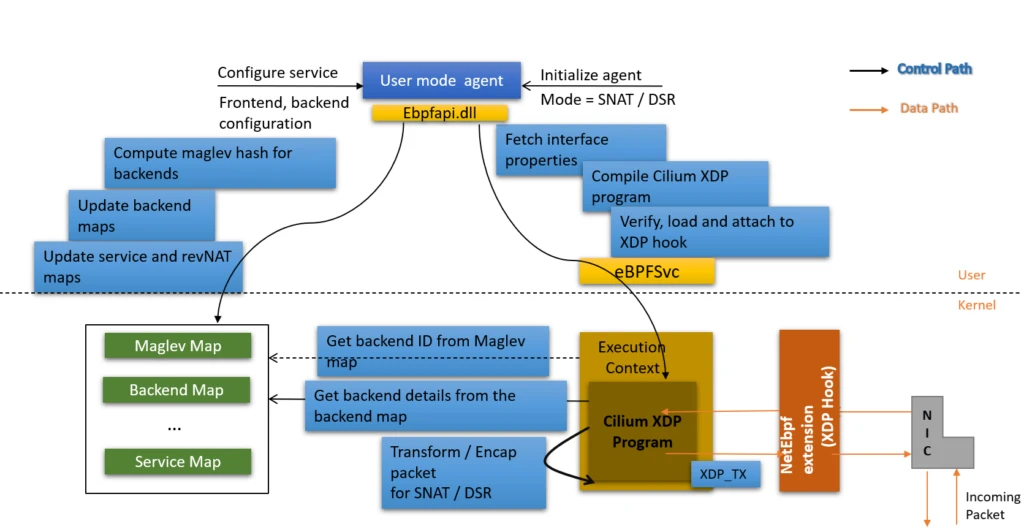
Figure 1: Software architecture of demo code

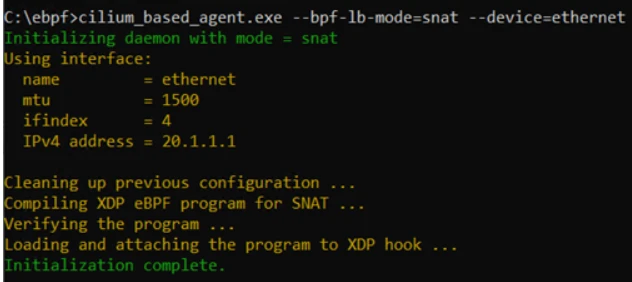
Figure 1 illustrates the software architecture of the demo load balancer. The code consists of a user-mode agent inspired by the Cilium L4LB’s agent. This reads several input properties such as interface details and accepts the desired service details. For the load balancer part, we ended up supporting both DSR and SNAT and the agent accepts this as a service mode. In addition to this, the agent receives the virtual IP (VIP) and the backend Direct IP (DIP) addresses. The agent computes the Maglev hash for the backends and then sets up a number of maps required for the BPF program such as the Maglev map, the backend map, the service map, and more. The agent calls the eBPF APIs through which the BPF L4LB program is verified and then loaded at the XDP hook.
Linux based eBPF programs
Figure 2: User-mode agent CLI

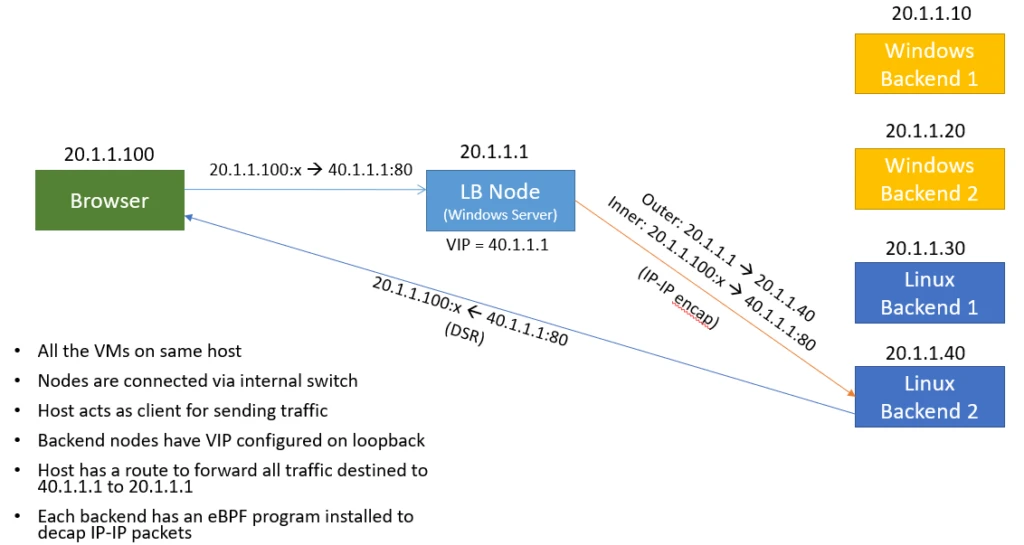
The demo topology consists of five virtual machines (VMs)—one load balancer VM and four backend DIP VMs, and a browser session representing the client. We hosted these VMs on the same server for the sake of simplicity, although this should not matter. The VMs are interconnected using an internal VMSwitch on the server. Figure 3 shows the topology of the setup and the packet path taken in the DSR mode.

Demo Topology DSR
Linux based eBPF programs
Figure 3: Topology diagram with DSR mode in action

The client initiates a web request with a source address of 20.1.1.100 to the VIP address 40.1.1.1. In the SNAT mode, the load balancer translates the IP header in both the inbound and outbound directions. The connection state is tracked using the connection tracker map.
Linux based eBPF programs
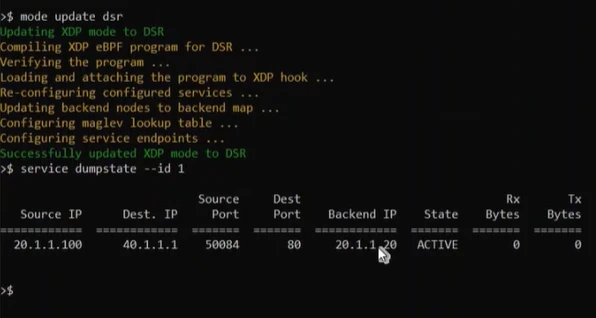
Figure 4: Screenshot of DSR mode

In the DSR mode, the load balancer encapsulates the incoming request in an outer IP header and sends it to the selected backend VM. The backend VM therefore must decapsulate the outer IP header and provide it to the webserver. We chose two backend VMs to run Windows and two VMs to run Linux. For the Windows backend, we used an XDP program to handle the decapsulation while the Linux VM used a TC-based program.

All the demo code described above is open sourced is available on GitHub and can be used by anyone to play with or extend as they wish.

What next?

We keep the list of open work items in our public GitHub repository. We will continue to be application-centric with a focus on hooks and helpers for better network observability. Maximizing eBPF source code compatibility will continue to be an important goal for us as we build out the platform to help even more applications be deployed on top of eBPF for Windows. Other than this, we are actively discussing with the community how to accept signed eBPF programs.

For all our work, we invite collaborations from the community to contribute to this work be it code, design, or bug reports.

Doctor visit helper

Prepare before seeing a doctor

A simple rural-patient checklist to help you explain symptoms clearly, ask better questions, and avoid unsafe self-treatment.

Safety note: This is not a prescription or diagnosis. For severe symptoms, pregnancy danger signs, children with serious illness, chest pain, breathing difficulty, stroke-like weakness, or major injury, seek urgent care.

Which doctor may help?

Start with a registered doctor or the nearest qualified health center.

What to tell the doctor

  • Write when the problem started and how it changed.
  • Bring old prescriptions, investigation reports, and current medicines.
  • Write allergies, pregnancy status, diabetes, kidney/liver disease, and major past illnesses.
  • Bring one family member if the patient is weak, elderly, confused, or a child.

Questions to ask

  • What is the most likely cause of my symptoms?
  • Which danger signs mean I should go to hospital quickly?
  • Which tests are necessary now, and which can wait?
  • How should I take medicines safely and what side effects should I watch for?
  • When should I come for follow-up?

Tests to discuss

  • Vital signs: temperature, pulse, blood pressure, oxygen saturation
  • Basic physical examination by a clinician
  • CBC, urine test, blood sugar, or imaging only when clinically needed

Avoid these mistakes

  • Do not use antibiotics, steroid tablets/injections, or strong painkillers without proper medical advice.
  • Do not hide pregnancy, kidney disease, ulcer, allergy, or blood thinner use.
  • Do not delay emergency care when danger signs are present.

Medicine safety and first-aid guide

This section is for patient education only. It does not replace a doctor, pharmacist, or emergency care.

Safe first steps

  • Avoid heavy lifting, sudden bending, and prolonged bed rest.
  • Use comfortable posture and gentle movement as tolerated.
  • Discuss physiotherapy, X-ray, or MRI only when clinically needed.

OTC medicine safety

  • For mild back pain, pain-relief medicine may be discussed with a doctor or pharmacist.
  • Avoid repeated painkiller use if you have kidney disease, stomach ulcer, uncontrolled blood pressure, or are taking blood thinners.

Avoid these mistakes

  • Do not start antibiotics without a proper medical decision.
  • Do not use steroid tablets or injections casually for quick relief.
  • Do not delay emergency care because of home remedies.

Get urgent help if

  • Back pain with leg weakness, numbness around private area, loss of urine/stool control, fever, cancer history, or major injury needs urgent care.
Medicine names, dose, and timing must be decided by a qualified clinician or pharmacist after checking age, pregnancy, allergy, other diseases, and current medicines.

For rural patients and family caregivers

Patient health record and symptom diary

Write your symptoms, medicines already taken, test results, and questions before visiting a doctor. This note stays on your device unless you print or copy it.

Doctor to discuss: Doctor / qualified healthcare provider
Tests to discuss with doctor
  • Basic vital signs: temperature, pulse, blood pressure, oxygen level if needed
  • Relevant blood, urine, imaging, or specialist tests only after clinical assessment
Questions to ask
  • What is the most likely cause of my symptoms?
  • Which warning signs mean I should go to emergency care?
  • Which tests are really needed now?
  • Which medicines are safe for my age, pregnancy status, allergy, kidney/liver/stomach condition, and current medicines?

Emergency warning signs such as chest pain, severe breathing difficulty, sudden weakness, confusion, severe dehydration, major injury, or loss of bladder/bowel control need urgent medical care. Do not wait for online information.

Safe pathway to proper treatment

Care roadmap for: Linux based eBPF programs

Use this simple roadmap to understand the next safe steps. It is educational and does not replace examination by a doctor.

Go to emergency care if you notice:
  • Severe or rapidly worsening symptoms
  • Breathing difficulty, chest pain, fainting, confusion, severe weakness, major injury, or severe dehydration
Doctor / service to discuss: Qualified healthcare provider; specialist depends on symptoms and examination.
  1. Step 1

    Check danger signs first

    If danger signs are present, seek emergency care and do not wait for online information.

  2. Step 2

    Record the symptom story

    Write when symptoms started, severity, medicines already taken, allergies, pregnancy status, and test results.

  3. Step 3

    Visit a qualified clinician

    A doctor, nurse, or qualified healthcare provider can examine you and decide which tests or treatment are needed.

  4. Step 4

    Do only useful tests

    Do tests after clinical assessment. Avoid unnecessary tests, random antibiotics, or repeated medicines without diagnosis.

  5. Step 5

    Follow up and return early if worse

    If symptoms worsen, new warning signs appear, or treatment is not helping, return for review quickly.

Rural patient practical tips
  • Take a written symptom diary and all previous prescriptions/test reports.
  • Do not hide medicines already taken, even herbal or over-the-counter medicines.
  • Ask which warning signs mean urgent referral to hospital.

This roadmap is for education. A real diagnosis and treatment plan requires history, examination, and clinical judgment.

RX Patient Help

Ask a health question safely

Write your symptom story. A health professional or site editor can review it before any answer is prepared. This box is not for emergency care.

Emergency first: Severe chest pain, breathing trouble, unconsciousness, stroke signs, severe injury, heavy bleeding, or rapidly worsening symptoms need urgent local medical care now.

Frequently Asked Questions

Identifying the cross-platform functionality The Cilium load balancer is very rich in functionality, and we identified a subset of the functionality for this work that provides L4 load balancing. Thanks to the devs on the Cilium project, the L4LB code is open sourced. We started by doing a deep dive into how the application is structured, the division of functionality between the user-mode application and the eBPF program that is loaded in the kernel, what eBPF hooks and helpers are used, and for what purposes. User mode application Naturally, the application was developed on Linux and we quickly found that the user-mode application uses libraries such as netlink that are Linux specific. As a result, we decided to write a Cilium agent-inspired user mode app that uses the Windows SDK for some of the networking APIs, and the eBPF for Windows platform for driving the eBPF programs. The application creates the same types of maps that the Cilium agent does and loads the eBPF program that implements the load balancing functionality. Hooks and helpers Next, we made a list of the hooks and helpers used by the L4LB functionality. We found that, at a high level, Cilium has a standalone load balancer that uses eXpress Data Path (XDP) and socket/Traffic Control subsystem (TC) hooks. For the L4LB the XDP hook is particularly interesting since it allows executing BPF programs directly inside the network driver’s receive path as early as possible in order to process a high volume of inbound packets. Socket/TC hooks are used for optional health probing of backends. For the purposes of the demo, we decided to focus on the datapath and started building out the hooks, helpers, and maps for this. We had already implemented an XDP hook based on the Windows Filtering Platform (WFP) for handling layer 2 traffic and enhanced that for this work. The table below shows the hooks and helpers we needed to add for this purpose with the entries having an asterisk (*) found to be either optional or something we worked around. For example, bpf_fib_lookup() was a helper we knew would provide the next hop-based information for sending the packets. For the demo, we used existing APIs from the Windows SDK to get the layer 2 data and populated it in a map for the eBPF program to use. Category Linux APIs Generic Helpers bpf_map_lookup/update/delete_elem bpf_tail_call bpf_get_prandom_u32 bpf_get_smp_processor_id bpf_csum_diff bpf_fib_lookup* bpf_ktime_get_ns XDP Helpers bpf_xdp_adjust_meta* bpf_xdp_adjust_tail* XDP action XDP_TX (hairpin) Maps We enhanced the support for additional types of maps from the following list: Category Linux APIs Map types bpf_map_type_hash bpf_map_type_percpu_array bpf_map_type_percpu_hash bpf_map_type_prog_array bpf_map_type_hash_of_maps bpf_map_type_lru_hash bpf_map_type_lpm_trie bpf_map_type_perf_event_array* Verifier functionality enhancements Just as we were making progress, we started running into verification failures running the PREVAIL verifier on the Cilium L4LB code. Digging deeper, we noticed that the Cilium L4LB program embedded Linux-specific assembly rather than being compiled from C, and the assembly was apparently due to needing workarounds for Linux kernel verifier artifacts. That assembly was failing PREVAIL verifier verification, but the original C code was fine, as a result we went back to using C instead of assembly for such code paths. We then found two common cases where additional functionality was needed in the PREVAIL verifier to handle such real-world programs. We created patches for PREVAIL and contributed them upstream. Getting it all to work together Finally, we put all the pieces together to run both the Direct Server Return (DSR) and Source NAT (SNAT) functionality of the load balancer. After commenting out functionality we identified as optional (as far as a demo is concerned) and handling the aforementioned cases of assembly instructions, we were able to get around 96 percent of the eBPF code that was written for Linux to run on top of the eBPF for Windows platform. This includes eBPF code written for Maglev hashing, NAT engine, connection tracker, packet handling code, and so on. We think this is very encouraging and exciting because it demonstrates the cross-platform value of eBPF. Software Architecture Figure 1: Software architecture of demo code Figure 1 illustrates the software architecture of the demo load balancer. The code consists of a user-mode agent inspired by the Cilium L4LB’s agent. This reads several input properties such as interface details and accepts the desired service details. For the load balancer part, we ended up supporting both DSR and SNAT and the agent accepts this as a service mode. In addition to this, the agent receives the virtual IP (VIP) and the backend Direct IP (DIP) addresses. The agent computes the Maglev hash for the backends and then sets up a number of maps required for the BPF program such as the Maglev map, the backend map, the service map, and more. The agent calls the eBPF APIs through which the BPF L4LB program is verified and then loaded at the XDP hook. Figure 2: User-mode agent CLI The demo topology consists of five virtual machines (VMs)—one load balancer VM and four backend DIP VMs, and a browser session representing the client. We hosted these VMs on the same server for the sake of simplicity, although this should not matter. The VMs are interconnected using an internal VMSwitch on the server. Figure 3 shows the topology of the setup and the packet path taken in the DSR mode. Demo Topology DSR Figure 3: Topology diagram with DSR mode in action The client initiates a web request with a source address of 20.1.1.100 to the VIP address 40.1.1.1. In the SNAT mode, the load balancer translates the IP header in both the inbound and outbound directions. The connection state is tracked using the connection tracker map. Figure 4: Screenshot of DSR mode In the DSR mode, the load balancer encapsulates the incoming request in an outer IP header and sends it to the selected backend VM. The backend VM therefore must decapsulate the outer IP header and provide it to the webserver. We chose two backend VMs to run Windows and two VMs to run Linux. For the Windows backend, we used an XDP program to handle the decapsulation while the Linux VM used a TC-based program. All the demo code described above is open sourced is available on GitHub and can be used by anyone to play with or extend as they wish. What next?

We keep the list of open work items in our public GitHub repository. We will continue to be application-centric with a focus on hooks and helpers for better network observability. Maximizing eBPF source code compatibility will continue to be an important goal for us as we build out the platform to help even more applications be deployed on top of eBPF for Windows. Other than this, we are actively discussing with the community how to accept signed eBPF programs. For all our…

References

Add references, clinical guidelines, textbooks, journal articles, or trusted medical sources here. You can edit this area from the RX Article Professional Blocks panel.