
Optimization across hardware with Olive

Patient Tools

Read, save, and share this guide

Use these quick tools to make this medical article easier to read, print, save, or share with a family member.

Patient Mode

Understand this article easily

Switch between simple English and easy Bangla patient notes. This is for education and does not replace a doctor consultation.

Hardware-aware model optimization is the process of optimizing machine learning models to make the most efficient use of specific hardware architectures—like CPUs, GPUs, and neural processing units (NPUs)—to meet production requirements such as accuracy, latency, and throughput. However, it can be challenging. Firstly, it requires...

For severe symptoms, danger signs, pregnancy, child illness, or sudden worsening, seek urgent medical care.

বাংলা রোগী নোট এখনো যোগ করা হয়নি। পোস্ট এডিটরে “RX Bangla Patient Mode” বক্স থেকে সহজ বাংলা সারাংশ যোগ করুন।

এই তথ্য শিক্ষা ও সচেতনতার জন্য। এটি ডাক্তারি পরীক্ষা, রোগ নির্ণয় বা প্রেসক্রিপশনের বিকল্প নয়।

Article Summary

Hardware-aware model optimization is the process of optimizing machine learning models to make the most efficient use of specific hardware architectures—like CPUs, GPUs, and neural processing units (NPUs)—to meet production requirements such as accuracy, latency, and throughput. However, it can be challenging. Firstly, it requires expertise in various independent hardware vendor (IHV) toolkits to handle the unique characteristics and optimizations needed for each hardware architecture....

Key Takeaways

  • This article explains Easing model optimization across hardware with Olive in simple medical language.
  • This article explains Intel and AMD optimization innovations in Olive in simple medical language.
  • This article explains Streamlining user experience through Olive in simple medical language.
  • This article explains Looking ahead in simple medical language.
Educational health guideWritten for patient understanding and clinical awareness.
Reviewed content workflowUse writer and reviewer profiles for stronger trust.
Emergency safety firstUrgent warning signs are highlighted below.

Seek urgent medical care if you notice

These warning signs are general safety guidance. Local emergency numbers and clinical judgment should always come first.

  • Severe symptoms, breathing difficulty, fainting, confusion, or rapidly worsening illness.
  • New weakness, severe pain, high fever, or symptoms after a serious injury.
  • Any symptom that feels urgent, unusual, or unsafe for the patient.
1

Emergency now

Use emergency care for severe, sudden, rapidly worsening, or life-threatening symptoms.

2

See a doctor

Book a professional medical evaluation if symptoms persist, worsen, recur often, affect daily activities, or occur in a high-risk patient.

3

Learn safely

Use this article to understand possible causes, tests, treatment options, prevention, and questions to ask your clinician.

Before reading

RX Patient Tools

Use these quick guides before reading the article, or return to them when you need help preparing questions for a doctor.

Start here Choose the right pathway for symptoms, reports, medicines, or urgent warning signs. Disease article roadmap Read this topic step by step: meaning, symptoms, warning signs, diagnosis, treatment, prevention, and follow-up. Treatment planner Prepare questions about treatment choices, benefits, risks, side effects, and follow-up. Family & caregiver guide Organize symptoms, reports, medicines, questions, and follow-up safely. Nutrition & diet guide Prepare food, hydration, supplement, and medicine-timing questions safely. Prevention guide Organize risk factors, protective habits, screening, and warning signs. Recovery guide Prepare a safe plan for activity, rehabilitation, warning signs, and follow-up.

Hardware-aware model optimization is the process of optimizing machine learning models to make the most efficient use of specific hardware architectures—like CPUs, GPUs, and neural processing units (NPUs)—to meet production requirements such as accuracy, latency, and throughput. However, it can be challenging. Firstly, it requires expertise in various independent hardware vendor (IHV) toolkits to handle the unique characteristics and optimizations needed for each hardware architecture. Secondly, aggressive optimizations can have an impact on model quality, balancing accuracy and efficiency within hardware constraints needs to be carefully managed. Additionally, the rapidly evolving hardware landscape necessitates constant updates and adaptations.

To alleviate this burden, we introduce Olive, an easy-to-use toolchain for optimizing models with hardware awareness. With Olive, you don’t need to be an expert to explore diverse hardware optimization toolchains. It handles the complex optimization process for you, ensuring you achieve the best possible performance without the hassle.

Easing model optimization across hardware with Olive

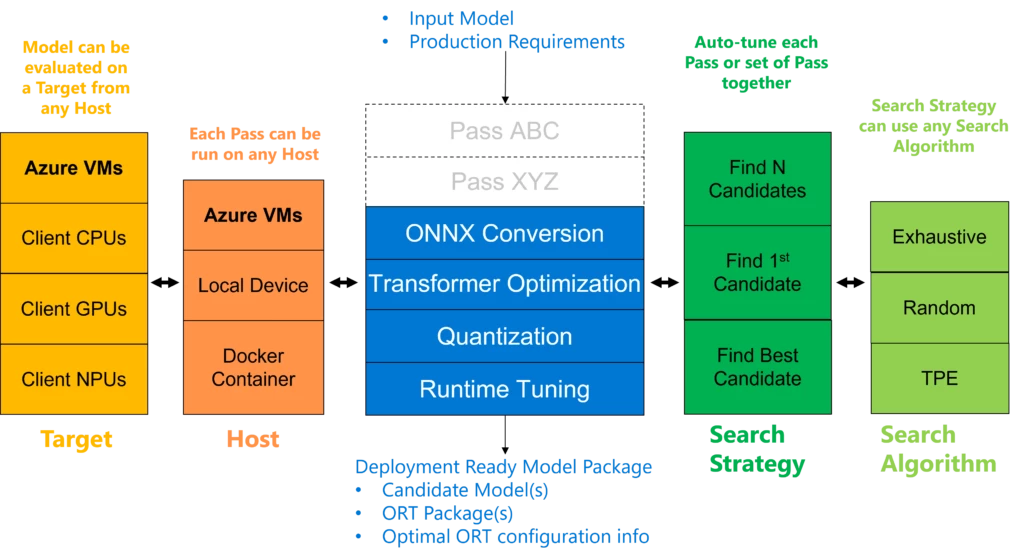
As a hardware-aware model optimization solution, Olive composes effective techniques in model compression, optimization, and compilation. As shown in Figure 1, for a given model and target hardware, Olive intelligently tunes the most appropriate optimization techniques to generate highly efficient models for inference. Currently, a range of optimization techniques is supported in Olive, including model quantization tuning, transformer optimization, ONNX Runtime performance tuning, and more. Moreover, Olive considers various constraints such as accuracy and latency to ensure the optimized models meet your specific requirements. Olive streamlines the process of optimizing machine learning models to make the most efficient use of specific hardware architectures. Whether you’re working on cloud-based applications or edge devices, Olive enables you to optimize your models effortlessly and effectively. It works with ONNX Runtime, a high-performance inference engine, as an end-to-end inference optimization solution.
Optimization across hardware with Olive

Figure 1: Olive architecture

By providing a configuration file specifying your model and scenario-specific information, Olive tunes optimization techniques to generate the optimal model(s) on the Pareto frontier based on the metrics goal you set. When working with the configuration file, you typically need to provide information about the input model—including input names, shapes, and the location where the model is stored. Moreover, you specify your performance preferences, such as desired latency, accuracy, or other relevant factors. In addition to this information, you can choose from a range of optimizations provided by Olive that you wish to apply to your specific hardware target. You also have the option to define the target hardware and utilize any additional features offered by Olive. By utilizing the configuration file, all you need to do is execute a simple command, eliminating the need for any Python code.

python -m olive.workflows.run --config my_model_acceleration_description.json 

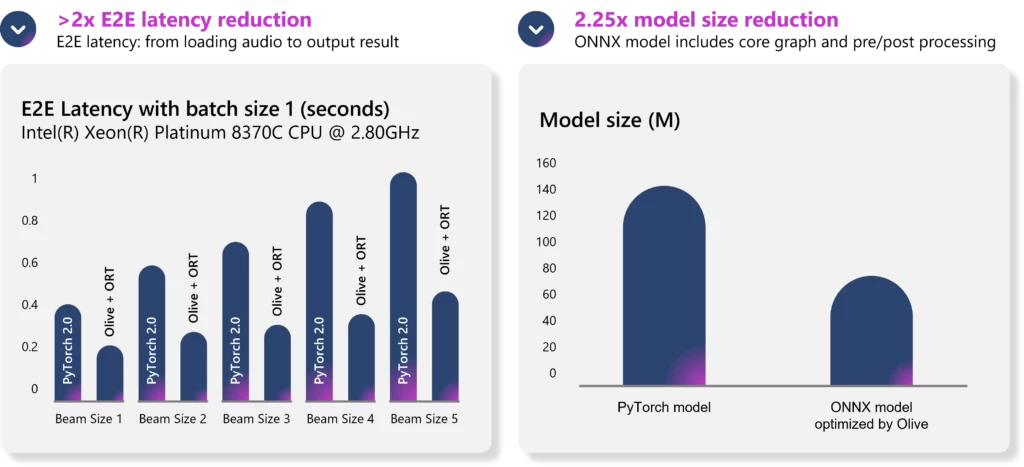
Here are comprehensive examples that demonstrate the process of optimizing models with Olive for various hardware targets. During the Microsoft Build 2023 conference, we showcase how Olive and the ONNX Runtime (ORT) optimize a whisper model, demonstrating a remarkable reduction in end-to-end latency by over two times on Intel Xeon device and a decrease in model size by 2.25 times, as shown in Figure 2.
Optimization across hardware with Olive

Figure 2: Whisper model optimization with Olive and ORT

Intel and AMD optimization innovations in Olive

In addition to simplifying the model optimization experience for model developers, Olive also provides a unified framework that allows industry experts to plug in their own optimization innovations as optimization passes into Olive, resulting in a comprehensive and ready-to-use solution. Intel and AMD have integrated their optimization innovations in Olive. Learn more about contributing your optimization techniques.

  • Intel Neural Compressor (INC). The Intel Neural Compressor framework develops several techniques for model compression to better leverage Intel hardware, such as quantization, pruning, and knowledge distillation. Now INC quantization, including both static quantization and dynamic quantization, is available in Olive. Learn more by reading this example and our blog. More compression techniques will be added to Olive in the future.
  • AMD Vitis-AI quantizer. Vitis-AI quantizer is a tool provided by AMD as part of the Vitis-AI development platform. It is designed to facilitate model quantization for efficient deployment of deep learning models on AMD hardware platforms. You can easily set Vitis-AI quantizer in Olive for quantizing your model to get performance acceleration on AMD hardware. Here is an example.

Streamlining user experience through Olive

To overcome any potential user hesitations surrounding technology that prioritizes performance gains over ease of use, Olive is dedicated to enhancing the user experience across various scenarios. This commitment is demonstrated through the implementation of a wide range of highlighted features that aim to improve usability and satisfaction for users:

  • Model packaging: Olive can produce a comprehensive package that includes optimized models, the appropriate runtime, and sample code for executing the model. This empowers you to effortlessly deploy the optimized models within your application.
  • Easy access Microsoft Azure Machine Learning resources and assets: By utilizing your Azure Machine Learning authentication credentials, Olive can establish a connection with Azure Machine Learning. This connection enables Olive to access your registered model, as well as optimize the model for cloud computing within the Azure environment.
  • Built-in support for HuggingFace model optimization: The utilization of HuggingFace models has gained widespread popularity. Olive enhances this experience by seamlessly enabling the direct utilization of HuggingFace models, datasets, and metrics for optimizing and assessing HuggingFace models.

Looking ahead

Performance and ease of use are key priorities in Olive. Our ongoing efforts include collaborating with hardware partners to incorporate their latest technologies into Olive, making it the most comprehensive solution for model optimization. Simultaneously, we are committed to enhancing usability—ensuring a smoother and more accessible model optimization experience for all users.

If you have any feedback or questions regarding Olive, please don’t hesitate to file an issue on GitHub. We highly encourage you to do so, and our team will promptly follow up to address your concerns and provide assistance.

Doctor visit helper

Prepare before seeing a doctor

A simple rural-patient checklist to help you explain symptoms clearly, ask better questions, and avoid unsafe self-treatment.

Safety note: This is not a prescription or diagnosis. For severe symptoms, pregnancy danger signs, children with serious illness, chest pain, breathing difficulty, stroke-like weakness, or major injury, seek urgent care.

Which doctor may help?

Start with a registered doctor or the nearest qualified health center.

What to tell the doctor

  • Write when the problem started and how it changed.
  • Bring old prescriptions, investigation reports, and current medicines.
  • Write allergies, pregnancy status, diabetes, kidney/liver disease, and major past illnesses.
  • Bring one family member if the patient is weak, elderly, confused, or a child.

Questions to ask

  • What is the most likely cause of my symptoms?
  • Which danger signs mean I should go to hospital quickly?
  • Which tests are necessary now, and which can wait?
  • How should I take medicines safely and what side effects should I watch for?
  • When should I come for follow-up?

Tests to discuss

  • Vital signs: temperature, pulse, blood pressure, oxygen saturation
  • Basic physical examination by a clinician
  • CBC, urine test, blood sugar, or imaging only when clinically needed

Avoid these mistakes

  • Do not use antibiotics, steroid tablets/injections, or strong painkillers without proper medical advice.
  • Do not hide pregnancy, kidney disease, ulcer, allergy, or blood thinner use.
  • Do not delay emergency care when danger signs are present.

Medicine safety and first-aid guide

This section is for patient education only. It does not replace a doctor, pharmacist, or emergency care.

Safe first steps

  • Rest, drink safe water, and observe symptoms carefully.
  • Keep a written note of symptoms, duration, temperature, medicines already taken, and allergy history.
  • Seek medical care quickly if symptoms are severe, worsening, or unusual for the patient.

OTC medicine safety

  • For mild pain or fever, ask a registered pharmacist or doctor before using common over-the-counter pain/fever medicines.
  • Do not combine multiple pain medicines without advice, especially if you have kidney disease, liver disease, stomach ulcer, asthma, pregnancy, or take blood thinners.
  • Do not give adult medicines to children unless a qualified clinician advises it.

Avoid these mistakes

  • Do not start antibiotics without a proper medical decision.
  • Do not use steroid tablets or injections casually for quick relief.
  • Do not delay emergency care because of home remedies.

Get urgent help if

  • Severe symptoms, confusion, fainting, breathing difficulty, chest pain, severe dehydration, or sudden weakness need urgent medical care.
Medicine names, dose, and timing must be decided by a qualified clinician or pharmacist after checking age, pregnancy, allergy, other diseases, and current medicines.

For rural patients and family caregivers

Patient health record and symptom diary

Write your symptoms, medicines already taken, test results, and questions before visiting a doctor. This note stays on your device unless you print or copy it.

Doctor to discuss: Doctor / qualified healthcare provider
Tests to discuss with doctor
  • Basic vital signs: temperature, pulse, blood pressure, oxygen level if needed
  • Relevant blood, urine, imaging, or specialist tests only after clinical assessment
Questions to ask
  • What is the most likely cause of my symptoms?
  • Which warning signs mean I should go to emergency care?
  • Which tests are really needed now?
  • Which medicines are safe for my age, pregnancy status, allergy, kidney/liver/stomach condition, and current medicines?

Emergency warning signs such as chest pain, severe breathing difficulty, sudden weakness, confusion, severe dehydration, major injury, or loss of bladder/bowel control need urgent medical care. Do not wait for online information.

Safe pathway to proper treatment

Care roadmap for: Optimization across hardware with Olive

Use this simple roadmap to understand the next safe steps. It is educational and does not replace examination by a doctor.

Go to emergency care if you notice:
  • Severe or rapidly worsening symptoms
  • Breathing difficulty, chest pain, fainting, confusion, severe weakness, major injury, or severe dehydration
Doctor / service to discuss: Qualified healthcare provider; specialist depends on symptoms and examination.
  1. Step 1

    Check danger signs first

    If danger signs are present, seek emergency care and do not wait for online information.

  2. Step 2

    Record the symptom story

    Write when symptoms started, severity, medicines already taken, allergies, pregnancy status, and test results.

  3. Step 3

    Visit a qualified clinician

    A doctor, nurse, or qualified healthcare provider can examine you and decide which tests or treatment are needed.

  4. Step 4

    Do only useful tests

    Do tests after clinical assessment. Avoid unnecessary tests, random antibiotics, or repeated medicines without diagnosis.

  5. Step 5

    Follow up and return early if worse

    If symptoms worsen, new warning signs appear, or treatment is not helping, return for review quickly.

Rural patient practical tips
  • Take a written symptom diary and all previous prescriptions/test reports.
  • Do not hide medicines already taken, even herbal or over-the-counter medicines.
  • Ask which warning signs mean urgent referral to hospital.

This roadmap is for education. A real diagnosis and treatment plan requires history, examination, and clinical judgment.

RX Patient Help

Ask a health question safely

Write your symptom story. A health professional or site editor can review it before any answer is prepared. This box is not for emergency care.

Emergency first: Severe chest pain, breathing trouble, unconsciousness, stroke signs, severe injury, heavy bleeding, or rapidly worsening symptoms need urgent local medical care now.

Frequently Asked Questions

Is this article a replacement for a doctor?

No. It is educational content only. Patients should consult a qualified clinician for diagnosis and treatment.

When should I seek urgent care?

Seek urgent care for severe symptoms, rapidly worsening condition, breathing difficulty, severe pain, neurological changes, or any emergency warning sign.

References

Add references, clinical guidelines, textbooks, journal articles, or trusted medical sources here. You can edit this area from the RX Article Professional Blocks panel.