MotionCtrl: A Unified and Flexible Motion Controller for Video Generation

Patient Tools

Read, save, and share this guide

Use these quick tools to make this medical article easier to read, print, save, or share with a family member.

Article Summary

Motions in a video primarily consist of camera motion, induced by camera movement, and object motion, resulting from object movement. Accurate control of both camera and object motion is essential for video generation. However, existing works either mainly focus on one type of motion or do not clearly distinguish between the two, limiting their control capabilities and diversity. Therefore, this paper presents MotionCtrl, a unified...

Key Takeaways

  • This article explains Abstract in simple medical language.
  • This article explains Methods in simple medical language.
Educational health guideWritten for patient understanding and clinical awareness.
Reviewed content workflowUse writer and reviewer profiles for stronger trust.
Emergency safety firstUrgent warning signs are highlighted below.

Seek urgent medical care if you notice

These warning signs are general safety guidance. Local emergency numbers and clinical judgment should always come first.

  • Severe symptoms, breathing difficulty, fainting, confusion, or rapidly worsening illness.
  • New weakness, severe pain, high fever, or symptoms after a serious injury.
  • Any symptom that feels urgent, unusual, or unsafe for the patient.
1

Emergency now

Use emergency care for severe, sudden, rapidly worsening, or life-threatening symptoms.

2

See a doctor

Book a professional medical evaluation if symptoms persist, worsen, recur often, affect daily activities, or occur in a high-risk patient.

3

Learn safely

Use this article to understand possible causes, tests, treatment options, prevention, and questions to ask your clinician.

Motions in a video primarily consist of camera motion, induced by camera movement, and object motion, resulting from object movement. Accurate control of both camera and object motion is essential for video generation. However, existing works either mainly focus on one type of motion or do not clearly distinguish between the two, limiting their control capabilities and diversity. Therefore, this paper presents MotionCtrl, a unified and flexible motion controller for video generation designed to effectively and independently control camera and object motion. The architecture and training strategy of MotionCtrl are carefully devised, taking into account the inherent properties of camera motion, object motion, and imperfect training data. Compared to previous methods, MotionCtrl offers three main advantages: 1) It effectively and independently controls camera motion and object motion, enabling more fine-grained motion control and facilitating flexible and diverse combinations of both types of motion. 2) Its motion conditions are determined by camera poses and trajectories, which are appearance-free and minimally impact the appearance or shape of objects in generated videos. 3) It is a relatively generalizable model that can adapt to a wide array of camera poses and trajectories once trained. Extensive qualitative and quantitative experiments have been conducted to demonstrate the superiority of MotionCtrl over existing methods.

Selected Results of MotionCtrl + SVD

  • Current version of MotionCtrl + SVD has the capability to guide an image-to-video generation model to create videos with both basic and complex camera motion, given a sequence of camera poses.
  • You are able to generate videos with our provided Gradio Demo and [Source Code].

MotionCtrl: A Unified and Flexible Motion Controller for Video GenerationMotionCtrl: A Unified and Flexible Motion Controller for Video Generation


Selected Results of MotionCtrl + VideoCrafter

  • MotionCtrl has the capability to guide the video generation model in creating videos with complex camera motion, given a sequence of camera poses.
  • MotionCtrl can guide the video generation model to produce videos with specific object motion, provided object trajectories.
  • These results are generative with only one unified trained model.

 

Abstract

Motions in a video primarily consist of camera motion, induced by camera movement, and object motion, resulting from object movement. Accurate control of both camera and object motion is essential for video generation. However, existing works either mainly focus on one type of motion or do not clearly distinguish between the two, limiting their control capabilities and diversity. Therefore, this paper presents MotionCtrl, a unified and flexible motion controller for video generation designed to effectively and independently control camera and object motion. The architecture and training strategy of MotionCtrl are carefully devised, taking into account the inherent properties of camera motion, object motion, and imperfect training data. Compared to previous methods, MotionCtrl offers three main advantages: 1) It effectively and independently controls camera motion and object motion, enabling more fine-grained motion control and facilitating flexible and diverse combinations of both types of motion. 2) Its motion conditions are determined by camera poses and trajectories, which are appearance-free and minimally impact the appearance or shape of objects in generated videos. 3) It is a relatively generalizable model that can adapt to a wide array of camera poses and trajectories once trained. Extensive qualitative and quantitative experiments have been conducted to demonstrate the superiority of MotionCtrl over existing methods.


Methods
MotionCtrl: A Unified and Flexible Motion Controller for Video Generation

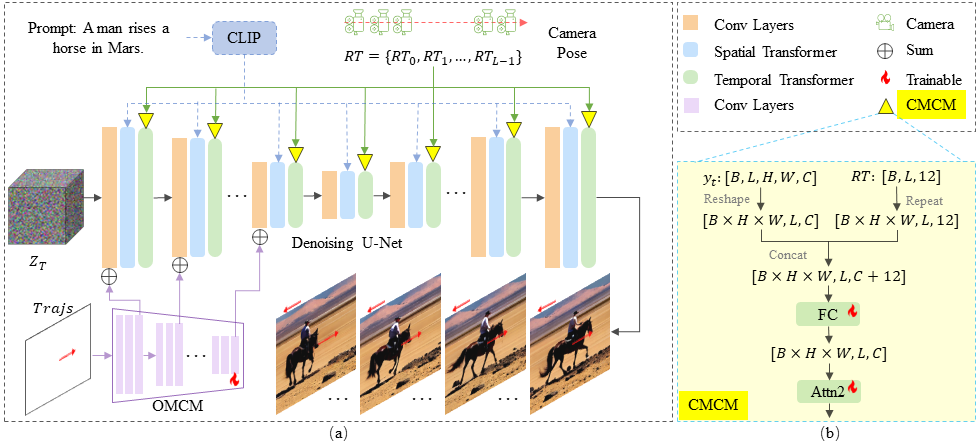
MotionCtrl extends the Denoising U-Net structure of LVDM with a Camera Motion Control Module (CMCM) and an Object Motion Control Module (OMCM). As illustrated in (b), the CMCM integrates camera pose sequences RT with LVDM’s temporal transformers by appending RT to the input of the second self-attention module and applying a tailored and lightweight fully connected layer to extract the camera pose feature for subsequent processing. The OMCM utilizes convolutional layers and downsamplings to derive multi-scale features from Trajs, which are spatially incorporated into LVDM’s convolutional layers to direct object motion. Further given a text prompt, LVDM generates videos from noise that correspond to the prompt, with background and object movements reflecting the specified camera poses and trajectories.

Patient safety assistant

Check your symptom safely

Hi, I am RX Symptom Navigator. I can help you understand what to read next and what warning signs need care.
Warning: Do not use this in emergencies, pregnancy, severe illness, or as a substitute for a doctor. For children or teens, use with a parent/guardian and clinician.
A rural-friendly guide: warning signs, when to see a doctor, related articles, tests to discuss, and OTC safety education.
1 Symptom 2 Severity 3 Safe guidance
First safety question

Is there chest pain, breathing trouble, fainting, confusion, severe bleeding, stroke-like weakness, severe injury, or pregnancy danger sign?

Choose quickly

Browse by body area
Start here: Write or select a symptom. The guide will show warning signs, doctor guidance, diagnostic tests to discuss, OTC safety education, and related RX articles.

Important: This tool is educational only. It cannot diagnose, treat, or replace a doctor. OTC information is not a prescription. In an emergency, contact local emergency services or go to the nearest hospital.

Doctor visit helper

Prepare before seeing a doctor

A simple rural-patient checklist to help you explain symptoms clearly, ask better questions, and avoid unsafe self-treatment.

Safety note: This is not a prescription or diagnosis. For severe symptoms, pregnancy danger signs, children with serious illness, chest pain, breathing difficulty, stroke-like weakness, or major injury, seek urgent care.

Which doctor may help?

Start with a registered doctor or the nearest qualified health center.

What to tell the doctor

  • Write when the problem started and how it changed.
  • Bring old prescriptions, investigation reports, and current medicines.
  • Write allergies, pregnancy status, diabetes, kidney/liver disease, and major past illnesses.
  • Bring one family member if the patient is weak, elderly, confused, or a child.

Questions to ask

  • What is the most likely cause of my symptoms?
  • Which danger signs mean I should go to hospital quickly?
  • Which tests are necessary now, and which can wait?
  • How should I take medicines safely and what side effects should I watch for?
  • When should I come for follow-up?

Tests to discuss

  • Vital signs: temperature, pulse, blood pressure, oxygen saturation
  • Basic physical examination by a clinician
  • CBC, urine test, blood sugar, or imaging only when clinically needed

Avoid these mistakes

  • Do not use antibiotics, steroid tablets/injections, or strong painkillers without proper medical advice.
  • Do not hide pregnancy, kidney disease, ulcer, allergy, or blood thinner use.
  • Do not delay emergency care when danger signs are present.

Medicine safety and first-aid guide

This section is for patient education only. It does not replace a doctor, pharmacist, or emergency care.

Safe first steps

  • Rest, drink safe water, and observe symptoms carefully.
  • Keep a written note of symptoms, duration, temperature, medicines already taken, and allergy history.
  • Seek medical care quickly if symptoms are severe, worsening, or unusual for the patient.

OTC medicine safety

  • For mild pain or fever, ask a registered pharmacist or doctor before using common over-the-counter pain/fever medicines.
  • Do not combine multiple pain medicines without advice, especially if you have kidney disease, liver disease, stomach ulcer, asthma, pregnancy, or take blood thinners.
  • Do not give adult medicines to children unless a qualified clinician advises it.

Avoid these mistakes

  • Do not start antibiotics without a proper medical decision.
  • Do not use steroid tablets or injections casually for quick relief.
  • Do not delay emergency care because of home remedies.

Get urgent help if

  • Severe symptoms, confusion, fainting, breathing difficulty, chest pain, severe dehydration, or sudden weakness need urgent medical care.
Medicine names, dose, and timing must be decided by a qualified clinician or pharmacist after checking age, pregnancy, allergy, other diseases, and current medicines.

For rural patients and family caregivers

Patient health record and symptom diary

Write your symptoms, medicines already taken, test results, and questions before visiting a doctor. This note stays on your device unless you print or copy it.

Doctor to discuss: Doctor / qualified healthcare provider
Tests to discuss with doctor
  • Basic vital signs: temperature, pulse, blood pressure, oxygen level if needed
  • Relevant blood, urine, imaging, or specialist tests only after clinical assessment
Questions to ask
  • What is the most likely cause of my symptoms?
  • Which warning signs mean I should go to emergency care?
  • Which tests are really needed now?
  • Which medicines are safe for my age, pregnancy status, allergy, kidney/liver/stomach condition, and current medicines?

Emergency warning signs such as chest pain, severe breathing difficulty, sudden weakness, confusion, severe dehydration, major injury, or loss of bladder/bowel control need urgent medical care. Do not wait for online information.

Safe pathway to proper treatment

Patient care roadmap

Use this simple roadmap to understand the next safe steps. It is educational and does not replace examination by a doctor.

Go to emergency care if you notice:
  • Severe or rapidly worsening symptoms
  • Breathing difficulty, chest pain, fainting, confusion, severe weakness, major injury, or severe dehydration
Doctor / service to discuss: Qualified healthcare provider; specialist depends on symptoms and examination.
  1. Step 1

    Check danger signs first

    If danger signs are present, seek emergency care and do not wait for online information.

  2. Step 2

    Record the symptom story

    Write when symptoms started, severity, medicines already taken, allergies, pregnancy status, and test results.

  3. Step 3

    Visit a qualified clinician

    A doctor, nurse, or qualified healthcare provider can examine you and decide which tests or treatment are needed.

  4. Step 4

    Do only useful tests

    Do tests after clinical assessment. Avoid unnecessary tests, random antibiotics, or repeated medicines without diagnosis.

  5. Step 5

    Follow up and return early if worse

    If symptoms worsen, new warning signs appear, or treatment is not helping, return for review quickly.

Rural patient practical tips
  • Take a written symptom diary and all previous prescriptions/test reports.
  • Do not hide medicines already taken, even herbal or over-the-counter medicines.
  • Ask which warning signs mean urgent referral to hospital.

This roadmap is for education. A real diagnosis and treatment plan requires history, examination, and clinical judgment.

RX Patient Help

Ask a health question safely

Write your symptom story. A health professional or site editor can review it before any answer is prepared. This box is not for emergency care.

Emergency first: Severe chest pain, breathing trouble, unconsciousness, stroke signs, severe injury, heavy bleeding, or rapidly worsening symptoms need urgent local medical care now.

Frequently Asked Questions

Is this article a replacement for a doctor?

No. It is educational content only. Patients should consult a qualified clinician for diagnosis and treatment.

When should I seek urgent care?

Seek urgent care for severe symptoms, rapidly worsening condition, breathing difficulty, severe pain, neurological changes, or any emergency warning sign.

References

Add references, clinical guidelines, textbooks, journal articles, or trusted medical sources here. You can edit this area from the RX Article Professional Blocks panel.