
The Garden classification is used to classify intracapsular proximal femur fractures, and subcapital femoral neck fractures are the most widely used and predict the development of AVN. There are several types of fracture managing methods for classifying, investigating the fracture pattern, severity, degree, location, type, angulation, shortening – lengthening, comminution, rotation, displacement, the status of the femoral implant, the quality of surrounding femoral soft tissue injury and fracture angle are universally and widely accepted by orthopedic surgeons to assess the initial injury, plan management, and predict prognosis, to manage decision making, in determining whether a fracture requires an intramedullary nail or open reduction with internal fixation with steel screws, rods, plates, pins, or K-wires to hold the broken bones in the correct position even external fixation attaches a metal framework outside the limb and includes the Ilizarov method and an X-frame.
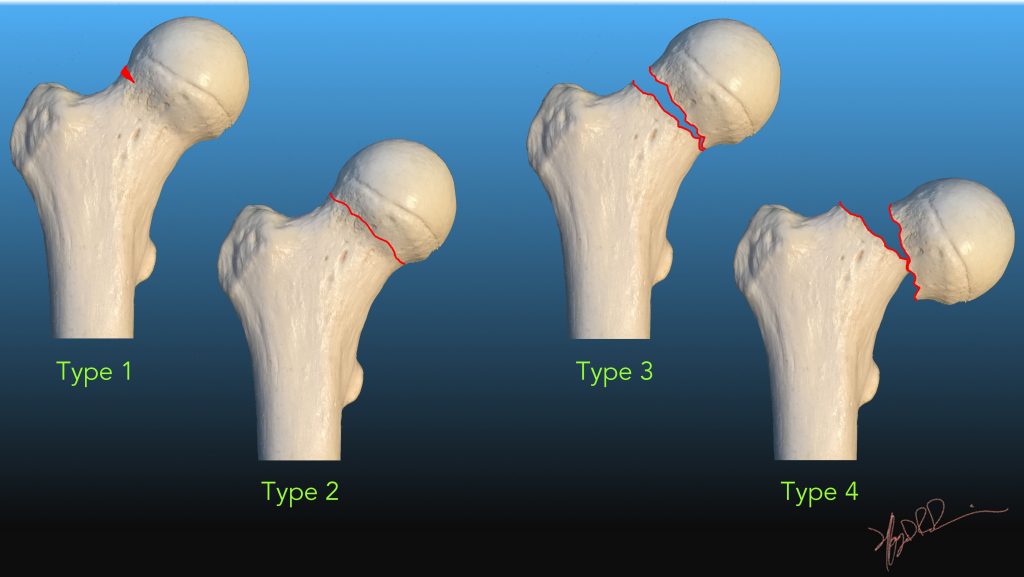
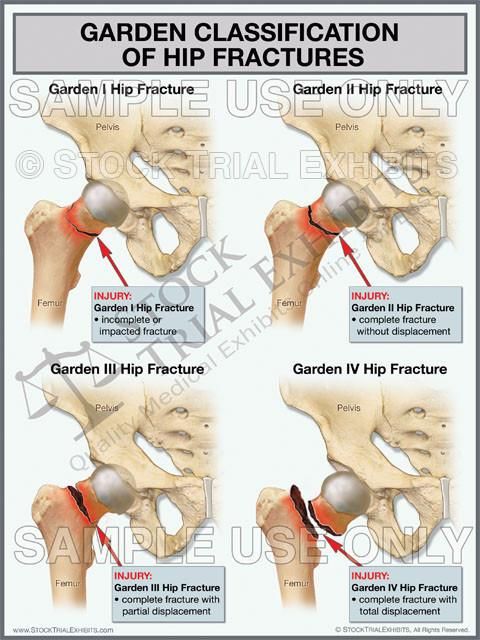
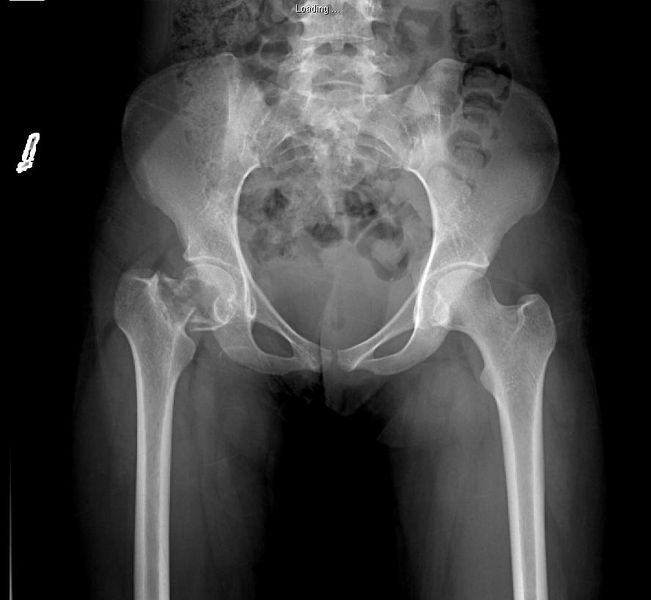
This fracture disrupts the blood supply to the femoral head. British orthopedic surgeon Robert Symon Garden described a classification system for this type of fracture, referred to as the Garden classification and consisting of four grades
The Garden classification of subcapital femoral neck fractures classification is the most widely used. It is simple and predicts the development of AVN classification. Garden described particular femoral neck and acetabular trabeculae patterns which can assist in recognizing differences within this classification system.
- Garden stage I: undisplaced incomplete, including valgus impacted fractures
- medial group of femoral neck trabeculae may demonstrate a greenstick fracture
- Garden stage II: undisplaced complete
- no disturbance of the medial trabeculae
- Garden stage III: complete fracture, incompletely displaced
- femoral head tilts into a varus position causing its medial trabeculae to be out of line with the pelvic trabeculae
- Garden stage IV: complete fracture, completely displaced
- femoral head aligned normally in the acetabulum and its medial trabeculae are in line with the pelvic trabeculae
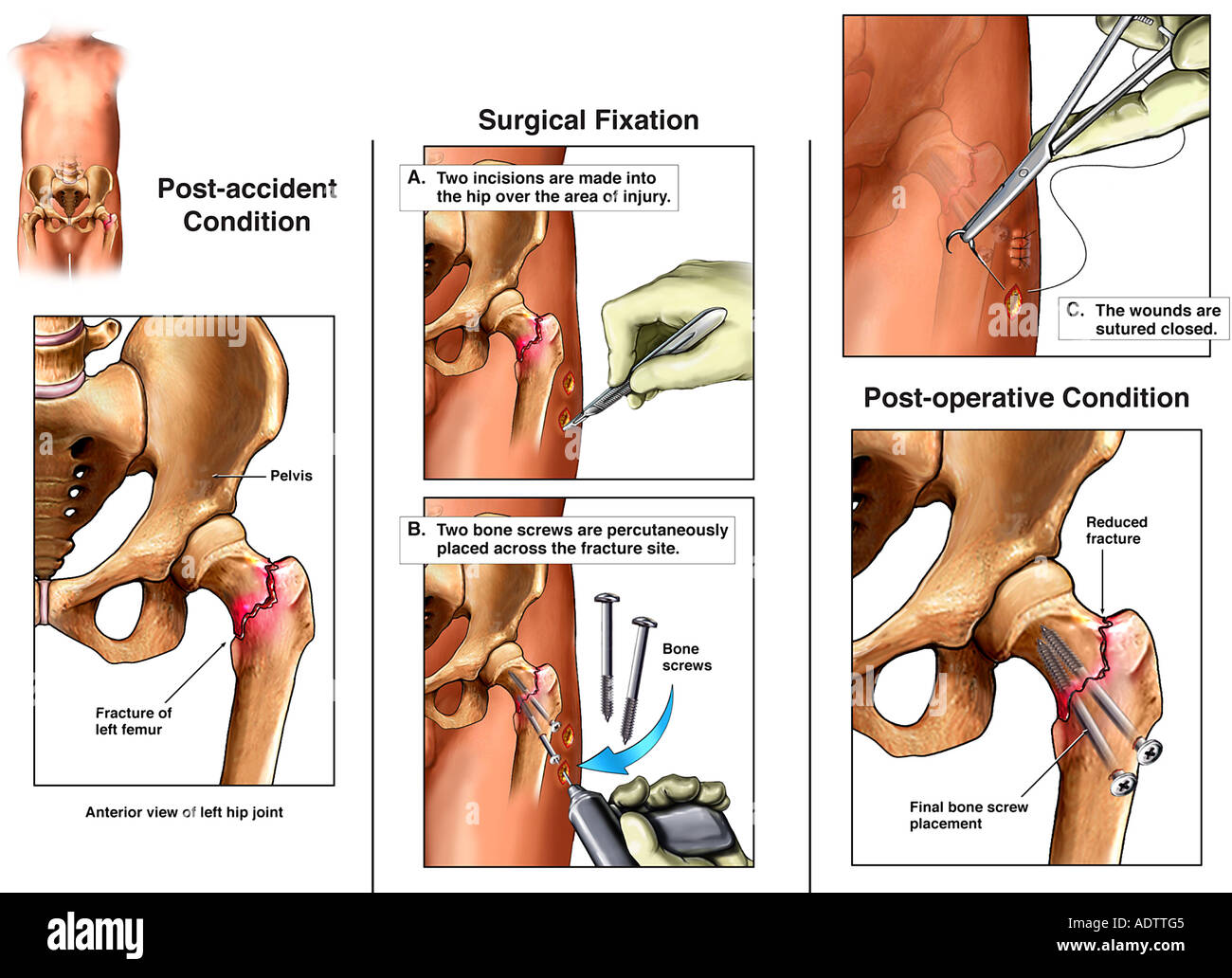
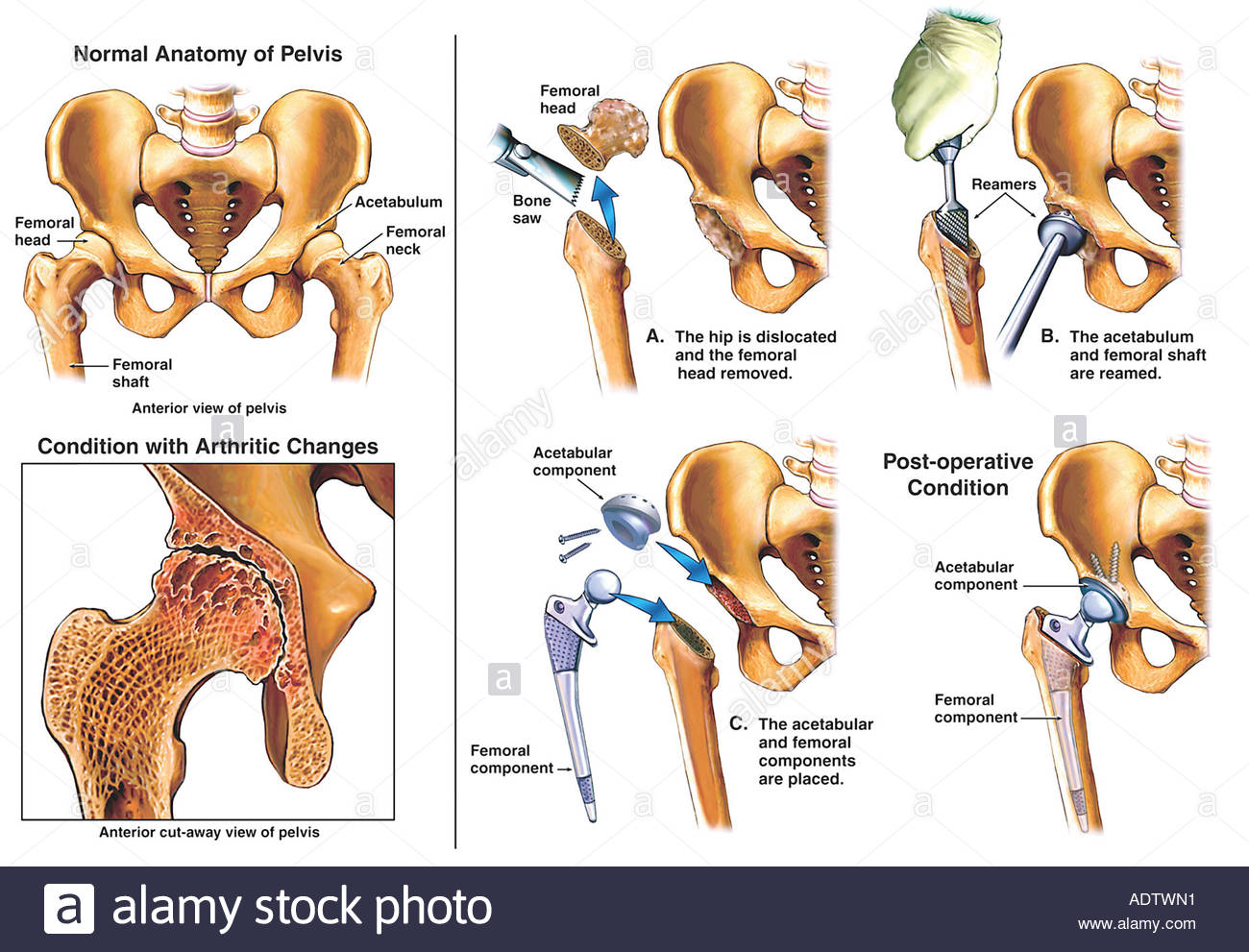
In general, stages I and II are stable fractures and can be treated with internal fixation (head-preservation) and stages III and IV are unstable fractures and hence treated with arthroplasty (either hemi- or total arthroplasty).
or
Classification
| Types | Description |
|---|---|
| 1 | Incomplete Stable fracture with impaction in valgus |
| 2 | Complete but non displaced with two groups of trabeculae in line |
| 3 | Partially displaced with varus with all three trabeculae disturb. |
| 4 | Completely displaced with no contact between the fracture fragments |
The blood supply of the femoral head is far more likely to be disrupted in Garden types 3 or 4 fractures. Surgeons may treat these sorts of fractures by replacing the fractured bone with a prosthesis arthroplasty. Alternatively, the treatment is to scale back the fracture (manipulate the fragments back to an honest position) and fix them in situ with metal screws. Common practice is to repair Garden 1 and a couple of fractures with screws and to exchange Garden 3 and 4 fractures with arthroplasty, except in young patients in whom screw repair is attempted first, followed by arthroplasty if necessary this is often wiped out an attempt to conserve the natural joint since prosthetic joints ultimately wear out and need to get replaced. a significant but common complication of a fractured femoral neck is avascular necrosis. The vasculature to the femoral head is definitely disturbed during fractures or from swelling inside the joint capsule. this will cause strangulation of the blood supply to the femoral head and death of the bone and cartilage.
Simplify or modified Garden Classification
Increasing modern technology, the treatment pattern, system, molecule, implant has been change, at a same time previous classification has been modified, and are following
|
Garden Classification
(based on AP radiographs and does not consider lateral or sagittal plane alignment)
|
||
|
Type I
|
Incomplete fx (valgus impacted)
|
|
|
Type II
|
Complete fx, nondisplaced
|
|
|
Type III
|
Complete fx, partially displaced
|
|
|
Type IV
|
Complete fx, fully displaced
|
|
|
Simplified Garden Classification
|
||
|
Nondisplaced
|
Includes Garden I and II
|
|
|
Displaced
|
Includes Garden IIII and IV
|
|
|
Pauwels Classification
(based on the vertical orientation of fracture line)
|
||
|
Type I
|
< 30 deg from horizontal
|
|
|
Type II
|
30 to 50 deg from horizontal
|
|
|
Type III
|
> 50 deg from horizontal (most unstable with the highest risk of nonunion/AVN)
|
|


References
- https://www.ncbi.nlm.nih.gov/pmc/articles/PMC5154424/
- https://www.ncbi.nlm.nih.gov/pmc/articles/PMC7725205/
- https://www.ncbi.nlm.nih.gov/pmc/articles/PMC5726208/
- https://journals.lww.com/jorthotrauma/fulltext/2018/01001/
- https://www.ncbi.nlm.nih.gov/pmc/articles/PMC3069264/
- https://www.ncbi.nlm.nih.gov/pmc/articles/PMC7407870/
- https://en.wikipedia.org/wiki/Vancouver_classification
- https://www.sciencedirect.com/science/article/pii/S0020138318306582
- https://www.ncbi.nlm.nih.gov/books/NBK556057/
- https://en.wikipedia.org/wiki/Winquist_and_Hansen_classification
- https://www.ncbi.nlm.nih.gov/pmc/articles/PMC2656872/
- https://www.ncbi.nlm.nih.gov/books/NBK544275/
- https://www.ncbi.nlm.nih.gov/pmc/articles/PMC6370083/
- https://www.ncbi.nlm.nih.gov/pmc/articles/PMC4562928/
- https://www.sciencedirect.com/science/article/pii/S2210261219301348
- https://www.ncbi.nlm.nih.gov/pmc/articles/PMC3163773/
- https://www.ncbi.nlm.nih.gov/pmc/articles/PMC7203210/
- https://www.ncbi.nlm.nih.gov/pmc/articles/PMC5154424/
- https://en.wikipedia.org/wiki/Danis%E2%80%93Weber_classification
- https://www.ncbi.nlm.nih.gov/pmc/articles/PMC4252160
- https://www.ncbi.nlm.nih.gov/pmc/articles/PMC5291558/
- https://journals.lww.com/md-journal/fulltext/
- https://pacs.de/term/pelvic-bucket-handle-fracture
- https://en.wikipedia.org/wiki/Young-Burgess_classification
- https://www.tandfonline.com/doi/abs/10.1080/10255842.2018.1553238?
- https://pubs.rsna.org/doi/10.1148/rg.345135113
- https://www.ncbi.nlm.nih.gov/pmc/articles/PMC1005359/pdf/annrheumd00494-0065.pdf
- https://www.ncbi.nlm.nih.gov/pmc/articles/PMC4531757/
- https://www.e-roj.org/journal/view.php?number=105
- https://www.researchgate.net/publication/16587969_Parasymphyseal_insufficiency_fractures_of_the_os_pubis
- https://en.wikipedia.org/wiki/Duverney_fracture
- https://www.ncbi.nlm.nih.gov/pmc/articles/PMC7265089/
- https://www.ncbi.nlm.nih.gov/pmc/articles/PMC4728702/
- https://www.ncbi.nlm.nih.gov/pmc/articles/PMC2588293/
- https://www.ncbi.nlm.nih.gov/pmc/articles/PMC5333948/
- https://www.ncbi.nlm.nih.gov/books/NBK493161/
- https://www.ncbi.nlm.nih.gov/books/NBK519005/
- https://pubmed.ncbi.nlm.nih.gov/18063712/
- https://apm.amegroups.com/article/view/10536/11577
- https://www.ncbi.nlm.nih.gov/pmc/articles/PMC3728390/
- https://academic.oup.com/jrr/article/54/6/1102/1132874
- https://bmjopen.bmj.com/content/9/7/e032111
- https://www.ncbi.nlm.nih.gov/books/NBK559168/
- https://www.sciencedirect.com/topics/medicine-and-dentistry/avulsion-fracture
- https://medlineplus.gov/
- https://en.wikipedia.org/wiki/Acetabular_fracture
- https://radiopaedia.org/articles/judet-and-letournel-classification-for-acetabular-fractures
- https://books.google.com.bd/books?id=XvbsDwAAQBAJ&pg
- https://en.wikipedia.org/wiki/Bone_fracture
- https://en.wikipedia.org/wiki/Fracture
- https://www.ncbi.nlm.nih.gov/books/NBK542250/
- https://www.ncbi.nlm.nih.gov/books/NBK549912/
- https://www.ncbi.nlm.nih.gov/pmc/articles/PMC3445231/
- https://www.ncbi.nlm.nih.gov/books/NBK542221/
- https://www.sciencedirect.com/science/article/pii/S1930043315301862
- https://www.ncbi.nlm.nih.gov/pmc/articles/PMC5903328/
- https://www.ncbi.nlm.nih.gov/pmc/articles/PMC5961267/
- https://www.ncbi.nlm.nih.gov/pmc/articles/PMC5721952/

