
Pipkin classification is most commonly used to diagnose femoral head fracture taking under consideration the direction of dislocation and joint stability. Another one is the Brumback classifications system highlights the importance of joint instability, the direction of dislocation, and acetabular fracture severity within the prediction of a poorer outcome, some consider that it’s going to be a more accurate arrangement. However, until intraobserver and interobserver reliability of the Brumback classification is validated in a robust way, we recommend readers use it only with caution.
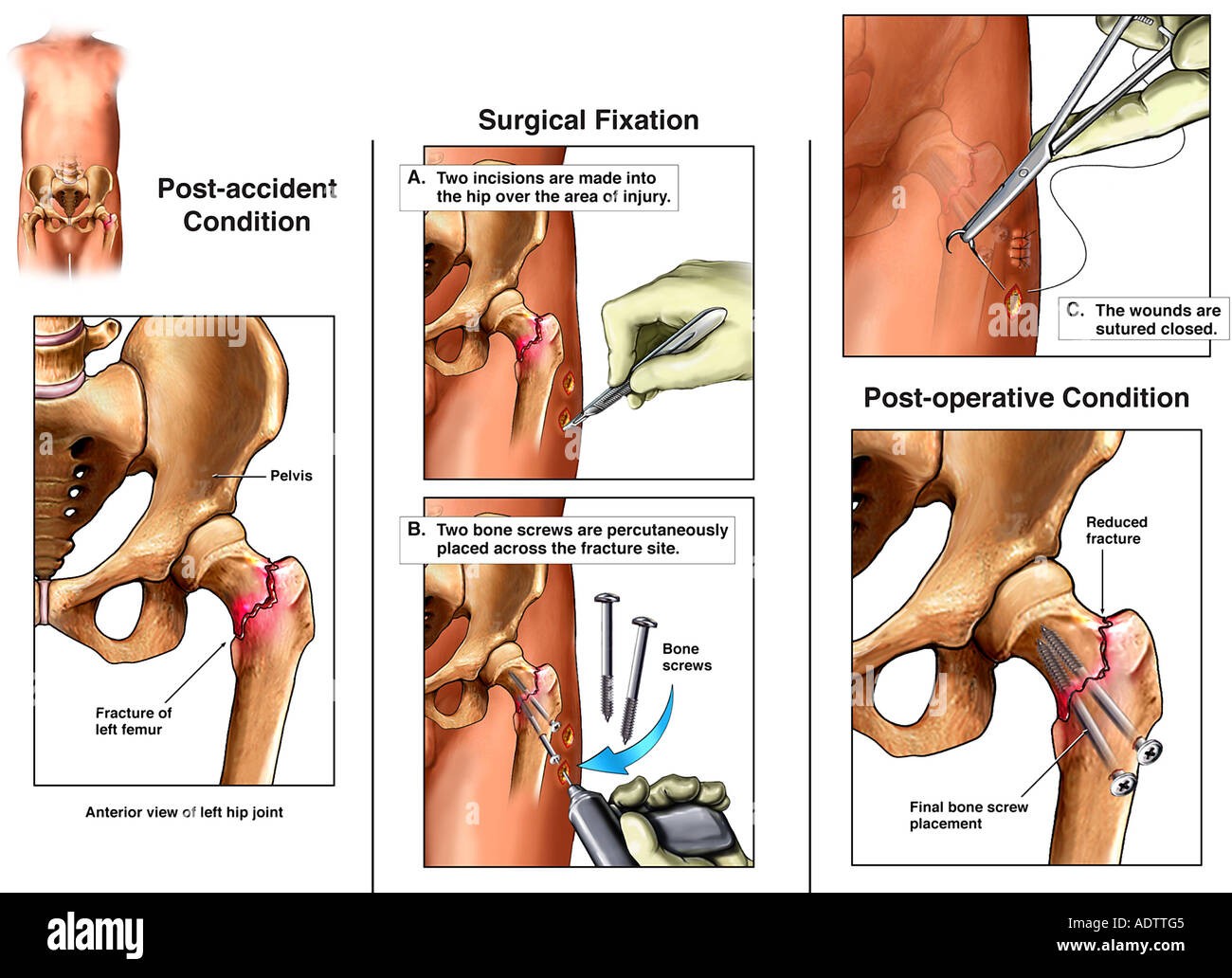
There are several types of fracture managing methods for classifying, investigating the fracture pattern, severity, degree, location, type, angulation, shortening – lengthening, comminution, rotation, displacement, the status of the femoral implant, the quality of surrounding femoral soft tissue injury and fracture angle are universally and widely accepted by orthopedic surgeons to assess the initial injury, plan management, and predict prognosis, to manage decision making, in determining whether a fracture requires an intramedullary nail or open reduction with internal fixation with steel screws, rods, plates, pins, or K-wires to hold the broken bones in the correct position even external fixation attaches a metal framework outside the limb and includes the Ilizarov method and an X-frame.
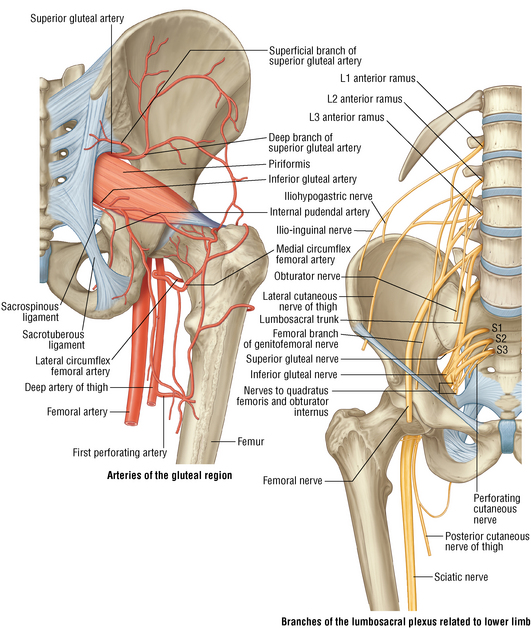
Pipkin Classification and Brumback Classifications For Femoral Head Injury
Pipkin classification is the most commonly used classification for femoral head fractures, which are uncommon but are associated with hip dislocations.
Classification
- type I: fracture inferior to the fovea capitis, a small fracture not involving the weight-bearing surface
- type II: fracture extending superior to the fovea capitis, a large fracture involving the weight-bearing surface
- type III: type I or II fracture with a fracture of the femoral neck, has an increased risk of avascular necrosis
- type IV: type I or II fracture with a fracture of the acetabular wall, usually the posterior wall
Classification
|
Pipkin Classification
|
||
|
Type I
|
Fracture below fovea/ ligamentum (small)
Does not involve the weight-bearing portion of the femoral head
|
|
|
Type II
|
Fracture above fovea/ ligamentum (larger)
Involves the weight-bearing portion of the femoral head
|
|
|
Type III
|
Type I or II with an associated femoral neck fracture
High incidence of AVN
|
|
|
Type IV
|
Type I or II with associated acetabular fx (usually posterior wall fracture)
|
|
1957 – Garrett Pipkin (1904 – 1981) analyzed a group of 25 cases (cases of his own and those of colleagues) and developed his fractures classification system of femoral head fractures (4 Types)
- Type I: Femoral head fracture inferior (distal) to the fovea.
- Type II: Femoral head fracture superior (proximal) to the fovea.
- Type III: Type I/II femoral head fracture AND fracture of the femoral neck.
- Type IV: Type I/II femoral head fracture AND fracture of acetabulum, most commonly the posterior wall
1987 – Robert Joseph Brumback proposed a more comprehensive arrangement, taking under consideration the direction of dislocation and joint stability. The Brumback classification highlights the importance of joint instability, the direction of dislocation, and acetabular fracture severity within the prediction of a poorer outcome appears to supply prognostic value, with patients sustaining Type IIIB and sort V injuries faring the worst, and patients with Type IIB fractures having the simplest physical outcomes
- Type I: Posterior hip dislocation, femoral head fracture (inferomedial portion)
- Type Ia: minimum/ no fracture of the acetabular rim and stable hip joint after reduction.
- Type Ib: significant acetabular rim and hip joint instability after reduction.
- Type II: Posterior hip dislocation, femoral head fracture (supermedial portion)
- Type IIa: minimum/ no fracture of the acetabular rim and stable joint after reduction.
- Type IIb: significant acetabular fracture and hip joint instability after reduction.
- Type III: Dislocation of the hip (unspecified direction) with a femoral neck fracture.
- Type IIIa: Without fracture of the femoral head.
- Type IIIb: With the fracture of the femoral head.
- Type IV: Anterior dislocation of the femoral head.
- Type IVa: Indentation type; depression of the superolateral surface of the femoral head.
- Type IVb: Transchondral type; osteocartilaginous shear fracture of the weight-bearing surface of the femoral head.
- Type V: Central fracture-dislocation of the hip with femoral head fracture.
Description above all
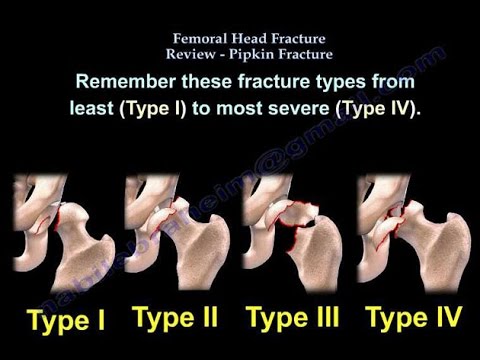
Femoral head fractures are categorized by Pipkin into four types supported location of the fracture fragment in reference to the fovea and presence of associated fractures.
Type 1 fractures are inferior to the fovea, type 2 fractures are superior to the fovea, type 3 also involves a femoral neck fracture, and sort 4 also involves a fracture of the acetabulum.
Patients with types 1, 2, and 4 femoral head fractures should undergo emergent closed reduction of the hip dislocation with postreduction CT scanning to gauge fracture displacement. Generally, femoral head fractures are treated supported fragment location, size, displacement, and hip stability.
A nondisplaced or minimally displaced Pipkin type 1 fracture is often managed nonoperatively a little or comminuted displaced Pipkin type 1 fracture can usually be simply excised resulting from the very fact that this fracture is below the weight-bearing dome of the femoral head while larger fragments may require surgical fixation.
Pipkin type 2 fractures mandate accurate anatomic reduction and stable internal fixation. Titanium countersunk screw fixation is preferred to permit MRI imaging within the future if needed.
The anterior Smith-Peterson approach is usually preferred as a result of improved visualization for reduction and internal fixation and a lower complication rate as compared to a posterior approach. A trochanteric flip could also be added.
Pipkin type 3 fractures are extremely rare and typically occur in younger patients. These should be treated with internal fixation of both the femoral neck and femoral head fracture. In older patients with poor bone quality and low functional demands, prosthetic replacement is perhaps more predictable and is usually preferred.
Pipkin type 4 fractures are treated supported the situation of the femoral head fracture and therefore the sort of associated acetabular fracture. the foremost common clinical scenario may be a posterior wall acetabular fracture related to a little , displaced, inferior (infra-foveal) femoral head fracture. this mix of injuries could also be treated through a Kocher-Langenbeck approach with excision of the inferior femoral head fragment and simultaneous internal fixation of the posterior acetabular wall fracture.
A larger (suprafoveal) femoral head fracture during this situation may require an anterior exposure for femoral head fracture fixation and a posterior exposure for posterior acetabular wall fixation or the utilization of an extensile approach.
History
1869 – John Birkett (1815 – 1904) provided the primarily published case description of femoral head fracture. Birkett reported the case of a 35-year-old woman who died following a fall from a window. Autopsy demonstrated left hip dislocation with a femoral head fracture.
On further examination, it had been discovered that some of the tops of the femur had been broken off. This fragment, to which the greater a part of the ligamentum teres was still attached, remained within the acetabulum.
Authorities upon the topic of dislocations of the joints don’t even allude to the present complication. Malgaigne states “Les luxations du femur ne sont guere compliquees que de fractures soit des os du bassin, soit du femur meme soit d’autres os plus eloignes (The luxations of the femur are but little complicated with fractures, either of the pelvic bones, the femur itself, or more distant bones)”
Having did not find a parallel case within the book of Robert W. Smith of Dublin, I wrote thereto gentleman who did me the favor to reply as follows “Although tolerably conversant in the literature of fractures and luxations i’m not conscious of any similar injury having been placed on record as happening to the top of the femur.” We have then, probably, under observation an injury hitherto undescribed.
Birkett 1869
1872 – Walter Moxon (1836 – 1886) performed the autopsy on a person struck by a train. He sustained a compound iliac dislocation of the hip with partial avulsion of the femoral head.
At the post-mortem examination, a really singular injury was found. some of the tops of the bone remained within the hip-joint, attached by the round ligament, in order that fracture also as dislocation had occurred. Evidently, on the displacement of the top of the bone, some violent force, taking advantage of the leverage the limb afforded, had forced the top of the femur to plow its way among muscles, the thigh being flexed at an equivalent moment that the bone was carried backward, and whilst it pivoted on the side of the pelvis; none but very enormous violence could effect such a terrible injury.
Moxon 1872
1926 – Frederick Christopher (1889 – 1967) published an in-depth review and analysis of the 14 femoral head fractures published in world literature, which substantially contributed to a far better understanding of this injury. He added a case of his own from 1924, a lady who sustained a posterior dislocation of the hip related to avulsion of the inferior part of the femoral head. Closed reduction under general anesthesia was successful.
[URIS id=170059]
References
- https://www.ncbi.nlm.nih.gov/pmc/articles/PMC5154424/
- https://www.ncbi.nlm.nih.gov/pmc/articles/PMC5916590/
- https://en.wikipedia.org/wiki/Pipkin_classification
- https://www.sciencedirect.com/topics/medicine-and-dentistry/femoral-head-fracture
- https://www.ncbi.nlm.nih.gov/pmc/articles/PMC7725205/
- https://www.ncbi.nlm.nih.gov/pmc/articles/PMC5726208/
- https://journals.lww.com/jorthotrauma/fulltext/2018/01001/
- https://www.ncbi.nlm.nih.gov/pmc/articles/PMC3069264/
- https://www.ncbi.nlm.nih.gov/pmc/articles/PMC7407870/
- https://en.wikipedia.org/wiki/Vancouver_classification
- https://www.sciencedirect.com/science/article/pii/S0020138318306582
- https://www.ncbi.nlm.nih.gov/books/NBK556057/
- https://en.wikipedia.org/wiki/Winquist_and_Hansen_classification
- https://www.ncbi.nlm.nih.gov/pmc/articles/PMC2656872/
- https://www.ncbi.nlm.nih.gov/books/NBK544275/
- https://www.ncbi.nlm.nih.gov/pmc/articles/PMC6370083/
- https://www.ncbi.nlm.nih.gov/pmc/articles/PMC4562928/
- https://www.sciencedirect.com/science/article/pii/S2210261219301348
- https://www.ncbi.nlm.nih.gov/pmc/articles/PMC3163773/
- https://www.ncbi.nlm.nih.gov/pmc/articles/PMC7203210/
- https://www.ncbi.nlm.nih.gov/pmc/articles/PMC5154424/
- https://en.wikipedia.org/wiki/Danis%E2%80%93Weber_classification
- https://www.ncbi.nlm.nih.gov/pmc/articles/PMC4252160
- https://www.ncbi.nlm.nih.gov/pmc/articles/PMC5291558/
- https://journals.lww.com/md-journal/fulltext/
- https://pacs.de/term/pelvic-bucket-handle-fracture
- https://en.wikipedia.org/wiki/Young-Burgess_classification
- https://www.tandfonline.com/doi/abs/10.1080/10255842.2018.1553238?
- https://pubs.rsna.org/doi/10.1148/rg.345135113
- https://www.ncbi.nlm.nih.gov/pmc/articles/PMC1005359/pdf/annrheumd00494-0065.pdf
- https://www.ncbi.nlm.nih.gov/pmc/articles/PMC4531757/
- https://www.e-roj.org/journal/view.php?number=105
- https://www.researchgate.net/publication/16587969_Parasymphyseal_insufficiency_fractures_of_the_os_pubis
- https://en.wikipedia.org/wiki/Duverney_fracture
- https://www.ncbi.nlm.nih.gov/pmc/articles/PMC7265089/
- https://www.ncbi.nlm.nih.gov/pmc/articles/PMC4728702/
- https://www.ncbi.nlm.nih.gov/pmc/articles/PMC2588293/
- https://www.ncbi.nlm.nih.gov/pmc/articles/PMC5333948/
- https://www.ncbi.nlm.nih.gov/books/NBK493161/
- https://www.ncbi.nlm.nih.gov/books/NBK519005/
- https://pubmed.ncbi.nlm.nih.gov/18063712/
- https://apm.amegroups.com/article/view/10536/11577
- https://www.ncbi.nlm.nih.gov/pmc/articles/PMC3728390/
- https://academic.oup.com/jrr/article/54/6/1102/1132874
- https://bmjopen.bmj.com/content/9/7/e032111
- https://www.ncbi.nlm.nih.gov/books/NBK559168/
- https://www.sciencedirect.com/topics/medicine-and-dentistry/avulsion-fracture
- https://medlineplus.gov/
- https://en.wikipedia.org/wiki/Acetabular_fracture
- https://radiopaedia.org/articles/judet-and-letournel-classification-for-acetabular-fractures
- https://books.google.com.bd/books?id=XvbsDwAAQBAJ&pg
- https://en.wikipedia.org/wiki/Bone_fracture
- https://en.wikipedia.org/wiki/Fracture
- https://www.ncbi.nlm.nih.gov/books/NBK542250/
- https://www.ncbi.nlm.nih.gov/books/NBK549912/
- https://www.ncbi.nlm.nih.gov/pmc/articles/PMC3445231/
- https://www.ncbi.nlm.nih.gov/books/NBK542221/
- https://www.sciencedirect.com/science/article/pii/S1930043315301862
- https://www.ncbi.nlm.nih.gov/pmc/articles/PMC5903328/
- https://www.ncbi.nlm.nih.gov/pmc/articles/PMC5961267/
- https://www.ncbi.nlm.nih.gov/pmc/articles/PMC5721952/
Explore this medical topic
Continue through verified related conditions, investigations, medicines, and patient guides. These links are educational and do not replace professional medical advice.

