
On-Device Training with ONNX Runtime

Patient Tools

Read, save, and share this guide

Use these quick tools to make this medical article easier to read, print, save, or share with a family member.

Patient Mode

Understand this article easily

Switch between simple English and easy Bangla patient notes. This is for education and does not replace a doctor consultation.

We are introducing On-Device Training, a new capability in ONNX Runtime (ORT) which enables training models on edge devices without the data ever leaving the device. The edge devices can be any compute-enabled devices like laptops, smartphones, gaming consoles, or other embedded devices. This capability opens new opportunities...

For severe symptoms, danger signs, pregnancy, child illness, or sudden worsening, seek urgent medical care.

বাংলা রোগী নোট এখনো যোগ করা হয়নি। পোস্ট এডিটরে “RX Bangla Patient Mode” বক্স থেকে সহজ বাংলা সারাংশ যোগ করুন।

এই তথ্য শিক্ষা ও সচেতনতার জন্য। এটি ডাক্তারি পরীক্ষা, রোগ নির্ণয় বা প্রেসক্রিপশনের বিকল্প নয়।

Article Summary

We are introducing On-Device Training, a new capability in ONNX Runtime (ORT) which enables training models on edge devices without the data ever leaving the device. The edge devices can be any compute-enabled devices like laptops, smartphones, gaming consoles, or other embedded devices. This capability opens new opportunities for application developers, as they can now personalize experiences for users without compromising privacy. This blog post provides a quick...

Key Takeaways

  • This article explains ONNX Runtime at a glance in simple medical language.
  • This article explains On-Device Training with ONNX Runtime in simple medical language.
  • This article explains Key benefits in simple medical language.
  • This article explains Applications of On-Device Training in simple medical language.
Educational health guideWritten for patient understanding and clinical awareness.
Reviewed content workflowUse writer and reviewer profiles for stronger trust.
Emergency safety firstUrgent warning signs are highlighted below.

Seek urgent medical care if you notice

These warning signs are general safety guidance. Local emergency numbers and clinical judgment should always come first.

  • Severe symptoms, breathing difficulty, fainting, confusion, or rapidly worsening illness.
  • New weakness, severe pain, high fever, or symptoms after a serious injury.
  • Any symptom that feels urgent, unusual, or unsafe for the patient.
1

Emergency now

Use emergency care for severe, sudden, rapidly worsening, or life-threatening symptoms.

2

See a doctor

Book a professional medical evaluation if symptoms persist, worsen, recur often, affect daily activities, or occur in a high-risk patient.

3

Learn safely

Use this article to understand possible causes, tests, treatment options, prevention, and questions to ask your clinician.

Before reading

RX Patient Tools

Use these quick guides before reading the article, or return to them when you need help preparing questions for a doctor.

Start here Choose the right pathway for symptoms, reports, medicines, or urgent warning signs. Disease article roadmap Read this topic step by step: meaning, symptoms, warning signs, diagnosis, treatment, prevention, and follow-up. Treatment planner Prepare questions about treatment choices, benefits, risks, side effects, and follow-up. Family & caregiver guide Organize symptoms, reports, medicines, questions, and follow-up safely. Nutrition & diet guide Prepare food, hydration, supplement, and medicine-timing questions safely. Prevention guide Organize risk factors, protective habits, screening, and warning signs. Recovery guide Prepare a safe plan for activity, rehabilitation, warning signs, and follow-up.

We are introducing On-Device Training, a new capability in ONNX Runtime (ORT) which enables training models on edge devices without the data ever leaving the device. The edge devices can be any compute-enabled devices like laptops, smartphones, gaming consoles, or other embedded devices. This capability opens new opportunities for application developers, as they can now personalize experiences for users without compromising privacy. This blog post provides a quick overview of On-Device Training with ORT and resources to help you get started.

ONNX Runtime at a glance

ORT is a high-performance cross-platform inference and training engine that can run a variety of machine learning models. ORT provides an easy-to-use experience for the AI developers to run models on multiple hardware and software platforms. Beyond accelerating server-side inference and training, ORT is also available for inferencing on mobile devices and on web browsers.

The new On-Device Training capability extends the ORT-Mobile inference offering to enable training on the edge devices. The goal is to make it easy for developers to take an inference model and train it locally on-device—with data present on-device—to provide an improved user experience for end customers.

On-Device Training with ONNX Runtime

As opposed to traditional deep learning (DL) model training, On-Device Training requires efficient use of compute and memory resources. Additionally, edge devices vary greatly in compute and memory configurations. To support these unique needs of edge device training, we created On-Device Training capability that is framework agnostic and builds on top of the existing C++ ORT core functionality.

With On-Device Training, application developers can now infer and train using the same binaries. At the end of a training session, the runtime produces optimized inference ready models which can then be used for a more personalized experience on the device. For scenarios like federated learning, the runtime provides model differences since the aggregation happens on the server side.
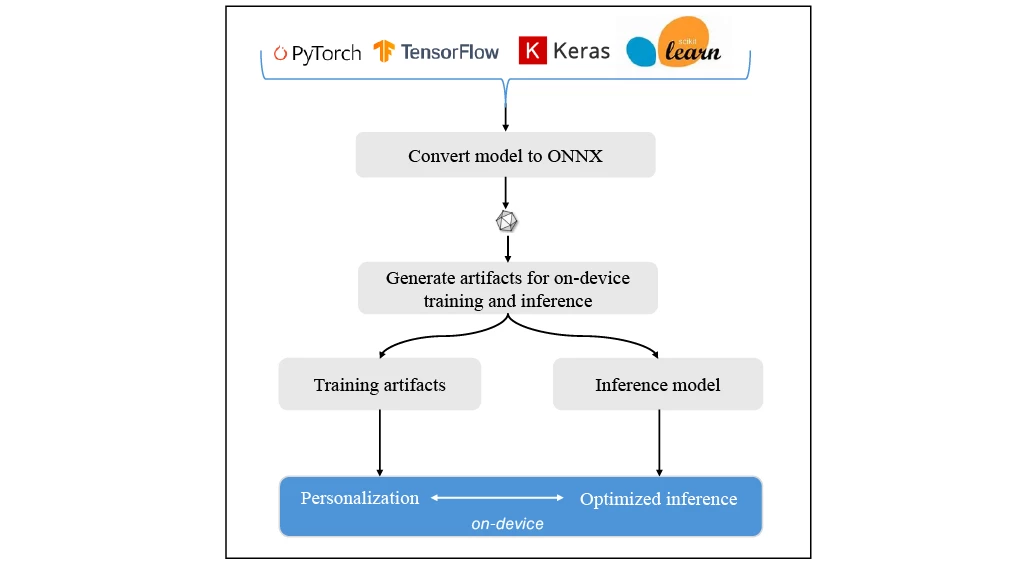
On-Device Training with ONNX Runtime
Figure 1: High-Level workflow for personalization with ONNX Runtime

Key benefits

  • Memory and performance efficient local trainer for lower resource consumption on device (battery life, power usage, and multiple app training).
  • Optimized binary size which fits strict constraints on edge devices.
  • Simple APIs and multiple language bindings make it easy to scale across multiple platform targets (Now available – C, C++, Python, C#, Java. Upcoming – JS, Objective-C, and Swift).
  • Developers can extend their existing ORT Inference solutions to enable training on the edge.
  • Same ONNX model and runtime optimizations can run across desktop, edge, and mobile devices, without having to re-design training solution across platforms.

Applications of On-Device Training

The applications of On-Device Training fall into two broad categories:

Federated learning: This technique can be used to train global models based on decentralized data without sacrificing user privacy. Federated learning involves updating a global model based on training that happens on edge devices. The edge devices train their version of the global model based on data local to the devices and return the model difference to the server. The server then aggregates these model differences from various devices to update the global model. This process is repeated until the desired outcome from the model is achieved. On-Device Training provides the local trainer which will run on individual devices. Federated learning infrastructure will provide the orchestration of managing the output of the local trainers, across a large number of devices, to update the global model.

For instance, healthcare industries can use federated learning to train models based on data from different hospitals with the data always staying on location, to provide better predictions for health conditions. Privacy for the patients is maintained because user data never leaves the devices or hospitals. The model improves the quality because it is updated based on model changes suggested from individual hospitals. This should lead to a comprehensive global model with an overall better performance for the end customer.

Personalized learning: This technique involves fine-tuning models on-device to create new personalized models. The training is based on data on-device, which produces a model personalized for the end user locally. On-Device Training again acts as a local trainer, which will update the model present on-device. This personalized model will then be used for inference to provide an improved experience for the end customer.

Personalization has a variety of applications. For instance, personalization can be used to train text prediction, image detection, or image classification models locally on the device. In the case of prediction or detection it is tuned to the individual user behavior or data, so that results are more customized for the end customer. For an image classification scenario like photo-tagging, the customer can leverage device data to customize their photo-tagging experience—for their family and friends—without the data leaving their device.

Looking forward

We are continuously working on improving the feature set and platform support. In the next release, we will add support for iOS and web browser. We will also enable more optimizations to make On-Device Training more efficient. Additionally, we will publish deep dives and tutorials in the coming months. We would love to hear your feedback and feature requests. Please use our GitHub repository to leave comments and feedback.

Doctor visit helper

Prepare before seeing a doctor

A simple rural-patient checklist to help you explain symptoms clearly, ask better questions, and avoid unsafe self-treatment.

Safety note: This is not a prescription or diagnosis. For severe symptoms, pregnancy danger signs, children with serious illness, chest pain, breathing difficulty, stroke-like weakness, or major injury, seek urgent care.

Which doctor may help?

Start with a registered doctor or the nearest qualified health center.

What to tell the doctor

  • Write when the problem started and how it changed.
  • Bring old prescriptions, investigation reports, and current medicines.
  • Write allergies, pregnancy status, diabetes, kidney/liver disease, and major past illnesses.
  • Bring one family member if the patient is weak, elderly, confused, or a child.

Questions to ask

  • What is the most likely cause of my symptoms?
  • Which danger signs mean I should go to hospital quickly?
  • Which tests are necessary now, and which can wait?
  • How should I take medicines safely and what side effects should I watch for?
  • When should I come for follow-up?

Tests to discuss

  • Vital signs: temperature, pulse, blood pressure, oxygen saturation
  • Basic physical examination by a clinician
  • CBC, urine test, blood sugar, or imaging only when clinically needed

Avoid these mistakes

  • Do not use antibiotics, steroid tablets/injections, or strong painkillers without proper medical advice.
  • Do not hide pregnancy, kidney disease, ulcer, allergy, or blood thinner use.
  • Do not delay emergency care when danger signs are present.

Medicine safety and first-aid guide

This section is for patient education only. It does not replace a doctor, pharmacist, or emergency care.

Safe first steps

  • Rest, drink safe water, and observe symptoms carefully.
  • Keep a written note of symptoms, duration, temperature, medicines already taken, and allergy history.
  • Seek medical care quickly if symptoms are severe, worsening, or unusual for the patient.

OTC medicine safety

  • For mild pain or fever, ask a registered pharmacist or doctor before using common over-the-counter pain/fever medicines.
  • Do not combine multiple pain medicines without advice, especially if you have kidney disease, liver disease, stomach ulcer, asthma, pregnancy, or take blood thinners.
  • Do not give adult medicines to children unless a qualified clinician advises it.

Avoid these mistakes

  • Do not start antibiotics without a proper medical decision.
  • Do not use steroid tablets or injections casually for quick relief.
  • Do not delay emergency care because of home remedies.

Get urgent help if

  • Severe symptoms, confusion, fainting, breathing difficulty, chest pain, severe dehydration, or sudden weakness need urgent medical care.
Medicine names, dose, and timing must be decided by a qualified clinician or pharmacist after checking age, pregnancy, allergy, other diseases, and current medicines.

For rural patients and family caregivers

Patient health record and symptom diary

Write your symptoms, medicines already taken, test results, and questions before visiting a doctor. This note stays on your device unless you print or copy it.

Doctor to discuss: Doctor / qualified healthcare provider
Tests to discuss with doctor
  • Basic vital signs: temperature, pulse, blood pressure, oxygen level if needed
  • Relevant blood, urine, imaging, or specialist tests only after clinical assessment
Questions to ask
  • What is the most likely cause of my symptoms?
  • Which warning signs mean I should go to emergency care?
  • Which tests are really needed now?
  • Which medicines are safe for my age, pregnancy status, allergy, kidney/liver/stomach condition, and current medicines?

Emergency warning signs such as chest pain, severe breathing difficulty, sudden weakness, confusion, severe dehydration, major injury, or loss of bladder/bowel control need urgent medical care. Do not wait for online information.

Safe pathway to proper treatment

Care roadmap for: On-Device Training with ONNX Runtime

Use this simple roadmap to understand the next safe steps. It is educational and does not replace examination by a doctor.

Go to emergency care if you notice:
  • Severe or rapidly worsening symptoms
  • Breathing difficulty, chest pain, fainting, confusion, severe weakness, major injury, or severe dehydration
Doctor / service to discuss: Qualified healthcare provider; specialist depends on symptoms and examination.
  1. Step 1

    Check danger signs first

    If danger signs are present, seek emergency care and do not wait for online information.

  2. Step 2

    Record the symptom story

    Write when symptoms started, severity, medicines already taken, allergies, pregnancy status, and test results.

  3. Step 3

    Visit a qualified clinician

    A doctor, nurse, or qualified healthcare provider can examine you and decide which tests or treatment are needed.

  4. Step 4

    Do only useful tests

    Do tests after clinical assessment. Avoid unnecessary tests, random antibiotics, or repeated medicines without diagnosis.

  5. Step 5

    Follow up and return early if worse

    If symptoms worsen, new warning signs appear, or treatment is not helping, return for review quickly.

Rural patient practical tips
  • Take a written symptom diary and all previous prescriptions/test reports.
  • Do not hide medicines already taken, even herbal or over-the-counter medicines.
  • Ask which warning signs mean urgent referral to hospital.

This roadmap is for education. A real diagnosis and treatment plan requires history, examination, and clinical judgment.

RX Patient Help

Ask a health question safely

Write your symptom story. A health professional or site editor can review it before any answer is prepared. This box is not for emergency care.

Emergency first: Severe chest pain, breathing trouble, unconsciousness, stroke signs, severe injury, heavy bleeding, or rapidly worsening symptoms need urgent local medical care now.

Frequently Asked Questions

Is this article a replacement for a doctor?

No. It is educational content only. Patients should consult a qualified clinician for diagnosis and treatment.

When should I seek urgent care?

Seek urgent care for severe symptoms, rapidly worsening condition, breathing difficulty, severe pain, neurological changes, or any emergency warning sign.

References

Add references, clinical guidelines, textbooks, journal articles, or trusted medical sources here. You can edit this area from the RX Article Professional Blocks panel.