Generative Adversarial Networks (GANs)

Patient Tools

Read, save, and share this guide

Use these quick tools to make this medical article easier to read, print, save, or share with a family member.

Patient Mode

Understand this article easily

Switch between simple English and easy Bangla patient notes. This is for education and does not replace a doctor consultation.

Generative Adversarial Networks (GANs) are deep learning architectures that generate high quality synthetic images of people, animals or objects around us. These networks have enabled us to provide text-based prompts for generating realistic images, modifying existing images and to complete missing information in training datasets....

For severe symptoms, danger signs, pregnancy, child illness, or sudden worsening, seek urgent medical care.

বাংলা রোগী নোট এখনো যোগ করা হয়নি। পোস্ট এডিটরে “RX Bangla Patient Mode” বক্স থেকে সহজ বাংলা সারাংশ যোগ করুন।

এই তথ্য শিক্ষা ও সচেতনতার জন্য। এটি ডাক্তারি পরীক্ষা, রোগ নির্ণয় বা প্রেসক্রিপশনের বিকল্প নয়।

Article Summary

Generative Adversarial Networks (GANs) are deep learning architectures that generate high quality synthetic images of people, animals or objects around us. These networks have enabled us to provide text-based prompts for generating realistic images, modifying existing images and to complete missing information in training datasets. StyleGAN is a type of GAN designed to control the style of the generated images for high quality and detailed...

Key Takeaways

  • This article explains StyleGAN in simple medical language.
  • This article explains DragGAN in simple medical language.
  • This article explains ONNX Runtime (ORT) and the training APIs in simple medical language.
  • This article explains DragGAN optimization with ONNX Runtime in simple medical language.
Educational health guideWritten for patient understanding and clinical awareness.
Reviewed content workflowUse writer and reviewer profiles for stronger trust.
Emergency safety firstUrgent warning signs are highlighted below.

Seek urgent medical care if you notice

These warning signs are general safety guidance. Local emergency numbers and clinical judgment should always come first.

  • Severe symptoms, breathing difficulty, fainting, confusion, or rapidly worsening illness.
  • New weakness, severe pain, high fever, or symptoms after a serious injury.
  • Any symptom that feels urgent, unusual, or unsafe for the patient.
1

Emergency now

Use emergency care for severe, sudden, rapidly worsening, or life-threatening symptoms.

2

See a doctor

Book a professional medical evaluation if symptoms persist, worsen, recur often, affect daily activities, or occur in a high-risk patient.

3

Learn safely

Use this article to understand possible causes, tests, treatment options, prevention, and questions to ask your clinician.

Before reading

RX Patient Tools

Use these quick guides before reading the article, or return to them when you need help preparing questions for a doctor.

Start here Choose the right pathway for symptoms, reports, medicines, or urgent warning signs. Disease article roadmap Read this topic step by step: meaning, symptoms, warning signs, diagnosis, treatment, prevention, and follow-up. Treatment planner Prepare questions about treatment choices, benefits, risks, side effects, and follow-up. Family & caregiver guide Organize symptoms, reports, medicines, questions, and follow-up safely. Nutrition & diet guide Prepare food, hydration, supplement, and medicine-timing questions safely. Prevention guide Organize risk factors, protective habits, screening, and warning signs. Recovery guide Prepare a safe plan for activity, rehabilitation, warning signs, and follow-up.

Generative Adversarial Networks (GANs) are deep learning architectures that generate high quality synthetic images of people, animals or objects around us. These networks have enabled us to provide text-based prompts for generating realistic images, modifying existing images and to complete missing information in training datasets. StyleGAN is a type of GAN designed to control the style of the generated images for high quality and detailed results. Once such realistic images are created, any minor tweaks or updates can be performed through the DragGAN model, which allows minor edits to the generated images without having to recreate the images again.

In this Blog we will describe our implementation of the DragGANalgorithm, based on StyleGAN1, using ONNX Runtime. We will give a technical overview of the architectures, describe the motivation and discuss challenges and their resolution. We have released Python code for navigating the implementation and included a C# example for integrating the models into a native Windows application. We invite readers to explore ONNX Runtime On-Device Training through this example and leverage it for other image scenarios on edge devices.

StyleGAN

The StyleGAN decoder and generator takes as input the latent vector and a set of learned style vectors, which control various aspects of the image’s appearance, such as its geometry, texture, and color. Through a series of convolutional layers and non-linear operations, the StyleGAN decoder transforms these inputs into a high-resolution image, allowing for the generation of highly customizable and visually convincing artificial images with exceptional control over their visual attributes.

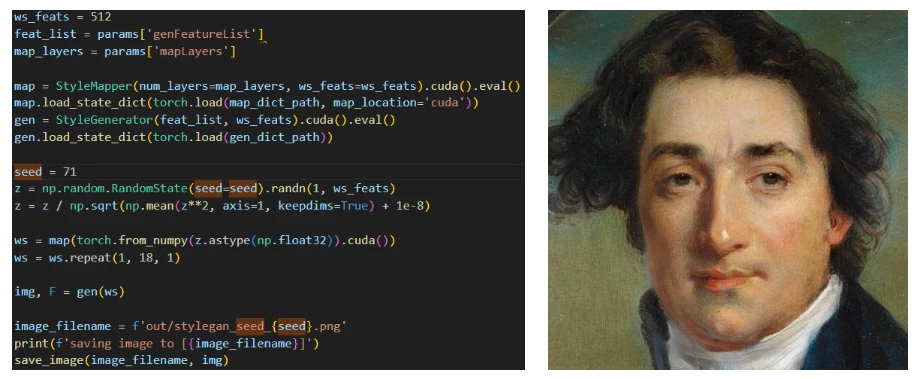
Figure 1 shows an example of StyleGAN code (mapper and decoder) which allows you to take a random vector, map it to a latent vector and generate a detailed image. Converting it to ONNX format is easy and straight forward.
Generative Adversarial Networks (GANs)
Figure 1 StyleGAN code (left) that produces the image on the right from the metfaces dataset using the seed 71. 

DragGAN

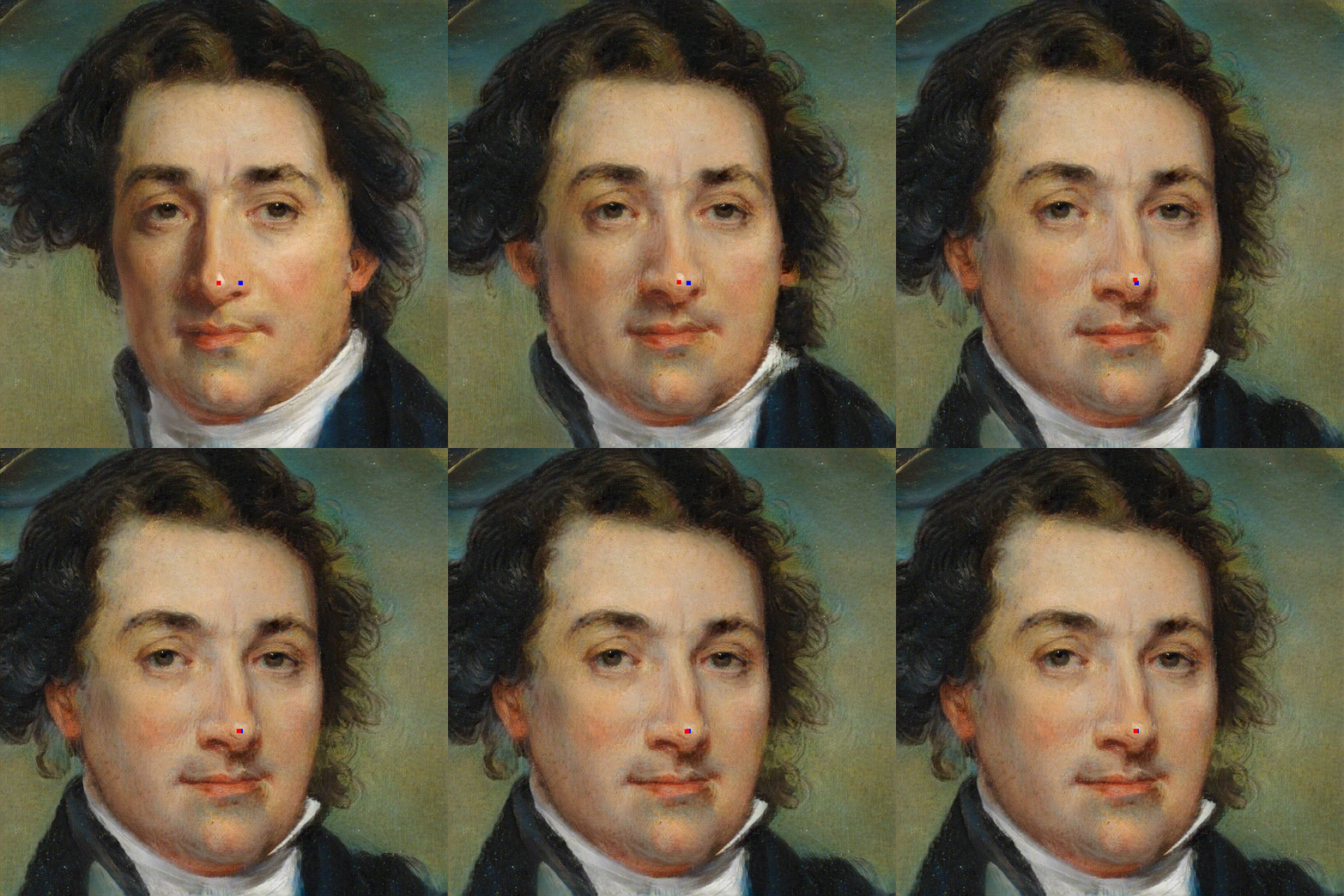
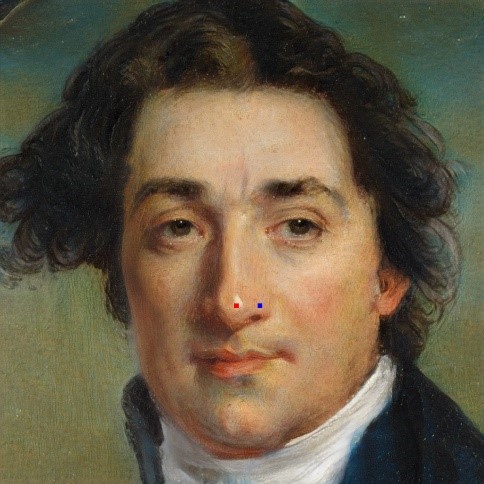
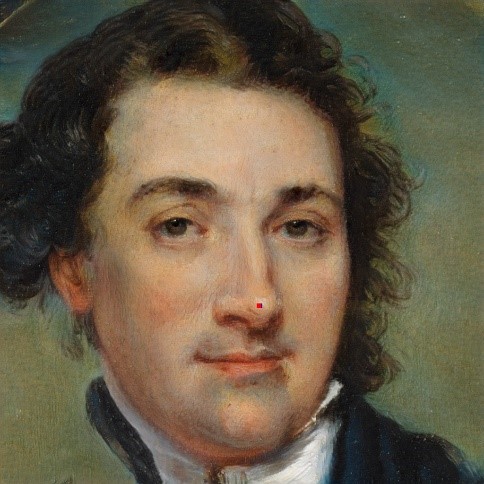
If the image generated by StyleGAN is mostly right and just needs minor tweaks to be perfect, the DragGAN algorithm allows the user to supply constraints or tweaks to modify the image to the desired form. If the latent vector created by StyleGAN is close to the user’s needs, DragGAN can optimize the latent vector, so the resulting image is exactly as the user desired. The user can specify the constraints as pairs of points (source and target) and the DragGAN optimization will result in the source points moving towards their respective target location (Figures 2a, 2b, 2c).
Generative Adversarial Networks (GANs)
Figure 2a
Generative Adversarial Networks (GANs)
Firgure 2b

Generative Adversarial Networks (GANs)

Figure 2c

Figures 2a, 2b, 2c—Example of DragGAN in action. Top-Original image + pair of points handles. Middle-Result of the DragGAN optimization process. Bottom-Animation of the intermediate frames during the optimization.

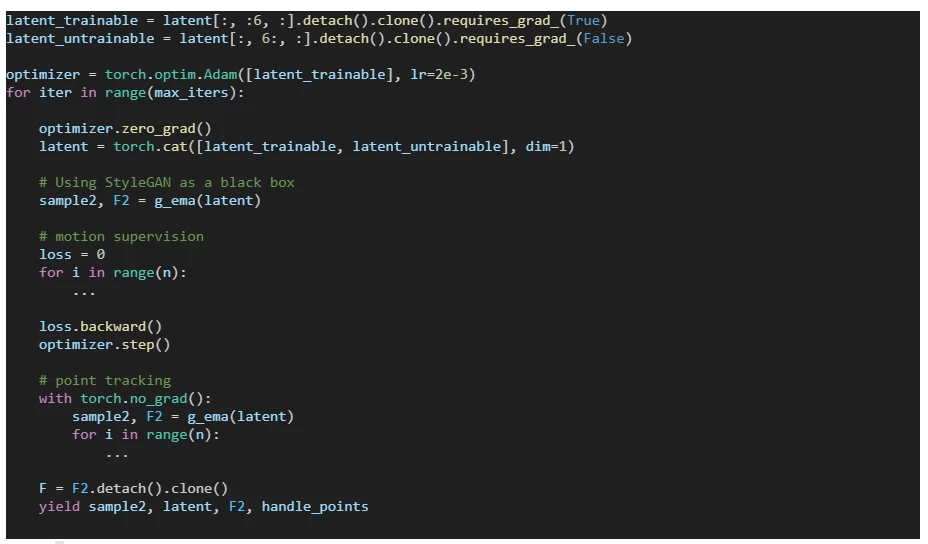
The following code describes the main optimization loop of the DragGAN algorithm:
Generative Adversarial Networks (GANs)
Figure 3 Skeleton code of the DragGAN’s optimization loop. 

In this blog we are skipping a lot of technical details of both StyleGAN (paper) and DragGAN (paper). The interested reader is encouraged to review the original papers for a more in-depth discussion of StyleGAN and DragGAN.

ONNX Runtime (ORT) and the training APIs

We aimed to showcase the seamless integration of an interactive image manipulation tool into Windows or Linux applications. We started from a PyTorch implementation but also wanted cross-platform compatibility through ONNX Runtime. With its support for various platforms and programming language APIs, ONNX Runtime provides a means to execute our tool as a native application on diverse devices without external dependencies.

Exporting StyleGAN mapper and optimizer models to ONNX is easy using the torch.onnx.export method. However, the optimizer in DragGAN uses the gradient information that is calculated during the process of StyleGAN to optimize the loss function which is based on the distance between the current user’s handle points to their target locations.

To do that we would have to calculate and use the gradient information from StyleGAN, and that is where we can use the training APIs provided through ORT On-Device Training.

Formulation as a training problem

ORT On-Device Training enables training models on edge devices without the data ever leaving the device, which is great for personalizing experiences without compromising privacy. So, if training is possible, gradient information must be involved. To use this capability, we need to formulate our algorithm as a learning problem, where the weights we are learning are the part of the latent vector we want to optimize.

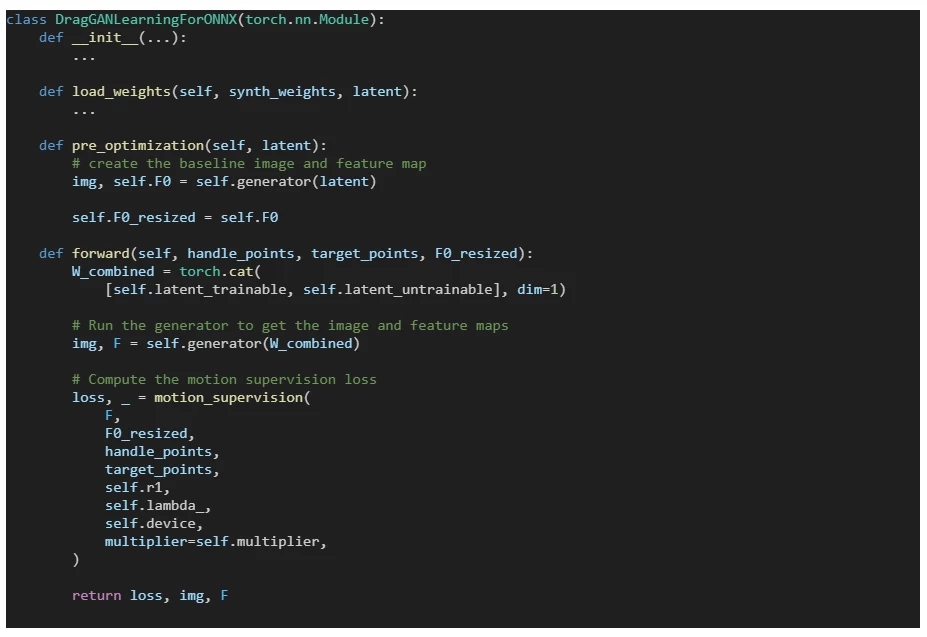
This idea leads to the following PyTorch module:
Generative Adversarial Networks (GANs)

We use the gradients calculated during the StyleGAN generator pass in the motion supervision part. The point tracking step can be left outside of this module and implemented in the chosen language as a loop over the feature map (see the draggan_demo.py).

One pass of this model is equivalent to one iteration in the original optimization loop, allowing us to get the intermediate images and give the user visual feedback.

Exporting the ONNX Model and training artifacts

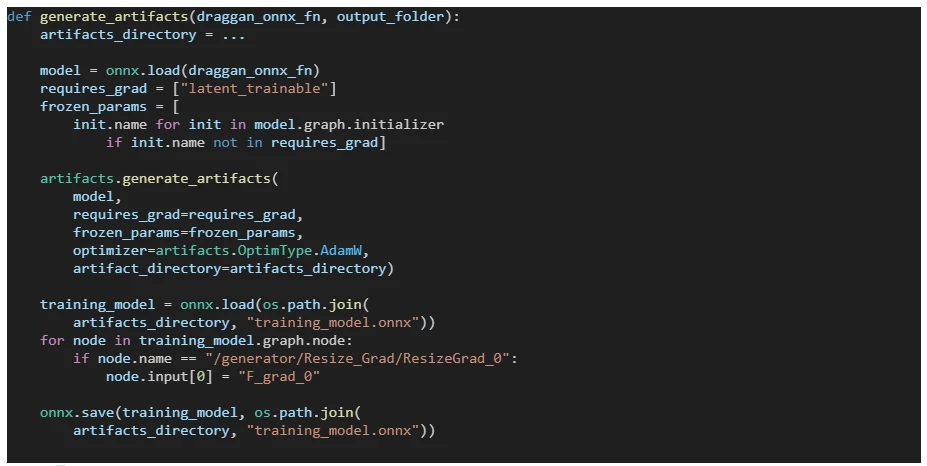
Exporting the main module to ONNX is done using the torch.onnx.export method. The additional artifacts that allow the ORT Framework to perform the optimization are exported using the following code (see the draggan_demo.py):
Generative Adversarial Networks (GANs)
Figure 5 Example code to export the ONNX Training Artifacts (checkpoint data and eval, optimizer and training models) 

Above we intentionally refrain from including a loss argument when calling the artifacts.generate_artifacts method. In such cases, ORT assumes that the ONNX model’s first output serves as the loss.

The shifted patch loss is defined with two tensors, one of which is detached from the computation graph. This detachment signifies the need to eliminate the gradient subgraph originating from the loss gradient related to the detached input (see draggan_demo.py for motion_supervision implementation).

With the creation of the four essential training artifacts—the training model, eval model, optimizer model, and the checkpoint file—we can start the training process with the chosen language binding on the device.

DragGAN optimization with ONNX Runtime

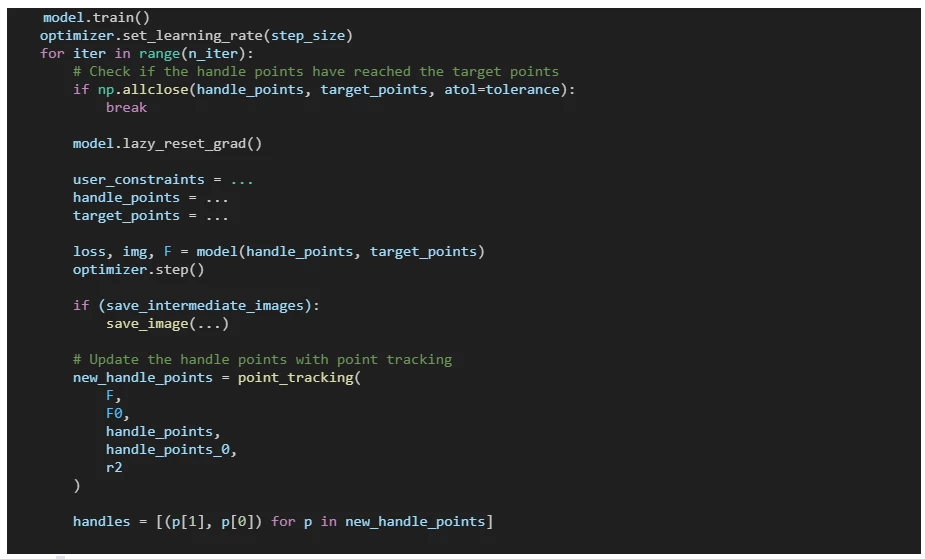
For full details of the optimization process, please see draggan_onnx_demo.py, and specifically the optimize method. The following code snippet give the main idea:
Generative Adversarial Networks (GANs)
Figure 6 Skeleton code of the DragGAN optimization loop using the ONNX Runtime artifacts.

Updating the ONNX graph

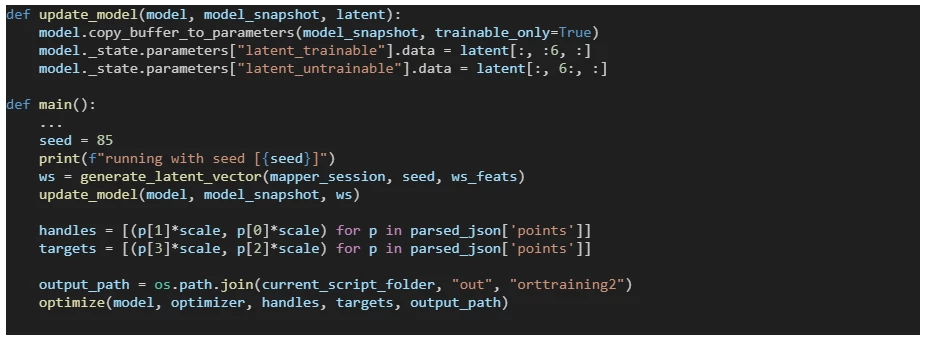
The DragGAN model that was exported to ONNX contains the latent vector as part of its structure. To allow us to use different latent vectors that are generated from different seeds, we update the ONNX model with parameters before running the optimization (see draggan_onnx_demo.py):
Generative Adversarial Networks (GANs)
Figure 7 Illustration of the update_model method, demonstrating the dynamic adjustment of ONNX graph using distinct latent vectors. Model constraints, defined as parameters, interact with the latent vector within the optimization graph.

Interactive examples

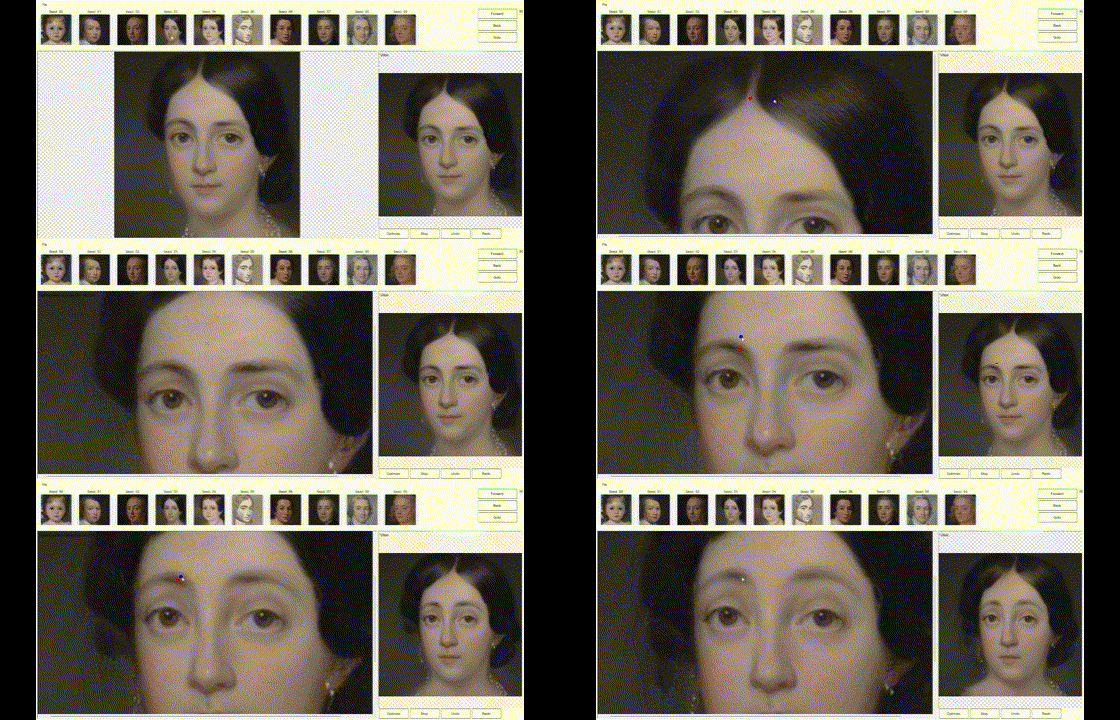
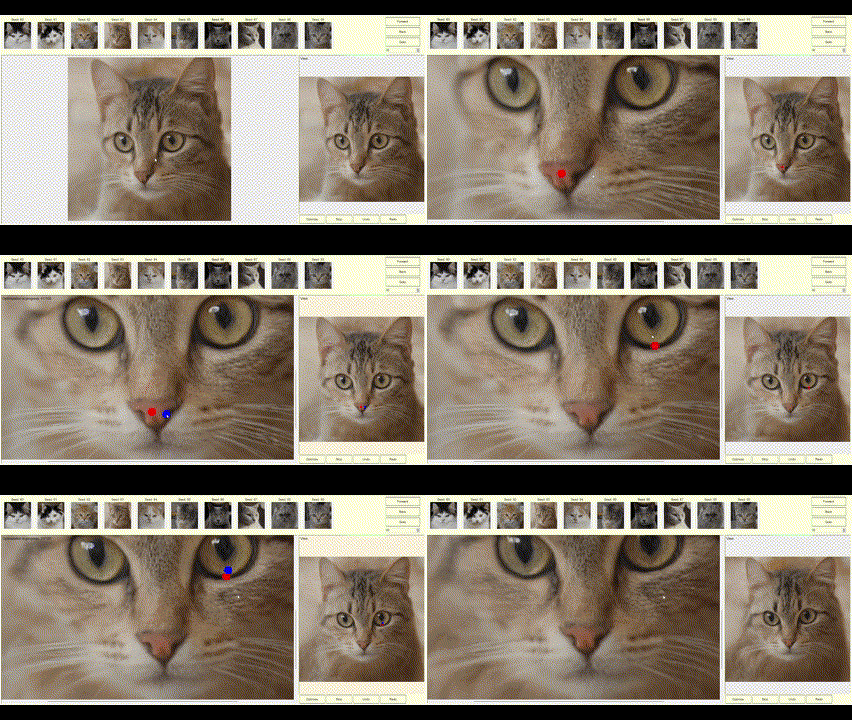
The examples below demonstrate how images can be modified by specifying the source and target points to get the desired results.
Generative Adversarial Networks (GANs)

Generative Adversarial Networks (GANs)

Figure 8 Snapshots from an interaction editing session showcasing a practical example in a technical context.

Getting started with DragGAN using ONNX Runtime

We have published the code repository for the DragGAN demonstration for experimenting and trying out the model on your own data. The sample demonstrates the ease of use of such models and the benefits of running them on multiple platforms using ORT. We have included additional resources below for a deeper look into on-device training with ONNX Runtime. These resources should help with implementing similar GAN based models for image related scenarios using the ORT on-device solution.


References:

  1. Training Generative Adversarial Networks with Limited Data, Paper and Source Code, NVIDIA, 2020
  1. Drag Your GAN: Interactive Point-based Manipulation on the Generative Image Manifold, Pan et al., SIGGRAPH 2023

  1. On-Device Training: Efficient training on the edge with ONNX Runtime – Microsoft Open Source Blog
  1. ORT On-Device Training Deep Dive blog
  1. Getting Started
  2. Examples repo
Doctor visit helper

Prepare before seeing a doctor

A simple rural-patient checklist to help you explain symptoms clearly, ask better questions, and avoid unsafe self-treatment.

Safety note: This is not a prescription or diagnosis. For severe symptoms, pregnancy danger signs, children with serious illness, chest pain, breathing difficulty, stroke-like weakness, or major injury, seek urgent care.

Which doctor may help?

Start with a registered doctor or the nearest qualified health center.

What to tell the doctor

  • Write when the problem started and how it changed.
  • Bring old prescriptions, investigation reports, and current medicines.
  • Write allergies, pregnancy status, diabetes, kidney/liver disease, and major past illnesses.
  • Bring one family member if the patient is weak, elderly, confused, or a child.

Questions to ask

  • What is the most likely cause of my symptoms?
  • Which danger signs mean I should go to hospital quickly?
  • Which tests are necessary now, and which can wait?
  • How should I take medicines safely and what side effects should I watch for?
  • When should I come for follow-up?

Tests to discuss

  • Vital signs: temperature, pulse, blood pressure, oxygen saturation
  • Basic physical examination by a clinician
  • CBC, urine test, blood sugar, or imaging only when clinically needed

Avoid these mistakes

  • Do not use antibiotics, steroid tablets/injections, or strong painkillers without proper medical advice.
  • Do not hide pregnancy, kidney disease, ulcer, allergy, or blood thinner use.
  • Do not delay emergency care when danger signs are present.

Medicine safety and first-aid guide

This section is for patient education only. It does not replace a doctor, pharmacist, or emergency care.

Safe first steps

  • Avoid heavy lifting, sudden bending, and prolonged bed rest.
  • Use comfortable posture and gentle movement as tolerated.
  • Discuss physiotherapy, X-ray, or MRI only when clinically needed.

OTC medicine safety

  • For mild back pain, pain-relief medicine may be discussed with a doctor or pharmacist.
  • Avoid repeated painkiller use if you have kidney disease, stomach ulcer, uncontrolled blood pressure, or are taking blood thinners.

Avoid these mistakes

  • Do not start antibiotics without a proper medical decision.
  • Do not use steroid tablets or injections casually for quick relief.
  • Do not delay emergency care because of home remedies.

Get urgent help if

  • Back pain with leg weakness, numbness around private area, loss of urine/stool control, fever, cancer history, or major injury needs urgent care.
Medicine names, dose, and timing must be decided by a qualified clinician or pharmacist after checking age, pregnancy, allergy, other diseases, and current medicines.

For rural patients and family caregivers

Patient health record and symptom diary

Write your symptoms, medicines already taken, test results, and questions before visiting a doctor. This note stays on your device unless you print or copy it.

Doctor to discuss: Doctor / qualified healthcare provider
Tests to discuss with doctor
  • Basic vital signs: temperature, pulse, blood pressure, oxygen level if needed
  • Relevant blood, urine, imaging, or specialist tests only after clinical assessment
Questions to ask
  • What is the most likely cause of my symptoms?
  • Which warning signs mean I should go to emergency care?
  • Which tests are really needed now?
  • Which medicines are safe for my age, pregnancy status, allergy, kidney/liver/stomach condition, and current medicines?

Emergency warning signs such as chest pain, severe breathing difficulty, sudden weakness, confusion, severe dehydration, major injury, or loss of bladder/bowel control need urgent medical care. Do not wait for online information.

Safe pathway to proper treatment

Care roadmap for: Generative Adversarial Networks (GANs)

Use this simple roadmap to understand the next safe steps. It is educational and does not replace examination by a doctor.

Go to emergency care if you notice:
  • Severe or rapidly worsening symptoms
  • Breathing difficulty, chest pain, fainting, confusion, severe weakness, major injury, or severe dehydration
Doctor / service to discuss: Qualified healthcare provider; specialist depends on symptoms and examination.
  1. Step 1

    Check danger signs first

    If danger signs are present, seek emergency care and do not wait for online information.

  2. Step 2

    Record the symptom story

    Write when symptoms started, severity, medicines already taken, allergies, pregnancy status, and test results.

  3. Step 3

    Visit a qualified clinician

    A doctor, nurse, or qualified healthcare provider can examine you and decide which tests or treatment are needed.

  4. Step 4

    Do only useful tests

    Do tests after clinical assessment. Avoid unnecessary tests, random antibiotics, or repeated medicines without diagnosis.

  5. Step 5

    Follow up and return early if worse

    If symptoms worsen, new warning signs appear, or treatment is not helping, return for review quickly.

Rural patient practical tips
  • Take a written symptom diary and all previous prescriptions/test reports.
  • Do not hide medicines already taken, even herbal or over-the-counter medicines.
  • Ask which warning signs mean urgent referral to hospital.

This roadmap is for education. A real diagnosis and treatment plan requires history, examination, and clinical judgment.

RX Patient Help

Ask a health question safely

Write your symptom story. A health professional or site editor can review it before any answer is prepared. This box is not for emergency care.

Emergency first: Severe chest pain, breathing trouble, unconsciousness, stroke signs, severe injury, heavy bleeding, or rapidly worsening symptoms need urgent local medical care now.

Frequently Asked Questions

Is this article a replacement for a doctor?

No. It is educational content only. Patients should consult a qualified clinician for diagnosis and treatment.

When should I seek urgent care?

Seek urgent care for severe symptoms, rapidly worsening condition, breathing difficulty, severe pain, neurological changes, or any emergency warning sign.

References

Add references, clinical guidelines, textbooks, journal articles, or trusted medical sources here. You can edit this area from the RX Article Professional Blocks panel.