
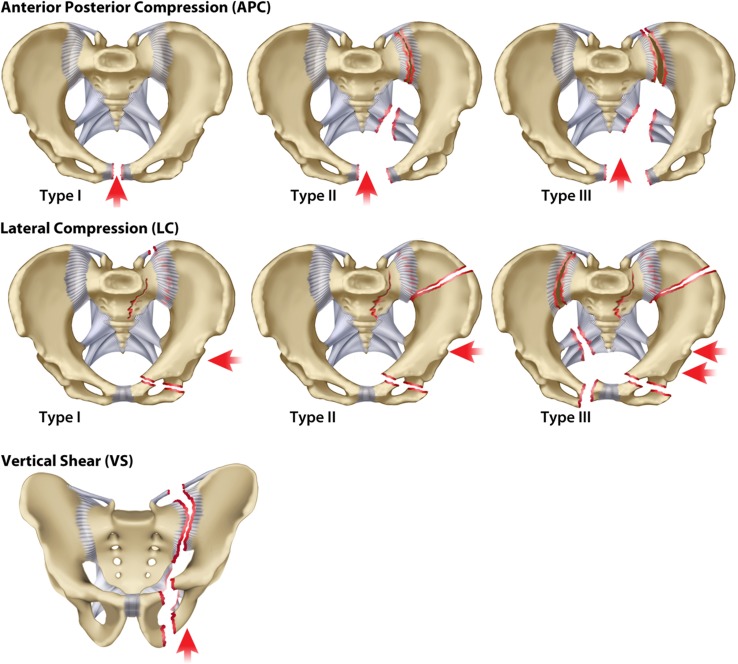
The Young and Burgess classification is a modified form of the earlier Tile classification for allowing judgment on pelvic stability. It is the recommended and most widely used classification system for pelvic ring fractures, and ligament injury. There are several types of fracture managing methods for classifying, investigating the fracture pattern, severity, degree, location, type, angulation, shortening – lengthening, comminution, rotation, displacement, the status of the pelvic implant, the quality of surrounding pelvic soft tissue injury and fracture angle are universally and widely accepted by orthopedic surgeons to assess the initial injury, plan management, and predict prognosis, diagnosis to manage decision making, in determining whether a fracture requires an intramedullary nail or open reduction with internal fixation with steel screws, rods, plates, pins, or K-wires to hold the broken bones in the correct position even external fixation attaches a metal framework outside the limb and includes the Ilizarov method and an X-frame.
Young and Burgess classification of pelvic ring fractures
Classification
Anteroposterior compression (APC)
- APC I: stable
- pubic diastasis <2.5 cm
- APC II: rotationally unstable, vertically stable
- pubic diastasis >2.5 cm
- disruption and diastasis of the anterior part of the sacroiliac joint, with intact posterior sacroiliac joint ligaments
- APC III: equates to a complete hemipelvis separation (but without vertical displacement); unstable
- pubic diastasis >2.5 cm
- disruption-diastasis of both anterior and posterior sacroiliac joint ligaments with dislocation
Lateral compression (LC)
Most common type.
- LC I: stable
- oblique fracture of pubic rami
- ipsilateral anterior compression fracture of the sacral ala
- LC II: rotationally unstable, vertically stable
- fracture of pubic rami
- posterior fracture with dislocation of the ipsilateral iliac wing (crescent fracture)
- LC III: unstable
- ipsilateral lateral compression (LC)
- contralateral anteroposterior compression (APC)
Vertical shear (VS)
Most severe and unstable type with a high association of visceral injuries.
- vertical displacement of hemipelvis, pubic and sacroiliac joint fractures
Combined
Stability depends on the individual components of this injury.
- complex fracture, including a combination of anteroposterior compression (APC), lateral compression (LC), and/or vertical shear (VS)
Tile classification
|
Tile classification
|
||
|
A: Stable
|
|
|
|
|
A1: fracture not involving the ring (avulsion or iliac wing fracture)
|
|
|
|
A2: stable or minimally displaced fracture of the ring
|
|
|
|
A3: transverse sacral fracture (Denis zone III sacral fracture)
|
|
|
B: Rotationally unstable, vertically stable
|
|
|
|
|
B1: open-book injury (external rotation)
|
|
|
B2: lateral compression injury (internal rotation)
|
|
|
|
|
B2-1: with anterior ring rotation/displacement through ipsilateral rami
|
|
|
B2-2-with anterior ring rotation/displacement through contralateral rami (bucket-handle injury)
|
|
|
|
B3: bilateral
|
|
|
|
C: Rotationally and vertically unstable
|
|
|
|
C1: unilateral
|
|
|
|
C1-1: iliac fracture
|
|
|
|
|
C1-2: sacroiliac fracture-dislocation
|
|
|
|
C1-3: sacral fracture
|
|
|
C2: bilateral with one side type B and one side type C
|
|
|
|
|
C3: bilateral with both sides type C
|
|
Young-Burgess Classification
|
Anterior Posterior Compression (APC)
|
||
|
APC I
|
Symphysis widening < 2.5 cm
|
|
|
APC II
|
Symphysis widening > 2.5 cm. Anterior SI joint diastasis.
Posterior SI ligaments are intact.
Disruption of sacrospinous and sacrotuberous ligaments
|
|
|
APC III
|
Disruption of anterior and posterior SI ligaments (SI dislocation). Disruption of sacrospinous and sacrotuberous ligaments.
APCIII associated with vascular injury
|
|
|
Lateral Compression (LC)
|
||
|
LC I
|
Oblique or transverse ramus fracture and ipsilateral anterior sacral ala compression fracture
|
|
|
Rami fracture and ipsilateral posterior ilium fracture-dislocation (crescent fracture).
|
|
|
|
LC III
|
Ipsilateral lateral compression and contralateral APC (windswept pelvis).
A common mechanism is rollover vehicle accident or pedestrian vs auto
|
|
|
Vertical Shear (VS)
|
||
|
Vertical shear
|
Posterior and superior directed force.
Associated with the highest risk of hypovolemic shock (63%); mortality rate up to 25%
|
|
Additional comments on the Young-Burgess classification:
- APC fractures typically result from ‘head on’ collisions, LS fractures from ‘side on’ impacts, and VS fractures from falls from height or ‘head on’ motor vehicle crashes.
- The Young-Burgess classification was originally thought to predict the extent of hemorrhage but this has not been supported by subsequent research. The ‘lesser’ fractures can still result in arterial hemorrhage in some cases.
References
- https://www.ncbi.nlm.nih.gov/pmc/articles/PMC5154424/
- https://www.ncbi.nlm.nih.gov/pmc/articles/PMC5916590/
- https://www.ncbi.nlm.nih.gov/pmc/articles/PMC4079881/
- https://en.wikipedia.org/wiki/Young-Burgess_classification
- https://en.wikipedia.org/wiki/Pipkin_classification
- https://www.sciencedirect.com/topics/medicine-and-dentistry/femoral-head-fracture
- https://www.ncbi.nlm.nih.gov/pmc/articles/PMC7725205/
- https://www.ncbi.nlm.nih.gov/pmc/articles/PMC5726208/
- https://journals.lww.com/jorthotrauma/fulltext/2018/01001/
- https://www.ncbi.nlm.nih.gov/pmc/articles/PMC3069264/
- https://www.ncbi.nlm.nih.gov/pmc/articles/PMC7407870/
- https://en.wikipedia.org/wiki/Vancouver_classification
- https://www.sciencedirect.com/science/article/pii/S0020138318306582
- https://www.ncbi.nlm.nih.gov/books/NBK556057/
- https://en.wikipedia.org/wiki/Winquist_and_Hansen_classification
- https://www.ncbi.nlm.nih.gov/pmc/articles/PMC2656872/
- https://www.ncbi.nlm.nih.gov/books/NBK544275/
- https://www.ncbi.nlm.nih.gov/pmc/articles/PMC6370083/
- https://www.ncbi.nlm.nih.gov/pmc/articles/PMC4562928/
- https://www.sciencedirect.com/science/article/pii/S2210261219301348
- https://www.ncbi.nlm.nih.gov/pmc/articles/PMC3163773/
- https://www.ncbi.nlm.nih.gov/pmc/articles/PMC7203210/
- https://www.ncbi.nlm.nih.gov/pmc/articles/PMC5154424/
- https://en.wikipedia.org/wiki/Danis%E2%80%93Weber_classification
- https://www.ncbi.nlm.nih.gov/pmc/articles/PMC4252160
- https://www.ncbi.nlm.nih.gov/pmc/articles/PMC5291558/
- https://journals.lww.com/md-journal/fulltext/
- https://pacs.de/term/pelvic-bucket-handle-fracture
- https://www.ncbi.nlm.nih.gov/books/NBK519005/
- https://pubmed.ncbi.nlm.nih.gov/18063712/
- https://apm.amegroups.com/article/view/10536/11577
- https://www.ncbi.nlm.nih.gov/pmc/articles/PMC3728390/
- https://academic.oup.com/jrr/article/54/6/1102/1132874
- https://bmjopen.bmj.com/content/9/7/e032111
- https://www.ncbi.nlm.nih.gov/books/NBK559168/
- https://www.sciencedirect.com/topics/medicine-and-dentistry/avulsion-fracture
- https://medlineplus.gov/
- https://en.wikipedia.org/wiki/Acetabular_fracture
- https://radiopaedia.org/articles/judet-and-letournel-classification-for-acetabular-fractures
- https://books.google.com.bd/books?id=XvbsDwAAQBAJ&pg
- https://en.wikipedia.org/wiki/Bone_fracture
- https://en.wikipedia.org/wiki/Fracture
- https://www.ncbi.nlm.nih.gov/books/NBK542250/
- https://www.ncbi.nlm.nih.gov/books/NBK549912/
- https://www.ncbi.nlm.nih.gov/pmc/articles/PMC3445231/
- https://www.ncbi.nlm.nih.gov/books/NBK542221/
- https://www.sciencedirect.com/science/article/pii/S1930043315301862
- https://www.ncbi.nlm.nih.gov/pmc/articles/PMC5903328/
- https://www.ncbi.nlm.nih.gov/pmc/articles/PMC5961267/
- https://www.ncbi.nlm.nih.gov/pmc/articles/PMC5721952/
Explore this medical topic
Continue through verified related conditions, investigations, medicines, and patient guides. These links are educational and do not replace professional medical advice.

