
Radius, a new open-source application platform

Patient Tools

Read, save, and share this guide

Use these quick tools to make this medical article easier to read, print, save, or share with a family member.

Patient Mode

Understand this article easily

Switch between simple English and easy Bangla patient notes. This is for education and does not replace a doctor consultation.

Developers and IT operators today know all too well the pain involved with deploying, managing, and making sense of applications in an ever-evolving and increasingly complicated cloud-native landscape. While it’s true that advancements in cloud infrastructure and platforms like Kubernetes have been gamechangers for developing...

For severe symptoms, danger signs, pregnancy, child illness, or sudden worsening, seek urgent medical care.

বাংলা রোগী নোট এখনো যোগ করা হয়নি। পোস্ট এডিটরে “RX Bangla Patient Mode” বক্স থেকে সহজ বাংলা সারাংশ যোগ করুন।

এই তথ্য শিক্ষা ও সচেতনতার জন্য। এটি ডাক্তারি পরীক্ষা, রোগ নির্ণয় বা প্রেসক্রিপশনের বিকল্প নয়।

Article Summary

Developers and IT operators today know all too well the pain involved with deploying, managing, and making sense of applications in an ever-evolving and increasingly complicated cloud-native landscape. While it’s true that advancements in cloud infrastructure and platforms like Kubernetes have been gamechangers for developing flexible, scalable, and portable microservice applications, they have also made things more challenging for developers and operators alike. For developers,...

Key Takeaways

  • This article explains A single tool to describe, deploy, and manage your entire application in simple medical language.
  • This article explains Radius features available in this first open-source release in simple medical language.
  • This article explains Consistent experience across platforms, cloud providers, and on-premises in simple medical language.
  • This article explains Automate environment configurations and resource provisioning with Recipes in simple medical language.
Educational health guideWritten for patient understanding and clinical awareness.
Reviewed content workflowUse writer and reviewer profiles for stronger trust.
Emergency safety firstUrgent warning signs are highlighted below.

Seek urgent medical care if you notice

These warning signs are general safety guidance. Local emergency numbers and clinical judgment should always come first.

  • Severe symptoms, breathing difficulty, fainting, confusion, or rapidly worsening illness.
  • New weakness, severe pain, high fever, or symptoms after a serious injury.
  • Any symptom that feels urgent, unusual, or unsafe for the patient.
1

Emergency now

Use emergency care for severe, sudden, rapidly worsening, or life-threatening symptoms.

2

See a doctor

Book a professional medical evaluation if symptoms persist, worsen, recur often, affect daily activities, or occur in a high-risk patient.

3

Learn safely

Use this article to understand possible causes, tests, treatment options, prevention, and questions to ask your clinician.

Before reading

RX Patient Tools

Use these quick guides before reading the article, or return to them when you need help preparing questions for a doctor.

Start here Choose the right pathway for symptoms, reports, medicines, or urgent warning signs. Disease article roadmap Read this topic step by step: meaning, symptoms, warning signs, diagnosis, treatment, prevention, and follow-up. Treatment planner Prepare questions about treatment choices, benefits, risks, side effects, and follow-up. Family & caregiver guide Organize symptoms, reports, medicines, questions, and follow-up safely. Nutrition & diet guide Prepare food, hydration, supplement, and medicine-timing questions safely. Prevention guide Organize risk factors, protective habits, screening, and warning signs. Recovery guide Prepare a safe plan for activity, rehabilitation, warning signs, and follow-up.

Developers and IT operators today know all too well the pain involved with deploying, managing, and making sense of applications in an ever-evolving and increasingly complicated cloud-native landscape. While it’s true that advancements in cloud infrastructure and platforms like Kubernetes have been gamechangers for developing flexible, scalable, and portable microservice applications, they have also made things more challenging for developers and operators alike. For developers, the complexity of managing infrastructure and lack of visibility into the resources that make up their applications are major roadblocks for productivity. For operators, the lack of standardization and automation in the deployment process can lead to loss of control over the infrastructure, and degradation of confidence in the applications that are deployed. At the end of the day, development teams are left with a disjointed experience between platforms and cloud providers. Developers and operators alike find themselves struggling to make sense of how their application comes together across disparate sets of tools that provide little more than a list of their deployed artifacts.

Applications are, of course, so much more than just Kubernetes and flat lists of resources. The Microsoft Azure Incubations team is excited to announce a new open application platform called Radius that places the application at the center of every stage of development—redefining how applications are built, managed, and understood. With features like Recipes and Connections that standardize deployments and automate resource provisioning, Radius provides a centralized toolset for developer and operator teams to effectively collaborate. And because the relationships between resources are inherently captured in application authoring and deployment activities, Radius enables a comprehensive view into an organization’s architecture via its application graph data. Furthermore, Radius is open-source and multi-cloud from the start, allowing for applications that can be written once and, using the same toolset and workflows, deployed to any cloud or on-premises infrastructure. To get started or learn more about Radius, visit radapp.io, join the discussions on Discord, or dial into an upcoming community meeting.

Radius, a new open-source application platform

A single tool to describe, deploy, and manage your entire application

Radius is focused on solving platform engineering challenges involved in supporting application deployments across on-premises infrastructure and cloud providers like Microsoft Azure and Amazon Web Services. Meeting developers and operators where they are today, Radius offers built-in support for some of the most popular app development tools like Dapr, and infrastructure as code (IaC) languages like Terraform and Bicep. Designed to fit into, rather than disrupt, existing development tasks and CI/CD pipelines, Radius works to help developers better understand all the components that comprise their applications and takes care of platform configurations like permissions, connection strings, and more to simplify their tasks. As a result, operators can ensure that all applications are deployed in compliance with organizational policies, then use Radius to manage the application and its resources.
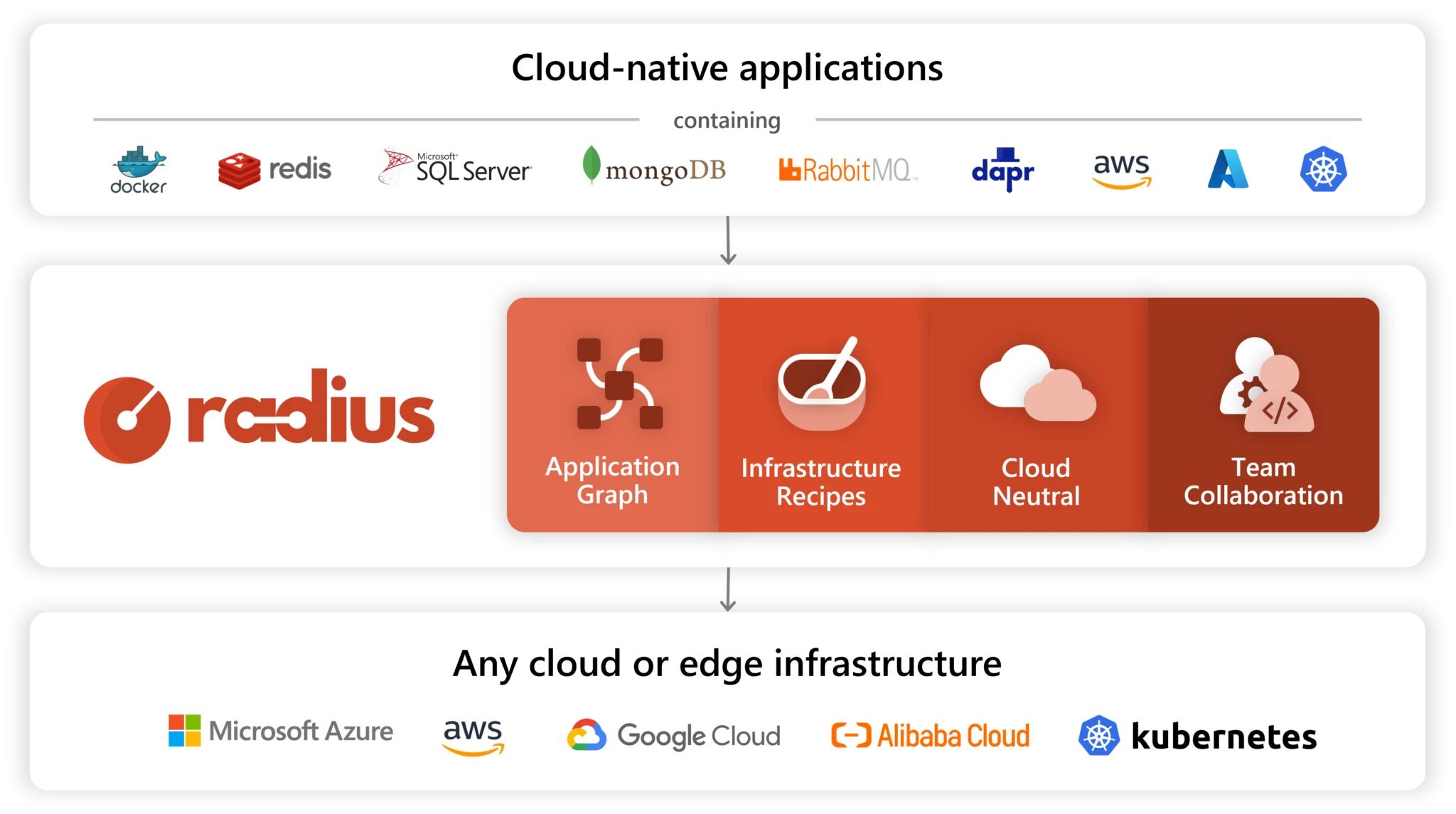
Radius, a new open-source application platform

Radius features available in this first open-source release

In this first release, the focus is on the features that are most foundational to the Radius platform and its goals of improving the productivity of application development workflows. These include:

  • Simplified and consistent application development experience: Deploy to any cloud provider or on-premises using the same application definition, all with a consistent set of tooling and experience. These include capabilities to automate resource access and provisioning, as well as the ability to configure environments that meet the needs of each phase of development.
  • Recipes and environments: Standardize and scale deployments with clear separation of concerns between developers and operators. Radius Recipes are pre-definable templates that automate the provisioning of infrastructure resources and environment configurations that can be designed to adhere to cost, security, and compliance standards.
  • Application graph: Gain visibility into the resources and relationships that make up an application. Radius captures the relationships between resources in an application as a part of the development activities, which can in turn be queried and understood.

Consistent experience across platforms, cloud providers, and on-premises

To meet the growing business and technical needs for multi-cloud architectures, applications defined and managed with Radius can be deployed and run on any cloud using the same set of tools, meaning that the application code, definitions, and development workflows remain consistent. Agnostic to whether the application is deployed to Azure, AWS, or on-premises the authoring, deployment, and management experience remains the same. Furthermore, Radius makes it easy to connect and leverage many popular services such as Redis, Mongo, Dapr, and SQL, with more to be added as the needs and requirements of the community grows.

For example, imagine an application that leverages a SQL database. When running locally, the developer may want to use a SQL container and when running in production, operators may want to enforce the use of high-throughput databases. With Radius, developers can model a SQL resource in their app and use its connection string during their development and testing stages. When it comes time to deploy in production, developers can swap their application resources by changing just their app definition connections to services like Azure SQL DB or AWS RDS that have been pre-configured by operators. In other words, changing the backing infrastructure for an application in Radius no longer requires app code or configuration changes.
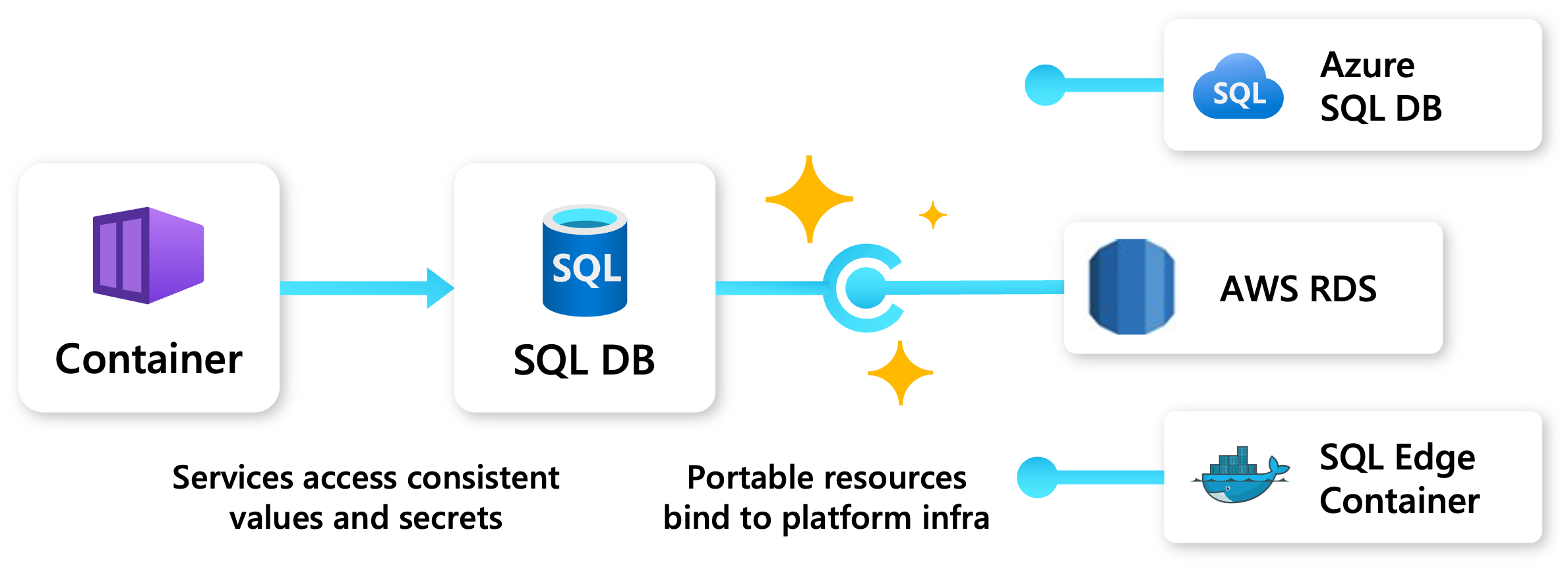
Radius, a new open-source application platform

Automate environment configurations and resource provisioning with Recipes

Collaboration between developers and operators today requires detailed coordination, resulting in back-and-forth manual processes that slow down development velocity. Most organizations have resorted to building custom pipelines or ticketing systems for infrastructure deployments, but these only ease part of the pain without addressing the core need for manual processes. This is where Radius Recipes adds new value: operators are able to configure IaC templates (Terraform modules and Bicep files) that developers can use for self-service resource provisioning and deployments. Recipes also allow operators to define and enforce corporate policies, such as which cloud resources can be used, how they are configured, and who can deploy them. This means that developers no longer need to worry about the details involved in deploying appropriate infrastructure when building out their applications, allowing them to focus on writing application code.

For example, an operator can define a Recipe that deploys a Redis cache that meets the production requirements of their organization: minimum of two nodes and a minimum of two replicas. The operator can also specify that the Redis cache must be deployed to a specific region and be pre-configured with the correct connection string and necessary credentials. Once the Recipe is defined, developers can use it to deploy a Redis cache without having to worry about the details of how to deploy it, or whether it is configured correctly. This separation of concerns enables operator teams to scale their support for developer teams, while ensuring that applications are deployed in compliance with organizational policies.
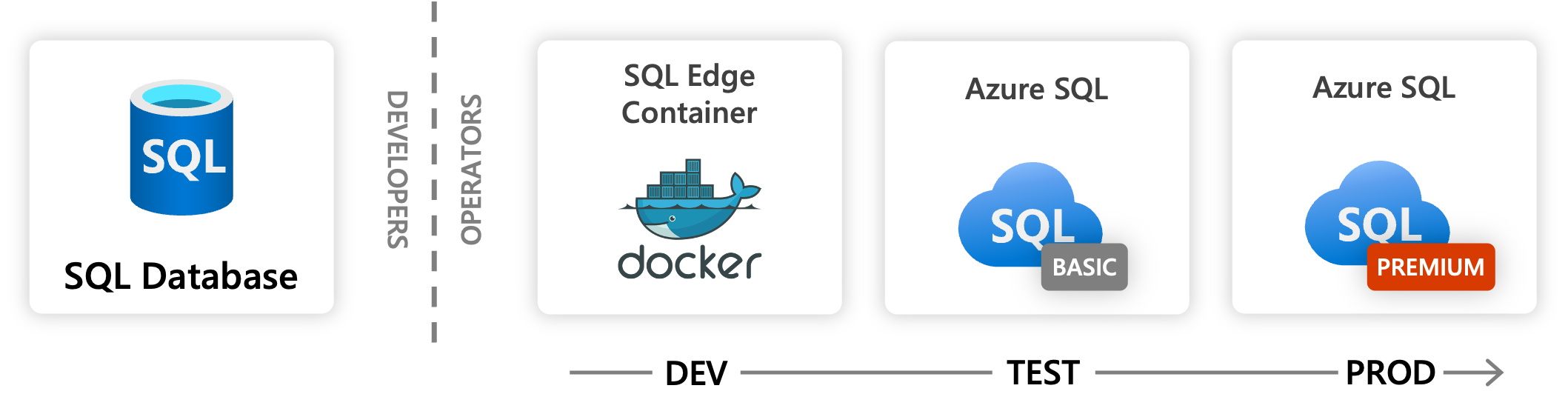
Radius, a new open-source application platform

Manage infrastructure leveraging the Radius application graph

One of the biggest challenges of managing cloud-native applications is ensuring that the cloud infrastructure used by applications meets cost, operations, and security requirements. However, IT operators are often in the dark when it comes to having a clear and accurate representation of the deployed application resources, limiting their ability to effectively manage their corporate infrastructure. Radius introduces an application structure that includes environments, resource groups, and connections, resulting in an application graph that shows precisely how the application and its infrastructure are interconnected, enabling teams that support developers to build views and intuitively understand what makes up an app. Furthermore, Radius integrates with popular infrastructure tools like Terraform, and existing CI/CD systems like GitHub Actions to provide a seamless operator experience.
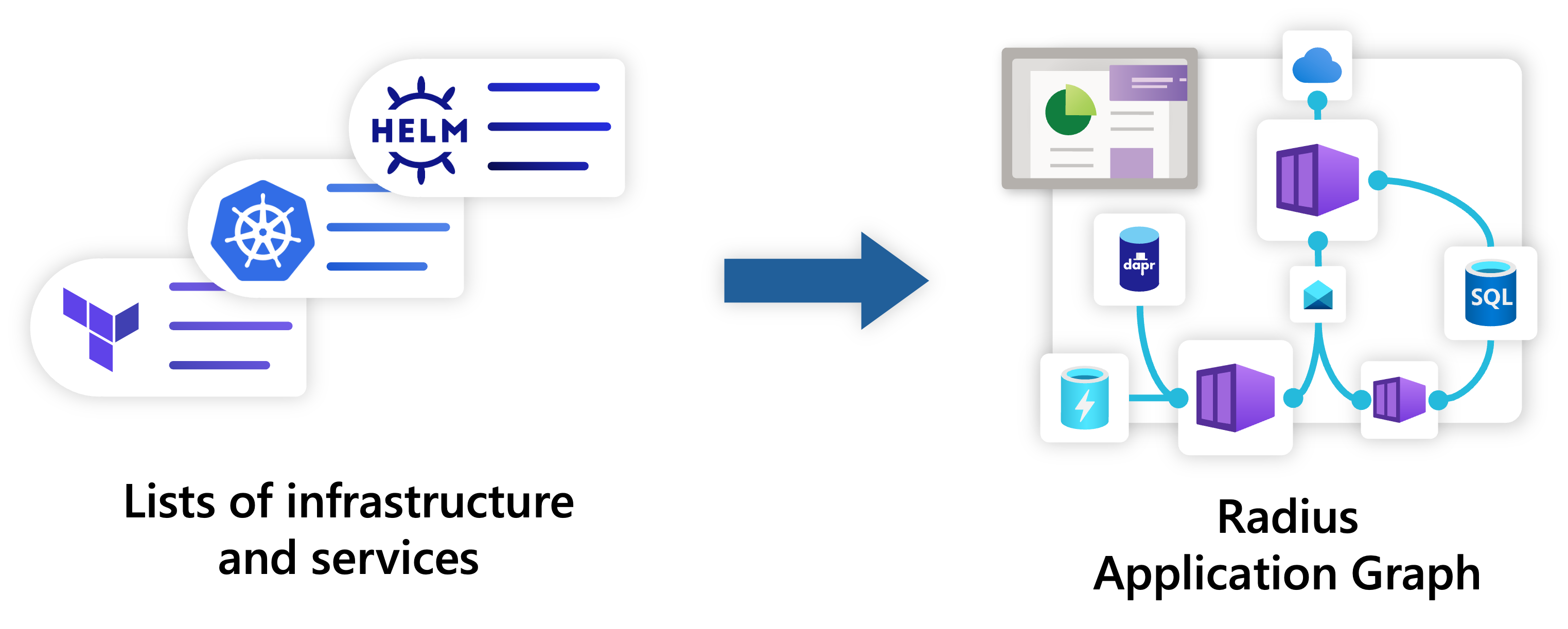
Radius, a new open-source application platform

Learn more and contribute

Fully committed to achieving industry-wide impact via open-source, the maintainers are in the process of submitting Radius as a new project to the Cloud Native Computing Foundation (CNCF). Enterprises like Microsoft, BlackRock, Comcast, and Millennium BCP have already been working together to ensure Radius evolves along with the broader cloud native community. The Radius maintainers are excited to continue collaborating with the open-source community to grow its feature set and welcome all contributions from the community.


Doctor visit helper

Prepare before seeing a doctor

A simple rural-patient checklist to help you explain symptoms clearly, ask better questions, and avoid unsafe self-treatment.

Safety note: This is not a prescription or diagnosis. For severe symptoms, pregnancy danger signs, children with serious illness, chest pain, breathing difficulty, stroke-like weakness, or major injury, seek urgent care.

Which doctor may help?

Start with a registered doctor or the nearest qualified health center.

What to tell the doctor

  • Write when the problem started and how it changed.
  • Bring old prescriptions, investigation reports, and current medicines.
  • Write allergies, pregnancy status, diabetes, kidney/liver disease, and major past illnesses.
  • Bring one family member if the patient is weak, elderly, confused, or a child.

Questions to ask

  • What is the most likely cause of my symptoms?
  • Which danger signs mean I should go to hospital quickly?
  • Which tests are necessary now, and which can wait?
  • How should I take medicines safely and what side effects should I watch for?
  • When should I come for follow-up?

Tests to discuss

  • Vital signs: temperature, pulse, blood pressure, oxygen saturation
  • Basic physical examination by a clinician
  • CBC, urine test, blood sugar, or imaging only when clinically needed

Avoid these mistakes

  • Do not use antibiotics, steroid tablets/injections, or strong painkillers without proper medical advice.
  • Do not hide pregnancy, kidney disease, ulcer, allergy, or blood thinner use.
  • Do not delay emergency care when danger signs are present.

Medicine safety and first-aid guide

This section is for patient education only. It does not replace a doctor, pharmacist, or emergency care.

Safe first steps

  • Avoid heavy lifting, sudden bending, and prolonged bed rest.
  • Use comfortable posture and gentle movement as tolerated.
  • Discuss physiotherapy, X-ray, or MRI only when clinically needed.

OTC medicine safety

  • For mild back pain, pain-relief medicine may be discussed with a doctor or pharmacist.
  • Avoid repeated painkiller use if you have kidney disease, stomach ulcer, uncontrolled blood pressure, or are taking blood thinners.

Avoid these mistakes

  • Do not start antibiotics without a proper medical decision.
  • Do not use steroid tablets or injections casually for quick relief.
  • Do not delay emergency care because of home remedies.

Get urgent help if

  • Back pain with leg weakness, numbness around private area, loss of urine/stool control, fever, cancer history, or major injury needs urgent care.
Medicine names, dose, and timing must be decided by a qualified clinician or pharmacist after checking age, pregnancy, allergy, other diseases, and current medicines.

For rural patients and family caregivers

Patient health record and symptom diary

Write your symptoms, medicines already taken, test results, and questions before visiting a doctor. This note stays on your device unless you print or copy it.

Doctor to discuss: Doctor / qualified healthcare provider
Tests to discuss with doctor
  • Basic vital signs: temperature, pulse, blood pressure, oxygen level if needed
  • Relevant blood, urine, imaging, or specialist tests only after clinical assessment
Questions to ask
  • What is the most likely cause of my symptoms?
  • Which warning signs mean I should go to emergency care?
  • Which tests are really needed now?
  • Which medicines are safe for my age, pregnancy status, allergy, kidney/liver/stomach condition, and current medicines?

Emergency warning signs such as chest pain, severe breathing difficulty, sudden weakness, confusion, severe dehydration, major injury, or loss of bladder/bowel control need urgent medical care. Do not wait for online information.

Safe pathway to proper treatment

Care roadmap for: Radius, a new open-source application platform

Use this simple roadmap to understand the next safe steps. It is educational and does not replace examination by a doctor.

Go to emergency care if you notice:
  • Severe or rapidly worsening symptoms
  • Breathing difficulty, chest pain, fainting, confusion, severe weakness, major injury, or severe dehydration
Doctor / service to discuss: Qualified healthcare provider; specialist depends on symptoms and examination.
  1. Step 1

    Check danger signs first

    If danger signs are present, seek emergency care and do not wait for online information.

  2. Step 2

    Record the symptom story

    Write when symptoms started, severity, medicines already taken, allergies, pregnancy status, and test results.

  3. Step 3

    Visit a qualified clinician

    A doctor, nurse, or qualified healthcare provider can examine you and decide which tests or treatment are needed.

  4. Step 4

    Do only useful tests

    Do tests after clinical assessment. Avoid unnecessary tests, random antibiotics, or repeated medicines without diagnosis.

  5. Step 5

    Follow up and return early if worse

    If symptoms worsen, new warning signs appear, or treatment is not helping, return for review quickly.

Rural patient practical tips
  • Take a written symptom diary and all previous prescriptions/test reports.
  • Do not hide medicines already taken, even herbal or over-the-counter medicines.
  • Ask which warning signs mean urgent referral to hospital.

This roadmap is for education. A real diagnosis and treatment plan requires history, examination, and clinical judgment.

RX Patient Help

Ask a health question safely

Write your symptom story. A health professional or site editor can review it before any answer is prepared. This box is not for emergency care.

Emergency first: Severe chest pain, breathing trouble, unconsciousness, stroke signs, severe injury, heavy bleeding, or rapidly worsening symptoms need urgent local medical care now.

Frequently Asked Questions

Is this article a replacement for a doctor?

No. It is educational content only. Patients should consult a qualified clinician for diagnosis and treatment.

When should I seek urgent care?

Seek urgent care for severe symptoms, rapidly worsening condition, breathing difficulty, severe pain, neurological changes, or any emergency warning sign.

References

Add references, clinical guidelines, textbooks, journal articles, or trusted medical sources here. You can edit this area from the RX Article Professional Blocks panel.