
RX Patient Tools
Use these quick guides before reading the article, or return to them when you need help preparing questions for a doctor.
Test Diagnosis of Piriformis Syndrome is a neuromuscular condition characterized by hip and buttock pain. This syndrome is often overlooked in clinical settings because its presentation may be similar to that of lumbar pain, numbness, tingling, or weakness. সহজ বাংলা: নার্ভ রুট চাপা/জ্বালায় ব্যথা বা অবশভাব।" data-rx-term="radiculopathy" data-rx-definition="Radiculopathy means nerve-root irritation or compression causing pain, numbness, tingling, or weakness. সহজ বাংলা: নার্ভ রুট চাপা/জ্বালায় ব্যথা বা অবশভাব।">radiculopathy, primary sacral dysfunction, or innominate dysfunction. The ability to recognize piriformis syndrome requires an understanding of the structure and function of the piriformis muscle and its relationship to the sciatic nerve. The authors review the anatomic and clinical features of this condition, summarizing the osteopathic medical approach to diagnosis and management. A holistic approach to diagnosis requires a thorough neurologic history and physical assessment of the patient based on the pathologic characteristics of piriformis syndrome. The authors note that several nonpharmacologic therapies, including osteopathic manipulative treatment, can be used alone or in conjunction with pharmacotherapeutic options in the management of piriformis syndrome.[Rx]
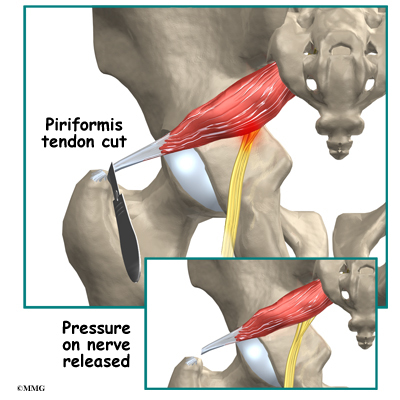
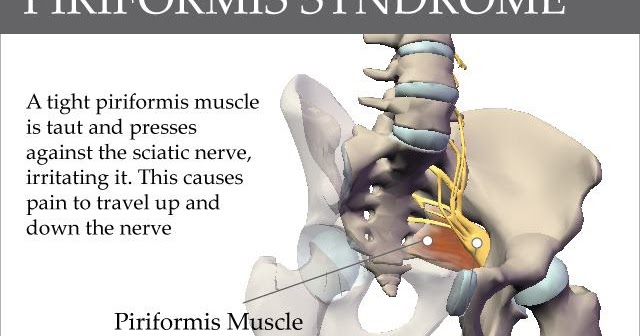
Piriformis syndrome (PS) is a painful musculoskeletal condition, characterized by a combination of symptoms including buttock or hip pain due to compressed and/or irritated sciatic nerve by the piriformis muscle as it passes deeply through your buttock, resulting in pain. It is an uncommon neuromuscular disorder that is caused when the piriformis muscle compresses the sciatic nerve.[Rx]
Piriformis syndrome is an often misdiagnosed cause of pain traveling along the sciatic nerve, often from lower back to leg. সহজ বাংলা: কোমর থেকে পায়ে নামা নার্ভের ব্যথা।" data-rx-term="sciatica" data-rx-definition="Sciatica means pain traveling along the sciatic nerve, often from lower back to leg. সহজ বাংলা: কোমর থেকে পায়ে নামা নার্ভের ব্যথা।">sciatica, leg, or buttock pain, and disability. The sciatic nerve may be compressed within the buttock by the piriformis muscle, with pain increased by muscular contraction, palpation, or prolonged sitting. A thorough medical history and physical examination are essential to proper diagnosis. Diagnostic testing may be used to differentiate piriformis syndrome from other causes of pain traveling along the sciatic nerve, often from lower back to leg. সহজ বাংলা: কোমর থেকে পায়ে নামা নার্ভের ব্যথা।" data-rx-term="sciatica" data-rx-definition="Sciatica means pain traveling along the sciatic nerve, often from lower back to leg. সহজ বাংলা: কোমর থেকে পায়ে নামা নার্ভের ব্যথা।">sciatica, lower extremity weakness, and pain. This article reviews the pathophysiology and management of piriformis syndrome.
The piriformis is a flat, pyramid-shaped muscle that lies parallel to (in line with) the gluteus medius muscle’s back margin and underneath the gluteus maximus muscle in the hip area.

Pain in your buttocks and radiating sciatic pain is sometimes the result of piriformis syndrome, or tightening and irritation of the piriformis muscle.
Anatomy of Piriformis Syndrome
Sciatic nerve
- Inferior to piriformis
- Superior to superior gemellus
Muscles
External rotators of the thigh include (superior to inferior)
- Piriformis
- Superior gemellus
- Obturator internus
- Inferior gemellus
- Obturator externus
- Quadratus femoris
Causes of Piriformis Syndrome
- Muscle spasm in the piriformis muscle, either because of irritation in the piriformis muscle itself, or irritation of a nearby structure such as the sacroiliac joint or hip
- Repetitive, improper movements or physical activities, such as those commonly found in long-distance running, sitting for lengthy periods of time and/or sports
- Sudden injury, trauma or accident causing irritation to the piriformis muscle or nearby areas, such as the hip or sacroiliac joint
- Previous injuries near the back, pelvis, piriformis muscle or sciatic nerve
- an injury, such as a fall, a blow to the area, or a car accident
- overuse, such as from frequent running, excessive exercise, or over-stretching
- a sedentary lifestyle, especially with long periods of sitting
- changing from a sedentary lifestyle to more frequent exercise
- buttock muscles wasting away
- Tightening of the muscle, in response to injury or spasm
- Swelling of the piriformis muscle, due to injury or spasm
- Bleeding in the area of the piriformis muscle.
- muscle tension and excess weight due to pregnancy
Causes of piriformis syndrome include the following: [2]
-
Trauma to the hip or buttock area
-
Piriformis muscle hypertrophy (often seen in athletes during periods of increased weightlifting requirements or pre-season conditioning)
-
Sitting for prolonged periods (taxi drivers, office workers, bicycle riders)
Anatomic anomalies
-
Bipartite piriformis muscle
-
Sciatic nerve course/branching variations with respect to the piriformis muscle
-
Early (proximal) divisions of the sciatic nerve into its tibial and common peroneal components can predispose patients to piriformis syndrome, with these branches passing through and below the piriformis muscle or above and below the muscle [4]
-
In >80% of the population, the sciatic nerve courses deep to and exits inferiorly to the piriformis muscle belly/tendon [3]
Symptoms of Piriformis Syndrome
- pain when an area is touched or pressed. সহজ বাংলা: চাপ দিলে ব্যথা।" data-rx-term="tenderness" data-rx-definition="Tenderness means pain when an area is touched or pressed. সহজ বাংলা: চাপ দিলে ব্যথা।">Tenderness, pain, numbness or tingling in the buttocks or along the back of the leg that intensifies without activity
- Pain in the buttock or hip area is the most common symptom.
- Pain may radiate from the buttock area down into the lower leg along the path of the sciatic nerve. Some patients may complain of low back pain.
- There may be numbness and tingling in the buttock area, which can sometimes radiate down to the lower leg.
- Pain with bowel movements may be present.
- Women can sometimes experience painful intercourse.
- There may be pain when an area is touched or pressed. সহজ বাংলা: চাপ দিলে ব্যথা।" data-rx-term="tenderness" data-rx-definition="Tenderness means pain when an area is touched or pressed. সহজ বাংলা: চাপ দিলে ব্যথা।">tenderness in the buttock area when pressure is applied. Certain patients may have a palpable “sausage-shaped” mass in the buttock area from piriformis muscle contraction/spasm.
- Difficulty participating in daily activities
- Aching, soreness or tightness in the buttocks that can worsen with long periods of sitting, running or walking up or down stairs
- A noticeably reduced range of motion through the hip joint
- Discomfort when light pressure is applied over the p
- Sciatic pain is sharp and searing, rather than dull, and is described as “pins and needles.” You may also experience numbness and weakness in this leg. This pain can be debilitating and make it difficult to stand and walk.
Common complaints associated with piriformis syndrome include
- Pain that becomes more severe following prolonged periods of sitting
- A dull and achy pain located in the gluteus region
- Numbing sensations within the feet
- Pain walking up stairs or an incline
- A headache
- Muscle weakness in the lower limbs
- Difficulty walking
- Reduced range of motion within the hip joint
- Radiating pain
- Abdominal pain, pelvic pain, or groin pain
- Muscle spasms
- Pain during bowel movements
- In women, pain during intercourse
Diagnosis of Piriformis Syndrome
- A medical history – in which you answer questions about your health, symptoms, and activity.
- A physical exam to assess your strength – reflexes, sensation, stability, alignment, and motion. You may also need blood tests.
- Magnetic resonance imaging (MRI) scan – which uses magnetic fields and computers to produce three-dimensional images of your spine & nerve.
- A myelogram – an X-ray of the spinal canal after injection of contrast material — which can pinpoint pressure on the sciatic nerve
- Magnetic resonance neurography – This form of magnetic resonance imaging (MRI) test looks for inflammation in the nerves.
- FAIR Test – The flexion, adduction, and internal rotation test flex the hip to stretch the piriformis and compress the sciatic nerve. It measures delays in sciatic nerve signals due to its compression under the piriformis.
Piriformis syndrome tests
There are also a few specific tests for piriformis syndrome that have been highlighted in scientific studies.

IA, insertional activity; Fib, fibrillation; PSW, positive sharp wave; Amp, amplitude; Dur, duration; PPP, polyphasic pattern; N, normal; Inc, increased.
The straight-leg raise test
Pain will shoot down the back of your leg when your leg is raised straight (typically by a partner) while you lie on your back. This is indicative of irritation of the sciatic nerve, though it is not specific to piriformis syndrome.
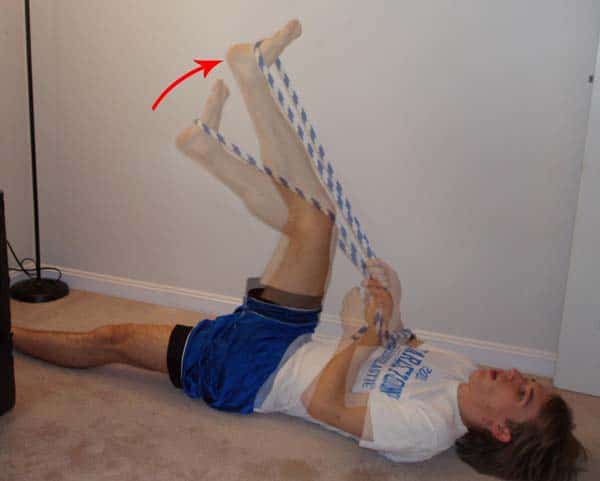
The straight-leg raise test can cause sciatica-like pain if you have piriformis syndrome, but might also indicate the presence of low back problems
Knees against resistance test
This test can be performed while sitting.
Attempt to push your knees out against resistance (provided by a partner or rope). If this causes pain, piriformis syndrome is likely.
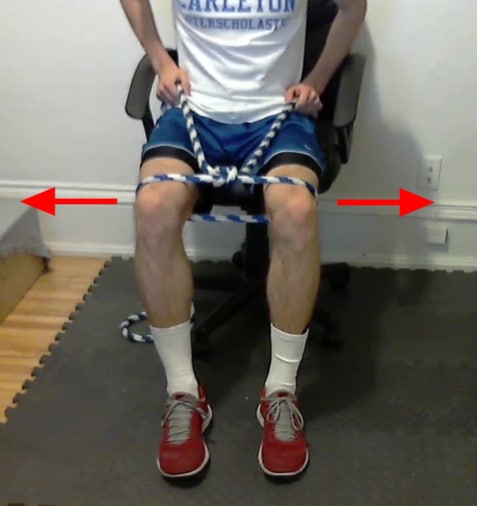
Pain might also occur if you attempt to abduct your hips from a sitting position against resistance provided by a partner or a rope.
Piriformis stretch test
Finally, two maneuvers which put a stretch on the piriformis muscle can also be used to test for piriformis pain.
Having a partner rotate your hip and leg inwards while you lie on your back with your knees straight can produce pain, as can lying on your unaffected side and rotating the painful side across your body with your knee bent.
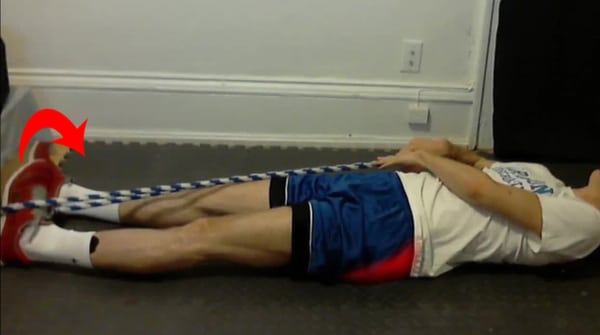
One test which can produce piriformis-specific pain is a supine internal leg rotation, assisted by either by a partner or a rope, as illustrated here.
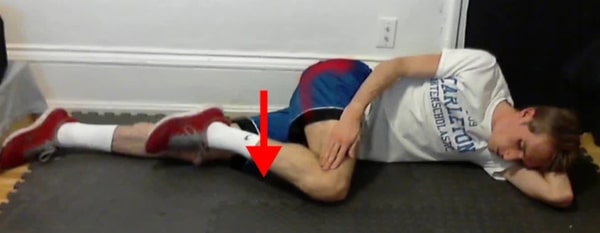
Stretching the piriformis in this position can elicit pain (red area) if you have piriformis syndrome
Though these piriformis-specific tests can help confirm the presence of piriformis syndrome, they are not accurate enough to rule it out.
But here’s the kicker
Hopayian et al.’s review study found no one technique to be reliable or accurate enough to endorse; rather, they cited the more general symptom of aggravation or modulation of piriformis pain when you stretch or tension the piriformis muscle.
You might also be able to feel a thickening in the piriformis muscle itself, deep within your glutes, but this is also not enough by itself to definitively diagnose piriformis syndrome.
Differential Diagnosis
The differential diagnosis includes: [11]
-
Hamstring injury
-
Lumbosacral disc injuries
-
Lumbosacral discogenic pain syndrome
-
Lumbosacral facet syndrome
-
Lumbosacral radiculopathy
-
Lumbosacral spine sprain
-
Lumbosacral spondylolisthesis
-
Lumbosacral spondylolysis
-
Sacroiliac joint injury/dysfunction
-
Inferior gluteal artery aneurysm or pseudoaneurysm
-
Malignancy/tumors
-
Arteriovenous malformations
References
- https://www.ncbi.nlm.nih.gov/pubmed/19011229
- https://www.ncbi.nlm.nih.gov/books/NBK448172/
- https://www.ncbi.nlm.nih.gov/pmc/articles/PMC2997212/
- https://www.ncbi.nlm.nih.gov/pubmed/19466717
- https://www.ncbi.nlm.nih.gov/pmc/articles/PMC5843966/
- https://www.sciencedirect.com/science/article/pii/S106018720400067X
- https://www.sciencedirect.com/topics/neuroscience/piriformis-muscle
- https://en.wikipedia.org/wiki/Piriformis_syndrome
- https://en.wikipedia.org/wiki/Piriformis_muscle
- https://physioworks.com.au/injuries-conditions-1/piriformis-syndrome
- https://www.webmd.com/pain-management/guide/piriformis-syndrome-causes-symptoms-treatments
- https://books.google.com/books/about/Sacroiliac_Joint_Dysfunction_and_Pirifor.html?
- https://books.google.com/books/about/Sciatica_Piriformis_Syndrome.html?id=CN_RlAEACAAJ
- https://www.medicinenet.com/piriformis_syndrome/article.htm
- https://link.springer.com/chapter/10.1007/978-3-319-50512-1_51
- https://www.sciencedaily.com/releases/2005/02/050201192443.htm

