
Treatment Exercise of piriformis syndrome is a neuromuscular condition characterized by hip and buttock pain. This syndrome is often overlooked in clinical settings because its presentation may be similar to that of lumbar radiculopathy, primary sacral dysfunction, or innominate dysfunction. The ability to recognize piriformis syndrome requires an understanding of the structure and function of the piriformis muscle and its relationship to the sciatic nerve. The authors review the anatomic and clinical features of this condition, summarizing the osteopathic medical approach to diagnosis and management. A holistic approach to diagnosis requires a thorough neurologic history and physical assessment of the patient based on the pathologic characteristics of piriformis syndrome. The authors note that several nonpharmacologic therapies, including osteopathic manipulative treatment, can be used alone or in conjunction with pharmacotherapeutic options in the management of piriformis syndrome.[Rx]
Treatment of Piriformis Syndrome
Clinical treatment options include
- Botox injections that can reduce muscle spasms and relieve pain.
- Prescription pain medications or muscle relaxants. A person should discuss the risks and benefits of pain medication with their doctor, as these drugs can be addictive.
- Corticosteroid or anesthetic injections.
- Alternative treatments, such as acupuncture, chiropractic manipulation, and trigger point therapy.
- Physical therapy to regain use of the piriformis, and to prevent wasting related to disuse and dysfunction in surrounding muscles.
Physiotherapy
- Stretching exercises and massage,
- Avoidance of contributory activities as noted before
- Stretching exercises
- Local ice/heat
- Custom foot orthotics
- Gait correction
- Ultrasound to provide deeper heat
- Injections – steroids, botulinum toxin, lidocaine
- Surgery.
The best piriformis stretch (that actually works!)
This is exactly what is accomplished in the stretches recommended by Douglas Keskula and Michael Tamburello in a 1992 article on treatments for piriformis syndrome.
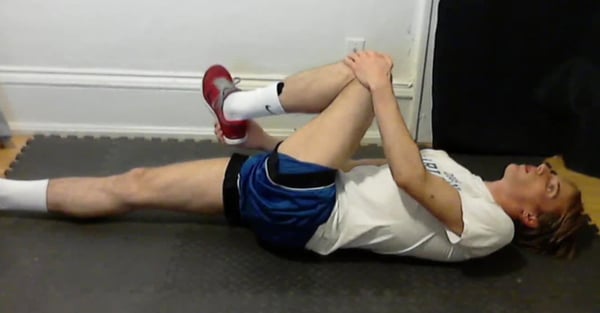
Supine piriformis stretch with a crossover (moving left knee towards right shoulder)
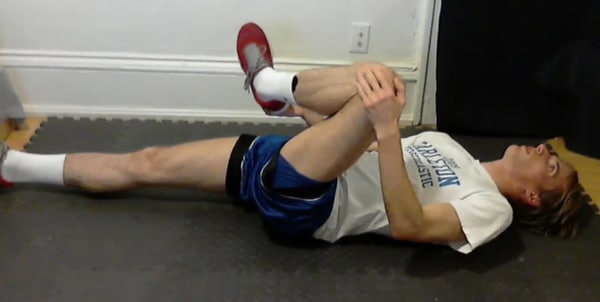 ,
,
Supine piriformis stretch without a crossover (moving heel towards right shoulder)
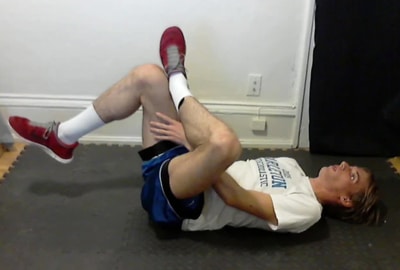
Supine piriformis stretch assisted by opposite leg (moving right knee towards right
You should be gentle with the stretches, not overly aggressive—this may put too much stress on the already-irritated piriformis.
Piriformis exercises
Strengthening exercises are also recommended in several different scientific papers.
As the piriformis works as an abductor and rotator of the hip, strengthening both the piriformis itself and the other hip muscles that surround it is a primary goal of treatment.
RunnersConnect Insider Bonus
Download our full Piriformis Prevention Routine inside your Insider Members area.
It’s a PDF with images and descriptions of the 10 most effective prevention and rehab exercises for runners with Piriformis issues.
Click here to access
Not a RunnersConnect Insider member? It’s FREE to join. Click here to get your guide and get started free
A 2010 case report by Jason Tonley and a group of fellow physical therapists describes in detail a strengthening protocol used to successfully treat piriformis syndrome in a 30-year-old recreational athlete who displayed many of the classic signs of poor hip muscle coordination: inward knee rotation during single-leg squats and poor hip abduction and external rotation strength.
To address this, the authors prescribed a 14-week, three-step program for hip muscle rehabilitation.
- The first phase consisted only of glute bridges and clamshell leg lifts, both using a theraband for resistance.
- After four weeks, the patient progressed to weight-bearing exercises: standing mini-squats (with a theraband), “monster walk” side steps (also with a band), a “sit-to-stand” exercise, and single-leg mini-squats.
- Following four weeks of the second phase, the patient progressed to lunges, deep squats, and even plyometric-style hops and landings (with the intent to prepare him to return to basketball and tennis, his principle sports).
In all phases of rehab, the patient progressed over time to three sets of fifteen repeats of each exercise.
These are the piriformis stretches I have been looking for! Great detail!CLICK TO TWEET
A similar program designed for runners is illustrated below. Start gradually, but build up over time to three sets of 15 repeats of each exercise.
Phase I: Four weeks
a. Clamshell exercise, adding resistance with theraband
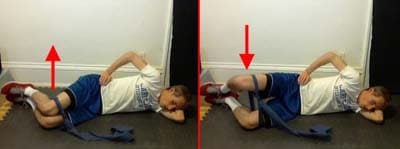
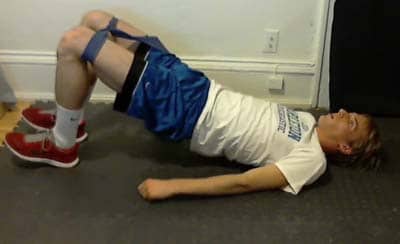
b. Glute bridge with theraband (hold, for up to two minutes)
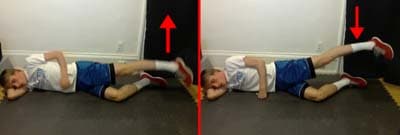
c. Side leg lift
Phase II: Four weeks
Do all Phase I exercises, and add the following:
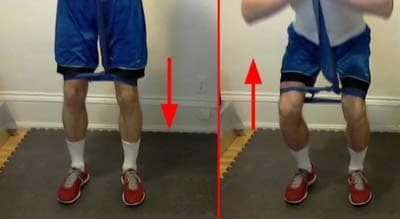
a. Standing mini-squats with a theraband
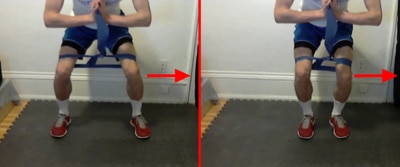
b. “Monster walk” side steps (continuously moving in one direction, then moving back the other), also with a band
c. Single-leg “sit-to-stand” from chair
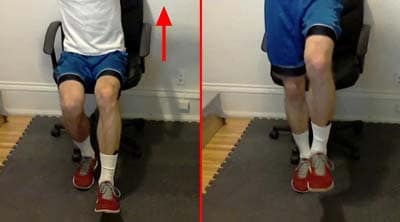
d. Single-leg mini-squats off a step
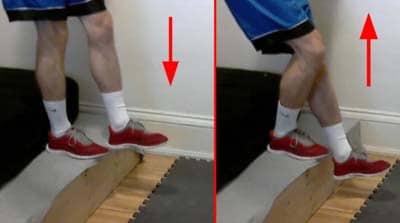
Phase III: 6 weeks.
Do all phase I and II exercises, and add the following:
a. Front and diagonal lunges
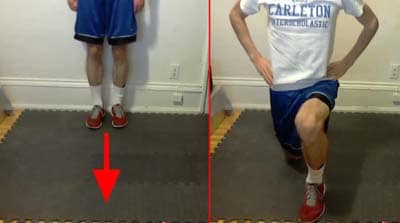
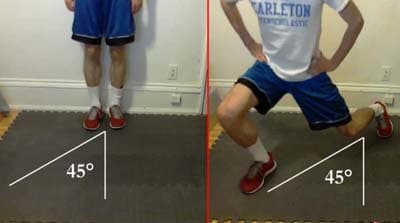
While the rehab program in Conley et al. was immensely successful with their patient, a case report obviously isn’t as useful as a randomized clinical trial.
It’s unclear how useful this program would be for other athletes with piriformis syndrome, but given the lack of high-quality studies, and the dearth of research on treatments specifically for athletes, Conley et al.’s program is still a pretty good place to start.
Consider this:
Combining these strength exercises with the stretches described above should address both muscle weakness and tightness.
These stretches and exercises were just what I needed for my piriformis syndrome!
Other research on piriformis syndrome has focused on treatments for more stubborn cases.
Is this you?
Some isolated studies describe injections into the piriformis muscle, either of a local anesthetic like lidocaine or of a corticosteroid. Studies indicate that pain relief from injections is highly variable, with some patients experiencing long-lasting relief, and others getting none at all.
You won’t believe this:
Some newer trials have even investigated BOTOX injections (the muscle-paralyzing drug better-known for its use in cosmetic surgery) for treating recalcitrant piriformis syndrome.
Given how little is known about injectable treatments for piriformis syndrome, especially considering that none of the studies on this topic involved athletes, it’s hard to draw any concrete recommendations—these options are something you should discuss with your doctor.
Looking for a last resort?
Surgical release of the piriformis muscle has also been described in multiple papers as a last-resort treatment for piriformis syndrome. As with injectable treatments, studies on surgical patients invariably focus on sedentary people, often with additional existing back or spine problems, so it’s nearly impossible to extract any information useful to a runner. Again, talk to a trusted doctor if you are considering surgery.
RunnersConnect Insider Bonus
Download our full Piriformis Prevention Routine inside your Insider Members area.
It’s a PDF with images and descriptions of the 10 most effective prevention and rehab exercises for runners with
Not a RunnersConnect Insider member? It’s FREE to join. Click here to get started
Other Piriformis Syndrome Treatment Options
Though there’s not much in the literature about treating piriformis syndrome in runners, it occurs commonly enough for several “folk treatments” and workarounds to have emerged. Among these are:
- Having a massage or stretching out the piriformis muscle and reduce tightness. One way many runners do so is by rolling their glute muscles on a tennis ball or a lacrosse ball (perfectly shaped to put controlled pressure on the glute area).
- Deep tissue massage techniques are also popular, and they may well accomplish the same goal as the “myofascial release” massage techniques that are described in some case studies by physical therapists.
- Another popular method to address piriformis syndrome is to simply avoid doing things that irritate the piriformis muscle: prolonged sitting, in particular, can be very irritating, so modifying your routine so you don’t need to sit as often or for as long can be helpful.
- Standing desks are becoming more popular, and taking a short break every hour or so allows you to get your piriformis stretches in, too. If nothing else, experimenting with different sitting surfaces (harder, softer, flatter, or more contoured) might also reduce irritation.
- If you are still able to do some running, avoiding workouts or conditions which irritate your piriformis will also help—common culprits include high speeds, uphills and downhills, and tight turns.
Of course, it goes without saying that none of this is supported by scientific research, so you’ll have to experiment with what works for you and what does not.
Summary of treatment for piriformis syndrome
Conservative treatments
These are methods that are fairly simple, inexpensive, and can be done on your own at home.
Before jumping right into treatment, it is important to emphasize that these treatments have been developed specifically with piriformis syndrome in mind, not buttock or sciatic pain in general.
Remember
If you’re not sure whether you have piriformis syndrome, you should see a doctor to get a proper diagnosis. Other injuries which cause similar symptoms will require different treatments.
Stretching routine incorporating the following exercises.
Begin by stretching very gently, building up over time to three sets of 5-10 individual stretches, each held for five seconds. Over time, you can build up to 60 seconds for each stretch.
Supine piriformis stretch with a crossover
Supine piriformis stretch without a crossover
Supine piriformis stretch assisted by opposite leg
Hip strengthening exercises
Based on Conley et al.’s paper, with a few minor modifications to make the exercises more relevant for runners. Start gradually, but build up over time to three sets of 15 repeats of each exercise.
Phase I: four weeks
- Clamshell exercise, adding resistance with theraband
- Glute bridge with theraband (hold for up to two minutes)
- Side leg lift
Phase II: four weeks
Do all phase I exercises, and add the following:
- Standing mini-squats with a theraband
- “Monster walk” side steps, also with a band
- Single-leg “sit-to-stand” from the chair
- Single-leg mini-squats off a step
Phase III: 6 weeks.
Do all phase I and II exercises, and add the following:
- Front and diagonal lunges
Gentle daily rolling
Use a foam roller (making sure you do not make these 4 mistakes), tennis ball, or lacrosse ball to loosen up the piriformis muscle and glutes.
This article breaks piriformis syndrome into helpful phases, a must read!
Piriformis syndrome treatment for those who have tried everything else
These are treatments with more cost and less certainty about outcomes but may prove useful when you are fed up of your pain.
Working with a physical therapist to develop a specialized rehab program
Because the literature is so sparse on appropriate exercises for treating piriformis syndrome in runners, it might make sense to see a PT if your case is particularly troublesome or long-lasting.
That way, you can address any aspects of your own individual muscular tightness or weakness that might contribute to your injury
Active Release Technique or Graston Technique
These soft tissue mobilization exercises don’t have any support in the scientific literature but have been praised anecdotally by some, though not all, runners with piriformis syndrome.
Injections of a local anesthetic, corticosteroid, or BOTOX
If you have a recalcitrant case of piriformis syndrome that has not responded to many months of conservative rehab, you can talk to your doctor about an injectable treatment.
If all else fails, surgery is a final alternative. This is also something you should consult with a trusted doctor about.
Additional exercise
You may do all of these exercises right away.
- Gluteal stretch – Lie on your back with both knees bent. Rest the ankle on your injured side over the knee of your other leg. Grasp the thigh of the leg on the uninjured side and pull toward your chest. You will feel a stretch along the buttocks on the injured side and possibly along the outside of your hip. Hold the stretch for 15 to 30 seconds. Repeat 3 times.
- Standing hamstring stretch – Put the heel of the leg on your injured side on a stool about 15 inches high. Keep your leg straight. Lean forward, bending at the hips, until you feel a mild stretch in the back of your thigh. Make sure you don’t roll your shoulders or bend at the waist when doing this or you will stretch your lower back instead of your leg. Hold the stretch for 15 to 30 seconds. Repeat 3 times.
- Resisted hip abduction – Stand sideways near a door with your injured side further from the door. Tie elastic tubing around the ankle on your injured side. Knot the other end of the tubing and close the knot in the door near the floor. Pull the tubing out to the side, keeping your leg straight. Return to the starting position. Do 2 sets of 15. For more resistance, move farther away from the door.
- The plank – Lie on your stomach resting on our forearms. With your legs straight, lift your hips off the floor until they are in line with your shoulders. Support yourself on your forearms and toes. Hold this position for 15 seconds. (If this is too difficult, you can modify it by placing your knees on the floor.) Repeat 3 times. Work up to increase your hold time to 30 to 60 seconds.
- Side plank – Lie on your side with your legs, hips, and shoulders in a straight line. Prop yourself up onto your forearm with your elbow directly under your shoulder. Lift your hips off the floor and balance on your forearm and the outside of your foot. Try to hold this position for 15 seconds and then slowly lower your hip to the ground. Switch sides and repeat. Work up to holding for 1 minute. This exercise can be made easier by starting with your knees and hips flexed toward your chest.
- Prone hip extension with bent leg – Lie on your stomach with a pillow under your hips. Bend the knee on your injured side. Draw your belly button in towards your spine and tighten your abdominal muscles. Lift your bent leg off the floor about 6 inches (15 centimeters). Keep your other leg straight. Hold for 5 seconds. Then lower your leg and relax. Do 2 sets of 15.
- Clam exercise – Lie on your uninjured side with your hips and knees bent and feet together. Slowly raise your top leg toward the ceiling while keeping your heels touching each other. Hold for 2 seconds and lower slowly. Do 2 sets of 15 repetitions.
References
- https://www.ncbi.nlm.nih.gov/pubmed/19011229
- https://www.ncbi.nlm.nih.gov/books/NBK448172/
- https://www.ncbi.nlm.nih.gov/pmc/articles/PMC2997212/
- https://www.ncbi.nlm.nih.gov/pubmed/19466717
- https://www.ncbi.nlm.nih.gov/pmc/articles/PMC5843966/
- https://www.sciencedirect.com/science/article/pii/S106018720400067X
- https://www.sciencedirect.com/topics/neuroscience/piriformis-muscle
- https://en.wikipedia.org/wiki/Piriformis_syndrome
- https://en.wikipedia.org/wiki/Piriformis_muscle
- https://physioworks.com.au/injuries-conditions-1/piriformis-syndrome
- https://www.webmd.com/pain-management/guide/piriformis-syndrome-causes-symptoms-treatments
- https://books.google.com/books/about/Sacroiliac_Joint_Dysfunction_and_Pirifor.html?id=AL5QCwAAQBAJ
- https://books.google.com/books/about/Sciatica_Piriformis_Syndrome.html?id=CN_RlAEACAAJ
- https://www.medicinenet.com/piriformis_syndrome/article.htm
- https://link.springer.com/chapter/10.1007/978-3-319-50512-1_51
- https://www.sciencedaily.com/releases/2005/02/050201192443.htm

Explore this medical topic
Continue through verified related conditions, investigations, medicines, and patient guides. These links are educational and do not replace professional medical advice.
