
Trigger finger is a disorder characterized by catching or locking of the involved finger. Pain may occur in the palm of the hand or knuckles.The name is due to the popping sound made by the affected finger when moved. Most commonly the index finger or thumb is affected
Trigger finger is a “snapping” or “locking” condition of any of the digits of the hand when opened or closed. Trigger finger is medically termed stenosing tenosynovitis.
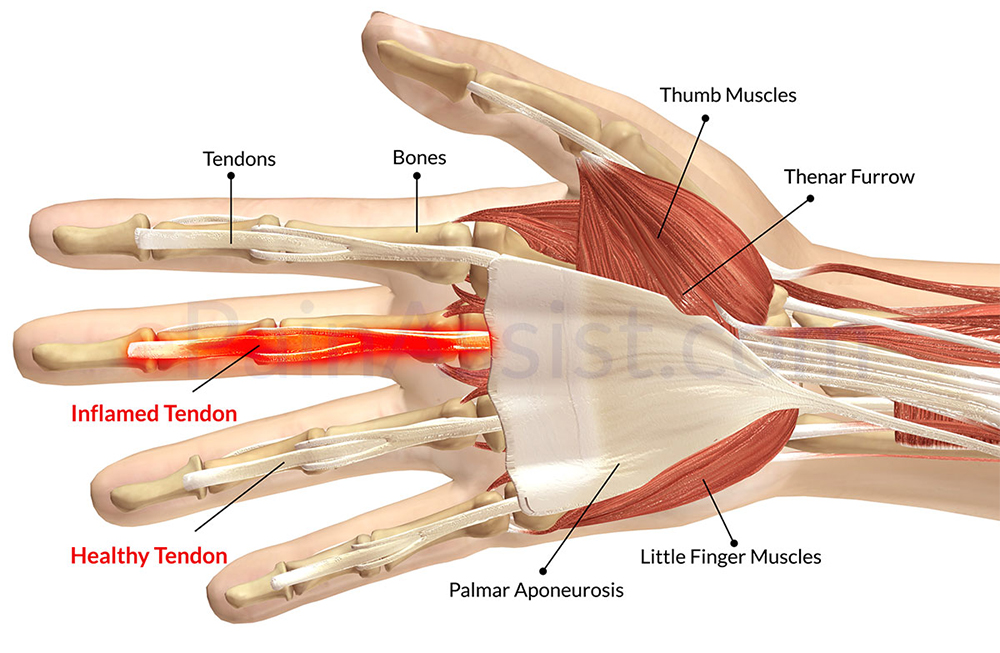
Trigger finger is a painful condition causing the fingers to catch or lock up when they are bent. This can also affect thumbs, called trigger thumb.
Trigger finger is usually due to inflammation of tendons connecting muscles andbones in the fingers or thumbs.
Tendons usually slide easily through their covering of tissue with a lubricating membrane surrounding the synovium joint.
However, this can become narrowed or swollen with inflammation so that bending the finger or thumb causes it to snap or pop.
The condition is also known as stenosing tenosynovitis or stenosing tenovaginosis
Alternative Names of Trigger Finger
Digital stenosing tenosynovitis; Trigger digit; Trigger finger release; Locked finger; Digital flexor tenosynovitis
Anatomy

Fingers
Tendon sheaths of the long flexors run from the level of the metacarpal heads (distal palmar crease, superficial; volar plate, deep) to the distal phalanges. They are attached to the underlying bones and volar plates, which prevent the tendons from bowstringing. Predictable and efficient thickenings in the fibrous flexor sheath act as pulleys, directing the sliding movements of the fingers.
The two types of pulleys are annular (A) and cruciate (C). Annular pulleys are composed of single fibrous bands (ie, rings), while cruciate pulleys have two crossing fibrous bands.
The order of the pulleys from proximal to distal is as follows:
-
The A1 pulley overlies the metacarpophalangeal (MCP) joints; it is released during surgery for TF (see the image below)
-
The A2 pulley overlies the proximal end of the proximal phalanx
-
The C1 pulley overlies the middle of the proximal phalanx
-
The A3 pulley lies over the proximal interphalangeal (PIP) joint
-
The C2 pulley lies over the proximal end of the middle phalanx
-
The A4 pulley lies over the middle of the middle phalanx
-
The C3 pulley lies over the distal end of the middle phalanx
-
The A5 pulley lies over the proximal end of the distal phalanx
Flexor tendons pass within tendon sheath and beneath A1 pulley at approximately metacarpal head, beyond which they travel into digit.
The A2 and A4 pulleys are vital in preventing bowstringing of the flexor tendons and must be preserved or reconstructed after any damage to them.
Thumb
The flexor anatomy of the thumb differs from that of the fingers. The flexor pollicis longus (FPL) tendon is a single tendon within the flexor sheath that inserts onto the base of the distal phalanx. The fibro-osseous sheath is composed of two annular pulleys (A1 and A2) that arise from the palmar plates of the MCP and interphalangeal (IP) joints, respectively. The oblique pulley, which originates from and inserts onto the proximal phalanx, is the most important pulley from a biomechanical perspective. The oblique pulley is approximately 10 mm in length, blending with a portion of the adductor pollicis insertion.
The digital nerves and arteries run parallel to the tendon sheath distally. At the level of the MCP flexion crease, they lie just deep to the skin. Proximal to the A1 pulley, the radial digital nerve of the thumb crosses obliquely over the sheath.
Epidemiology/Etiology
Trigger finger can occur in anyone, but, statistically women in their fifth to sixth decade of life are more likely to develop the condition than men and nearly six times more frequently. The chance of developing trigger finger is 2-3%, but in the diabetic population, it rises to 10%. The reason is not of glycemic nature, but rather is the actual cause of the duration and progression of the disease. Trigger finger can concomitantly occur in patients with:
- Carpal tunnel syndrome
- DeQuervain’s disease
- Hypothyroidism
- Rheumatoid arthritis
- Renal disease
- Amyloidosis
There have been many potential causes of trigger finger discussed throughout the literature. However, there is little to no evidence on the precise etiology. Occupational-related causes of trigger finger have been proposed, but the research linking the two is very inconsistent. Authors suggest that trigger finger can manifest from any activity requiring prolonged forceful finger flexion (i.e., carrying shopping bags or a briefcase, prolonged writing, rock climbing, or the strenuous grasping of small tools). It is important to consider that the cause of trigger finger is often times multifactorial in nature.
Causes of Trigger Finger
Often, the cause of trigger finger is unknown. However, many case of trigger finger are caused by one of the following:
Overuse of the hand from repetitive motions:
- Computer operation
- Machine operation
- Repeated use of hand tools
- Playing musical instruments
Inflammation caused by or associated with a disease
- Rheumatoid arthritis
- Gout
- Hypothyroidism
- Diabetes
Symptoms of Trigger Finger
Signs and symptoms of TF are as follows:
-
Locking or catching during active flexion-extension activity (passive manipulation may be needed to extend the digit in the later stages)
-
Stiff digit, especially in long-standing or neglected cases
-
Pain over the distal palm
-
Pain radiating along the digit
-
Triggering on active or passive extension by the patient
-
Palpable snapping sensation or crepitus over the A1 pulley
-
Tenderness over the A1 pulley
-
Palpable nodule in the line of the flexor digitorum superficialis (FDS), just distal to the metacarpophalangeal (MCP) joint in the palm
-
Fixed-flexion deformity in late presentations, especially in the proximal interphalangeal (PIP) joint
-
Evidence of associated conditions (eg, rheumatoid arthritis [RA], gout)
-
Early signs of triggering in other digits (may be bilateral)
Children with trigger thumb rarely complain of pain. They usually are brought in for evaluation when aged 1-4 years, when the parent first notices a flexed posture of the thumb’s interphalangeal (IP) joint. These children often demonstrate bilateral fixed flexion contractures of the thumb by the time they present to the physician. By the time the child presents to the clinic, surgical treatment is already indicated in most instances.
Diagnosis of Trigger Finger
The main characteristic of trigger finger is a popping and/or catching with movement of the digit. However, this characteristic is not unique to just trigger finger. Other etiologies associated with a locking digit include:
- Dupuytren’s contracture
- Focal dystonia
- Flexor tendon/sheath tumor
- Sesamoid bone anomalies
- Post-traumatic tendon entrapment on the metacarpal head
- Hysteria
Complaints of pain at the MCP joint could be associated with any of the following:
- DeQuervain’s (for trigger thumb only)
- Ulnar collateral ligament injury/Gamekeeper’s thumb
- MCP joint sprain
- Extensor apparatus injury
- MCP joint osteoarthritis
Diagnosis of trigger finger can be confirmed with the injection of lidocaine into the flexor sheath, which should relieve pain and allow flexion/extension of the joint. Imaging is not typically indicated, but ultrasound and MRI may be used to help diagnose other etiologies.
Outcome Measures
- Numeric Pain Rating Scale
- Grip Strength (Jamar dynameter)
- DASH Outcome Measure
- Stages of Stenosing Tenosynovitis
- Participant Perceive Improvement in Symptoms
- Open & Close Hand 10 Times
Stages of Stenosing Tenosynovitis (SST) > Stage of Symptoms
1 = Normal
2 = A painful palpable nodule
3 = Triggering
4 = The proximal interphalangeal (PIP) joint locks into flexion and is unlocked with active PIP joint extension
5 = The PIP joint locks and is unlocked with passive PIP joint extension
6 = The PIP joint remains locked in a flexed position
Participant Perceived Improvement in Symptoms Scale
1 = Resolved
2 = Improved, but not completely resolved
3 = Not resolved
4 = Resolved, but triggering at the distal interphalangeal/proximal interphalangeal joint(s)
5 = Resolved at ten weeks versus six weeks
Patient is to actively make ten fists. The number of triggering events in ten active full fists is then scored out of 10. If patient’s finger remains locked at any time, the test is completed and an automatic score of 10/10 is recorded.
Examination
Hx
- Recent trauma
- Job related repetitive movements
- Locking or snapping while flexing or extending the affected digit
- Radiating pain to the palm or digits
PMH
- Diabetic individuals are 4x more likely to develop trigger finger
- Disorders causing connective tissue changes such as RA and Gout
Observation
- A digit locked in flexion
- Bony proliferative changes in the subadjacent PIP joint
Palpation
- Painful nodule in the palmar MCP secondary to intratendinous swelling
ROM
- Loss of motion, particularly in extension
MMT
- Flexor Digitorum Profundus
- Flexor Digitorum Superficialis
- Grip strength using the Jamar Dynameter
Note: If the finger is locked, testing may not be possible.
Joint Accessory Mobility
- PIP, MCP, DIP, and CMC of all affected digits
- Surrounding tissues
- Wrist joint
Treating trigger finger
The treatment for trigger finger depends on the severity of your symptoms and how long you’ve had them. Sometimes, trigger finger gets better without treatment, so your GP may recommend avoiding activities that cause the pain to see if this helps relieve your symptoms. Non-steroidal anti-inflammatory drugs (NSAIDs), such as ibuprofen, may also be helpful in relieving any pain.
Splinting
- The goal of splinting is to prevent the friction caused by the flexor tendon movement through the affected A1 pulley until the inflammation there resolves [rx]. It is generally considered that splinting is an appropriate treatment option in patients who refuse or wish to avoid corticosteroid injection. A study of manual workers with distal interphalangeal (DIP) joint splints in full extension for 6 weeks demonstrated abatement of symptoms in over 50% of the patients [rx].
- In another study, splints of the MCP joint at 15 degrees of flexion (leaving the PIP and DIP joints free) were shown to provide resolution of symptoms in 65% of patients at 1-year follow-up [rx]. For patients who are most bothered by symptoms of locking in the morning, splinting the PIP joint at night can be effective. Splinting yields lower success rates in patients with severe triggering or longstanding duration of symptoms.
Corticosteroid injection
- Injection of corticosteroids for treatment of trigger finger was described as early as 1953 [rx]. It should be attempted before surgical intervention as it is very efficacious (up to 93%) [rx], especially in non-diabetic patients with recent onset of symptoms and one affected digit with a palpable nodule [rx].
- It is believed that corticosteroid injection is less successful in patients with longstanding disease (>6 months duration), diabetes mellitus, and multiple digit involvement as it is unable to reverse the changes of chondroid metaplasia that take place at the A1 pulley. The injection is traditionally given directly into the sheath, however, reports of extrasynovial injection show that it may be as effective while reducing the risk of tendon damage [rx, rx]
Surgery
Surgery may be recommended if the above treatments don’t work or are unsuitable. The surgeon will cut through the affected section of the tendon sheath so that your tendon can move freely again.
Whether surgery is recommended will depend on considerations such as the amount of pain you’re in, whether it’s associated with other medical problems, such as rheumatoid arthritis, and how much it’s affecting your life.
In most cases, trigger finger is a nuisance rather than a serious condition. However, if it isn’t treated, the affected finger or thumb may become permanently stuck in a bent position or, less commonly, in a straightened position. This can make carrying out everyday tasks difficult.
Surgery for trigger finger is effective and it’s rare for the problem to return in the treated finger or thumb. However, you may need to take some time off work and there’s a risk of complications (see below).
The operation takes around 20 minutes, and you won’t need to stay in hospital overnight. The procedure is usually carried out under local anaesthetic, so you’ll be awake but unable to feel any pain in your hand.
The two types of surgery for trigger finger are:
- open trigger finger release surgery
- percutaneous trigger finger release surgery
If you have rheumatoid arthritis, these types of surgery may not be recommended because they can cause your finger to drift sideways. Instead, a procedure known as a tenosynovectomy may be necessary. This involves removing part of the tendon sheath to allow the tendon to move again.
Open trigger finger release surgery
If you have open trigger finger release surgery, the surgeon will give you an injection of local anaesthetic into the palm of your hand.
A small incision will be made in the palm of your hand along one of the natural creases, which may mean the scar will be less noticeable. The surgeon will carefully cut through the tendon sheath to make it wider. The wound will then be closed with stitches and covered with a light bandage.
Percutaneous trigger finger release surgery
Percutaneous means ‘through the skin’. As with open surgery, the surgeon will inject your hand with a local anaesthetic. However, instead of making an incision in your palm, a needle will be inserted into the base of the affected finger and used to slice through the ligament to get to the tendon.
As percutaneous surgery doesn’t involve making an incision, you won’t have a wound or scar. However, the procedure is slightly more risky than open surgery and may be less effective at resolving the problem. Important nerves and arteries are very close to the tendon sheath and can easily be damaged. For this reason, open surgery is usually the preferred method.
Recovering from surgery
After the procedure, you should be able to move your finger straight away. The dressings can usually be removed after a few days to make movement easier, and full movement should return within a week or two.
If you’ve had open surgery, your palm may feel sore immediately after the procedure, but any discomfort should pass within two weeks.
You can start driving again as soon as you feel it’s safe for you to drive, which is usually after three to five days. You may be able to write and use a computer immediately.
You can play sports after around two or three weeks, once your wound has healed and you can grip again.
When you can return to work will depend on your job. If you have a desk job or a role that involves light manual duties, you may not need any time off work. If your job involves manual labour, you may need up to four weeks off.
If you’ve had surgery on more than one finger, your recovery period may be longer.
If you’ve had percutaneous surgery rather than open trigger finger release surgery, your recovery period may be shorter because you won’t have a wound on your palm.
Caring for your wound
If you’ve had open surgery, your surgeon should advise you about how to care for the wound in your palm. Washing it with mild soap and warm water is usually all that’s required.
If you have stitches, you’ll be told if you need to return to hospital to have them removed. Some stitches are dissolvable and will disappear on their own in around three weeks.
After your wound has healed, you may be left with a small scar running along your palm, where the incision was made. Read more about scars.
Hand therapy
If your finger was quite stiff before surgery, you may need specialised hand therapy after your operation to loosen it. Discuss this with your surgeon before the operation. The types of therapy you may need include:
- physiotherapy – where manipulation, massage and exercises are used to improve the movement and function of your hand
- occupational therapy – if you’re struggling with everyday tasks and activities, either at work or at home, an occupational therapist will be able to give you practical support to make those tasks easier
Complications of surgery
Trigger finger release surgery is a safe procedure. However, as with any type of surgery, there are some risks. Complications are rare, but could include:
- infection
- stiffness or pain in the finger
- a tender scar
- nerve damage (if a nerve is damaged during surgery, you may never recover the full sensation in the affected area)
- tendon bowstringing, where the tendon is in the wrong position
- complex regional pain syndrome (CRPS), which causes pain and swelling in your hand after surgery – this usually resolves itself after a few months, but there can be permanent problems
References

Explore this medical topic
Continue through verified related conditions, investigations, medicines, and patient guides. These links are educational and do not replace professional medical advice.
