Pronation Muscles of Anterior Forearm Deep Layer

Patient Tools

Read, save, and share this guide

Use these quick tools to make this medical article easier to read, print, save, or share with a family member.

Article Summary

Pronation Muscles of Anterior Forearm Deep Layer/The muscles are largely involved with flexion and pronation. The superficial muscles have their origin on the common flexor tendon. The ulnar nerve and artery are also contained within this compartment. The flexor digitorum superficialis lies in between the other four muscles of the superficial group and the three muscles of the deep group. This is why it is also classified as an intermediate group. Muscles of...

Key Takeaways

  • This article explains Surgical Considerations in simple medical language.
Educational health guideWritten for patient understanding and clinical awareness.
Reviewed content workflowUse writer and reviewer profiles for stronger trust.
Emergency safety firstUrgent warning signs are highlighted below.

Seek urgent medical care if you notice

These warning signs are general safety guidance. Local emergency numbers and clinical judgment should always come first.

  • Severe symptoms, breathing difficulty, fainting, confusion, or rapidly worsening illness.
  • New weakness, severe pain, high fever, or symptoms after a serious injury.
  • Any symptom that feels urgent, unusual, or unsafe for the patient.
1

Emergency now

Use emergency care for severe, sudden, rapidly worsening, or life-threatening symptoms.

2

See a doctor

Book a professional medical evaluation if symptoms persist, worsen, recur often, affect daily activities, or occur in a high-risk patient.

3

Learn safely

Use this article to understand possible causes, tests, treatment options, prevention, and questions to ask your clinician.

Pronation Muscles of Anterior Forearm Deep Layer/The muscles are largely involved with flexion and pronation. The superficial muscles have their origin on the common flexor tendon. The ulnar nerve and artery are also contained within this compartment. The flexor digitorum superficialis lies in between the other four muscles of the superficial group and the three muscles of the deep group. This is why it is also classified as an intermediate group.
Pronation Muscles of Anterior Forearm Deep Layer

Muscles of Anterior Compartment of Forearm (Flexors of Forearm)

Superficial layer

Pronator teres

  • Function: Pronation of radio-ulnar joint
  • Origin: Coronoid process and medial epicondyle of humerus
  • Insertion: Lateral surface of the radius
  • Innervation: Median nerve (C6, C7)

Flexor carpi radialis

  • Function: Flexion and adduction at the wrist
  • Origin: Medial epicondyle of humerus
  • Insertion: Base of second metacarpal
  • Innervation: Median nerve (C6, C7)

Palmaris longus

  • Function: Flexion at the wrist, tensing of the palmar aponeurosis
  • Origin: Medial epicondyle of humerus
  • Insertion: Flexor retinaculum
  • Innervation: Median nerve (C7, C8)

Flexor carpi ulnaris

  • Function: Flexion and adduction at the wrist
  • Origin: Medial epicondyle of humerus and olecranon
  • Insertion: Pisiform, hook of hamate and fifth metacarpal
  • Innervation: Median nerve (C7, C8)

Intermediate Layer

Flexor digitorum superficialis 

  • Function: Flexion of the proximal interphalangeal joint of the second, third, fourth, and fifth finger. Also has a weaker flexion action on the metacarpophalangeal joints of the same fingers
  • Origin: Medial epicondyle, coronoid process, and anterior radius
  • Insertion: Second, third, fourth, and fifth middle phalanges
  • Innervation: Median nerve (C7, C8, T1)

Deep Layer

Flexor digitorum profundus

  • Function: Flexion of the distal interphalangeal joint of the second, third, fourth, and fifth finger
  • Origin: Medial and the anterior surface of the proximal ulna and interosseous membrane
  • Insertion: Second, third, fourth, and fifth distal phalanges
  • Innervation: Ulnar nerve (C8, T1) for the medial part, anterior interosseous nerve (C8,T1) for the lateral

Flexor pollicis longus

  • Function: Flexion of the interphalangeal joint of the thumb
  • Origin: Anterior aspect of radius as well as interosseous membrane
  • Insertion: Base of distal phalanx of thumb
  • Innervation: Anterior interosseous nerve (C7, C8)

Pronator quadratus

  • Function: Pronator of the forearm
  • Origin: Anterior aspect of distal ulna
  • Insertion: Anterior aspect of the distal radius
  • Innervation: Anterior interosseous nerve (C7, C8)

Brachioradialis

  • Function: Weak flexor of the forearm
  • Origin: Proximal supracondylar ridge on the humerus
  • Insertion: Lateral surface of the distal end of radius
  • Innervation: Radial nerve (C5, C6, C7)

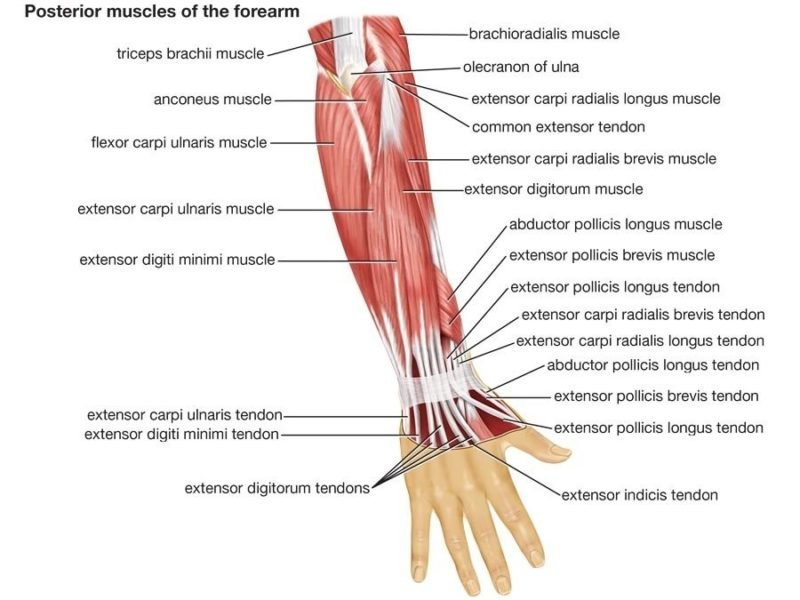
Muscles of Posterior Compartment of Forearm

Superficial

Extensor carpi radialis longus

  • Function: Extension and abduction of the wrist
  • Origin: Proximal supracondylar ridge on the humerus
  • Insertion: Dorsal base of the second metacarpal
  • Innervation: Radial nerve (C6, C7)

Extensor carpi radialis brevis 

  • Function: Extension and abduction of the wrist
  • Origin: Lateral epicondyle of humerus
  • Insertion: Dorsal base of the third metacarpal
  • Innervation: Deep branch of the radial nerve (C7, C8)

Extensor digitorum

  • Function: Extension of the proximal interphalangeal joint of the second, third, fourth, and fifth fingers. Also has a weaker extension action on the metacarpophalangeal joints of the same fingers
  • Origin: Lateral epicondyle of humerus
  • Insertion: Extensor expansions on the dorsal aspect of second, third, fourth, and fifth middle and distal phalanges
  • Innervation: Posterior interosseous nerve (C7, C8)

Extensor digit minimi

  • Function: Extension of the little finger at the metacarpophalangeal joint and interphalangeal joint
  • Origin: Lateral epicondyle of humerus
  • Insertion: Extensor expansion on the dorsal aspect of fifth phalanx
  • Innervation: Posterior interosseous nerve (C7, C8)

Extensor carpi ulnaris

  • Function: Extension and adduction of the wrist
  • Origin: Lateral epicondyle of the humerus and posterior ulna
  • Insertion: Fifth metacarpal base
  • Innervation: Posterior interosseous nerve (C7, C8)

Deep Layer

Extensor indices

  • Function: Extension of the index finger
  • Origin: Dorsal surface of distal ulna and interosseous membrane
  • Insertion: Extensor expansion of second finger
  • Innervation: Posterior interosseous nerve (C7, C8)

Supinator 

  • Function: Supination of the forearm
  • Origin: Lateral epicondyle and supinator crest of ulna
  • Insertion: Lateral surface of radius
  • Innervation: Deep branch of radial nerve (C7, C8)

Abductor policies longus 

  • Function: Abduction of the thumb by acting on the carpometacarpal joint and the metacarpophalangeal joint
  • Origin: Dorsal aspects of the proximal radius, ulna, and interosseous membrane
  • Insertion: Base of the first metacarpal
  • Innervation: Posterior interosseous nerve (C7, C8)

Extensor pollicus longus 

  • Function: Extension of the thumb by acting on the carpometacarpal joint, the metacarpophalangeal joint, and the interphalangeal joint.
  • Origin: Dorsal aspects of the middle ulna and interosseous membrane
  • Insertion: Distal phalanx of 1st finger
  • Innervation: Posterior interosseous nerve (C7, C8)

Extensor pollicus brevis

  • Function: Extension of the thumb by acting on the carpometacarpal joint and the metacarpophalangeal joint
  • Origin: Dorsal aspects of middle radius and interosseous membrane
  • Insertion: Distal phalanx of 1st finger
  • innervation: Posterior interosseous nerve (C7, C8)

Intrinsic Muscles of Hand

Thenar muscles

Opponents policies 

  • Function: Opposition of the thumb
  • Origin: Flexor retinaculum  and tubercle of trapezium
  • Insertion: Lateral aspect of first metacarpal
  • Innervation: Recurrent branch of median nerve (C8, T1)

Abductor policies Brevis

  • Function: Abduction of the thumb at the metacarpophalangeal joint
  • Origin: Flexor retinaculum  and tubercle of scaphoid
  • Insertion: Lateral aspect of proximal phalanx of first finger
  • Innervation: Recurrent branch of median nerve (C8, T1)

Flexor pollicus brevis 

  • Function: Flexion of the thumb at the metacarpophalangeal joint
  • Origin: Flexor retinaculum  and tubercle of trapezium
  • Insertion: Lateral aspect of proximal phalanx of first finger
  • Innervation: Recurrent branch of median nerve (C8, T1)

Adductor Compartment

Adductor pollicus 

  • Function: Adduction of the thumb
  • Origin: Second, third metacarpal, and capitate
  • Insertion: Proximal phalanx and extensor expansion of 1st finger
  • Innervation: Deep branch of ulnar nerve (C8, T1)

Hypothenar Muscles

Abductor digiti minimi

  • Function: Abduction of the little finger at the metacarpophalangeal joint
  • Origin: Pisiform
  • Insertion: Medial aspect of proximal phalanx of fifth finger
  • Innervation: Deep branch of ulnar nerve (C8, T1)

Flexor digiti minimi brevis

  • Function: Flexion of the little finger at the metacarpophalangeal joint
  • Origin: Flexor retinaculum and hook of hamate
  • Insertion: Medial aspect of proximal phalanx of fifth finger
  • Innervation: Deep branch of ulnar nerve (C8, T1)

Opponens digiti minimi

  • Function: Opposition of the little finger
  • Origin: Flexor retinaculum and hook of hamate
  • Insertion: Medial aspect of fifth metacarpal
  • Innervation: Deep branch of ulnar nerve (C8, T1)

Short Muscles

Lubricants 

  • Function: Flexion of the metacarpophalangeal joints with extension of the interphalangeal joints
  • Origin: Arise from tendons of flexor digitorum profundus. First 2 are unipennate, and the third and fourth are bipennate
  • Insertion: Extensor expansions of second, third, fourth, and fifth finger
  • Innervation: Median nerve (C8, T1) for the lateral 2 lumbricals, deep branch of ulnar nerve (C8, T1) for the medial 2 lumbricals

Dorsal interossei 

  • Function: Abduction of the second, third, and fourth finger away from the axial line
  • Origin: Adjacent metacarpals
  • Insertion: Extensor expansions and proximal phalanges of the second, third, and fourth fingers
  • Innervation: Deep branch of ulnar nerve (C8, T1)

Palmar interossei

  • Function: Adduction of the second, third, and fourth finger towards the axial line
  • Origin: Palmar surfaces of second, fourth, and fifth metacarpals
  • Insertion: Extensor expansions and proximal phalanges of the second, fourth, and fifth fingers
  • Innervation: Deep branch of ulnar nerve (C8, T1)

Surgical Considerations

The deltoid is a significant factor when considering the anterior surgical approach to gain access to the shoulder joint.  Some of these technical procedures include, but are not limited to the following:

  • Open Bankart repair/capsular reconstructions – indicated in the setting of recurrent anterior (or other directional) instability of the shoulder
  • Shoulder arthroplasty – indicated for cases of post-traumatic deformity, advanced degenerative pain, swelling, stiffness, or reduced movement. সহজ বাংলা: জয়েন্টের প্রদাহ।" data-rx-term="arthritis" data-rx-definition="Arthritis means joint inflammation causing pain, swelling, stiffness, or reduced movement. সহজ বাংলা: জয়েন্টের প্রদাহ।">arthritis, and/or avascular necrosis includes hemiarthroplasty, total shoulder arthroplasty (TSA), reverse total shoulder arthroplasty (TSA)
  • The long head of the biceps tendon (LHBT) – repair versus tenotomy versus tenodesis procedures  indicated in the setting of either LHBT/bicipital groove instability or advanced/end-stage LHBT tendinopathy and degeneration
  • Rotator cuff repair contemporary –  indications remain somewhat controversial although most of these procedures are now being performed arthroscopically popular approaches (as opposed to the deltopectoral approach) include the mini-open approach (lateral deltoid-splitting approach)

References


Patient safety assistant

Check your symptom safely

Hi, I am RX Symptom Navigator. I can help you understand what to read next and what warning signs need care.
Warning: Do not use this in emergencies, pregnancy, severe illness, or as a substitute for a doctor. For children or teens, use with a parent/guardian and clinician.
A rural-friendly guide: warning signs, when to see a doctor, related articles, tests to discuss, and OTC safety education.
1 Symptom 2 Severity 3 Safe guidance
First safety question

Is there chest pain, breathing trouble, fainting, confusion, severe bleeding, stroke-like weakness, severe injury, or pregnancy danger sign?

Choose quickly

Browse by body area
Start here: Write or select a symptom. The guide will show warning signs, doctor guidance, diagnostic tests to discuss, OTC safety education, and related RX articles.

Important: This tool is educational only. It cannot diagnose, treat, or replace a doctor. OTC information is not a prescription. In an emergency, contact local emergency services or go to the nearest hospital.

Doctor visit helper

Prepare before seeing a doctor

A simple rural-patient checklist to help you explain symptoms clearly, ask better questions, and avoid unsafe self-treatment.

Safety note: This is not a prescription or diagnosis. For severe symptoms, pregnancy danger signs, children with serious illness, chest pain, breathing difficulty, stroke-like weakness, or major injury, seek urgent care.

Which doctor may help?

Start with a registered doctor or the nearest qualified health center.

What to tell the doctor

  • Write when the problem started and how it changed.
  • Bring old prescriptions, investigation reports, and current medicines.
  • Write allergies, pregnancy status, diabetes, kidney/liver disease, and major past illnesses.
  • Bring one family member if the patient is weak, elderly, confused, or a child.

Questions to ask

  • What is the most likely cause of my symptoms?
  • Which danger signs mean I should go to hospital quickly?
  • Which tests are necessary now, and which can wait?
  • How should I take medicines safely and what side effects should I watch for?
  • When should I come for follow-up?

Tests to discuss

  • Vital signs: temperature, pulse, blood pressure, oxygen saturation
  • Basic physical examination by a clinician
  • CBC, urine test, blood sugar, or imaging only when clinically needed

Avoid these mistakes

  • Do not use antibiotics, steroid tablets/injections, or strong painkillers without proper medical advice.
  • Do not hide pregnancy, kidney disease, ulcer, allergy, or blood thinner use.
  • Do not delay emergency care when danger signs are present.

Medicine safety and first-aid guide

This section is for patient education only. It does not replace a doctor, pharmacist, or emergency care.

Safe first steps

  • Rest, drink safe water, and observe symptoms carefully.
  • Keep a written note of symptoms, duration, temperature, medicines already taken, and allergy history.
  • Seek medical care quickly if symptoms are severe, worsening, or unusual for the patient.

OTC medicine safety

  • For mild pain or fever, ask a registered pharmacist or doctor before using common over-the-counter pain/fever medicines.
  • Do not combine multiple pain medicines without advice, especially if you have kidney disease, liver disease, stomach ulcer, asthma, pregnancy, or take blood thinners.
  • Do not give adult medicines to children unless a qualified clinician advises it.

Avoid these mistakes

  • Do not start antibiotics without a proper medical decision.
  • Do not use steroid tablets or injections casually for quick relief.
  • Do not delay emergency care because of home remedies.

Get urgent help if

  • Severe symptoms, confusion, fainting, breathing difficulty, chest pain, severe dehydration, or sudden weakness need urgent medical care.
Medicine names, dose, and timing must be decided by a qualified clinician or pharmacist after checking age, pregnancy, allergy, other diseases, and current medicines.

For rural patients and family caregivers

Patient health record and symptom diary

Write your symptoms, medicines already taken, test results, and questions before visiting a doctor. This note stays on your device unless you print or copy it.

Doctor to discuss: Doctor / qualified healthcare provider
Tests to discuss with doctor
  • Basic vital signs: temperature, pulse, blood pressure, oxygen level if needed
  • Relevant blood, urine, imaging, or specialist tests only after clinical assessment
Questions to ask
  • What is the most likely cause of my symptoms?
  • Which warning signs mean I should go to emergency care?
  • Which tests are really needed now?
  • Which medicines are safe for my age, pregnancy status, allergy, kidney/liver/stomach condition, and current medicines?

Emergency warning signs such as chest pain, severe breathing difficulty, sudden weakness, confusion, severe dehydration, major injury, or loss of bladder/bowel control need urgent medical care. Do not wait for online information.

Safe pathway to proper treatment

Patient care roadmap

Use this simple roadmap to understand the next safe steps. It is educational and does not replace examination by a doctor.

Go to emergency care if you notice:
  • Severe or rapidly worsening symptoms
  • Breathing difficulty, chest pain, fainting, confusion, severe weakness, major injury, or severe dehydration
Doctor / service to discuss: Qualified healthcare provider; specialist depends on symptoms and examination.
  1. Step 1

    Check danger signs first

    If danger signs are present, seek emergency care and do not wait for online information.

  2. Step 2

    Record the symptom story

    Write when symptoms started, severity, medicines already taken, allergies, pregnancy status, and test results.

  3. Step 3

    Visit a qualified clinician

    A doctor, nurse, or qualified healthcare provider can examine you and decide which tests or treatment are needed.

  4. Step 4

    Do only useful tests

    Do tests after clinical assessment. Avoid unnecessary tests, random antibiotics, or repeated medicines without diagnosis.

  5. Step 5

    Follow up and return early if worse

    If symptoms worsen, new warning signs appear, or treatment is not helping, return for review quickly.

Rural patient practical tips
  • Take a written symptom diary and all previous prescriptions/test reports.
  • Do not hide medicines already taken, even herbal or over-the-counter medicines.
  • Ask which warning signs mean urgent referral to hospital.

This roadmap is for education. A real diagnosis and treatment plan requires history, examination, and clinical judgment.

RX Patient Help

Ask a health question safely

Write your symptom story. A health professional or site editor can review it before any answer is prepared. This box is not for emergency care.

Emergency first: Severe chest pain, breathing trouble, unconsciousness, stroke signs, severe injury, heavy bleeding, or rapidly worsening symptoms need urgent local medical care now.

Frequently Asked Questions

Is this article a replacement for a doctor?

No. It is educational content only. Patients should consult a qualified clinician for diagnosis and treatment.

When should I seek urgent care?

Seek urgent care for severe symptoms, rapidly worsening condition, breathing difficulty, severe pain, neurological changes, or any emergency warning sign.

References

Add references, clinical guidelines, textbooks, journal articles, or trusted medical sources here. You can edit this area from the RX Article Professional Blocks panel.