
The clavicle also called Collarbone curved anterior bone of the shoulder (pectoral) girdle invertebrates; it functions as a strut to support the shoulder. The clavicle is a sigmoid-shaped long bone with a convex surface along its medial end when observed from the cephalad position. It serves as a connection between the axial and appendicular skeleton in conjunction with the scapula, and each of these structures forms the pectoral girdle.[rx] Though not as large as other supporting structures in the body, clavicular attachments allow for significant function and range of motion of the upper extremity as well as protection of neurovascular structures posteriorly.
The clavicle, or collarbone, is a long bone that serves as a strut between the shoulder blade and the sternum (breastbone). There are two clavicles, one on the left and one on the right. The clavicle is the only long bone in the body that lies horizontally. Together with the shoulder blade, it makes up the shoulder girdle. It is a touchable bone, and in people who have less fat in this region, the location of the bone is clearly visible, as it creates a bulge in the skin.
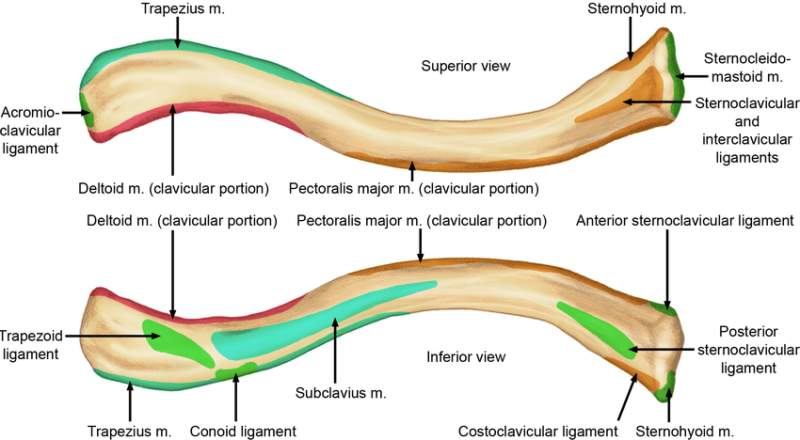
Bony Landmarks and Articulations of Clavicle
The clavicle is a slender bone with an ‘S’ shape. Facing forward, the medial aspect is convex, and the lateral aspect concave. It can be divided into a sternal end, a shaft, and an acromial end.
Sternal (medial) End
It is also known as the sternal end. The medial end is quadrangular and articulates with the clavicular notch of the manubrium of the sternum to form the sternoclavicular joint. The articular surface extends to the inferior aspect for attachment with the first costal cartilage.
The sternal end contains a large facet – for articulation with the manubrium of the sternum at the sternoclavicular joint. The inferior surface of the sternal end is marked by a rough oval depression for the costoclavicular ligament (a ligament of the SC joint).
Shaft of Clavicle
The shaft is divided into the medial two-thirds and the lateral one third. The medial part is thicker than the lateral. The shaft of the clavicle acts a point of origin and attachment for several muscles – deltoid, trapezius, subclavius, pectoralis major, sternocleidomastoid and sternohyoid
Acromial (lateral) End Lateral End
The lateral end is also known as the acromial end. It is flat from above downward. It bears a facet that articulates with the shoulder to form the acromioclavicular joint. The area surrounding the joint gives an attachment to the joint capsule. The anterior border is concave forward and the posterior border is convex backward.
The acromial end houses a small facet for articulation with the acromion of the scapula at the acromioclavicular joint. It also serves as an attachment point for two ligaments
- Conoid tubercle – attachment point of the conoid ligament, the medial part of the coracoclavicular ligament.
- Trapezoid line – attachment point of the trapezoid ligament, the lateral part of the coracoclavicular ligament.
The coracoclavicular ligament is a very strong structure, effectively suspending the weight of the upper limb from the clavicle.

3D model of the clavicle
Lateral one-third of the shaft
The lateral third of the shaft has two borders and two surfaces.
- the anterior border is concave forward and gives origin to the deltoid muscle.
- the posterior border is convex and gives attachment to the trapezius muscle.
- the inferior surface has a ridge called the trapezoid line and a tubercle; the conoid tubercle for attachment with the trapezoid and the conoid ligament, part of the coracoclavicular ligament that serves to connect the collarbone with the coracoid process of the scapula.
Surface of Clavicle
Superior surface
The superior surface of the clavicle has a smooth appearance. The acromial facet can be seen at the far posterior edge of the acromial end. It appears as a small flattened oval surface and enables the clavicle to articulate about the acromion of the scapula in the acromioclavicular joint.
Inferior surface
In contrast, the inferior surface of the clavicle is quite rough and has many prominent lines, indicating sites where muscle and ligaments may attach to the bone. These can be divided into three bony landmarks:
- The sternal facet – found far at the edge of the sternal end. It is shaped like a triangle, with a posterior tip and an anterior base, and forms the sternoclavicular joint.
- The costal tuberosity – located at the sternal end of the bone. It is distinguished as a broad rough surface over 2 cm in length and is the site where the costoclavicular ligament attaches.
- The conoid tubercle – which is found more laterally towards the acromial end. It appears as a rough eminence found where the flat portion of the clavicle meets the tip of the pyramidal sternal end. This feature acts as the site where the conoid ligament attaches.
The clavicle has multiple attachments for musculature that should be considered anatomically.
-
Superior surface – The anterior deltoid originates on the anterior aspect and assists in flexion of the shoulder while one of the insertion sites for the trapezius muscle is located at the posterior aspect. The trapezius predominantly is responsible for stabilizing the scapula.[rx]
-
Inferior surface – The subclavius muscle resides in the subclavian groove of the clavicle and functions to depress the shoulder as well as pull the clavicle anteroinferior. The coracoacromial ligament is located laterally and provides support from the coracoid residing below. The medial component of the CA ligament is the conoid ligament which inserts onto the conoid tubercle, and the lateral component is the trapezoid ligament which inserts onto the trapezoid line.
-
Anterior surface – The clavicular part of the pectoralis major muscle originates from the medial clavicle anteriorly. The clavicular head contributes to flexion, horizontal adduction, and inward rotation of the humerus.
-
Posterior surface – As mentioned, the trapezius inserts posterosuperior on the clavicle. The clavicular head of the sternocleidomastoid (SCM) also has a similar location but is found along with the medial third of the clavicle. The SCM, when contracting alone, causes the head to rotate to the opposite side and laterally side bend ipsilaterally. When both SCM contracts, this causes head flexion.
Blood Supply of Clavicle
Although classified as a long bone, the clavicle (in most cases) does not have a medullary cavity like its long bone counterparts. Previous studies have shown
- Periosteal arterial blood supply to the bony structure but no central nutrient artery (a.).
- The suprascapular artery
- Thoracoacromial artery
- Internal thoracic artery (mammalian a.) have all been found to provide arterial supply to the clavicle.[rx]
Nerves of Clavicle
Controversy surrounds the primary sensory innervation of the clavicle. Anesthetizing studies following clavicular fracture have suggested there may be involvement individually or in a combination
- Supraclavicular nerve,
- Subclavian nerve, and
- Long thoracic
- Suprascapular nerve.[rx]
- A common anatomical variation is a perforating branch of the supraclavicular nerve that passes in the superior surface of the clavicle.
- Post-mortem studies have revealed insertion of the nerve in bony tunnels or grooves that would prove susceptible to injury and may explain entrapment neuropathy following a clavicular fracture.[rx]
Functions of Clavicle
The collarbone serves several functions:
- It serves as a rigid support from which the scapula and free limb suspended; an arrangement that keeps the upper limb away from the thorax so that the arm has a maximum range of movement. Acting as a flexible, crane-like strut, it allows the scapula to move freely on the thoracic wall.
- Covering the cervicoaxillary canal, it protects the neurovascular bundle that supplies the upper limb.
- Transmits physical impacts from the upper limb to the axial skeleton.
Muscle Attachment of Clavicle
Muscles and ligaments that attach to the collarbone include:
| Attachment on collarbone | Muscle/Ligament | Other attachment |
|---|---|---|
| Superior surface and anterior border | Deltoid muscle | deltoid tubercle, anteriorly on the lateral third |
| Superior surface | Trapezius muscle | posteriorly on the lateral third |
| Inferior surface | Subclavius muscle | subclavian groove |
| Inferior surface | Conoid ligament (the medial part of the coracoclavicular ligament) | conoid tubercle |
| Inferior surface | Trapezoid ligament (the lateral part of the coracoclavicular ligament) | trapezoid line |
| Anterior border | Pectoralis major muscle | medial third (rounded border) |
| Posterior border | Sternocleidomastoid muscle (clavicular head) | superiorly, on the medial third |
| Posterior border | Sternohyoid muscle | inferiorly, on the medial third |
| Posterior border | Trapezius muscle | lateral third |
References
- https://www.ncbi.nlm.nih.gov/books/NBK507892/
- https://www.ncbi.nlm.nih.gov/books/NBK525990/
- https://www.ncbi.nlm.nih.gov/books/NBK537258/
- https://www.ncbi.nlm.nih.gov/books/NBK499858/
- https://www.ncbi.nlm.nih.gov/books/NBK545221/
- https://www.ncbi.nlm.nih.gov/books/NBK537056/
- https://www.ncbi.nlm.nih.gov/books/NBK482410/
- https://en.wikipedia.org/wiki/Clavicle
- https://www.sciencedirect.com/topics/medicine-and-dentistry/clavicle
- https://teachmeanatomy.info/upper-limb/bones/clavicle/
- https://teachmeanatomy.info/upper-limb/bones/clavicle/
- https://www.kenhub.com/en/library/anatomy/the-clavicle
- https://accessmedicine.mhmedical.com/content.aspx?
- https://www.getbodysmart.com/upper-limb-bones/clavicle-bone-anatomy
- https://www.britannica.com/science/vertebral-column
- https://www.britannica.com/science/vertebral-column
- https://www.getbodysmart.com/upper-limb-bones/clavicle-bone-anatomy
- https://teachmeanatomy.info/upper-limb/bones/clavicle/
- https://www.kenhub.com/en/library/anatomy/the-clavicle


