Thyroid Function Tests – Types, Symptom, Normal value

Patient Tools

Read, save, and share this guide

Use these quick tools to make this medical article easier to read, print, save, or share with a family member.

Patient Mode

Understand this article easily

Switch between simple English and easy Bangla patient notes. This is for education and does not replace a doctor consultation.

Thyroid function tests (TFTs) is a collective term for blood tests used to check the function of the thyroid. TFTs may be requested if a patient is thought to suffer from hyperthyroidism (overactive thyroid) or hypothyroidism (underactive thyroid), or to monitor the effectiveness of either thyroid-suppression or hormone replacement therapy....

For severe symptoms, danger signs, pregnancy, child illness, or sudden worsening, seek urgent medical care.

বাংলা রোগী নোট এখনো যোগ করা হয়নি। পোস্ট এডিটরে “RX Bangla Patient Mode” বক্স থেকে সহজ বাংলা সারাংশ যোগ করুন।

এই তথ্য শিক্ষা ও সচেতনতার জন্য। এটি ডাক্তারি পরীক্ষা, রোগ নির্ণয় বা প্রেসক্রিপশনের বিকল্প নয়।

Article Summary

Thyroid function tests (TFTs) is a collective term for blood tests used to check the function of the thyroid. TFTs may be requested if a patient is thought to suffer from hyperthyroidism (overactive thyroid) or hypothyroidism (underactive thyroid), or to monitor the effectiveness of either thyroid-suppression or hormone replacement therapy. It is also requested routinely in conditions linked to thyroid diseases, such as atrial fibrillation and anxiety disorder. A TFT...

Key Takeaways

  • This article explains Thyroid hormone regulation- the chain of command in simple medical language.
  • This article explains Symptoms of Hyperthyroid  in simple medical language.
  • This article explains Symptoms of Hypothyroidism in simple medical language.
  • This article explains Thyroid hormones in simple medical language.
Educational health guideWritten for patient understanding and clinical awareness.
Reviewed content workflowUse writer and reviewer profiles for stronger trust.
Emergency safety firstUrgent warning signs are highlighted below.

Seek urgent medical care if you notice

These warning signs are general safety guidance. Local emergency numbers and clinical judgment should always come first.

  • Severe symptoms, breathing difficulty, fainting, confusion, or rapidly worsening illness.
  • New weakness, severe pain, high fever, or symptoms after a serious injury.
  • Any symptom that feels urgent, unusual, or unsafe for the patient.
1

Emergency now

Use emergency care for severe, sudden, rapidly worsening, or life-threatening symptoms.

2

See a doctor

Book a professional medical evaluation if symptoms persist, worsen, recur often, affect daily activities, or occur in a high-risk patient.

3

Learn safely

Use this article to understand possible causes, tests, treatment options, prevention, and questions to ask your clinician.

Before reading

RX Patient Tools

Use these quick guides before reading the article, or return to them when you need help preparing questions for a doctor.

Start here Choose the right pathway for symptoms, reports, medicines, or urgent warning signs. Disease article roadmap Read this topic step by step: meaning, symptoms, warning signs, diagnosis, treatment, prevention, and follow-up. Treatment planner Prepare questions about treatment choices, benefits, risks, side effects, and follow-up. Family & caregiver guide Organize symptoms, reports, medicines, questions, and follow-up safely. Nutrition & diet guide Prepare food, hydration, supplement, and medicine-timing questions safely. Prevention guide Organize risk factors, protective habits, screening, and warning signs. Recovery guide Prepare a safe plan for activity, rehabilitation, warning signs, and follow-up.
Definition

Thyroid function tests (TFTs) is a collective term for blood tests used to check the function of the thyroidTFTs may be requested if a patient is thought to suffer from thyroid gland makes too much hormone. সহজ বাংলা: থাইরয়েড হরমোন বেশি।" data-rx-term="hyperthyroidism" data-rx-definition="Hyperthyroidism means the thyroid gland makes too much hormone. সহজ বাংলা: থাইরয়েড হরমোন বেশি।">hyperthyroidism (overactive thyroid) or hypothyroidism (underactive thyroid), or to monitor the effectiveness of either thyroid-suppression or hormone replacement therapy. It is also requested routinely in conditions linked to thyroid diseases, such as atrial fibrillation and anxiety disorder. A TFT panel typically includes thyroid hormones such as thyroid-stimulating hormone (TSH, thyrotropin) and thyroxine (T4), and triiodothyronine (T3) depending on local laboratory policy.

The thyroid gland produces hormones that are essential for normal body metabolism. Blood testing is now commonly available to determine the adequacy of the levels of thyroid hormones. These blood tests can define whether the thyroid gland’s hormone production is normal, overactive, or underactive.

Thyroid hormone regulation- the chain of command

The thyroid itself is regulated by another gland that is located in the brain, called the pituitary. In turn, the pituitary is regulated in part by the thyroid (via a “feedback” effect of thyroid hormone on the pituitary gland) and by another gland called the hypothalamus.

The hypothalamus releases a hormone called thyrotropin-releasing hormone (TRH), which sends a signal to the pituitary to release thyroid-stimulating hormone (TSH). In turn, TSH sends a signal to the thyroid to release thyroid hormones. If a disruption occurs at any of these levels, a defect in thyroid hormone production may result in a deficiency of thyroid hormone (hypothyroidism).

Hypothalamus – TRH

Pituitary – TSH

Thyroid – T4 and T3

The rate of thyroid hormone production is controlled by the pituitary gland. If there is an insufficient amount of thyroid hormone circulating in the body to allow for normal functioning, the release of TSH is increased by the pituitary gland in an attempt to stimulate more thyroid hormone production

Thyroid function tests help to determine if your thyroid is not working correctly:

  • hyperthyroid – an over-working thyroid
  • hypothyroid – poor thyroid function

Symptoms of Hyperthyroid 

The symptoms of thyroid gland makes too much hormone. সহজ বাংলা: থাইরয়েড হরমোন বেশি।" data-rx-term="hyperthyroidism" data-rx-definition="Hyperthyroidism means the thyroid gland makes too much hormone. সহজ বাংলা: থাইরয়েড হরমোন বেশি।">hyperthyroidism include the following

Symptoms of thyroid gland makes too little hormone. সহজ বাংলা: থাইরয়েড হরমোন কম।" data-rx-term="hypothyroidism" data-rx-definition="Hypothyroidism means the thyroid gland makes too little hormone. সহজ বাংলা: থাইরয়েড হরমোন কম।">Hypothyroidism

Test overall

Test Abbreviation Typical Ranges
Serum thyroxine T4 4.6-12 ug/dl
Free thyroxine fraction FT4F 0.03-0.005%
Free Thyroxine FT4 0.7-1.9 ng/dl
Thyroid hormone binding ratio THBR 0.9-1.1
Free Thyroxine index FT4I 4-11
Serum Triiodothyronine T3 80-180 ng/dl
Free Triiodothyronine l FT3 230-619 pg/d
Free T3 Index FT3I 80-180
Radioactive iodine uptake RAIU 10-30%
Serum thyrotropin TSH 0.5-6 uU/ml
Thyroxine-binding globulin TBG 12-20 ug/dl T4 +1.8 ugm
TRH stimulation test Peak TSH 9-30 uIU/ml at 20-30 min
Serum thyroglobulin l Tg 0-30 ng/m
Thyroid microsomal antibody titer TMAb Varies with method
Thyroglobulin antibody titer TgAb Varies with method

Thyroid hormones

Thyroid-stimulating hormone (TSH, thyrotropin)

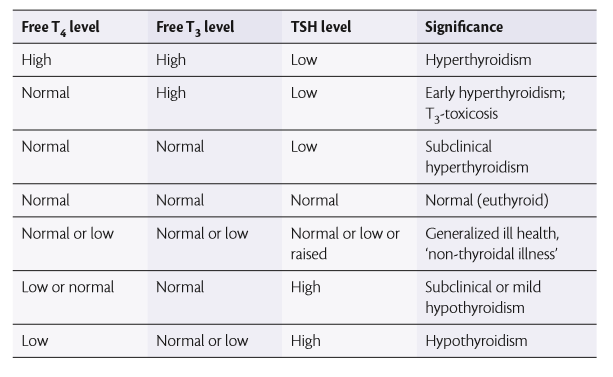
Thyroid-stimulating hormone (TSH, thyrotropin) is generally increased in hypothyroidism and decreased in hyperthyroidism.

Its measurement is the most sensitive test for thyroid hormone function. TSH is produced in the pituitary gland. The production of TSH is controlled by thyrotropin-releasing hormone(TRH), which is produced in the hypothalamus. TSH levels may be suppressed by excess free T3 (fT3) or free T4 (fT4) in the blood.
Thyroid Function Tests - Types, Symptom, Normal value

Total thyroxine(Total T4)

Total thyroxine is rarely measured, having been largely superseded by free thyroxine tests. Total thyroxine (Total T4) is generally elevated in thyroid gland makes too much hormone. সহজ বাংলা: থাইরয়েড হরমোন বেশি।" data-rx-term="hyperthyroidism" data-rx-definition="Hyperthyroidism means the thyroid gland makes too much hormone. সহজ বাংলা: থাইরয়েড হরমোন বেশি।">hyperthyroidism and decreased in hypothyroidism. It is usually slightly elevated in pregnancy secondary to increased levels of thyroid-binding globulin (TBG).

Total T4 is measured to see the bound and unbound levels of T4. The total T4 is less useful in cases where there could be protein abnormalities. The total T4 is less accurate due to a large amount of T4 that is bound. The total T3 is measured in clinical practice since the T3 has decreased amount that is bound as compared to T4.

Reference ranges depend on the method of analysis. Results should always be interpreted using the range from the laboratory that performed the test. Example values are

Lower limit Upper limit Unit
4, 5.5 11, 12.3 μg/dL
60 140,160 nmol/L

Free thyroxine (fT4)

Free thyroxine (fT4) is generally elevated in thyroid gland makes too much hormone. সহজ বাংলা: থাইরয়েড হরমোন বেশি।" data-rx-term="hyperthyroidism" data-rx-definition="Hyperthyroidism means the thyroid gland makes too much hormone. সহজ বাংলা: থাইরয়েড হরমোন বেশি।">hyperthyroidism and decreased in hypothyroidism.

Reference ranges depend on the method of analysis. Results should always be interpreted using the range from the laboratory that performed the test. Example values are

Patient type Lower limit Upper limit Unit
Normal adult 0.7, 0.8 1.4, 1.5,1.8 ng/dL
9, 10, 12  18, 23 pmol/L
Infant 0–3 d 2.0 5.0 ng/dL
26 65 pmol/L
Infant 3–30 d 0.9 2.2 ng/dL
12 30 pmol/L
Child/Adolescent
31 d – 18 y
0.8 2.0 ng/dL
10 26 pmol/L
Pregnant 0.5 1.0 ng/dL
6.5 13 pmol/L

Total triiodothyronine (Total T3

Total triiodothyronine (Total T3) is rarely measured, having been largely superseded by free T3 tests. Total T3 is generally elevated in hyperthyroidism and decreased in hypothyroidism.

Reference ranges depend on the method of analysis. Results should always be interpreted using the range from the laboratory that performed the test. Example values are:

Test Lower limit Upper limit Unit
Total triiodothyronine 60, 75 175, 181 ng/dL
0.9, 1.1 2.5,2.7 nmol/L

Free triiodothyronine(fT3

Free triiodothyronine (fT3) is generally elevated in hyperthyroidism and decreased in hypothyroidism.

Reference ranges depend on the method of analysis. Results should always be interpreted using the range from the laboratory that performed the test. Example values are:

Patient type Lower limit Upper limit Unit
Normal adult 3.0 7.0 pg/mL
3.1 7.7 pmol/L
Children 2–16 y 3.0 7.0 pg/mL
1.5 15.2 pmol/L

Carrier proteins

Thyroxine-binding globulin

An increased thyroxine-binding globulin results in increased total thyroxine and total triiodothyronine without an actual increase in the hormonal activity of thyroid hormones.

Reference ranges:

Lower limit Upper limit Unit
12 30 mg/L

Thyroglobulin

Reference ranges

Lower limit Upper limit Unit
1.5 30 pmol/L
1 20  μg/L

Other binding hormones

  • Transthyretin (prealbumin)
  • Albumin

Protein binding function

Thyroid hormone uptake(Tuptake or T3 uptake

Thyroid hormone uptake (Tuptake or T3 uptake) is a measure of the unbound thyroxine-binding globulins in the blood, that is, the TBG that is unsaturated with thyroid hormone. Unsaturated TBG increases with decreased levels of thyroid hormones. It is not directly related to triiodothyronine, despite the name T3 uptake.

Reference ranges

Patient type Lower limit Upper limit Unit
Females 25 35  %
In pregnancy 15 25  %
Males 25 35  %

Other protein binding tests

  • Thyroid Hormone Binding Ratio(THBR)
  • Thyroxine-binding index (TBI)

References


Doctor visit helper

Prepare before seeing a doctor

A simple rural-patient checklist to help you explain symptoms clearly, ask better questions, and avoid unsafe self-treatment.

Safety note: This is not a prescription or diagnosis. For severe symptoms, pregnancy danger signs, children with serious illness, chest pain, breathing difficulty, stroke-like weakness, or major injury, seek urgent care.

Which doctor may help?

Start with a registered doctor or the nearest qualified health center.

What to tell the doctor

  • Write when the problem started and how it changed.
  • Bring old prescriptions, investigation reports, and current medicines.
  • Write allergies, pregnancy status, diabetes, kidney/liver disease, and major past illnesses.
  • Bring one family member if the patient is weak, elderly, confused, or a child.

Questions to ask

  • What is the most likely cause of my symptoms?
  • Which danger signs mean I should go to hospital quickly?
  • Which tests are necessary now, and which can wait?
  • How should I take medicines safely and what side effects should I watch for?
  • When should I come for follow-up?

Tests to discuss

  • Vital signs: temperature, pulse, blood pressure, oxygen saturation
  • Basic physical examination by a clinician
  • CBC, urine test, blood sugar, or imaging only when clinically needed

Avoid these mistakes

  • Do not use antibiotics, steroid tablets/injections, or strong painkillers without proper medical advice.
  • Do not hide pregnancy, kidney disease, ulcer, allergy, or blood thinner use.
  • Do not delay emergency care when danger signs are present.

Medicine safety and first-aid guide

This section is for patient education only. It does not replace a doctor, pharmacist, or emergency care.

Safe first steps

  • Drink safe fluids and monitor temperature.
  • In dengue-prone areas, discuss CBC and platelet count when fever persists or warning signs appear.
  • Use tepid sponging for high fever discomfort; avoid ice-cold bathing.

OTC medicine safety

  • For fever, common fever medicine may be discussed with a clinician or pharmacist.
  • Avoid aspirin/ibuprofen-like medicines in suspected dengue unless a doctor says it is safe.

Avoid these mistakes

  • Do not start antibiotics without a proper medical decision.
  • Do not use steroid tablets or injections casually for quick relief.
  • Do not delay emergency care because of home remedies.

Get urgent help if

  • Fever with breathing difficulty, confusion, repeated vomiting, bleeding, severe weakness, stiff neck, or dehydration needs urgent care.
Medicine names, dose, and timing must be decided by a qualified clinician or pharmacist after checking age, pregnancy, allergy, other diseases, and current medicines.

For rural patients and family caregivers

Patient health record and symptom diary

Write your symptoms, medicines already taken, test results, and questions before visiting a doctor. This note stays on your device unless you print or copy it.

Doctor to discuss: Doctor / qualified healthcare provider
Tests to discuss with doctor
  • Basic vital signs: temperature, pulse, blood pressure, oxygen level if needed
  • Relevant blood, urine, imaging, or specialist tests only after clinical assessment
Questions to ask
  • What is the most likely cause of my symptoms?
  • Which warning signs mean I should go to emergency care?
  • Which tests are really needed now?
  • Which medicines are safe for my age, pregnancy status, allergy, kidney/liver/stomach condition, and current medicines?

Emergency warning signs such as chest pain, severe breathing difficulty, sudden weakness, confusion, severe dehydration, major injury, or loss of bladder/bowel control need urgent medical care. Do not wait for online information.

Safe pathway to proper treatment

Care roadmap for: Thyroid Function Tests – Types, Symptom, Normal value

Use this simple roadmap to understand the next safe steps. It is educational and does not replace examination by a doctor.

Go to emergency care if you notice:
  • Severe or rapidly worsening symptoms
  • Breathing difficulty, chest pain, fainting, confusion, severe weakness, major injury, or severe dehydration
Doctor / service to discuss: Qualified healthcare provider; specialist depends on symptoms and examination.
  1. Step 1

    Check danger signs first

    If danger signs are present, seek emergency care and do not wait for online information.

  2. Step 2

    Record the symptom story

    Write when symptoms started, severity, medicines already taken, allergies, pregnancy status, and test results.

  3. Step 3

    Visit a qualified clinician

    A doctor, nurse, or qualified healthcare provider can examine you and decide which tests or treatment are needed.

  4. Step 4

    Do only useful tests

    Do tests after clinical assessment. Avoid unnecessary tests, random antibiotics, or repeated medicines without diagnosis.

  5. Step 5

    Follow up and return early if worse

    If symptoms worsen, new warning signs appear, or treatment is not helping, return for review quickly.

Rural patient practical tips
  • Take a written symptom diary and all previous prescriptions/test reports.
  • Do not hide medicines already taken, even herbal or over-the-counter medicines.
  • Ask which warning signs mean urgent referral to hospital.

This roadmap is for education. A real diagnosis and treatment plan requires history, examination, and clinical judgment.

RX Patient Help

Ask a health question safely

Write your symptom story. A health professional or site editor can review it before any answer is prepared. This box is not for emergency care.

Emergency first: Severe chest pain, breathing trouble, unconsciousness, stroke signs, severe injury, heavy bleeding, or rapidly worsening symptoms need urgent local medical care now.

Frequently Asked Questions

Is this article a replacement for a doctor?

No. It is educational content only. Patients should consult a qualified clinician for diagnosis and treatment.

When should I seek urgent care?

Seek urgent care for severe symptoms, rapidly worsening condition, breathing difficulty, severe pain, neurological changes, or any emergency warning sign.

References

Add references, clinical guidelines, textbooks, journal articles, or trusted medical sources here. You can edit this area from the RX Article Professional Blocks panel.