
What is a Holter monitor?

Patient Tools

Read, save, and share this guide

Use these quick tools to make this medical article easier to read, print, save, or share with a family member.

On this page6 sections

Article Summary

The Holter monitor is a type of portable electrocardiogram (ECG). It records the electrical activity of the heart continuously over 24 hours or longer while you are away from the doctor's office. A standard or "resting" ECG is one of the simplest and fastest tests used to evaluate the heart. Electrodes (small, plastic patches that stick to the skin) are placed at certain points on...

Key Takeaways

  • This article explains Why might I need a Holter monitor? in simple medical language.
  • This article explains What are the risks of a Holter monitor? in simple medical language.
  • This article explains How do I get ready for a Holter monitor? in simple medical language.
  • This article explains What happens during a Holter monitor? in simple medical language.
Before reading

RX Patient Tools

Use these quick guides before reading the article, or return to them when you need help preparing questions for a doctor.

Start here Choose the right pathway for symptoms, reports, medicines, or urgent warning signs. Disease article roadmap Read this topic step by step: meaning, symptoms, warning signs, diagnosis, treatment, prevention, and follow-up. Treatment planner Prepare questions about treatment choices, benefits, risks, side effects, and follow-up. Family & caregiver guide Organize symptoms, reports, medicines, questions, and follow-up safely. Nutrition & diet guide Prepare food, hydration, supplement, and medicine-timing questions safely. Prevention guide Organize risk factors, protective habits, screening, and warning signs. Recovery guide Prepare a safe plan for activity, rehabilitation, warning signs, and follow-up.
Educational health guideWritten for patient understanding and clinical awareness.
Reviewed content workflowUse writer and reviewer profiles for stronger trust.
Emergency safety firstUrgent warning signs are highlighted below.
Choose your reading view

Patient View highlights a simple learning journey. Clinical View reveals structure, evidence, and editorial completeness.

Definition

The is a type of portable electrocardiogram (). It records the electrical activity of the heart continuously over 24 hours or longer while you are away from the doctor’s office. A standard or “resting” ECG is one of the simplest and fastest tests used to evaluate the heart. Electrodes (small, plastic patches that stick to the skin) are placed at certain points on the chest and . The electrodes are connected to an ECG machine by wires. Then, the electrical activity of the heart can be measured, recorded, and printed. No electricity is sent into the body.

Natural electrical impulses coordinate contractions of the different parts of the heart. This keeps blood flowing the way it should. An ECG records these impulses to show how fast the heart is beating, the rhythm of the heartbeats (steady or irregular), and the strength and timing of the electrical impulses. Changes in an ECG can be a sign of many heart-related conditions.
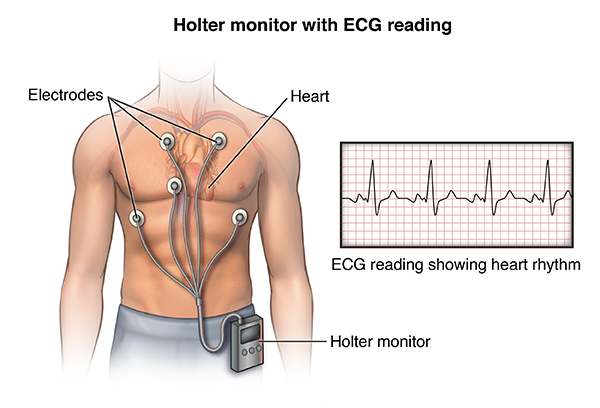
What is a Holter monitor?

Your healthcare provider may request a Holter monitor ECG if you have symptoms, such as , , low blood pressure, ongoing (tiredness), and and a resting ECG doesn’t show a clear cause. You wear the same kind of ECG electrode patches on your chest, and the electrodes are connected by wires to a small, portable recording device.

Certain arrhythmias (abnormal heart rhythms) may occur only now and then. Or, they may occur only under certain conditions, such as stress or activity. Arrhythmias of this type are hard to record on an ECG done in the office. Because of this, the healthcare provider might request a Holter monitor to get a better chance of capturing any abnormal heartbeats or rhythms that may be causing the symptoms. Some Holter monitors also have an event monitor feature that you activate when you notice symptoms.

You will get instructions on how long you will need to wear the monitor (usually 24 to 48 hours), how to keep a diary of your activities and symptoms during the test, and personal care and activity instructions, which include keeping the device dry while you are wearing it.

Why might I need a Holter monitor?

Some reasons for your healthcare provider to request a Holter monitor recording or event monitor recording include:

  • To evaluate that can’t be reproduced with exercise testing
  • To evaluate other signs and symptoms that may be heart-related, such as tiredness, , dizziness, or fainting
  • To identify irregular heartbeats or palpitations
  • To assess risk for future heart-related events in certain conditions, such as (thickened heart walls), after a that caused of the left side of the heart, or Wolff-Parkinson-White (where an abnormal electrical conduction pathway exists within the heart)
  • To see how well a pacemaker is working
  • To determine how well treatment for complex arrhythmias is working

There may be other reasons for your healthcare provider to recommend the use of a Holter monitor.

What are the risks of a Holter monitor?

The Holter monitor is an easy way to assess the heart’s function. Risks associated with the Holter monitor are rare.

It can be hard to keep the electrodes stuck to your skin, and extra tape may be needed. It may be uncomfortable when the sticky electrodes and tape are taken off. If the electrodes are on for a long time, they may cause tissue breakdown or skin irritation at the application site.

There may be other risks depending on your specific medical condition. Be sure to discuss any concerns with your healthcare provider before wearing the monitor.

Certain factors or conditions may interfere with or affect the results of the Holter monitor reading. These include, but are not limited to:

  • Close proximity to magnets, metal detectors, high-voltage electrical wires, and electrical appliances such as shavers, toothbrushes, and microwave ovens. Cell phones and MP3 players can also interfere with the signals and should be kept at least 6 inches away from the monitor box.
  • Smoking or using other forms of tobacco
  • Certain medicines
  • Excessive sweating, which may cause the leads to loosen or come off

How do I get ready for a Holter monitor?

  • Your healthcare provider will explain the procedure to you and you can ask questions.
  • You do not need to fast (not eat or drink).
  • Based on your medical condition, your healthcare provider may request other specific preparation.

What happens during a Holter monitor?

A Holter monitor recording is generally done on an basis. Procedures may vary depending on your condition and your healthcare providers practice.

Generally, a Holter monitor recording follows this process:

  1. You will be asked to remove any jewelry or other objects that may interfere with the reading.
  2. You will be asked to remove your clothing from the waist up so that electrodes can be attached to your chest. The technician will ensure your privacy by covering you with a sheet or gown and exposing only the necessary skin.
  3. The areas where the electrodes patches are placed are cleaned, and in some cases, hair may be shaved or clipped so that the electrodes will stick closely to the skin.
  4. Electrodes will be attached to your chest and abdomen. The Holter monitor will be connected to the electrodes with wires. The small monitor box may be worn over your shoulder like a shoulder bag, around your waist, or it may clip to a belt or pocket.
  5. Find out if you will have to change the batteries in the monitor. Be sure you know how to do it and have extra batteries on hand.
  6. Once you have been hooked up to the monitor and given instructions, you can return to your usual activities, such as work, household chores, and exercise, unless your healthcare provider tells you otherwise. This will allow your healthcare provider to identify problems that may only occur with certain activities.
  7. You will be instructed to keep a diary of your activities while wearing the monitor. Write down the date and time of your activities, particularly if any symptoms, such as dizziness, palpitations, chest , or other previously experienced symptoms, occur.

What happens after a Holter monitor?

You should be able to go back your normal diet and activities, unless your healthcare provider instructs you differently.

Generally, there is no special care after a Holter monitor recording.

Tell your healthcare provider if you develop any signs or symptoms you had before the recording (for example, chest pain, shortness of breath, dizziness, or fainting).

Your healthcare provider may give you other instructions after the procedure, depending on your particular situation.

Next steps

Before you agree to the test or the procedure make sure you know:

  • The name of the test or procedure
  • The reason you are having the test or procedure
  • What results to expect and what they mean
  • The risks and benefits of the test or procedure
  • What the possible side effects or complications are
  • When and where you are to have the test or procedure
  • Who will do the test or procedure and what that person’s qualifications are
  • What would happen if you did not have the test or procedure
  • Any alternative tests or procedures to think about
  • When and how will you get the results
  • Who to call after the test or procedure if you have questions or problems
  • How much will you have to pay for the test or procedure

References

RX Medical Knowledge Graph

Explore this medical topic

Continue through verified related conditions, investigations, medicines, and patient guides. These links are educational and do not replace professional medical advice.

RX Clinical Pathway Engine

Continue through a complete learning pathway

Move from understanding the topic to symptoms, tests, treatment, medicines, monitoring, and prevention.

Search the complete library
  1. Understand the condition Begin with the essential facts and a clear explanation of the topic.
  2. Recognize symptoms Learn common symptoms, signs, and patterns of presentation.
  3. Know when to seek help Review urgent warning signs and when professional assessment may be needed.
  4. Understand causes and risks Explore causes, risk factors, mechanisms, and contributing conditions.
  5. Explore tests and diagnosis Learn how clinicians assess the condition and which investigations may be discussed.
  6. Learn treatment approaches Review general treatment categories and management principles.
  7. Understand medicines safely Continue to medicine education, uses, precautions, and monitoring.
  8. Plan monitoring and follow-up Understand monitoring, complications, rehabilitation, and follow-up learning.
  9. Review prevention and self-care Explore prevention, healthy routines, and questions to discuss with a clinician.

Conditions & Diseases

Background, symptoms, causes, diagnosis, and care.

Explore this library

Tests & Investigations

Laboratory, imaging, screening, and diagnostic education.

Explore this library

Medicines

Uses, safety, monitoring, and related medicine knowledge.

Explore this library

Cancer Knowledge

Cancer types, screening, oncology, and treatment education.

No strong indexed relationship is available yet.

Explore this library
Doctor visit helper

Prepare before seeing a doctor

A simple rural-patient checklist to help you explain symptoms clearly, ask better questions, and avoid unsafe self-treatment.

Safety note: This is not a prescription or diagnosis. For severe symptoms, pregnancy danger signs, children with serious illness, chest pain, breathing difficulty, stroke-like weakness, or major injury, seek urgent care.

Which doctor may help?

Start with a registered doctor or the nearest qualified health center.

What to tell the doctor

  • Write when the problem started and how it changed.
  • Bring old prescriptions, investigation reports, and current medicines.
  • Write allergies, pregnancy status, diabetes, kidney/liver disease, and major past illnesses.
  • Bring one family member if the patient is weak, elderly, confused, or a child.

Questions to ask

  • What is the most likely cause of my symptoms?
  • Which danger signs mean I should go to hospital quickly?
  • Which tests are necessary now, and which can wait?
  • How should I take medicines safely and what side effects should I watch for?
  • When should I come for follow-up?

Tests to discuss

  • Vital signs: temperature, pulse, blood pressure, oxygen saturation
  • Basic physical examination by a clinician
  • CBC, urine test, blood sugar, or imaging only when clinically needed

Avoid these mistakes

  • Do not use antibiotics, steroid tablets/injections, or strong painkillers without proper medical advice.
  • Do not hide pregnancy, kidney disease, ulcer, allergy, or blood thinner use.
  • Do not delay emergency care when danger signs are present.

Medicine safety and first-aid guide

This section is for patient education only. It does not replace a doctor, pharmacist, or emergency care.

Safe first steps

  • Avoid heavy lifting, sudden bending, and prolonged bed rest.
  • Use comfortable posture and gentle movement as tolerated.
  • Discuss physiotherapy, X-ray, or MRI only when clinically needed.

OTC medicine safety

  • For mild back pain, pain-relief medicine may be discussed with a doctor or pharmacist.
  • Avoid repeated painkiller use if you have kidney disease, stomach ulcer, uncontrolled blood pressure, or are taking blood thinners.

Avoid these mistakes

  • Do not start antibiotics without a proper medical decision.
  • Do not use steroid tablets or injections casually for quick relief.
  • Do not delay emergency care because of home remedies.

Get urgent help if

  • Back pain with leg weakness, numbness around private area, loss of urine/stool control, fever, cancer history, or major injury needs urgent care.
Medicine names, dose, and timing must be decided by a qualified clinician or pharmacist after checking age, pregnancy, allergy, other diseases, and current medicines.

For rural patients and family caregivers

Patient health record and symptom diary

Write your symptoms, medicines already taken, test results, and questions before visiting a doctor. This note stays on your device unless you print or copy it.

Doctor to discuss: Emergency care / cardiology / medicine doctor
Tests to discuss with doctor
  • ECG as early as possible when chest pain suggests heart risk
  • Troponin or cardiac blood tests if doctor suspects heart attack
  • Blood pressure, oxygen level, chest examination, and other tests as advised urgently
Questions to ask
  • What is the most likely cause of my symptoms?
  • Which warning signs mean I should go to emergency care?
  • Which tests are really needed now?
  • Which medicines are safe for my age, pregnancy status, allergy, kidney/liver/stomach condition, and current medicines?
  • Is this heart-related, and do I need emergency observation?

Emergency warning signs such as chest pain, severe breathing difficulty, sudden weakness, confusion, severe dehydration, major injury, or loss of bladder/bowel control need urgent medical care. Do not wait for online information.

Safe pathway to proper treatment

Care roadmap for: What is a Holter monitor?

Use this simple roadmap to understand the next safe steps. It is educational and does not replace examination by a doctor.

Go to emergency care if you notice:
  • Severe or rapidly worsening symptoms
  • Breathing difficulty, chest pain, fainting, confusion, severe weakness, major injury, or severe dehydration
Doctor / service to discuss: Qualified healthcare provider; specialist depends on symptoms and examination.
  1. Step 1

    Check danger signs first

    If danger signs are present, seek emergency care and do not wait for online information.

  2. Step 2

    Record the symptom story

    Write when symptoms started, severity, medicines already taken, allergies, pregnancy status, and test results.

  3. Step 3

    Visit a qualified clinician

    A doctor, nurse, or qualified healthcare provider can examine you and decide which tests or treatment are needed.

  4. Step 4

    Do only useful tests

    Do tests after clinical assessment. Avoid unnecessary tests, random antibiotics, or repeated medicines without diagnosis.

  5. Step 5

    Follow up and return early if worse

    If symptoms worsen, new warning signs appear, or treatment is not helping, return for review quickly.

Rural patient practical tips
  • Take a written symptom diary and all previous prescriptions/test reports.
  • Do not hide medicines already taken, even herbal or over-the-counter medicines.
  • Ask which warning signs mean urgent referral to hospital.

This roadmap is for education. A real diagnosis and treatment plan requires history, examination, and clinical judgment.
