
RX Patient Tools
Use these quick guides before reading the article, or return to them when you need help preparing questions for a doctor.
Tardive dyskinesia is a syndrome which includes a group of iatrogenic movement disorders caused due to a blockade of dopamine receptors. The movement disorders include akathisia, dystonia, buccolingual stereotypy, myoclonus, chorea, tics and other abnormal involuntary movements which are commonly caused by the long-term use of typical antipsychotics. However, several other medications are also associated with tardive dyskinesia. The Diagnostic and Statistical Manual of Mental Disorders, Fifth Edition (DSM V) defines tardive dyskinesia as a medication-induced movement disorder and persists despite discontinuation or change of the medications. As per DSM-V, to confirm a diagnosis of tardive dyskinesia, symptoms must persist for a month after discontinuation of the medication. [rx][rx][rx]
Dyskinesia refers to a category of movement disorders that are characterized by involuntary muscle movements, including movements similar to tics or chorea and diminished voluntary movements. Dyskinesia can be anything from a slight tremor of the hands to an uncontrollable movement of the upper body or lower extremities. Discoordination can also occur internally especially with the respiratory muscles and it often goes unrecognized. Dyskinesia is a symptom of several medical disorders that are distinguished by their underlying cause.
Symptoms of Dyskinesia
| Benzisothiazole (ziprasidone) |
| Benzisoxazole (iloperidone) |
| Butyrophenones (haloperidol, droperidol) |
| Calcium channel blockers (flunarizine, cinnarizine) |
| Dibenzazepine (loxapine, asenapine) |
| Dibenzodiazepine (clozapine, quetiapine) |
| Diphenylbutylpiperidine (pimozide) |
| Indolones (molindone) |
| Lithium |
| Phenothiazines (chlorpromazine, triflupromazine, thioridazine, mesoridazine, trifluoperazine, prochlorperazine, perphenazine, fluphenazine, perazine) |
| Pyrimidinone (risperidone, paliperidone) |
| Quinolinone (aripiprazole) |
| Substitute benzamides (metoclopramide, tiapride, sulpiride, clebopride, remoxipride, veralipride, amisulpride, levosulpiride) |
| Serotonin reuptake or serotonin-norepinephrine reuptake inhibitors (duloxetine, citalopram) |
| Thienobenzodiazepine (olanzapine) |
| Thioxanthenes (chlorprothixene, thiothixene) |
| Tricyclic antidepressants (amoxapine) |
The medications are listed alphabetically
| Classic Tardive Dyskinesia | Isolated or Predominant Oro-Bucco-lingual Dyskinesia (stereotypy) |
|---|---|
| Tardive stereotypy | Seemingly purposeful, repetitive and coordinated movements in the limbs or trunk (if the face is mainly involved, would be considered as classic TD) |
| Tardive dystonia | Focal, segmental or generalized dystonia (classic features are retrocollis, opisthotonic trunk posturing, arm extension) |
| Tardive akathisia | Feeling of restlessness, inability to stay still, intense inner urge to move |
| Tardive tics (tardive tourettism) | Clinically indistinguishable from tics in Tourette syndrome but much older age of onset |
| Tardive tremor | Postural, kinetic, and rest tremor (typically high amplitude and low frequency) |
| Tardive myoclonus | Prominent postural myoclonic jerks in upper extremities |
| Tardive chorea | Usually accompanies classic TD in adult patient |
| Tardive parkinsonism | Rest tremor, bradykinesia, rigidity persisting for months/years after discontinuation of DRBAs; normal DAT SPECT |
| Withdrawal emergent syndrome | Generalized chorea (no or minimal involvement of oro-bucco-lingual region) in children after sudden discontinuation of DRBAs; self-limiting condition |
| Neuroleptic malignant syndrome | Fever, rigidity, mental status change, hyperthermia, elevated CK, leukocytosis |
| Tardive pain | Chronic painful oral and genital sensations |
Abbreviations: CK, creatine kinase; DAT, dopamine transporter; DRBA, dopamine receptor-blocking agent; SPECT, single photon emission computerized tomography TD, tardive dyskinesia.
Types of Dyskinesia
Medication-induced dyskinesias
Acute dystonia is a sustained muscle contraction that sometimes appears soon after administration of antipsychotic medications. Any muscle in the body may be affected, including the jaw, tongue, throat, arms, or legs. When the throat muscles are involved, this type of dystonia is called an acute laryngospasm and is a medical emergency because it can impair breathing. Older antipsychotics such as Haloperidol or Fluphenazine are more likely to cause acute dystonia than newer agents. Giving high doses of antipsychotics by injection also increases the risk of developing acute dystonia.
Methamphetamine, other amphetamines and dopaminergic stimulants including cocaine and pemoline can produce choreoathetoid dyskinesias; the prevalence, time-frame and prognosis are not well established. Amphetamines also cause a dramatic increase in choreoathetoid symptoms in patients with underlying chorea such as Sydenham’s, Huntington’s, and Lupus. Long-term use of amphetamines may increase the risk of Parkinson’s disease (PD): in one retrospective study with over 40,000 participants it was concluded that amphetamine abusers generally had a 200% higher chance of developing PD versus those with no history of abuse; the risk was much higher in women, almost 400%. There remains some controversy as of 2017.
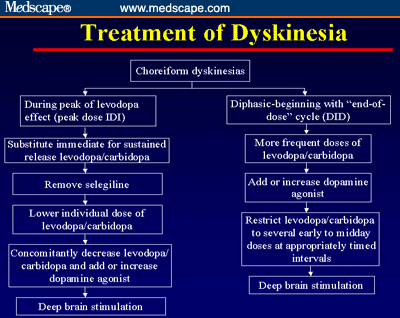
Levodopa-induced dyskinesia (LID) is evident in patients with Parkinson’s disease who have been on levodopa (L‑DOPA) for prolonged periods of time. LID commonly first appears in the foot, on the most affected side of the body. There are three main types that can be classified on the basis of their course and clinical presentation following an oral dose of L‑DOPA
- Off-period dystonia – correlated to the akinesia that occurs before the full effect of L‑DOPA sets in, when the plasma levels of L‑DOPA are low. In general, it occurs as painful spasms in the foot. Patients respond to L‑DOPA therapy.
- Diphasic dyskinesia – occurs when plasma L-DOPA levels are rising or falling. This form occurs primarily in the lower limbs (though they can happen elsewhere) and is usually dystonic (characterized by apparent rigidity within muscles or groups thereof) or ballistic (characterized by involuntary movement of muscles) and will not respond to L‑DOPA dosage reductions.
- Peak-dose dyskinesia – the most common form of levodopa-induced dyskinesia; it correlates with the plateau L‑DOPA plasma level. This type usually involves the upper limbs more (but could also affect the head, trunk, and respiratory muscles), is choreic (or chorea), and less disabling. Patients will respond to L‑DOPA reduction but may be accompanied by deterioration of parkinsonism. Peak-dose L-DOPA-induced dyskinesia has recently been suggested to be associated with cortical dysregulation of dopamine signaling.
Chronic or tardive of Dyskinesia
Late-onset dyskinesia, also known as tardive dyskinesia, occurs after long-term treatment with an antipsychotic drug such as haloperidol (Haldol) or amoxapine (Asendin). The symptoms include tremors and writhing movements of the body and limbs, and abnormal movements in the face, mouth, and tongue – including involuntary lip smacking, repetitive pouting of the lips, and tongue protrusions.
Rabbit syndrome is another type of chronic dyskinesia, while orofacial dyskinesia may be related to persistent replication of Herpes simplex virus type 1
Non-motor
Two other types, primary ciliary dyskinesia, and biliary dyskinesia are caused by specific kinds of ineffective movement of the body and are not movement disorders.
Spastic thrusting of the hip area can occur in Sodemytopic Parkinson’s.
| Medication | Starting Daily Dose | Daily Dose Range |
|---|---|---|
| Slow Taper of an Offending DRBA | ||
| Dopamine-depleting medications | ||
| Tetrabenazine[rx] | 12.5–25 mg | 25–200 mg (typical therapeutic dose 50–75 mg) |
| Reserpine[rx] | 0.25 mg | 0.75–8 mg |
| Amantadine[rx] | 100 mg | 100–300 mg |
| GABA agonistic medications | ||
| Clonazepam[rx] | 0.5 mg | 1–4 mg |
| Baclofen[rx] | 20–120 mg | |
| Valproic acid[ | 900–1500 mg | |
| Anticholinergic medications | ||
| Trihexyphenidyl[rx] | 1 mg | 4–20 mg |
| Less studied/might be effective medications (donepezil, lithium, antioxidants, zonisamide, vitamin B6, melatonin, zolpidem, propranolol) | ||
| Chemodenervation with botulinum toxin injections | ||
| Surgical treatment (deep brain stimulation) | ||
Abbreviations: DRBA, dopamine receptor-blocking agent.
FDA Approves First Drug for Tardive Dyskinesia
The FDA has approved valbenazine (Ingrezza, Neurocrine Biosciences Inc.) capsules, the first drug approved to treat adults with tardive dyskinesia.
Tardive dyskinesia, a neurological condition, is characterized by repetitive involuntary movements, usually of the jaw, lips, and tongue. Some individuals also experience involuntary movement of the extremities and difficulty breathing.
Tardive dyskinesia can also be a serious adverse effect seen in patients taking antipsychotic medications for long periods to treat chronic conditions, such as schizophrenia or bipolar disorder. It can also occur in patients taking medications for depression and certain medication for gastrointestinal disorders.
The approval is based on a clinical trial of 234 participants that demonstrated Ingrezza’s efficacy compared to a placebo. Patients who received Ingrezza experienced an improvement in the severity of abnormal involuntary movements after 6 weeks compared to those who received a placebo.
Some adverse effects associated with Ingrezza include sleepiness and heart rhythm problems (QT prolongation).
The application was previously granted Fast Track, Priority Review, and Breakthrough Therapy designations.
Reference


