Adrenal fatigue is a term that is used to describe your adrenal glands when they are struggling to cope with both stress and an overly busy schedule. In this state of adrenal fatigue, you’ll likely be feeling pretty burned out, overworked and feeling dull all over.
While ‘adrenal fatigue’ isn’t a diagnosis you’re going to get from your doctor, experiencing these signals below should be considered as warning signals from your body, that something needs to change, and your routine has got to ‘give.’
If you surpass the 4 stages of adrenal fatigue you may enter an adrenal insufficiency, which is now something that your medical doctor can diagnose. Listen to your body and it’s many signals now, tackle stress and get out of the tired rut before it potentially turns into something more serious!
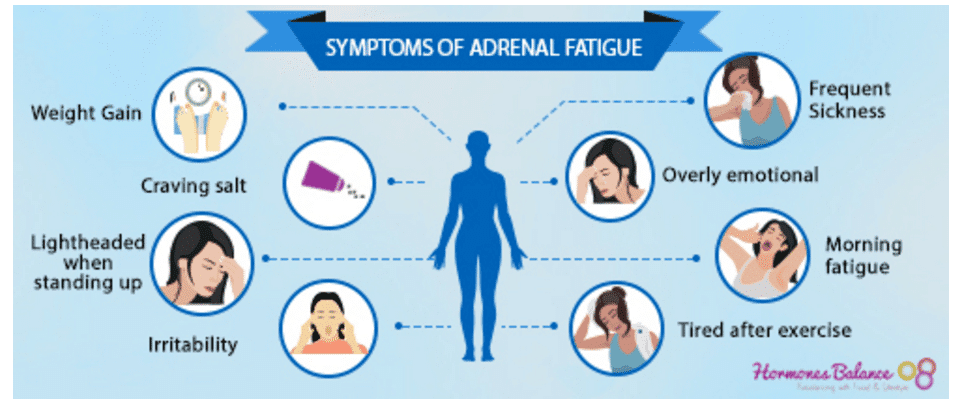
Many of us have taxed our adrenals; when stress doesn’t go away we are left with elevated cortisol levels, and other systems in the body become weakened – because your adrenals can only handle so much, just like you!
Symptoms of Adrenal Fatigue
First things first, check to see if you have signs of adrenal fatigue. They include:
- Feeling tired; struggling to wake up in the morning
- Trouble falling asleep
- A mid-afternoon slump
- Anxiety, or feeling on edge
- Mood swings
- Depression
- Weight gain
- Autoimmune issues
- Brain fog
- Body aches
- Hair loss
- Lightheadedness
So how do you know if you’ve got adrenal fatigue? And what can you do about it? Here are 9 signs of adrenal fatigue & some tips for a more vibrant you.
You’re Feeling Overwhelmed By Life
So many of us put self-care at the bottom of our to-do list – until it is too late! I agree that it can be so much easier to say ‘yes,’ than ‘no’ in many situations – but all work and no play can lead you right to a burnout! Being a go-getter and an over-achiever is ok. But the key to your success also resides in self-care practices (how can you
But the key to your success also resides in self-care practices (how can you BE your best if you don’t feel your best) You can SEE stress on people, and it does not look nice on anyone! Take a step back from some commitments that do not serve you, and add some self-care into your daily routine & remember that you need time for YOU.
Give yourself permission to take a step back, your body and adrenals will thank you. Bear in mind that if you’re feeling more of the signals listed below – what you are currently doing is NOT working for your body.
You Can’t Sleep
Ideally, we should all be getting 8-10 hours of uninterrupted sleep each night. Your body needs this time to recover, reset and recharge for a new day. You should wake up every morning feeling refreshed & energized.
However, many of us are instead giving up sleep to continue with more work + we rush from one thing to the next – this throws off your balance and makes it harder for you to fall/stay asleep. It’s time to introduce a healthy new habit to improve your rhythm.
Try and be in bed by 10:30 pm, even if you can’t fall asleep quite yet – being in the dark helps your body to produce melatonin – aka your sleep hormone. If your mind is racing before bed – practice some guided meditation, such as the HeadSpace App or take a warm bath with added AlkaBath to help you relax .
You Feel Exhausted After Working Out
Exercise should make you feel more energized, and it shouldn’t make you exhausted and fatigued afterward. Physical Stress is a known stressor for the adrenal glands – and too much exercise can do the opposite of what you want – as it can have negative effects on your adrenals since adding stress to your body!
If you’re working out constantly, but are not reaching your goals, are struggling with belly fat and feel fatigued after working out, it would be best for you to take part in a more gentle form of exercise; like stretching, walking and yoga – which will make you feel better – not worse.
If weight loss is your goal and your reason for working out, you should know that 80% of your results will come from proper nutrition, not from a gym membership .
Your Hormones Are Feeling Wacky
In stage 2 of adrenal fatigue, the thyroid may be affected, which may create unfavorable symptoms of a hypothyroid (fatigue, weight gain, dry hair & skin, poor circulation). When your adrenals cannot keep up with stress levels, hormone precursor material will be redirected for use in cortisol production, which can lead to a hormone imbalance.
While under long-term periods of stress, your cycle may be off and PMS symptoms may increase. Experiencing symptoms associated with a hormone imbalance are not pleasant ones to experience. At this time – a nourishing diet, adequate sleep, adaptogenic herbs, increased water intake and the elimination of caffeine is of great importance and value .
You’re Feeling Overly Anxious or Depressed
When you’ve got too much going on, anxiety kicks in. The pressure of deadlines and a busy schedule can have you running on an adrenaline rush. Adrenal hormones are involved in cognitive function, mood, and mental states – in very complex ways.
Anxiety and depression can be directly related to stress, as when we are less ‘tolerant’ than we normally are, we are more easily frustrated! Again, this goes back to #1 – take more time for YOU. You do enough, you give ENOUGH, you are ENOUGH! Your health and well-being are more important than a clean kitchen and a work function that you don’t want to go to .
You’ve Got Cravings for Salt
You’re not you when you’re stressed. When adrenal fatigue begins to affect hormone balance, it is common to crave salty snacks. The reason: your body is looking for sodium and other minerals. When production of aldosterone (the salt-retaining hormone) is decreased, this can lead to low blood pressure, heart palpitations, cravings for salt and dizziness/lightheadedness upon standing.
It is important to ensure that you are getting enough minerals in your daily routine, you can do this by using a high quality Himalayan pink salt in your cooking, along with using seaweeds such as dulse, kelp, and nori, you can also add mineral drops to your filtered water .
You Feel Stiff & Sore
Your body reacts to stressful events, feeling stiff and sore can be a sign that your body isn’t getting a full recharge. You may feel the stress in your neck, back or jaw – a simple way to reduce feeling like this is to optimize your sleep habits and spend more time working on your stretching or yoga routine.
Warm baths with a blend such as AlkaBath is phenomenal for its anti-inflammatory effects – the natural magnesium soothes your muscles and the added crystal blend gently detoxes and balances your body.
You’re Relying on Caffeine to Get You Through the Afternoon
Hello coffee lovers, it’s time to find out the truth on why caffeine can be good for some, and not for others. What you need to remember is that coffee does not give you energy – you are borrowing that energy. Caffeine may benefit your brain by helping you get through the day with added stimulation – but it also further weakens your adrenal glands – as caffeine keeps your body in stress mode, and signals the production of stress hormones like cortisol and epinephrine.
My biggest concern for caffeine drinkers is when you are dependent on it to make it through the day (the “don’t talk to me before I’ve had my coffee” people). Mornings can be tough when you have adrenal fatigue, but regular caffeine drinkers will know that the initial surge of energy wears off and that innocent cup of coffee can leave you feeling even more tired and crabby than you did when you woke up.
During your Recharge, it is best to reach for herbal teas and coffee substitutes such as holy basil, dandelion root or mint to name a few .
Your Digestion is Off
When you’re under stress, your body is not focusing on optimally digesting and absorbing the nutrition in your big healthy salad. Your body is responding to STRESS. Functions like digestion and your metabolism are downregulated in adrenal fatigue mode, which increases the likelihood of you being bloated after eating – you may also experience weight gain, indigestion or constipation/diarrhea!
You may be eating super healthy, but if your body is under stress, you may not even be absorbing the full nutrition from meals. Some tips for improving digestion which should be practiced alongside a nourishing diet and Recharge supplementation are: drinking lemon water, taking the time to savor your meals, drinking enough water, getting enough minerals and taking a probiotic daily.
References
- https://www.ncbi.nlm.nih.gov/pmc/articles/PMC4997656/
- https://www.ncbi.nlm.nih.gov/pmc/articles/PMC4045534/
- https://www.ncbi.nlm.nih.gov/pmc/articles/PMC2928659/
- https://www.ncbi.nlm.nih.gov/pmc/articles/PMC3056281/
- https://sciencebasedmedicine.org/adrenal-fatigue-a-fake-disease/
- https://www.health.harvard.edu/blog/is-adrenal-fatigue-real-2018022813344
- https://en.wikipedia.org/wiki/Adrenal_fatigue