
Implantable cardioverter-defibrillator

Patient Tools

Read, save, and share this guide

Use these quick tools to make this medical article easier to read, print, save, or share with a family member.

Patient Mode

Understand this article easily

Switch between simple English and easy Bangla patient notes. This is for education and does not replace a doctor consultation.

ICD; Defibrillation An implantable cardioverter-defibrillator (ICD) is a device that detects any life-threatening, rapid heartbeat. This abnormal heartbeat is called an arrhythmia. If it occurs, the ICD quickly sends an electrical shock to the heart. The shock changes the rhythm back to normal. This is...

For severe symptoms, danger signs, pregnancy, child illness, or sudden worsening, seek urgent medical care.

বাংলা রোগী নোট এখনো যোগ করা হয়নি। পোস্ট এডিটরে “RX Bangla Patient Mode” বক্স থেকে সহজ বাংলা সারাংশ যোগ করুন।

এই তথ্য শিক্ষা ও সচেতনতার জন্য। এটি ডাক্তারি পরীক্ষা, রোগ নির্ণয় বা প্রেসক্রিপশনের বিকল্প নয়।

Article Summary

ICD; Defibrillation An implantable cardioverter-defibrillator (ICD) is a device that detects any life-threatening, rapid heartbeat. This abnormal heartbeat is called an arrhythmia. If it occurs, the ICD quickly sends an electrical shock to the heart. The shock changes the rhythm back to normal. This is called defibrillation. Description An ICD is made of these parts: The pulse generator is about the size of a large...

Key Takeaways

  • This article explains Description in simple medical language.
  • This article explains Why the Procedure Is Performed in simple medical language.
  • This article explains Risks in simple medical language.
  • This article explains Before the Procedure in simple medical language.
Educational health guideWritten for patient understanding and clinical awareness.
Reviewed content workflowUse writer and reviewer profiles for stronger trust.
Emergency safety firstUrgent warning signs are highlighted below.

Seek urgent medical care if you notice

These warning signs are general safety guidance. Local emergency numbers and clinical judgment should always come first.

  • Severe symptoms, breathing difficulty, fainting, confusion, or rapidly worsening illness.
  • New weakness, severe pain, high fever, or symptoms after a serious injury.
  • Any symptom that feels urgent, unusual, or unsafe for the patient.
1

Emergency now

Use emergency care for severe, sudden, rapidly worsening, or life-threatening symptoms.

2

See a doctor

Book a professional medical evaluation if symptoms persist, worsen, recur often, affect daily activities, or occur in a high-risk patient.

3

Learn safely

Use this article to understand possible causes, tests, treatment options, prevention, and questions to ask your clinician.

ICD; Defibrillation

An implantable cardioverter-defibrillator (ICD) is a device that detects any life-threatening, rapid heartbeat. This abnormal heartbeat is called an arrhythmia. If it occurs, the ICD quickly sends an electrical shock to the heart. The shock changes the rhythm back to normal. This is called defibrillation.

Description

An ICD is made of these parts:

  • The pulse generator is about the size of a large pocket watch. It contains a battery and electrical circuits that read the electrical activity of your heart.
  • The electrodes are wires, also called leads, that go through your veins to your heart. They connect your heart to the rest of the device. Your ICD may have 1, 2, or 3 electrodes.
  • All ICDs have a built-in pacemaker. Your heart may need pacing if it is beating too slowly or too fast, or if you have had a shock from the ICD.
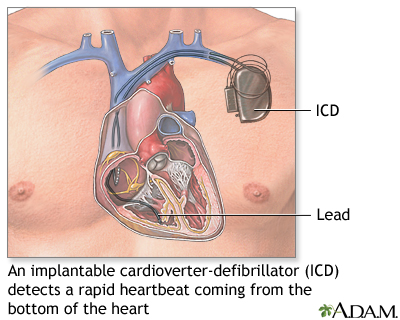
A cardiologist or surgeon most often will insert your ICD when you are awake. The area of your chest wall below your collarbone will be numbed with anesthesia, so you will not feel pain. The surgeon will make an incision (cut) through your skin and create space under your skin and muscle for the ICD generator. In most cases, this space is made near your left shoulder.

The surgeon will place the electrode into a vein, then into your heart. This is done using a special x-ray to see inside your chest. Then the surgeon will connect the electrodes to the pulse generator and pacemaker.

The procedure most often takes 2 to 3 hours.

Some people with this condition will have a special that combines a defibrillator and biventricular pacemaker placed. The pacemaker device helps the heart to beat in a more coordinated fashion.

Why the Procedure Is Performed

An ICD is placed in people who are at high risk of sudden cardiac death from an abnormal heart rhythm that is life-threatening. These include ventricular tachycardia (VT) or ventricular fibrillation (VF).

Reasons you may be at high risk are:

  • You have had episodes of one of these abnormal heart rhythms.
  • Your heart is weakened, too large, and does not pump blood very well. This may be from earlier heart attacks, heart failure, or cardiomyopathy  (diseased heart muscle).
  • You have a type of congenital (present at birth) heart problem or genetic health condition.

Risks

Risks for any surgery are:

  • Blood clots in the legs that may travel to the lungs
  • Breathing problems
  • Heart attack or stroke
  • Allergic reactions to medicines (anesthesia) used during surgery
  • Infection

Possible risks for this surgery are:

  • Wound infection
  • Injury to your heart or lungs
  • Dangerous heart arrhythmias

An ICD sometimes delivers shocks to your heart when you DO NOT need them. Even though a shock lasts a very short time, you can feel it in most cases.

This and other ICD problems can sometimes be prevented by changing how your ICD is programmed. It can also be set to sound an alert if there is a problem. The doctor who manages your ICD care can program your device.

Before the Procedure

Always tell your health care provider what drugs you are taking, even drugs or herbs you bought without a prescription.

The day before your surgery:

  • Let your provider know about any cold, flu, fever, herpes breakout, or other illness you might have.
  • Shower and shampoo well. You may be asked to wash your whole body below your neck with a special soap.
  • You may also be asked to take an bacterial infections. সহজ বাংলা: ব্যাকটেরিয়ার সংক্রমণের ওষুধ।" data-rx-term="antibiotic" data-rx-definition="An antibiotic is a medicine used to treat bacterial infections. সহজ বাংলা: ব্যাকটেরিয়ার সংক্রমণের ওষুধ।">antibiotic, to guard against infection.

On the day of the surgery:

  • You will usually be asked not to drink or eat anything after midnight the night before your surgery. This includes chewing gum and breath mints. Rinse your mouth with water if it feels dry, but be careful not to swallow.
  • Take the drugs you have been told to take with just a small sip of water.

You will be told when to arrive at the hospital.

After the Procedure

Most people who have an ICD implanted are able to go home from the hospital in 1 day. Most quickly return to their normal activity level. Full recovery takes about 4 to 6 weeks.

Ask your provider how much you can use the arm on the side of your body where the ICD was placed. You may be advised not to lift anything heavier than 10 to 15 pounds (4.5 to 6.75 kilograms) and to avoid pushing, pulling, or twisting your arm for 2 to 3 weeks. You may also be told not to raise your arm above your shoulder for several weeks.

When you leave the hospital, you will be given a card to keep in your wallet. This card lists the details of your ICD and has contact information for emergencies. You should always carry this wallet card with you.

You will need regular checkups so your ICD can be monitored. The provider will check to see if:

  • The device is properly sensing your heartbeat
  • How many shocks have been delivered
  • How much power is left in the batteries.

Outlook (Prognosis)

Your ICD will constantly monitor your heartbeats to make sure they are steady. It will deliver a shock to the heart when it senses a life-threatening rhythm. This device can also work as a pacemaker.

References

American Heart Association. Implantable cardioverter defibrillator (ICD). Updated August 24, 2016. www.heart.org/HEARTORG/Conditions/Arrhythmia/PreventionTreatmentofArrhythmia/Implantable-Cardioverter-Defibrillator-ICD_UCM_448478_Article.jsp#.V8U1j5h961s . Accessed August 30, 2016.

Epstein AE, DiMarco JP, Ellenbogen KA, et al. 2012 ACCF/AHA/HRS focused update incorporated into the ACCF/AHA/HRS 2008 guidelines for device-based therapy of cardiac rhythm abnormalities: a report of the American College of Cardiology Foundation/American Heart Association Task Force on practice guidelines and the Heart Rhythm Society. J Am Coll Cardiol . 2013;61(3):e6-e75. PMID: 23265327 www.ncbi.nlm.nih.gov/pubmed/23265327 .

Swerdlow CD, Wang PJ, Zipes DP. Pacemakers and implantable cardioverter-defibrillators. In: Mann DL, Zipes DP, Libby P, Bonow RO, Braunwald E, eds. Braunwald’s Heart Disease: A Textbook of Cardiovascular Medicine . 10th ed. Philadelphia, PA: Elsevier Saunders; 2015:chap 36.

Doctor visit helper

Prepare before seeing a doctor

A simple rural-patient checklist to help you explain symptoms clearly, ask better questions, and avoid unsafe self-treatment.

Safety note: This is not a prescription or diagnosis. For severe symptoms, pregnancy danger signs, children with serious illness, chest pain, breathing difficulty, stroke-like weakness, or major injury, seek urgent care.

Which doctor may help?

Start with a registered doctor or the nearest qualified health center.

What to tell the doctor

  • Write when the problem started and how it changed.
  • Bring old prescriptions, investigation reports, and current medicines.
  • Write allergies, pregnancy status, diabetes, kidney/liver disease, and major past illnesses.
  • Bring one family member if the patient is weak, elderly, confused, or a child.

Questions to ask

  • What is the most likely cause of my symptoms?
  • Which danger signs mean I should go to hospital quickly?
  • Which tests are necessary now, and which can wait?
  • How should I take medicines safely and what side effects should I watch for?
  • When should I come for follow-up?

Tests to discuss

  • Vital signs: temperature, pulse, blood pressure, oxygen saturation
  • Basic physical examination by a clinician
  • CBC, urine test, blood sugar, or imaging only when clinically needed

Avoid these mistakes

  • Do not use antibiotics, steroid tablets/injections, or strong painkillers without proper medical advice.
  • Do not hide pregnancy, kidney disease, ulcer, allergy, or blood thinner use.
  • Do not delay emergency care when danger signs are present.

Medicine safety and first-aid guide

This section is for patient education only. It does not replace a doctor, pharmacist, or emergency care.

Safe first steps

  • Drink safe fluids and monitor temperature.
  • In dengue-prone areas, discuss CBC and platelet count when fever persists or warning signs appear.
  • Use tepid sponging for high fever discomfort; avoid ice-cold bathing.

OTC medicine safety

  • For fever, common fever medicine may be discussed with a clinician or pharmacist.
  • Avoid aspirin/ibuprofen-like medicines in suspected dengue unless a doctor says it is safe.

Avoid these mistakes

  • Do not start antibiotics without a proper medical decision.
  • Do not use steroid tablets or injections casually for quick relief.
  • Do not delay emergency care because of home remedies.

Get urgent help if

  • Fever with breathing difficulty, confusion, repeated vomiting, bleeding, severe weakness, stiff neck, or dehydration needs urgent care.
Medicine names, dose, and timing must be decided by a qualified clinician or pharmacist after checking age, pregnancy, allergy, other diseases, and current medicines.

For rural patients and family caregivers

Patient health record and symptom diary

Write your symptoms, medicines already taken, test results, and questions before visiting a doctor. This note stays on your device unless you print or copy it.

Doctor to discuss: Medicine doctor / pediatrician for children / qualified clinician
Tests to discuss with doctor
  • Temperature chart and hydration assessment
  • CBC with platelet count if fever persists or dengue/other infection is possible
  • Urine test, malaria/dengue tests, chest evaluation, or blood culture only when clinically indicated
Questions to ask
  • What is the most likely cause of my symptoms?
  • Which warning signs mean I should go to emergency care?
  • Which tests are really needed now?
  • Which medicines are safe for my age, pregnancy status, allergy, kidney/liver/stomach condition, and current medicines?
  • Do I need antibiotics, or is this more likely viral?

Emergency warning signs such as chest pain, severe breathing difficulty, sudden weakness, confusion, severe dehydration, major injury, or loss of bladder/bowel control need urgent medical care. Do not wait for online information.

Safe pathway to proper treatment

Care roadmap for: Implantable cardioverter-defibrillator

Use this simple roadmap to understand the next safe steps. It is educational and does not replace examination by a doctor.

Go to emergency care if you notice:
  • Severe or rapidly worsening symptoms
  • Breathing difficulty, chest pain, fainting, confusion, severe weakness, major injury, or severe dehydration
Doctor / service to discuss: Qualified healthcare provider; specialist depends on symptoms and examination.
  1. Step 1

    Check danger signs first

    If danger signs are present, seek emergency care and do not wait for online information.

  2. Step 2

    Record the symptom story

    Write when symptoms started, severity, medicines already taken, allergies, pregnancy status, and test results.

  3. Step 3

    Visit a qualified clinician

    A doctor, nurse, or qualified healthcare provider can examine you and decide which tests or treatment are needed.

  4. Step 4

    Do only useful tests

    Do tests after clinical assessment. Avoid unnecessary tests, random antibiotics, or repeated medicines without diagnosis.

  5. Step 5

    Follow up and return early if worse

    If symptoms worsen, new warning signs appear, or treatment is not helping, return for review quickly.

Rural patient practical tips
  • Take a written symptom diary and all previous prescriptions/test reports.
  • Do not hide medicines already taken, even herbal or over-the-counter medicines.
  • Ask which warning signs mean urgent referral to hospital.

This roadmap is for education. A real diagnosis and treatment plan requires history, examination, and clinical judgment.

RX Patient Help

Ask a health question safely

Write your symptom story. A health professional or site editor can review it before any answer is prepared. This box is not for emergency care.

Emergency first: Severe chest pain, breathing trouble, unconsciousness, stroke signs, severe injury, heavy bleeding, or rapidly worsening symptoms need urgent local medical care now.

Frequently Asked Questions

Is this article a replacement for a doctor?

No. It is educational content only. Patients should consult a qualified clinician for diagnosis and treatment.

When should I seek urgent care?

Seek urgent care for severe symptoms, rapidly worsening condition, breathing difficulty, severe pain, neurological changes, or any emergency warning sign.

References

Add references, clinical guidelines, textbooks, journal articles, or trusted medical sources here. You can edit this area from the RX Article Professional Blocks panel.
