
Rubus Loganobaccus/The loganberry (Rubus × loganobaccus) is a hybrid of the North American blackberry (Rubus ursinus) and the European raspberry (Rubus idaeus).
The plant and the fruit resemble the blackberry more than the raspberry, but the fruit color is a dark red, rather than black as in blackberries. Loganberries – which were an accident of berry breeding by James Harvey Logan, for whom they are named[rx] – are cultivated commercially and by gardeners.
| Loganberry Quick Facts | |
|---|---|
| Name: | Loganberry |
| Scientific Name: | Rubus Loganobaccus |
| Origin | Santa Cruz, California |
| Colors | Initially green, ripening dark red to dark maroon to purplish-black |
| Shapes | Ovoid to oblong, aggregate fruit as large as the largest size blackberry |
| Taste | Pleasant, mild, vinous, delightful |
| Calories | 81 Kcal./cup |
| Major nutrients | Manganese (79.70%) Vitamin C (25.00%) Total dietary Fiber (20.53%) Copper 19.11%) Carbohydrate (14.72%) |
| Health benefits | Prevents Cancer, Promotes Brain Health, Excellent For Constipation, Fights Asthma, Makes for a Healthy Heart, Bones, and Nervous System, Helps in Losing Weight, Fights Macular Degeneration, Prevent Blood Clotting, Good for Digestion, Strengthens Immune System, Reduces Wrinkles, Improves Feminine Health, Antimicrobial, Tissue Development |
Loganberry scientifically known as Rubus loganobaccus, is a brambleberry named after its creator, James Harvey Logan. Loganberries appear to have been produced by accident in Oregon in the 1800s, and they quickly spread all the way South to Mexico. In the Pacific Northwest, loganberries are a very popular berry, and many people like to cultivate them at home. It is a combined hybrid fruit that was cultivated from crossing a blackberry and a raspberry. Other popular common names of the plant are Boysenberry, Loganberry, Phenomenal-berry, and Tayberry. The plant and the fruit resemble the blackberry more than the raspberry, but the fruit color is a dark red, rather than black as in blackberries. Loganberries are grown commercially and by gardeners. According to the Women Fitness website, loganberries are somewhat larger than both their parent berries and are considered by their deep reddish color and fleshy texture. They can be eaten right away. Another option is to make the loganberry as in
Plant Description
Loganberry is a spreading or climbing shrub that grows about 4.5 m high. The plant is found growing in relatively cold-tender and thrives best in areas with mild winters and warm summers. The plant prefers well-drained, humus-rich, loamy soil and is best trained on a wire trellis or other structure. The plant has a terete, glabrous stem with soft prickles 3–6 mm long. Leaves are imparipinnate compounds, with 3, 5, or rarely leaflets; the terminal leaflet is larger than the rest. Leaflets are sparsely pilose below, broadly-ovate and acute to acuminate tip, rounded bases and coarsely serrated margins and on 3–8.5 cm long petiole. The inflorescence is sub-corymbose with 6–12 flowers. Sepals are rarely with prickles. Petals are 12–18 mm long by 7–9 mm wide, elliptic, white. Stamens are normally shorter than styles. Ovoid to oblong, aggregate fruit is as large as the largest size blackberry and is of the same shape, with globules similar to that fruit. Fruits are initially green, ripening dark red to dark maroon to purplish-black. Fruits are pleasant, mild, vinous, and delightful to the taste and are normally used syrup, jam, and juice. It can also be a complementary menu of your salad.
History
The loganberry, a hexaploid, is usually supposed to be derived from a cross between the European red raspberry and the American blackberry. It was in fact accidentally created in 1880 or 1881 in Santa Cruz, California, by the American lawyer and horticulturist James Harvey Logan (1841–1928). It is largely grown in Oregon and Washington in the USA. It was introduced to the United Kingdom around 1899. It is cultivated in England and in Tasmania but has escaped and become a weed in Western Australia. Even though the Loganberry was created to make a fruit more superior than its origins, it does not have the commercial value of other its parent berries, mainly due to its acidic nature and its lack of shipping and storing qualities.
Amazing Health Benefits of Loganberry
Loganberries are considered the healthiest berries to snack on because they help to prevent common health conditions like constipation, colds, the flu, gout, stress, anxiety, fatigue, and depression. Berries are even excellent to help fight inflammatory and autoimmune diseases. Antioxidants in loganberries help to prevent several types of cancers naturally as well such as skin, breast, colon, stomach, prostate, and lung. Listed below are a few of the Health benefits of consuming Longan berry
1. Prevents Cancer
Cancer is considered one of the most common and hazardous diseases nowadays. Research has shown that the fruit can fight against numerous cancers. As an example, vitamin C present in it can help prevent Lung Cancer. It can even help prevent prostate cancer. If you are at risk of developing the diseases including the fruit in your diet can be an excellent idea, but always make any health-related decision with the permission of a doctor.
2. Promotes Brain Health
To live a healthy life, you just need a healthy body as well as a healthy mind. Loganberry helps to keep the brain strong and robust. Since they are rich in thiamine, it is wonderful for a healthy nervous system. Apart from that, it has the magical ability to repair damaged nerves. It also acts as a calming agent and helps to relax the body. Folic acid and manganese present in the fruit help to improve DNA synthesis and the general health of our neurological system. Adding Loganberries to your diet is considered a perfect way to keep your entire body as well as mind healthy.
3. Makes for a Healthy Heart
Loganberry is quite beneficial for the proper functioning of your heart. Manganese found abundantly in it acts as an antioxidant and deals with several harmful free radicals. Frequent use of these berries helps to prevent numerous heart diseases. It is particularly suggested for people who are at risk of a heart attack.
4. Nights Macular Degeneration
Eyes are considered windows to your soul and an entire door to enter the rest of the world. It is important to keep them in good shape and take good care of them as much as possible. Loganberries are considered wonderful for your ocular health. They can fight against macular degeneration, which is actually an age-related disease. It usually appears after 50 years of age and causes loss of vision.
5. Good for Digestion
Loganberry is one of the best options for keeping your bowel movement up and running so that you can enjoy the rest of your day. Nearly 20 percent of a Loganberry’s weight is fiber. It not only washes the harmful substances out of your body but also gets rid of constipation. It can also reduce the chances of gastrointestinal diseases, weight problems, and diabetes.
6. Reduces Wrinkles
As we all know the skin is the largest organ of our body. It is important to keep them healthy and young for as long as possible. Loganberry can be used in masks that help reduce wrinkles. They also contain vitamin C and other nutrients that fight against that damage from sunlight. It can also help treat acne, eczema, and pimples.
7. Strengthens Immune System
It is essential to keep your immune system strong to keep you healthy. Vitamin C is an anti-oxidizing agent and loganberry has it. Including fruit to your diet can help boost your immune system along with your general health. A strong immune system helps to keep several illnesses at bay. Include loganberry in your diet to strengthen your immune system.
8. Improves Feminine Health
Being a woman is never easy. We need to take distinctive care of ourselves, mainly when expecting. Pregnant women need to produce a lot of DNA. Folate is what helps in its production. If a woman is lacking in folate, it can lead to neural defects in the baby. It is also great for lactating moms and even single ladies. You can make things easy for yourself by adding this powerhouse of nutrients into your diet.
9. Helps in Losing Weight
Loganberry is the best option if you are trying to lose some weight as it is loaded with dietary fiber and low in Saturated Fat, Cholesterol, and Sodium. Manganese found within it helps to increase the metabolic rate, while the fiber keeps you feeling full for a long time. 150 grams of Loganberry has just 80 calories, so you can eat less, have more, and stay full with just one food.
10. Prevent Blood Clotting
Daily intake of loganberries completes our daily requirements of vitamin K in our diet. Vitamin K is a significant factor in blood clotting. It helps in supporting the synthesis of proteins for healthy bones and tissues. Vitamin K helps blood clotting, without which the problems related to bleeding arise.
11. Fights Asthma
As we obviously know that, respiration is a very vital function of the human body. Frequent consumption of Loganberry is considered beneficial for dealing with respiratory problems. Since it consists of Vitamin C, it can be wonderful for people with asthma.
12. Antimicrobial
Loganberries are excellent anti-viral and anti-microbial agents since they are packed with ellagic acid, rutin, and gallic acid. These agents kill bacteria and stop its growth
13. Tissue Development
Loganberries are enriched with folic acid or vitamin B which is very much important for the body for producing DNA. Folate plays an important role in tissue development and cell division. Daily consumption of folic acid is very much important for pregnant in order to prevent folic acid deficiency and neuronal defects in infants.
14. Bones and Nervous System
Loganberry is fortified with manganese which helps in the proper development of tissue and bone. It helps in the proper functioning of the brain and nervous system. The optimum dose of manganese is very much important to treat various diseases premenstrual syndrome, diseases.
15. Excellent For Constipation
As we have mentioned before loganberries are loaded with dietary fiber. They help in combating various problems arising due to deficiency of fiber. Consumption of a high dose of fiber lowers the risk of cardiovascular diseases, gastrointestinal diseases, obesity, and diabetes.
https://www.youtube.com/watch?v=MFQwi0JPdyI
Other health benefits loganberry
- Loganberry is useful to prevent cancer because it has high antioxidants.
- Vitamin C in loganberry is beneficial to prevent lung cancer.
- Loganberry can also prevent prostate cancer.
- Loganberry is also beneficial in improving and maintaining energy in the body.
- Research shows that loganberry is beneficial in lowering blood sugar levels in the body – very beneficial for diabetics.
- Loganberry offers general health to your bodies such as preventing colds, flu, gout, stress, anxiety, fatigue and depression.
- Like other berries, loganberries are useful for fighting inflammatory and autoimmune diseases.
- Vitamins and minerals in loganberries act as anti-aging and nourish your skin.
Culinary uses
- Loganberries may be eaten fresh without preparation.
- It is used for juice or in jams, pies, crumbles, fruit syrups, and country wines.
- Loganberries can be used interchangeably with raspberries or blackberries in most recipes.
- In the UK fresh or canned (tinned) loganberries are often paired with English Sherry trifle, or their juice (or syrup) paired with the Sherry wine.
- Loganberries can be used in savory uses along with fresh, creamy, and aged cheeses, sausages, pork, prosciutto, lamb, and within fresh salads.
- Loganberry muffins are a popular offering at bakeries in the Pacific Northwest.
Recipe
Summer berries and red wine jelly
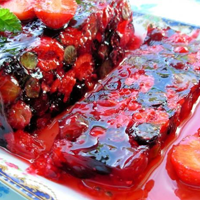
Ingredients
- 110g/4oz strawberries
- 110g/4oz blackberries
- 110g/4oz raspberries
- 110g/4oz blueberries
- 110g/4oz loganberries
- 2 oranges, juice only
- 110g/4oz sugar
- 1 vanilla pod, split lengthways
- 1 cinnamon stick
- 500ml/17fl oz. red wine (something light, for example, pinot noir)
- 300ml/10fl oz. red port
- 8 sheets gelatin
Directions
- In a hot pan place the sugar with the vanilla and cinnamon.
- Start adding the berries, firmest first and softest last, and then the orange juice.
- Cook the berries for approximately 5 minutes and remove from the heat. Chill them in the fridge.
- Warm the wine and port in a pan. Soften the gelatin in a little cold water and slowly add to the wine. Once it is all incorporated place it in a flat container and chill it.
- Once the jelly has been set, place it on a clean cloth and chop the jelly into small crystals, then put it back in the container.
- Spoon the jelly into the center of the plate and drizzle the berries around it to serve.
Loganberry Cake

Ingredients
- 1 1⁄2 cups cake flour
- 2 teaspoons baking powder
- 1⁄4 teaspoon salt
- 1 1⁄2 cups sugar
- 1 egg
- 3⁄4 cup milk
- 2 tablespoons butter, melted
- 1 1⁄2 cups brambleberries (loganberries, youngberries, marionberries, blackberries, or dewberries)
Directions
- Preheat oven to 350F and grease an 8″ round baking pan very well.
- Sift the first three ingredients together with 1/2 cup sugar.
- Beat egg; add milk and butter.
- Combine with dry ingredients only until no dry flour is evident (do not beat).
- Pour into prepared pan and sprinkle top with the berries.
- Cover with the remaining cup of sugar.
- Bake for about 35 minutes.
Loganberry Pie
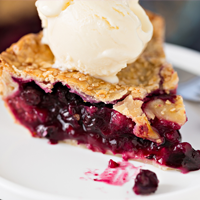
Ingredients
For the filling:
- pie dough for 1 double-crust pie (9-inch) or make from scratch
- 2 cups loganberries (you can use frozen)
- 1 tablespoon sugar
- zest of half a lemon
- pinch of nutmeg
- 1/4 cup orange juice
- 1 tablespoon cornstarch
Directions
For the filling:
- Preheat oven to 400°F.
- Roll the pie dough into a large circle and line your 9-inch pie plate with the dough. Roll the second piece of dough into a large circle and set it aside. This will be used to close the pie.
- In a small bowl combine all your ingredients, making sure to coat evenly.
- Pour your berry mixture into the prepared dough-lined pan.
- Place the top crust over the pie and trim, then crimp the edges.
- Cut vents in the top to allow steam to escape.
- Cover the edges of the pie with foil so it doesn’t burn.
- Bake for 25 minutes then remove the foil.
- Bake for an additional 15 minutes until the filling bubbles.
- Cool on wire rack.
Other Facts
- Each bush can produce 7 kg to 8 kg (15 lb to 18 lb) of fruit a year. Plants continue to fruit for around 15 years.
- A purple to dull blue dye is obtained from the fruit.
- Loganberry is used as a source of breeding material for the development of Rubus hybrids.
Precautions
- Those who are allergic to blackberries and red raspberries and have never had loganberries should take precautions before trying them.
- Loganberries do cause allergic reactions in some people.
- Loganberries are also known to cause weight gain so do not eat handfuls of them if you are trying to lose weight.
- It may not be safe to use loganberry leaves for long periods of time, it may cause nausea and vomiting.
References
- https://www.ncbi.nlm.nih.gov/pmc/articles/PMC3649719/
- https://www.ncbi.nlm.nih.gov/pmc/articles/PMC6315720/
- https://www.ncbi.nlm.nih.gov/pmc/articles/PMC3419346/
- https://www.ncbi.nlm.nih.gov/books/NBK11795/
- https://www.ncbi.nlm.nih.gov/pmc/articles/PMC5291486/
- https://fruits.edpsciences.org/articles/fruits/abs/2012/05/fruits120033/fruits120033.html
- http://www.fao.org/3/cb2395en/CB2395EN.pdf
- https://www.fao.org/in-action/inpho/crop-compendium/fruits-vegetables/en/
- https://www.fao.org/3/cb2395en/online/src/html/fruit-and-vegetables.html
- http://www.fao.org/3/cb2395en/CB2395EN.pdf
- https://en.wikipedia.org/wiki/Fruit
- https://en.wikipedia.org/wiki/List_of_food_plants_native_to_the_Americas
- https://en.wikipedia.org/wiki/List_of_culinary_fruits
- https://www.hsph.harvard.edu/nutritionsource/what-should-you-eat/vegetables-and-fruits/
- https://www.betterhealth.vic.gov.au/health/healthyliving/fruit-and-vegetables
- https://www.cdc.gov/healthyweight/healthy_eating/fruits_vegetables.html
- https://www.botanical-online.com/en/botany/fruits-types-characteristics
- https://www.fda.gov/food/laboratory-methods-food/mpm-v-9-fruits-and-fruit-products-v-51-v-78
- https://www.fda.gov/food/food-labeling-nutrition/nutrition-information-raw-fruits-vegetables-and-fish
- https://onlinelibrary.wiley.com/doi/abs/10.1111/mcn.12208
- http://news.discovery.com/earth/
- https://www.cabi.org/isc/datasheet/
- https://www.science.org/
- https://plants.ces.ncsu.edu/plants/
- https://www.sciencedirect.com/topics/agricultural-and-biological-sciences/fruit-vegetable
- https://www.researchgate.net/publication/
- https://www.ams.usda.gov/grades-standards/fruits
- https://www.aphis.usda.gov/aphis/resources/traveler/intl-travel/fruits-vegetables/fruits-vegetables
- https://snaped.fns.usda.gov/seasonal-produce-guide
- https://www.nass.usda.gov/Publications/Highlights/2015/FruitsNutsBerries_AgCensusHighlights.pdf
- https://plants.usda.gov/home/plantProfile?
- https://www.fs.fed.us/wildflowers/ethnobotany/food/nuts.shtml
- https://downloads.usda.library.cornell.edu/usda-esmis/files/zs25x846c/sf269213r/6t054c23t/ncit0521.pdf
- https://agr.wa.gov/departments/business-and-marketing-support/farm-to-school-toolkit/
- https://health.gov/sites/default/files/2020-01/DGA2000.pdf
- https://www.farmers.gov/archived/cfap2/specialty
- https://www.hsph.harvard.edu/nutritionsource/
- https://www.foodsafety.gov/food-safety-charts/food-safety-during-power-outage
- https://clinicaltrials.gov/ct2/show/
- https://botany.org/home/careers-jobs/careers-in-botany/what-is-botany.html
- https://www.healthbenefitstimes.com/category/fruits
- http://www.hear.org/pier/species/
- https://www.itis.gov/servlet/SingleRpt/SingleRpt?
- http://www.theplantlist.org/tpl1.1/record/
- https://www.fs.fed.us/database/feis/plants/tree/
- https://www.itis.gov/servlet/SingleRpt/SingleRpt?
- https://eol.org/pages/
- https://www.itis.gov/servlet/SingleRpt/SingleRpt?search_topic=TSN&search_value=506229#null
- http://www.hear.org/pier/species/rubus_loganobaccus.htm
- https://pfaf.org/User/Plant.aspx?LatinName=Rubus+loganobaccus
- https://davesgarden.com/guides/pf/go/128862/
- https://plants.usda.gov/core/profile?symbol=RULO11
- http://www.theplantlist.org/tpl1.1/record/rjp-1182
- https://en.wikipedia.org/wiki/Loganberry

