
Nannyberry/Viburnum lentigo scientifically known as nannyberry, sheepberry, or sweet viburnum, is a large deciduous shrub belonging to Caprifoliaceae (Honeysuckle family). The plant is native to northeastern and Midwestern United States and to southern Canada from New Brunswick west to southeastern Saskatchewan. It can also be found in the Dakotas, Wyoming, Colorado, and the Appalachian Mountains as far south as Kentucky and Virginia. Although widespread in eastern North America, this plant is only known to exist in Missouri in low woods and wooded slopes in Schuyler County. Nannyberry, Sweet Viburnum, Blackhaw, Wild Raisin, Sheepberry, Black Haw, Cowberry, Nannyberry Viburnum, Nanny Plum, Sweetberry, and Tea Plant are some of the popular common names of the plant.
| Nannyberry Quick Facts | |
|---|---|
| Name: | Nannyberry |
| Scientific Name: | Viburnum lentago |
| Origin | Northeastern and midwestern United States, and to southern Canada from New Brunswick west to southeastern Saskatchewan |
| Colors | Initially, green turning to red and maturing to blue or black. |
| Shapes | Edible, juicy, berry-like, and ellipse-shaped to nearly spherical, somewhat flattened, 8–16 mm (0.31–0.63 in) long drupe |
| Taste | Sweet |
| Health benefits | Beneficial for measles, painful urination, irregular menstruation, nervous irritation, muscular spasms, cramping, relieves pain, relieves anxiety, respiratory and digestive problems |
Genus name comes from the Latin name of a species plant. Specific epithet means flexible as the twigs are very tough and flexible. Nanny goats apparently feed on the ripe berries (reportedly more so than billy goats), hence the common name. The plant is also known as “sheepberry” because its fruit smells like wet sheep wool when over ripe. Nannyberry is a shade-tolerant, understory species useful in landscape plantings as shrub borders, taller barriers, hedges, and windbreaks. It produces good seasonal displays of flowers, fruits, and fall leaf color. The fruits are sweet and edible and are eaten by many species of birds and wildlife.
Nannyberry Facts
| Name | Nannyberry |
|---|---|
| Scientific Name | Viburnum lentago |
| Native | Northeastern and midwestern United States, and to southern Canada from New Brunswick west to southeastern Saskatchewan. It can also be found in the Dakotas, Wyoming, Colorado, and the Appalachian Mountains as far south as Kentucky and Virginia |
| Common Names | Nannyberry, Sweet Viburnum, Blackhaw, Wild Raisin, Sheepberry, Black Haw, Cowberry, Nannyberry Viburnum, Nanny Plum, Sweetberry and Tea Plant |
| Name in Other Languages | Croatian: Kanadska hudika Czech: Kalina severoamerická Dutch: Peersneeubal English: Nannyberry, sweet viburnum, Black haw, Sheepberry, Nannyberry Viburnum, viorne flexible, Birnenblttriger Schneeball, Schneeball Finnish: Kiiltoheisi French: Viorne a manchette, Viorne flexible, Alises, Alisier, Bourdaine, Viorne lentago, viorne luisante, Germany: Kanadischer Schneeball Italy: Lentaggine Lithuanian: Kanadinis putinas Netherlands: Sneeubal, peer Persian: بداغ Polish: Kalina kanadyjska Swedish: Glansolvon |
| Plant Growth Habit | Deciduous, multi-stemmed shrub or small to medium-sized deciduous tree |
| Growing Climates | Rocky woodlands, mesic woodlands, low woodlands along streams, thickets, roadsides, and fence rows, borders and banks of streams and rivers, fens, sedge meadows, tamarack swamps, shrubby swamps, swamps, borders of the forest, fence corners, rocky hillsides, swamp borders, upland woods, hardwood forest edges, flood plains, lakeshores |
| Soil | Grows best in a rich, moist area with clay-loam soil. It can tolerate both acid and alkaline soils |
| Plant Size | 9 m (30 ft.) tall with a trunk up to 25 cm (10 in) in diameter |
| Root | Roots are fibrous |
| Bark | Grayish-brown and smooth at first, becoming rough and shallowly furrowed with irregular, scaly plates with a few warty bumps and becoming scaly with age |
| Twigs | Pale green and covered with rusty down at first, later becoming dark reddish-brown, sometimes glaucous, smooth, tough, flexible, and produce an offensive odor when crushed or bruised. |
| Wood | Ill-smelling, dark orange-brown, heavy, hard, close-grained, with a density of 0.7303 |
| Leaf | Leaf-blades are relatively thin, broadly egg-shaped to elliptical or broadly elliptical, 2 – 4 inches long, and 1⅜ – 2⅜ inches wide |
| Flowering season | May to June |
| Flower | Flowers are 1/8 – 5⁄16 inches in diameter. There are five sepals, five petals, five stamens, and no style. The sepals are green, fused for most of their length into a minute cup (calyx), and separated at the tip into five-minute, egg-shaped lobes. The petals are pale yellow to creamy white, egg-shaped to elliptical, and 1 ⁄16 – 1/8 inches long |
| Fruit Shape & Size | Edible, juicy, berry-like, and ellipse-shaped to nearly spherical, somewhat flattened, 8–16 mm (0.31–0.63 in) long drupe |
| Fruit Color | Initially, green turning to red and maturing to blue or black |
| Flavor/Aroma | Refreshingly sweet-sour smell |
| Taste | Sweet |
| Plant Parts Used | Dried bark |
| Lifespan | About 8-10 weeks |
| Season | September to October |
| Precautions |
|
Nannyberry Scientific Classification
Scientific Name: Viburnum lentago
| Rank | Scientific Name & (Common Name) |
|---|---|
| Kingdom | Plantae (Plants) |
| Subkingdom | Tracheobionta (Vascular plants) |
| Infrakingdom | Streptophyta (land plants) |
| Superdivision | Spermatophyta (Seed plants) |
| Division | Magnoliophyta (Flowering plants) |
| Sub Division | Spermatophytina (spermatophytes, seed plants, phanérogames) |
| Class | Magnoliopsida (Dicotyledons) |
| Subclass | Asteridae |
| Super Order | Asteranae |
| Order | Dipsacales |
| Family | Caprifoliaceae (Honeysuckle family) |
| Genus | Viburnum L. (viburnum) |
| Species | Viburnum lentago L. (nannyberry) |
| Synonyms |
|
Plant Description
Nannyberry is a deciduous, multi-stemmed shrub or small to the medium-sized deciduous tree that normally grows about 9 m (30 ft.) tall with a trunk up to 25 cm (10 in) in diameter. The plant is found growing in rocky woodlands, mesic woodlands, low woodlands along streams, thickets, roadsides, and fence rows, borders and banks of streams and rivers, fens, sedge meadows, tamarack swamps, shrubby swamps, swamps, borders of the forest, fence corners, rocky hillsides, swamp borders, upland woods, hardwood forest edges, flood plains, and lakeshores. The plant grows best in a rich, moist area with clay-loam soil. It can tolerate both acid and alkaline soils. The plant rises from scattered, deep, anchoring roots and shallow, branched, fibrous, soil-binding roots. The roots have buds that may sprout and form above-ground stems (suckers). When conditions permit, it forms colonies that may become large and dense. Nannyberry is leggy and somewhat open at maturity with an irregular to rounded crown. Suckers often form at the base.
Twigs
Twigs are slender, long, flexible, and round or somewhat six-sided. First-year twigs are pale green and covered with downy, rust-colored hairs at first, becoming gray or dull grayish-brown, smooth, and hairless. Second-year twigs are brown to reddish-brown or grayish-brown and maybe somewhat covered with a whitish, waxy bloom (glaucous). The twigs have an unpleasant odor when bruised. The pith is white and solid. The leaf scars are narrow, crescent-shaped, and slightly raised. Each leaf scar has three bundle scars. The terminal bud is brownish-gray, hairless, ¾ inches to 1¼ inches long, oblong cone-shaped, and somewhat flattened, with a swollen, bulbous base and a long, tapered tip. It is covered by two sharply pointed, abutting but not overlapping, sharply-pointed scales. Lateral buds are about half as long, are not swollen at the base, and are often curved.
Bark
The bark is grayish-brown and smooth at first, becoming rough and shallowly furrowed with irregular, scaly plates with a few warty bumps and becoming scaly with age. Young stems can also have a rusty-brown downy appearance. When broken, the bark has a skunk-like odor. The flower buds that form on the tips of last year’s twigs are distinctive with a round base tapering to a long pointed spire.
Leaves
Leaves are opposite, undivided (simple), and deciduous. They are attached to the twig on a ⅝ inches to 1¼ inches long leaf stalk (petiole). The petiole is channeled on the upper side and has conspicuous wavy wings. It is moderately to densely covered with microscopic, red, star-shaped hairs when young, becoming hairless or nearly hairless at maturity. There are no projecting glands near the attachment of the leaf blade. There are no leaf-like appendages (stipules) at the base of the petiole. The leaf blades are relatively thin, broadly egg-shaped to elliptical or broadly elliptical, 2 – 4 inches long, and 1⅜ – 2⅜ inches wide. They are rounded or broadly tapered at the base and taper to a short, sharp point at the tip with concave sides along the tip. They are pinnately veined. The lateral veins are evenly spaced, curve toward the tip, and form a network with adjacent veins without reaching the margin. The upper surface is dark green or yellowish-green and glossy, with scattered, microscopic, red, star-shaped hairs when young, becoming hairless at maturity. The lower surface is pale green with tiny, dark brown dots. The margins have more than 25 fine, sharp, forward-pointing teeth on each side. The leaves turn red or reddish-purple in the fall.
Flower
The inflorescence is a dense, rounded, shallowly convex, 2 – 4 inch in diameter, branched cluster (cyme) at the ends of the current-year branches. The cymes have usually 3 to 5, sometimes up to 7, main branches originating from the tip of the branch. Each cyme has a few hundred to several hundred small flowers.
Flowers are 1/8 – 5⁄16 inches in diameter. There are five sepals, five petals, five stamens, and no style. The sepals are green, fused for most of their length into a minute cup (calyx), and separated at the tip into five-minute, egg-shaped lobes. The petals are pale yellow to creamy white, egg-shaped to elliptical, and 1 ⁄16 – 1/8 inches long. The stamens have white filaments and bright yellow anthers. They are 1/8 – 3 ⁄16 inches long, longer than the petals. There is a three-lobed, stalkless stigma on a short disk (stylopodium) at the top of the ovary. The flowers on the margin are fertile and are similar in appearance and size to the other flowers. The flowers are not fragrant. Flower stalks are hairless and green to red. They appear in mid-May to early June.
Fruits
Fertile flowers are followed by edible, juicy, berry-like, and ellipse-shaped to nearly spherical, somewhat flattened, 8–16 mm (0.31–0.63 in) long drupe that hangs from the reddish stem. The fleshy interior of each drupe is somewhat juicy and sweet, tasting like a raisin or date. drupes consist of a single large stone seed that occupies much of the volume of the drupe. The stone is oblong oval, flattened and dark-colored. The fruit is initially green turning to bluish-black and glaucous at maturity. The calyx and stigma persist in fruit, forming a dried tip at the end (apex) of the drupe. The pedicels turn red as the fruit matures. The fruit ripens in late August to late September, often remaining on the plant through the winter.
The ripe fruit is eaten by many birds and animals usually after it has frozen and thawed as the fruit then turns sweet. Overripe fruit smells like wet sheep wool, hence one of the alternate common names of Sheepberry. Humans will find the fruit barely palatable. Cooking has not found it any better.
Varieties of Nannyberry
There are a few subspecies of Nannyberry found and they are-
- Wayfaring Tree Viburnum
- Arrowwood Viburnum
- American Cranberrybush
- European Cranberrybush
Traditional uses and benefits of Nannyberry
- Bark and leaves were also used by Native Americans in the preparation of herbal medicines.
- An infusion of the leaves has been used in the treatment of measles.
- An infusion of the leaves has been drunk, or a poultice of leaves applied, in the treatment of dysuria (painful urination).
- The bark is antispasmodic.
- Decoction of the roots has been used to treat irregular menstruation and the spitting of blood.
- The juice taken from the nannyberry brings benefits to those suffering from digestive ills.
- Tea rendered from the tree bark has antispasmodic properties, making it a good choice to relax muscular spasms and cramping.
- Teas made from the leaves have been used to treat cases of measles.
- The juice taken from the nannyberry brings benefits to those suffering from digestive ills and menstrual problems as well as relieves pain and relieves anxiety.
- The leaves of this fruit and also the juice extract from the bark, seeds, and berries are useful in treating respiratory diseases, digestive and menstrual problems.
- The bark of the tree is antispasmodic which relaxes muscle spasms and cramps and also calms nervous irritation.
Culinary Uses
- Fruit can be consumed raw or cooked.
- Berry is used for making tea, jam, jelly, and dried fruit.
- It can be crushed into a smoothie or milkshake, like other berries.
- Nannyberry extracts are used as an ingredient in pies, cakes, sorbets, and other desserts.
- They are also used as appetizers and in cheese platters.
- These berries can be dried and eaten later as a snacking item.
Other Facts
- This plant can be used as a hedge.
- Wood is heavy, hard, close-grained, and malodorous.
- Medium to large shrubs of this plant can be used as windbreaks in farms.
- The trees can also be used as shrub borders, tall barriers, and hedges.
- They can be used as Agro-forestry products-cut or dried flowers, fresh, dried, and processed fruits.
- The bark can be used to make tea.
Recipes
Nannyberry-Maple Butter
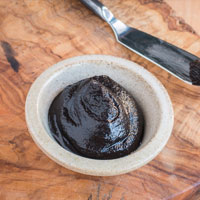
Ingredients
- 10 cups nannyberries
- 7 cups water
Directions
- Wash the nannyberries well and drain, then combine with the water, bring to a simmer, and cook for 40-45 minutes on low heat, mashing them up to extract a thick puree.
- Pass the mixture through a food mill or strainer while hot, and discard the seeds.
- To finish the nannyberry-maple butter add 1 cup maple to the above yield of puree, then process in a blender in batches to make it extra smooth.
- Bake, whisking occasionally for about 30-45 minutes at 325 or until you can notice the evaporation and the mixture is thickened to your liking. A good pinch of cinnamon is great too.
Nannyberry Pudding
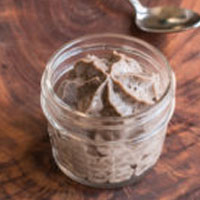
Ingredients
Nannyberry Pudding
- ¾ cup very thick nannyberry butter See recipe here
- 1 cup half and half
- 3/4 cup sugar
- 4 tablespoons cornstarch + 4 Tablespoons water
- 1 tablespoon fresh lemon juice
- ½ teaspoon orange zest to taste
- ¼ teaspoon cinnamon
- 4 tablespoons unsalted butter
- Good pinch of salt
Final Mousse
- 1 cup heavy cream
Directions
Nannyberry Pudding
- Oil a small 3-4 cup souffle mold, or individual custard dishes, then line with cling film.
- Mix the cornstarch, ¼ cup sugar, egg yolks, orange zest, lemon, and water to make a slurry.
- Heat the nannyberry butter and the half and half, whisking, until hot and steaming, but not boiling.
- Stir in the cornstarch-egg slurry and whisk constantly, keeping the heat at medium, until the mixture thickens, then turn the heat down to as low as possible and continue whisking for a few minutes more, or until you can tell the cornstarch is completely activated.
- Take the pan off the heat and whisk in the butter, then transfer the pudding to the prepared mold(s) and refrigerate overnight, or until the pudding is set and able to be unmolded.
Nannyberry Mousse
- Whip 1 cup of cream to soft peaks and gently fold into the pudding when it’s completely cooled to room temperature, then refrigerate.
- Before serving, spoon the mousse into custard cups.
- Good garnishes could be fruit coulis, orange custard sauce, persimmons, and or toasted nuts, especially black walnuts.
References
- https://www.ncbi.nlm.nih.gov/pmc/articles/PMC3649719/
- https://www.ncbi.nlm.nih.gov/pmc/articles/PMC6315720/
- https://www.ncbi.nlm.nih.gov/pmc/articles/PMC3419346/
- https://www.ncbi.nlm.nih.gov/books/NBK11795/
- https://www.ncbi.nlm.nih.gov/pmc/articles/PMC5291486/
- https://fruits.edpsciences.org/articles/fruits/abs/2012/05/fruits120033/fruits120033.html
- http://www.fao.org/3/cb2395en/CB2395EN.pdf
- https://www.fao.org/in-action/inpho/crop-compendium/fruits-vegetables/en/
- https://www.fao.org/3/cb2395en/online/src/html/fruit-and-vegetables.html
- http://www.fao.org/3/cb2395en/CB2395EN.pdf
- https://en.wikipedia.org/wiki/Fruit
- https://en.wikipedia.org/wiki/List_of_food_plants_native_to_the_Americas
- https://en.wikipedia.org/wiki/List_of_culinary_fruits
- https://www.hsph.harvard.edu/nutritionsource/what-should-you-eat/vegetables-and-fruits/
- https://www.betterhealth.vic.gov.au/health/healthyliving/fruit-and-vegetables
- https://www.cdc.gov/healthyweight/healthy_eating/fruits_vegetables.html
- https://www.botanical-online.com/en/botany/fruits-types-characteristics
- https://www.fda.gov/food/laboratory-methods-food/mpm-v-9-fruits-and-fruit-products-v-51-v-78
- https://www.fda.gov/food/food-labeling-nutrition/nutrition-information-raw-fruits-vegetables-and-fish
- https://onlinelibrary.wiley.com/doi/abs/10.1111/mcn.12208
- https://www.cabi.org/isc/datasheet/
- https://www.science.org/
- https://www.sciencedirect.com/topics/agricultural-and-biological-sciences/fruit-vegetable
- https://www.researchgate.net/publication/
- https://www.ams.usda.gov/grades-standards/fruits
- https://www.aphis.usda.gov/aphis/resources/traveler/intl-travel/fruits-vegetables/fruits-vegetables
- https://snaped.fns.usda.gov/seasonal-produce-guide
- https://www.nass.usda.gov/Publications/Highlights/2015/FruitsNutsBerries_AgCensusHighlights.pdf
- https://plants.usda.gov/home/plantProfile?
- https://www.fs.fed.us/wildflowers/ethnobotany/food/nuts.shtml
- https://downloads.usda.library.cornell.edu/usda-esmis/files/zs25x846c/sf269213r/6t054c23t/ncit0521.pdf
- https://agr.wa.gov/departments/business-and-marketing-support/farm-to-school-toolkit/
- https://health.gov/sites/default/files/2020-01/DGA2000.pdf
- https://www.farmers.gov/archived/cfap2/specialty
- https://www.hsph.harvard.edu/nutritionsource/
- https://www.foodsafety.gov/food-safety-charts/food-safety-during-power-outage
- https://clinicaltrials.gov/ct2/show/
- https://botany.org/home/careers-jobs/careers-in-botany/what-is-botany.html
- https://www.healthbenefitstimes.com/category/fruits
- http://www.hear.org/pier/species/
- https://www.itis.gov/servlet/SingleRpt/SingleRpt?
- http://www.theplantlist.org/tpl1.1/record/
- https://www.fs.fed.us/database/feis/plants/tree/
- https://www.itis.gov/servlet/SingleRpt/SingleRpt?search_topic=TSN&search_value=504625#null
- https://pfaf.org/user/Plant.aspx?LatinName=Prunus+pumila
- https://www.cabi.org/isc/datasheet/44333
- https://en.wikipedia.org/wiki/Prunus_pumila
- https://plants.usda.gov/core/profile?symbol=PRPU3
- https://gobotany.nativeplanttrust.org/species/prunus/pumila/
- https://www.minnesotawildflowers.info/shrub/sand-cherry
- http://temperate.theferns.info/viewtropical.php?id=Prunus+pumila
- https://gd.eppo.int/taxon/PRNPU

