
RX Patient Tools
Use these quick guides before reading the article, or return to them when you need help preparing questions for a doctor.
Mangifera pajang is a species of tree in the family Anacardiaceae. It is endemic to Borneo, where it is known by the native name Bambangan.
Compared to other mangoes, Borneo’s bambangan stands out for a few reasons. It looks different, with rough brown skin and a hefty size (a single fruit can reach more than five pounds). It smells different, with ripe varieties emitting a funky, durian-like aroma. And it certainly tastes different, with a savoriness reminiscent of French onion soup and eggs hovering over a base of sourness.
Most mango lovers have enjoyed only the common mango, also known as Mangifera indica. The bambangan, however, is Mangifera pajang. Labeled as a vulnerable species by the International Union for Conservation of Nature, the rare variety is found only on the island of Borneo, particularly in the state of Sabah.
| Bambangan Quick Facts | |
|---|---|
| Name: | Bambangan |
| Scientific Name: | Mangifera pajang |
| Origin | Borneo – Sarawak, Sabah, Brunei, Kalimantan |
| Colors | Potato Brown |
| Shapes | Drupe, brownish, globose to broad-ovoid, 15–20 cm across, roughish fruit |
| Flesh colors | Bright deep yellowish flesh |
| Taste | Taste sweet if the fruits fall to the ground but taste sour when it is unripe |
Mangifera pajang or bambangan is actually a fruit found only in Borneo, which includes the Brunei sultanate, Kalimantan province of Indonesia, and the Malaysian states of Sabah and Sarawak. The fruit is known in Borneo with its native name, Bambangan. It is a species of plant in the Anacardiaceae family. Some of the popular common names of the fruit are Bambangan, Pajang, Membangan, and Wild Mango. This fruit is used locally as food, the kernel sometimes being used to make pickles.
Plant Description
Bambangan is a tall, perennial, deciduous medium-sized tree, 15–50 m high with huge, inaccessible columnar straight trunk with branches raised high above the ground and a bole of 30–70 cm with grey or sometimes dark brown, smooth, or broadly fissured bark and an umbrella-shaped canopy high up the tree. The plant is found growing wild in the forests where the tropical agro-climatic regime is humid and shaded. For instance in the lowland dipterocarp forest and in forests on well-drained alluvial soils. Areas with heavy rainfall and strong wind are not suited as conditions are detrimental to flower induction and fruit set. It can withstand prolonged dry weather and flooding and can be grown on a wide range of soils including upland soils. It thrives best on, well-drained alluvial clay to sandy loam with a pH ranging from 5 to 7. It cannot tolerate acid peat swamps or the leached coastal sandy beaches.
Leaves
Mature leaves are rigidly coriaceous, elliptic-oblong or occasionally obovate-oblong, 17.5– 45 cm long by 7–15 cm wide, cuneate to attenuated base, acute to mucronate apex, entire margin, with 14–30 pairs of prominent nerves, usually dark green in color and borne on petioles up to 12 cm long. Young flushes are bronze to pink in color. Panicles are terminal and also in upper leaf axils, pyramidal, to 30 cm long with lateral branches up to 1 cm long and densely flowered.
Flower & Fruit
The inflorescence is a terminal and subterminal panicle, erect, pyramidal, up to 30 cm long, densely flowered, glabrous, fragrant. Flowers are 5-merous, petals up to 9 mm long, outside pinkish-white, inside purple, becoming yellowish after anthesis, with 3 ridges confluent at the base, disk stipe-like, one or two stamens fertile, staminodes smaller and unequal, filaments connate at base; ovary white. Fruit is a drupe, brownish, globose to broad-ovoid, 15–20 cm across, roughish fruit that have thick rind about 5–10 mm thick and is peeled like a banana. Inside the thick skin is a bright deep yellowish flesh that is fibrous, sweet-acid, pleasantly aromatic. The fruit weighs about 2-3 kg. The fruit consists of a single stone plump that is 9 cm × 6.5 cm × 4.5 cm, endocarp is woody, up to 5 mm thick, and seed is mono embryonic.
History
The plant is native to Borneo – Sarawak, Sabah, Brunei, and Kalimantan. The species is found mostly wild in the forests or in scattered backyard plantings in villages. Areas of wild distribution are found mostly around Kapit, Ulu Dapoi, Long Silat in Sarawak; Sipitang, Sandakan, Beaufort in Sabah; Sangkulirang and west Kutei in Kalimantan. Nowadays it can be found in several parts of the world due to its amazing features.
Culinary uses of Bambangan
- Thick, acid sweet, and mildly banana flavored, fibrous pulp is eaten fresh.
- The thick skin is edible when pickled or eaten fresh with sambal belacan.
- One food item that is widely consumed in the Kadazan-dusun community in Sabah is the ‘nonsom Bambangan’ or ‘jeruk Bambangan’.
- In Sarawak, the acid fruits are eaten with sambal belacan or cooked in a curry.
- Fresh young leaf flushes are sold in local markets and are cooked and consumed with sambal belacan or tempoyak.
- The peel, which possesses an aromatic smell, is sometimes used in the cooking of local dishes.
- Thick skin is added in the curry to give mangoes aroma, and can also be eaten after being pickled.
- Kernel or the seed is sometimes used with the flesh for making pickles.
Lists of delicacies of Bambangan Fruit
- Pickle Bambangan Fruit
- Fish Soup with cut Bambangan
- Stir-fry Salted Fish, pickle Bambangan, and Chili.
Bambangan Pickles
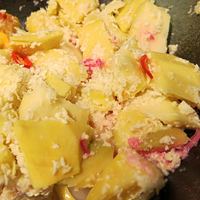
Ingredients:
- 2-3 unripe Bambangan ( peeled & sliced the pulps into cubes )
- Cut split the seed.
- Grate the inner seed.
- Bird’s eye chilies to taste
- Salt to taste
Method
- Mix all the above ingredients together.
- Put them into a clean container & cover them tightly.
- Keep the container at room temperature for 1 week.
- Pickled Bambangan goes really well with plain white rice & deep-fried fish.
Pickled fish with bambangan fruit
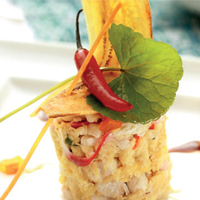
Ingredients
- 500 g mackerel (ikan tenggiri)
- 60 g lime juice
- 30 g bambangan fruit (local fruit), diced
- 10 g red chili, chopped
- 4 g green bird’s eye chili, sliced
- 10 g ginger, minced
- 10 g shallot, sliced
- 3 g pickled papaya, sliced
- 3 g salt
- 2 g sugar
- 2 tbsp palm oil
Methods
- Prepare mackerel by washing it well, removing the bone and skin with a sharp knife, and then cutting it into small pieces.
- Transfer the fish into a bowl and add the lime juice, bambangan fruit, chilies, ginger shallot, pickled papaya, salt, sugar, and palm oil, mixing all together. Let it stand for 5 minutes and serve.
References
- https://www.ncbi.nlm.nih.gov/pmc/articles/PMC3649719/
- https://www.ncbi.nlm.nih.gov/pmc/articles/PMC6315720/
- https://www.ncbi.nlm.nih.gov/pmc/articles/PMC3419346/
- https://www.ncbi.nlm.nih.gov/books/NBK11795/
- https://www.ncbi.nlm.nih.gov/pmc/articles/PMC5291486/
- https://fruits.edpsciences.org/articles/fruits/abs/2012/05/fruits120033/fruits120033.html
- http://www.fao.org/3/cb2395en/CB2395EN.pdf
- https://www.fao.org/in-action/inpho/crop-compendium/fruits-vegetables/en/
- https://www.fao.org/3/cb2395en/online/src/html/fruit-and-vegetables.html
- http://www.fao.org/3/cb2395en/CB2395EN.pdf
- https://en.wikipedia.org/wiki/Fruit
- https://en.wikipedia.org/wiki/List_of_food_plants_native_to_the_Americas
- https://en.wikipedia.org/wiki/List_of_culinary_fruits
- https://www.hsph.harvard.edu/nutritionsource/what-should-you-eat/vegetables-and-fruits/
- https://www.betterhealth.vic.gov.au/health/healthyliving/fruit-and-vegetables
- https://www.cdc.gov/healthyweight/healthy_eating/fruits_vegetables.html
- https://www.botanical-online.com/en/botany/fruits-types-characteristics
- https://www.fda.gov/food/laboratory-methods-food/mpm-v-9-fruits-and-fruit-products-v-51-v-78
- https://www.fda.gov/food/food-labeling-nutrition/nutrition-information-raw-fruits-vegetables-and-fish
- https://onlinelibrary.wiley.com/doi/abs/10.1111/mcn.12208
- http://news.discovery.com/earth/
- https://www.cabi.org/isc/datasheet/
- https://www.science.org/
- https://plants.ces.ncsu.edu/plants/
- https://www.sciencedirect.com/topics/agricultural-and-biological-sciences/fruit-vegetable
- https://www.researchgate.net/publication/
- https://www.ams.usda.gov/grades-standards/fruits
- https://www.aphis.usda.gov/aphis/resources/traveler/intl-travel/fruits-vegetables/fruits-vegetables
- https://snaped.fns.usda.gov/seasonal-produce-guide
- https://www.nass.usda.gov/Publications/Highlights/2015/FruitsNutsBerries_AgCensusHighlights.pdf
- https://plants.usda.gov/home/plantProfile?
- https://www.fs.fed.us/wildflowers/ethnobotany/food/nuts.shtml
- https://downloads.usda.library.cornell.edu/usda-esmis/files/zs25x846c/sf269213r/6t054c23t/ncit0521.pdf
- https://agr.wa.gov/departments/business-and-marketing-support/farm-to-school-toolkit/
- https://health.gov/sites/default/files/2020-01/DGA2000.pdf
- https://www.farmers.gov/archived/cfap2/specialty
- https://www.hsph.harvard.edu/nutritionsource/
- https://www.foodsafety.gov/food-safety-charts/food-safety-during-power-outage
- https://clinicaltrials.gov/ct2/show/
- https://botany.org/home/careers-jobs/careers-in-botany/what-is-botany.html
- https://www.healthbenefitstimes.com/category/fruits
- http://www.hear.org/pier/species/
- https://www.itis.gov/servlet/SingleRpt/SingleRpt?
- http://www.theplantlist.org/tpl1.1/record/
- https://www.fs.fed.us/database/feis/plants/tree/
- https://www.itis.gov/servlet/SingleRpt/SingleRpt?
- https://eol.org/pages/
- https://npgsweb.ars-grin.gov/gringlobal/taxonomydetail.aspx?id=316159
- http://tropical.theferns.info/viewtropical.php?id=Mangifera+pajang
- https://en.wikipedia.org/wiki/Mangifera_pajang
- http://www.catalogueoflife.org/col/details/species/id/86f4ece12f12c9931adb86e3c5881d0f
- http://www.academicjournals.org/journal/JMPR/article-full-text-pdf/1F683BD41963
- https://uses.plantnet-project.org/en/Mangifera_pajang_(PROSEA)

