
Ribes rubrum is a deciduous shrub normally growing to 1–1.5 meters (3–5 ft) tall, occasionally 2 m (7 ft), with five-lobed leaves arranged spirally on the stems. The flowers are inconspicuous yellow-green, in pendulous 4–8 cm (1+1⁄2–3+1⁄4 in) racemes, maturing into bright red translucent edible berries about 8–12 mm (3⁄8–1⁄2 in) diameter, with 3–10 berries on each raceme. An established bush can produce 3–4 kg (7–9 lb) of berries from mid to late summer.[rx]
| Redcurrants Quick Facts | |
|---|---|
| Name: | Redcurrants |
| Scientific Name: | Ribes rubrum |
| Origin | Western Europe and Northern Asia |
| Colors | Pale green turning to bright red translucent as mature |
| Shapes | Smooth skinned, globose, pleasantly acid, glabrous, about 8–12 mm diameter |
| Taste | Tart and sour |
| Calories | 63 Kcal./cup |
| Major nutrients | Vitamin C (51.00%) Iron (14.00%) Copper (13.33%) Total dietary Fiber (12.63%) Carbohydrate (11.89%) |
| Health benefits | Beautiful Skin, Boost your Blood, Strong Immune System, Constipation, Heart-Healthy, Weight loss |
Redcurrant scientifically known as Ribes rubrum is a small, deciduous low-growing shrub in the Grossulariaceae (currant and gooseberry genus, although in many classifications formerly included in Saxifragaceae), native to northern Europe and northern Asia, which is widely cultivated for its fruit both commercially and in home gardens. Other red-fruited wild and cultivated currant species that may be known as red currants include R. sativum, sometimes called the cherry currant, as well as R. petraeum, R. longeracemosum, and R. multiflorum. Apart from red currants it is also known as Cultivated Currant, Common Currant, Garden Currant, Reps, Ribs, Risp, White Currant.
Red Currants Facts
The redcurrant (Ribes rubrum) is a member of the genus Ribes in the gooseberry family Grossulariaceae. The plant is native to parts of Western Europe (Belgium, France, Norway, Sweden, Germany, the Netherlands, northern Italy, northern Spain, Portugal, and Poland). The tart flavor of the redcurrant fruit is somewhat greater than the blackcurrant; however, they have got same approximate sweetness. Redcurrants are usually grown for jams and cooked preparations, but are used for salads, garnishes, or drinks.
| Name | Red currant |
|---|---|
| Scientific Name | Ribes rubrum |
| Native | Native to parts of western Europe (Belgium, France, Germany, Netherlands, Northern Italy Northern Spain and Portugal) and Northern Asia |
| Common Names | Cultivated Currant, Common Currant, Garden Currant, Red Currant, Reps, Ribs, Risp, White Currant. |
| Name in Other Languages | Arabic: Kishmish Ahmar, Nnbaq hhmar (Morocco), Chinese: Ru Hong Cu Li (如红醋 栗), Ōuzhōu hóng suì cù lì (欧洲红穗醋栗), Hóngguǒ chá biāo (红果茶藨), Hóngchá biāo zi (红茶藨子), Hóng cù lì (红醋栗), ong cha biao zi Czech: Meruzalka Červená, Rybíz Červený Danish: Have-Ribs, Ribs Dutch: Ribes Sort, Rode Aalbes, Rode Bessen, Rodetrosbes, Witte Aalbes Eastonian: Punane Sõstar English: Common Currants, garden currant, Red Currant, red garden currant, white currants, European red currant, cultivated red currant, garden red currant, northern red currant, Finnish: Herukka, Lännenpunaherukka, Punaherukka, Valkea Viinimarja, Valkoherukka, Viinimarja French: Groseillier À Grappes, Groseillier Commun, Groseillier Rouge, Raisin-De-Mars, Groseillier en épi, Groseillier à maquereaux German: Garten-Johannisbeere, Gewöhnliche Johannisbeere, Johannisbeere Johannisbeerstrauch, Ribisel, Rote Johannisbeere, Weiße Johannisbeere Greek: Fragostafyla Kokkina, Fragostafylla, Fragostafylo Hungarian: Kerti Ribiszke, Piros Ribiszke, Ribizke, Ribizli, Termesztett Ribiszke, Vadegres, Vörös Ribiszke Icelandic: Rauð Hlaupber Italian: Ribes Rosso, Ribisi Japanese: Aka Fusa Suguri (ア カフサスグリ), Aka-Suguri, Shiro, Fusa Suguri, Shiromi fusasuguri (白実房スグ) Korean: Pulgunkkachibapnamu, Pulgunsongimulaengdunamu Morocco: Nnbaq Hhmar ( Arabic ) Norwegian: Hagerips Polish: Czerwona Porzeczka, Porzeczka Czerwona, Porzeczka Zwyczajna Portuguese: Groselheira Vermelha Russian: Smorodina, смородина, smorodina krasnaâ Slovašcina: Grozdičje Rdeče Slovencina: Ríbezľa Červená Spanish: Grosella Colorada, Grosella Roja, Grosellero Común, Grosellero Rojo Swedish: Röda Vinbär , Trädgårdsvinbär, lännenpunaherukka |
| Plant Growth Habit | Small, deciduous shrub |
| Growing Climate | Extremely cold hardy, have long chilling requirements, intolerant of summer heat and have short maturity. |
| Soil | Thrives in organically rich, medium moisture, well-drained loamy soil. |
| Plant Size | 1 to 1.5 m (3 to 4.5 ft.) in height |
| Stem | Smooth or gland tipped hairy stems |
| Leaf | Alternate and simple, with 3 to 5 coarsely toothed lobes; the terminal lobe is longer than the side lobes. |
| Flower | Inconspicuous, yellow-green, pentamerous in 10–20 flowered, 4–8 cm long pendulous racemes, campanulate (bell-shaped), with 5 purplish petals at the end. |
| Fruit Shape & Size | Smooth skinned, globose, pleasantly acid, glabrous, about 8–12 mm diameter, with 3–10 berries on each raceme |
| Fruit Color | Pale green maturing into bright red translucent |
| Taste | Tart and sour |
| Seed | 3-12 tiny edible seeds |
| Plant Parts Used | Fruit |
| Major Nutrition | Vitamin C (Ascorbic acid) 45.9 mg (51.00%) Iron, Fe 1.12 mg (14.00%) Copper, Cu 0.12 mg (13.33%) Total dietary Fiber 4.8 g (12.63%) Carbohydrate 15.46 g (11.89%) Vitamin K (phylloquinone) 12.3 µg (10.25%) Manganese, Mn 0.208 mg (9.04%) Phosphorus, P 49 mg (7.00%) Potassium, K 308 mg (6.55%) Vitamin B6 (Pyridoxine) 0.078 mg (6.00%) |
| Calories in 1 cup (112 gm) | 63 K cal |
| Health Benefits |
Weight loss |
Redcurrant Scientific Classification
Scientific Name: Ribes rubrum
| Rank | Scientific Name & (Common Name) |
|---|---|
| Kingdom | Plantae (Plants) |
| Subkingdom | Tracheobionta (Vascular plants) |
| Infrakingdom | Streptophyta (land plants) |
| Superdivision | Spermatophyta (Seed plants) |
| Division | Magnoliophyta (Flowering plants) |
| Class | Magnoliopsida (Dicotyledons) |
| Subclass | Rosidae |
| Order | Rosidae |
| Family | Grossulariaceae (Currant family) |
| Genus | Ribes L. (currant) |
| Species | Ribes rubrum L. (cultivated currant) |
| Synonyms |
|
Plant Description
Growth Habit
Redcurrant is a deciduous shrub, fast-growing under ideal conditions. The plant is a multiple-stemmed clump, 1 to 1.5 m (3 to 4.5 ft.) in height, but is suitable for training as a standard. Annual growth is in a single flush in spring. The roots are superficial, fine, and easily damaged by frequent cultivation. The plants are extremely cold hardy, have long chilling requirements, intolerant of summer heat, and have short maturity, and thrive in organically rich, medium moisture, well-drained loamy soil.
Foliage
The leaves are alternate, single, lobed, and maple-like with 3 to 5 coarsely toothed lobes; the terminal lobe is longer than the side lobes. Black currant leaves are pale green, while those of the redcurrant are deep blue-green. Both are easily burned by strong sunlight. Leaf size and number are decreased under water stress.
Flowers
Currant flowers are borne toward the bases of one-year-old stems and on spurs on older stems. They appear in early spring with new growth. Each flower bud opens to a number of flowers (up to 20), joined together on a delicate, drooping 5 – 6 inch stem, and called a strig. The strig length is reduced or flowering is suppressed by lack of winter chill. Individual flowers (green in the case of redcurrants and blush pink for black currants) are not showy but joined together on the strig they give the bush a lacy texture. Depending upon the cultivar, fruits ripen from 70 to 100 days after blossoming.
Fruit
Fully set strigs will be a pendulous chain of small berries. The fruit is easier to pick if their strigs are long and have “handles” (clear lengths at the bases) for holding onto while harvesting. Black currants commonly ripen from the top-down, encouraging birds to strip berries as they color. Modern redcurrant varieties have been selected for their ability to ripen all the berries on a strig at once. Berries are smooth-skinned, globose, pleasantly acid, glabrous, about 8–12 mm diameter, with 3–10 berries on each raceme. The berries contain 3 – 10 minute, bony seeds.
Nutritional value of Redcurrant raw
Calories 63 K cal. Calories from Fat 1.98 K cal.
| Proximity | Amount | % DV |
|---|---|---|
| Water | 94.02 g | N/D |
| Energy | 63 Kcal | N/D |
| Energy | 262 kJ | N/D |
| Protein | 1.57 g | 3.14% |
| Total Fat (lipid) | 0.22 g | 0.63% |
| Ash | 0.74 g | N/D |
| Carbohydrate | 15.46 g | 11.89% |
| Total dietary Fiber | 4.8 g | 12.63% |
| Total Sugars | 8.25 g | N/D |
| Sucrose | 0.68 g | N/D |
| Glucose (dextrose) | 3.61 g | N/D |
| Fructose | 3.95 g | N/D |
| Minerals | Amount | % DV |
|---|---|---|
| Calcium, Ca | 37 mg | 3.70% |
| Iron, Fe | 1.12 mg | 14.00% |
| Magnesium, Mg | 15 mg | 3.57% |
| Phosphorus, P | 49 mg | 7.00% |
| Potassium, K | 308 mg | 6.55% |
| Sodium, Na | 1 mg | 0.07% |
| Zinc, Zn | 0.26 mg | 2.36% |
| Copper, Cu | 0.12 mg | 13.33% |
| Manganese, Mn | 0.208 mg | 9.04% |
| Selenium, Se | 0.7 µg | 1.27% |
| Vitamins | Amount | % DV |
|---|---|---|
| Water-soluble Vitamins | ||
| Vitamin B1 (Thiamin) | 0.045 mg | 3.75% |
| Vitamin B2 (Riboflavin) | 0.056 mg | 4.31% |
| Vitamin B3 (Niacin) | 0.112 mg | 0.70% |
| Vitamin B5 (Pantothenic acid) | 0.072 mg | 1.44% |
| Vitamin B6 (Pyridoxine) | 0.078 mg | 6.00% |
| Vitamin B9 (Folate) | 9 µg | 2.25% |
| Folate, food | 9 µg | N/D |
| Folate, DEF | 9 µg | N/D |
| Choline | 8.5 mg | 1.55% |
| Vitamin C (Ascorbic acid) | 45.9 mg | 51.00% |
| Fat-soluble Vitamins | ||
| Vitamin A, RAE | 2 µg | 0.29% |
| Vitamin A, IU | 47 IU | N/D |
| Beta Carotene | 28 µg | N/D |
| Lutein + zeaxanthin | 53 µg | N/D |
| Vitamin E (alpha-tocopherol) | 0.11 mg | 0.73% |
| Vitamin K (phylloquinone) | 12.3 µg | 10.25% |
| Lipids | Amount | % DV |
|---|---|---|
| Fatty acids, total saturated | 0.019 g | N/D |
| Palmitic acid 16:00 (Hexadecanoic acid) | 0.011 g | N/D |
| Stearic acid 18:00 (Octadecanoic acid) | 0.003 g | N/D |
| Fatty acids, total monounsaturated | 0.031 g | N/D |
| Palmitoleic acid 16:1 (hexadecenoic acid) | 0.001 g | N/D |
| Oleic acid 18:1 (octadecenoic acid) | 0.031 g | N/D |
| Fatty acids, total polyunsaturated | 0.099 g | N/D |
| Linoleic acid 18:2 (octadecadienoic acid) | 0.059 g | N/D |
| Linolenic acid 18:3 (Octadecatrienoic acid) | 0.039 g | N/D |
Above mentioned Percent Daily Values (%DVs) are based on 2,000 calorie diet intake. Daily values (DVs) may be different depending upon your daily calorie needs. Mentioned values are recommended by the U.S. Department of Agriculture. They are not rxharun.com recommendations. Calculations are based on average age of 19 to 50 years and weigh 194 lbs. Source: https://ndb.nal.usda.gov/
Health benefits of Redcurrants
Redcurrants are a great source of antioxidants such as vitamin C and manganese. Antioxidants protect the body from the effects of oxidative stress, which may help strengthen the immune system and ward off diseases. Listed below are a few of the health benefits of using redcurrants in your daily life
1. Beautiful Skin
Redcurrants are packed with nutrients that are beneficial for the skin. Redcurrants are rich in B vitamins and Vitamin C. Vitamin C is a powerful antioxidant that fights and even reverses free radical damage in skin cells. These vitamins also help with skin cell regeneration and promote healing from harmful UV ray damage. This makes redcurrants a great food to add to your skincare diet.(1)
2. Boost your Blood
Redcurrants are a good source of iron, which is essential for the formation of red blood cells. Red blood cells constitute about 40 – 45% of the total composition of blood. Red blood cells are extremely important as they carry out the work of transporting blood and other nutrients to various cells and organs in the body. Lack of iron can have many consequences, which can be avoided by taking iron-rich foods, including fruits like red currants.(2)
3. Strong Immune System
As mentioned before, Redcurrants are rich in vitamin C, which strengthens the immune system, nourishing it to prevent the body from succumbing to viral and bacterial attacks. It prevents not only common colds but also gives the body the ability to fight against the formation of certain kinds of cancers. Vitamin C plays an antioxidant role in the respiratory tract, thus a source of relief for asthmatics. Vitamin C contained in redcurrants also contains anti-histamine properties, which prevent and reduce the effect of allergies.
4. Constipation
These little red berries are a fairly large dose of fiber content. Fiber is an essential part of a balanced diet that promotes regular bowel movements by soaking up water in the lower digestive tract and physically cleaning and pushing out waste. It helps to bulk up the colon and activates bowel movements. Fiber helps to prevent constipation, which is lush in today’s society because of junk food that is refined and virtually fiber-free.
5. Heart-Healthy
Potassium present in redcurrants is a heart-healthy mineral that plays an important role in cardiovascular health. It also helps prevent hypertension and lowers blood pressure. Potassium is also great for other body organs including the kidney and is known to reduce the risk of strokes as well.
6. Weight loss
Organic redcurrants are low in calories, with only 63 per cup. They are also low in fat and high in dietary fiber, making them an ideal weight-loss food. Fiber makes you feel full faster, so you eat less.
Other Traditional Medicinal uses of Red currants
- The fruit is antiscorbutic, aperient, depurative, digestive, diuretic, laxative, refrigerant and sialagogue.
- A concoction of them is used externally to relieve rheumatic symptoms.
- They are also used in poultices to relieve sprains or reduce the pain of dislocations.
- Redcurrant is considered to have fever-reducing, sweat-inducing, menstrual- flow inducing, mildly laxative, astringent, appetite-increasing, diuretic, and digestive properties.
- Tea made from dried redcurrant leaves is said to ease the symptoms of gout and rheumatism, be useful in compressing for poorly healing wounds, and as a gargling solution for mouth infections.
- Fruit is used cosmetically in face masks for firming up tired and lifeless skin.
- Wine made from white ‘red’ currants has been used for calculous affections.
- Redcurrant has also proven effective in relieving certain skin ailments including eczema and acne.
- Redcurrant helps purify the blood and enhance the texture of the skin.
- Redcurrant can heal wounds, thereby preventing septic infections. It can be used to cure mild burns.
- If consumed regularly, redcurrants work wonders for diabetic patients, heart patients, cancer patients, and people suffering from aging.
- Many researchers believe that redcurrants have fever-reducing properties.
Culinary Uses
- Redcurrant fruit is slightly more acidic than blackcurrant and is cultivated mainly for jams, preserves, jellies, and cooked dishes, rather than for eating raw.
- It is often served raw or as a simple supplement in salads, garnishes, or drinks when in season.
- It is commonly used in fruit soups and summer puddings in Scandinavia.
- It is used together with custard or meringue as a filling for tarts in Germany.
- It is the most frequently used filling for Linzer torte in Linz, Austria.
- In German-speaking areas, syrup or nectar processed from the red currant is added to soda water and relished as a refreshing drink, Johannisbeerenschorle.
- Redcurrant jelly is used as a traditional condiment with lamb in a Sunday roast in the United Kingdom.
- Highly delicate and hand-made Bar-le-Duc or Lorraine jelly is a spreadable preparation traditionally made from white currants (albino red currants) or alternatively red currants in France.
- Combine red currants with orange juice and baking spices for a sweet and spicy glaze for baked ham.
- Redcurrants are a popular flavor for iced/frappé drinks and desserts, most commonly in ‘raspado’ in Mexico.
Other Facts
- A yellow dye is obtained from the leaves
- Black dye is obtained from the fruit.
- Fruit is used cosmetically in face masks for firming up tired and lifeless skin.
- Red currant can be used as a ground cover.
Types of Red Currants
Red currants are for culinary use: juice, jellies, and purees. Cultivars are selected for the clarity of juice, size of berry, and productivity.
1. Jonkheer van Tets
It has vigorous, habit spreading, bush open. Blooms early resist mildew. Fruits earliest to ripen, tend to run off (drop) from strig.
2. Perfection
Bush is upright, twiggy, roots particularly susceptible to Armillaria. Strigs clustered at the base of the current year’s growth, fruits small to average, clear red, midseason.
3. Red Lake
Bush is vigorous, much branching, roots most resistant to Armillaria, tolerates some dryness. Tends to break dormancy early, with protracted bloom, some strigs ripening as others are still in bloom. Earlier fruits will mature while soil remains moist from winter rains. Berries are dark red, rather small.
4. Wilder – R. Vulgare
Bush is spreading, tends to layer self. Largest of red currants. Ripens late, hold long on the bush. Very productive of full strigs of rather oblate, pale red berries.
Buying & Storage
Select red currants that are firm and vibrant in color. Soft and soggy currants are probably too ripe or spoiled.
Once bought keep refrigerated. They will keep fresh for up to a week.
Red currants can also be frozen to be used when not in season. If you fear your red currants will get spoiled before usage, simply pop them in the freezer.
Recipe
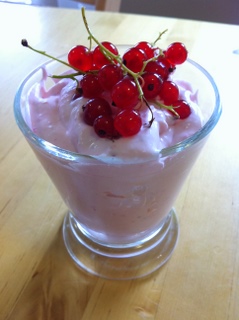
Red Currant Fool
Ingredients
- 750 gr red currants removed from stalks
- 2 tsp vanilla extract
- 4 tbsp icing sugar (or confectioner’s sugar)
- 200 ml double or whipping cream
- 200 ml natural Greek yogurt (thick natural yogurt)
Method
- Separate the fruit and put two-thirds of it into a blender with 2 tbsps. of the sugar and blend to a puree.
- Whip the cream until it is stiff then add the vanilla extract and the remaining sugar and whisk until stiff again.
- Add the yogurt and fruit puree to this and mix in well. Fold in the remaining fruit, leaving some to decorate the top of the fool with, and mix well.
- Spoon into individual glasses and refrigerate until ready to serve.
References
- https://www.ncbi.nlm.nih.gov/pmc/articles/PMC3649719/
- https://www.ncbi.nlm.nih.gov/pmc/articles/PMC6315720/
- https://www.ncbi.nlm.nih.gov/pmc/articles/PMC3419346/
- https://www.ncbi.nlm.nih.gov/books/NBK11795/
- https://www.ncbi.nlm.nih.gov/pmc/articles/PMC5291486/
- https://fruits.edpsciences.org/articles/fruits/abs/2012/05/fruits120033/fruits120033.html
- http://www.fao.org/3/cb2395en/CB2395EN.pdf
- https://www.fao.org/in-action/inpho/crop-compendium/fruits-vegetables/en/
- https://www.fao.org/3/cb2395en/online/src/html/fruit-and-vegetables.html
- http://www.fao.org/3/cb2395en/CB2395EN.pdf
- https://en.wikipedia.org/wiki/Fruit
- https://en.wikipedia.org/wiki/List_of_food_plants_native_to_the_Americas
- https://en.wikipedia.org/wiki/List_of_culinary_fruits
- https://www.hsph.harvard.edu/nutritionsource/what-should-you-eat/vegetables-and-fruits/
- https://www.betterhealth.vic.gov.au/health/healthyliving/fruit-and-vegetables
- https://www.cdc.gov/healthyweight/healthy_eating/fruits_vegetables.html
- https://www.botanical-online.com/en/botany/fruits-types-characteristics
- https://www.fda.gov/food/laboratory-methods-food/mpm-v-9-fruits-and-fruit-products-v-51-v-78
- https://www.fda.gov/food/food-labeling-nutrition/nutrition-information-raw-fruits-vegetables-and-fish
- https://onlinelibrary.wiley.com/doi/abs/10.1111/mcn.12208
- http://news.discovery.com/earth/
- https://www.cabi.org/isc/datasheet/
- https://www.science.org/
- https://plants.ces.ncsu.edu/plants/
- https://www.sciencedirect.com/topics/agricultural-and-biological-sciences/fruit-vegetable
- https://www.researchgate.net/publication/
- https://www.ams.usda.gov/grades-standards/fruits
- https://www.aphis.usda.gov/aphis/resources/traveler/intl-travel/fruits-vegetables/fruits-vegetables
- https://snaped.fns.usda.gov/seasonal-produce-guide
- https://www.nass.usda.gov/Publications/Highlights/2015/FruitsNutsBerries_AgCensusHighlights.pdf
- https://plants.usda.gov/home/plantProfile?
- https://www.fs.fed.us/wildflowers/ethnobotany/food/nuts.shtml
- https://downloads.usda.library.cornell.edu/usda-esmis/files/zs25x846c/sf269213r/6t054c23t/ncit0521.pdf
- https://agr.wa.gov/departments/business-and-marketing-support/farm-to-school-toolkit/
- https://health.gov/sites/default/files/2020-01/DGA2000.pdf
- https://www.farmers.gov/archived/cfap2/specialty
- https://www.hsph.harvard.edu/nutritionsource/
- https://www.foodsafety.gov/food-safety-charts/food-safety-during-power-outage
- https://clinicaltrials.gov/ct2/show/
- https://botany.org/home/careers-jobs/careers-in-botany/what-is-botany.html
- https://www.healthbenefitstimes.com/category/fruits
- http://www.hear.org/pier/species/
- https://www.itis.gov/servlet/SingleRpt/SingleRpt?
- http://www.theplantlist.org/tpl1.1/record/
- https://www.fs.fed.us/database/feis/plants/tree/
- https://www.itis.gov/servlet/SingleRpt/SingleRpt?
- https://eol.org/pages/
- http://www.hear.org/pier/species/vitis_vinifera.htm
- https://npgsweb.ars-grin.gov/gringlobal/taxonomydetail.aspx?id=426915
- http://www.missouribotanicalgarden.org/PlantFinder/PlantFinderDetails.aspx?taxonid=287551&isprofile=0&
- http://www.floracatalana.net/vitis-vinifera-l-
- https://en.wikipedia.org/wiki/Zante_currant
- https://www.itis.gov/servlet/SingleRpt/SingleRpt?search_topic=TSN&search_value=28629#null
- https://plants.usda.gov/core/profile?symbol=VIVI5

