
Citrofortunella microcarpa/Calamansi (Citrus × microcarpa), also known as calamondin, Philippine lime, or Philippine lemon, is an economically important citrus hybrid predominantly cultivated in the Philippines. It is native to the Philippines, Borneo, Sumatra, and Sulawesi in Indonesia in Southeast Asia, as well as southern China and Taiwan in East Asia. Calamansi is ubiquitous in traditional Filipino cuisine. It is naturally very sour, and is used in various condiments, beverages, dishes, marinades, and preserves. Calamansi is also used as an ingredient in Malaysian and Indonesian cuisines.
Calamansi is a hybrid between kumquat (formerly considered as belonging to a separate genus Fortunella) and another species of Citrus (in this case probably the mandarin orange).[6]
| Calamondin Quick Facts | |
|---|---|
| Name: | Calamondin |
| Scientific Name: | Citrofortunella microcarpa |
| Origin | China |
| Colors | Green turning to yellow, orange-yellow or deep orange |
| Shapes | Globose or oblate, 2–4.5 cm diameter, rind thin dotted with numerous small oil glands |
| Flesh colors | Fleshy orange |
| Taste | Sour |
| Health benefits | Weight Loss, Controls Cholesterol Levels, Improves Respiratory Health, Lowers Acidity, Boosts Immunity, Promotes Collagen Production, Detoxifies the Body, Controls Diabetes, Skin Care, Prevents oral problems |
Citrofortunella macrocarpa, commonly known as calamondin or orange calamondin, is actually a small, bushy, evergreen tree or shrub belonging to the Rutaceae (Rue family). The plant is said to have originated from China or the Philippines and has spread out through South East Asia, India, Hawaii, West Indies, Central and North America where it was acquired the name “acid orange” as it resembles an orange. The plant is believed to be a natural hybrid between a sour, loose-skinned mandarin, probably Citrus reticulata var. Austria, and a kumquat, perhaps Fortunella margarita. The “X” preceding the genus name indicates that this hybrid is between plants of different genera (bi-generic hybrid).
Some of the popular common names of the plant are Calamandarin, Calamansi, Calamondin Orange, China Orange, Chinese Orange, Golden Lime, Musk Lime, Philippine Lime, Panama Orange, Scarlet Lime, Limau Kasturi, Limau Chuit, Hazara, kalamunding, ma nao wan, szu kai kat and calamondin. Genus Citrus refers to the lemon-scented fragrance from the plant. Species macrocarpa means small-fruited. The plant is particularly valued for its acidic juice and is also grown as an ornamental. This fruit is available throughout the year in the Philippines and is mostly found in its unripe green state. The plant adds artistic value when planted as it is planted as a hedge or patio plant more than because of the edible fruit.
Plant Description
Calamondin is a medium-sized evergreen shrub or small tree that grows about 6 1/2 to 25 ft. (2-7.5 m) tall. The plant is adapted to warm climates but it can also grow in cool, frost-free areas. It is also adaptable to areas with long dry periods provided irrigation is available. This fruit thrives well in cold climates, unlike other citrus fruits. It thrives well when planted in containers or tubs as a flower. This fruit is also drought-resistant than other citrus species do. However, for it to grow well and bear fruits, it requires bright light with slow-release fertilizer added to it especially at the beginning of spring as that is its season to produce. The plant is adaptable to a wide range of soils from clay loams to calcareous soils to sandy soils. It does best in well-drained, sandy loams or clay loams rich in organic matter. It is moderately drought-tolerant and intolerant of strong winds.
The plant has a deep taproot and sparsely spiny stem. Branchlets are strongly angled and glabrous. Evergreen leaves (technically single leaflets) are alternate, aromatic, broad-oval, dark-green, glossy on the upper surface, yellowish-green beneath, 1 1/2 to 3 in (4-7.5 cm) long, faintly toothed at the apex, with short, narrowly-winged petiole that is 8–12 mm long, very narrowly winged, 1–2 mm wide.
Flower & Fruit
Flowers are axillary or terminal, usually solitary, sometimes 2–3 flowered, bisexual, fragrant. Rachis is 5 mm long, glabrous. Pedicels are 6–8 mm long and glabrous. The calyx is 1 mm long, deeply 5-lobed. Lobes are acute, minutely pubescent. Petals are 5, elliptic-oblong, pure-white c. 12 mm long. The filament is 7 mm long, anthers ellipsoidal, c. 1 mm long. Style is 3 mm long. Flowers are followed globose or oblate, juicy, golf-ball-sized orange fruit, 2–4.5 cm diameter, rind thin dotted with numerous small oil glands,) which is edible but the pulp and juice are very acidic (sour). The peel is sweet. Fruits are initially green turning to yellow, orange-yellow, or deep orange as they mature. Fruit skin is thin, spongy, and smooth which surrounds the fleshy orange pulp. Each fruit contains 6-9 fleshy segments. Seeds are large, smooth 1–5 small, obovoid, green within, and polyembryonic. Fruit remains on the plant for a long time (takes up to one year for the fruit to ripen to orange).
History
Calamondin originated in China as a natural hybrid, however, the exact hybrid nature remains to be established. It is believed to have been introduced in early times to Indonesia and the Philippines where it became the most important Citrus juice source in the Philippine Islands. Today, it is widely grown in India and throughout southern Asia and Southeast Asia especially in Malaysia. It is a common ornamental dooryard tree in Hawaii, the Bahamas, some islands of the West Indies, and parts of Central America.
Health benefits of Calamondin fruit
Apart from the aesthetic value of the calamondin tree, the acidic fruit brings about health benefits to individuals. The fruit is used in making spices, added flavor in fish and cakes, in making beverages such as tea, used as a preservative, and making marmalades. It is also essential for soap and shampoo making. Here are the benefits brought about by this fruit
1. Weight Loss
This particular tropical juice is well-known for its impact on weight loss, as it has the ability to not only boost the metabolism but also remove many of the toxins in the body that can contribute to fat storage. By increasing metabolic speed, this juice can improve passive fat-burning throughout the day, while detoxifying the body will help all of your organ systems run more smoothly and function properly, aiding in calorie burning. By reducing fat storage, you will have more usable energy and less adipose fat formation. Many people drink a glass of calamansi juice every morning to stimulate the body and achieve weight-loss goals.
2. Controls Cholesterol Levels
Anecdotal evidence and some studies have found that this juice can help you lower your cholesterol levels, which is an important step towards weight loss and avoiding metabolic syndrome. It can also help lower your risk of atherosclerosis, heart attack, and stroke.(1)
3. Improves Respiratory Health
A strong citric acid level in calamansi juice helps cut through phlegm and mucus, where infections often live and propagate, while also soothing inflammation in the throat and respiratory tracts.(2)
4. Lowers Acidity
Despite the high levels of citric acid and acidity of this fruit, many people drink it as a soothing substance for the stomach. It can lower levels of inflammation when consumed in moderation, lower your risk of developing ulcers, and protect you from acid reflux disease.(3)
5. Boosts Immunity
The fruit is loaded with vitamin C and other beneficial nutrients and its juice has been used as an immune booster for generations. It can encourage the production of white blood cells and counter the negative effects of free radicals, thanks to its antioxidant and antibacterial properties.(4)
6. Promotes Collagen Production
Vitamin C is an essential element in collagen production, which is the compound needed to create every tissue, muscle fiber, and cell in the body. This juice can supply a burst of ascorbic acid that will increase your body’s ability to grow, as well as repair damage from injury, illness or surgery.(5)
7. Detoxifies the Body
Known to encourage urination and flush out the kidneys, calamansi juice can be a powerful detoxifying agent, strengthening the functioning of your liver, kidneys, and gallbladder to help you eliminate excess toxins in the body.(6)
8. Controls Diabetes
A significant amount of research has been done on the blood sugar-moderating effects of calamansi juice. It can help to regulate the release of glucose and insulin into the bloodstream, which is excellent news for those suffering from diabetes or those at risk of developing the disease. (7)
9. Skin Care
All over Asia, people use calamansi juice on their skin, as it functions as a natural bleaching agent. In addition to clearing the skin of blemishes or discoloration, it can also deliver antioxidants to the skin that will prevent wrinkles and other signs of aging.(8)
10. Prevents oral problems
You can use calamansi juice as a mouthwash. Vitamin C from this juice helps prevent tooth decay, bleeding gums, gingivitis, or loosening of teeth. It helps remove stains and plaque.
How to Use Calamansi in Skincare?
Now, here are the ways to include Calamansi in your daily skincare regimen. Start with cutting the fruit into two halves and removing its seeds carefully. The next step can be any of the following ones:
- Rub the fruit halves all over your body focusing on comparatively darker parts like elbows and knees. If you have dark spots or older scars, you should scrub the juice on those sections too. Take a shower or wash off with lukewarm water after half an hour.
- Squeeze out the fresh juice of Calamansi and dip a small cotton ball into it. Now, apply it to the dark spots of your face, wait for 10 minutes and then rinse off with lukewarm water.
- Add 1 teaspoon of Calamansi juice to 2 tablespoons of milk and apply this mixture all over your face and body. Wash off after 5 to 10 minutes with lukewarm water.
However, the acidic nature of Calamansi may cause a stinging or burning sensation if used daily on the skin. So, practice this twice or thrice a week and you will get your desired results easily.
Traditional uses and benefits of Calamondin
- Calamondin fruits may be crushed with the saponaceous bark of Entada Phaseoloides for shampooing the hair, or the fruit juice applied to the scalp after shampooing.
- It eliminates itching and promotes hair growth.
- Rubbing calamondin juice on insect bites banishes the itching and irritation.
- It bleaches freckles and helps to clear up acne vulgaris and pruritus vulvae.
- Calamondin juice is considered a refrigerant (being a rich source of Vitamin C) and is taken orally as a cough remedy and anti-phlogistic.
- Slightly diluted and drunk warm, it serves as a laxative
- Combined with pepper, it is prescribed in Peninsular Malaysia to expel phlegm.
- Fruit juice also serves as a body deodorant.
- Root enters into a treatment given at childbirth in the Philippines.
- Distilled oil of the leaves serves as a carminative with more potency than peppermint oil.
- It is also used in shampoos, bath lotion, and skin cleanser cosmetics.
- Juice is used to treat skin irritations, as a cough remedy, an anti-phlogistic, laxative, and, when combined with pepper, it is prescribed to expel phlegm.
- Roots are used for a traditional treatment at childbirth.
- Distilled oil of the leaves is used to cure flatulence.
- Calamansi can help aid sore throats. You just mix one Calamansi with warm water, a pinch of salt, and gargle.
- It is mixed with pepper to expel phlegm in Malaya.
Culinary uses
- Calamondin can be eaten fresh but it is usually made into juice, drinks, dried, and used as preserves, pickles, or to flavor food.
- Fruit is used for marmalade and chutneys, preserved whole in sugar syrup, and used as a flavoring in seafood and meat dishes.
- It is frequently used to impart acidity to noodles like Pad Thai, laksa, grilled fish, or smoked fish and in a variety of sambal sauces in Southeast Asia.
- Calamondin is an ingredient in chutney in Malaysia.
- Whole fruits, fried in coconut oil with various seasonings, are eaten with curry.
- Preserved peel is added as flavoring to other fruits stewed or preserved.
- Calamondin halves or quarters may be served with iced tea, seafood, and meats, or noodles to be squeezed for the acid juice.
- Calamondin fruits can be sliced and boiled with cranberries to make a tart sauce.
- Calamondins are also preserved whole in sugar syrup or made into sweet pickles or marmalade.
- Superior marmalade is made by using equal quantities of calamondins and kumquats.
- Calamondin- papaya marmalade is popular in Hawaii.
- Acid fruit juice is processed into bottled concentrate and juice.
- Juice is primarily valued for making acid beverages.
- It is often used like lime or lemon juice to make gelatin salads or desserts, custard pie, or chiffon pie.
- In the Philippines, the extracted juice, with the addition of gum tragacanth as an emulsifier, is pasteurized and bottled commercially.
- Pectin is recovered from the peel as a by-product of juice production.
- Preserved peel is used as a flavoring in other foods.
- It is often a key ingredient in preparing ice cream, sorbets, jello, juice, soft drinks, nectar, jelly, gummy candies, sauces, vinaigrettes, fruit preserves and yogurt.
- Calamansi becomes the key ingredient of fruit sweet pickles or marmalade.
- Hawaiians like their calamansi made into marmalade with papaya in it.
- Malaysians like their Calamansi made into coarsely grounded chutney.
- The Philippines extract the juice and sell it commercially after it has been pasteurized.
- Not many are aware of the fact that calamansi juice is often used as a replacement lime or lemon juice to make gelatin for preparing salads or desserts, custard pies, or chiffon pies.
Recipes
Calamondin Orange Marmalade
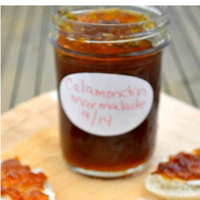
Ingredients
- 40 fresh calamondin sour oranges
- juice of the calamondin oranges ( about 3/4 cup)
- equal amounts of sugar
- 1 1/4 cup water
- 1 tablespoon butter
Directions
- Cut each calamondin orange in half and remove the seeds.
- Squeeze the juice into a bowl or measuring cup and set aside.
- Flatten each calamondin half and thinly slice the peel into ribbons.
- Measure the calamondin peel, water and calamondin juice before pouring into a large jam pot.
- Measure equal amounts of sugar and add to the pot.
- Add butter to pot.
- Heat on low, stirring occasionally so the sugar doesn’t scorch on the bottom of the pot.
- Once the sugar has dissolved turn the heat up to medium high and bring to a boil.
- Place a saucer in the freezer.
- Cook until marmalade sets.
- Check set by dropping a dollop of marmalade on the cold saucer and push the edge with your fingertip.
- If marmalade wrinkles it has set.
- Process marmalade in a hot water bath 20 minutes.
Sweet tart Calamondin Pie

Ingredients
For the Graham cracker Crust
- 1 1/4 cups graham cracker crumbs
- 1/3 cup butter melted
- 1/4 cup sugar
- 1/2 cup sweetened shredded coconut
For the Pie Fillings
- 1 14 ounce can sweetened condensed milk
- 3 large egg yolks
- 1/2 cup calamondin juice (from about 12-18 calamondins – depending on how juicy they are) strained to remove any excess pulp
- 1/4 teaspoon calamondin zest
For the Whipped Cream
- 1 cup heavy whipping cream
- 2 tablespoons confectioners’ sugar
- 1 teaspoon gelatin
- 1 tablespoon water
For garnish
- 1/4 cup shredded sweetened coconut toasted
Directions
For the Pie Shell
- Preheat the oven to 350°.
- In a medium bowl, combine the graham cracker crumbs, sugar, coconut and melted butter. Stir until well combined. Pour the crumb mixture into a 9″ tart pan or pie plate and press the crumbs firmly against the bottom and sides of the pan. Set aside.
For the pie Fillings
- In a large bowl, combine the sweetened condensed milk, egg yolks calamondin juice. Whisk to combine and add the zest. Stir until evenly incorporated. Pour the filling into the pie shell and bake for 15 minutes. Remove the pie from the oven and let cool for 15 minutes, then refrigerate until cold and set.
For the Whipped Cream toppings
- In a small prep bowl, combine the gelatin and water and let rest for 2 minutes to bloom. Place the bowl in the microwave and heat in 5 second bursts until the gelatin has dissolved. Set aside to cool. (It should not be warm when you add it to the cream — this is important).
- Add the whipping cream to a medium bowl and beat on high speed with a hand mixer for one to two minutes or until the cream starts to look airier and fluffy. Add the confectioners’ sugar one tablespoon at a time, beating after each addition. Only beat the cream to soft peak stage — which means that when you lift the beaters, you can see a peak, but it will bend and fold over on itself.
- Test the gelatin — it should still be in liquid form, but at room temperature. Add one tablespoon of the cream to the gelatin and stir to temper it. While beating on high speed, in a steady stream, add the gelatin mixture to the cream. Beat until stiff peaks form. Cover and refrigerate until ready to garnish.
- Fit a piping bag with a star tip or other large decorative tip. Fill the bag with stabilized whipped cream. Sprinkle coconut around the rim. Pipe the whipped cream decoratively over the coconut. You could also pipe the whipped cream first, then sprinkle with coconut — whatever you prefer. Refrigerate until ready to serve.
Vintage Calamondin Cake
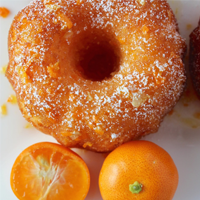
Ingredients
Cake
- ½ c. + 2 Tb. calamondin puree (about 40-50 pieces)
- 1 package white cake mix
- 1 3-oz. package orange jello
- ⅓ c. milk
- 4 large eggs
- ¾ c. vegetable oil
- 1 Tb. lemon juice
Glaze
- 2 Tb. calamondin puree
- zest of 1 orange
- 8 Tb. fresh orange juice
- 2 c. powdered sugar
Instructions
- Heat oven to 350 degrees.
- Grease and flour (or use cooking spray) a large bundt pan (10” X 4” X1/2”), OR 2 single rounds, OR 12 mini Bundt pans or muffin tins.
- Slice and seed calamondins then place in a food processor and pulse several times until you have a fine puree. Set aside.
- Combine cake mix and jello in a large bowl.
- In a separate bowl, combine milk, oil, eggs and lemon juice, and ½ c. of the puree. Whisk to combine then add to dry ingredients and stir well to combine.
- Pour batter into prepared baking dish(es).
- Bake for about 40 minutes for large bundt or round pans. If using mini bundt pans or muffin tins, bake for about 20-25 minutes – check regularly to ensure they don’t overcook. Remove when a cake tester comes out clean.
- Allow to cool slightly while making the glaze. After the cake(s) have cooled but are still slightly warm, remove from the baking dish (es) onto a serving platter. Spoon the glaze over the warm cake(s).
Other facts
- Calamondin is also a popular ornamental in many homes in Southeast Asia.
- Fruit juice is used in the Philippines to bleach ink stains from fabrics and clothes.
- Calamondin is also used as rootstock for lemons and the oval kumquat.
- Variegated calamondin plants are often grown as ornamental potted plants.
- Juice is used as a stain remover, body deodorant, and skin bleach and hair shampoo.
- Plant can be used as a rootstock for lemons and the oval kumquat.
- Juice can be used as a whitening solution and stain remover for your clothes.
- Trees start fruit production 5-6 years after planting.
- A 3-year old calamondin tree may yield 0.75 kg of fruits.
- A 6-year old tree may bear up to 5000 fruits with an average yield of 10 kg.
Precautions
- It shouldn’t be consumed in excess during pregnancy.
- Citrus fruits like lemon and calamansi can trigger heartburn during pregnancy.
- Citrus juices may cause stomach cramps, indigestion, or diarrhea if consumed in excessive amounts.
References
- https://www.ncbi.nlm.nih.gov/pmc/articles/PMC3649719/
- https://www.ncbi.nlm.nih.gov/pmc/articles/PMC6315720/
- https://www.ncbi.nlm.nih.gov/pmc/articles/PMC3419346/
- https://www.ncbi.nlm.nih.gov/books/NBK11795/
- https://www.ncbi.nlm.nih.gov/pmc/articles/PMC5291486/
- https://fruits.edpsciences.org/articles/fruits/abs/2012/05/fruits120033/fruits120033.html
- http://www.fao.org/3/cb2395en/CB2395EN.pdf
- https://www.fao.org/in-action/inpho/crop-compendium/fruits-vegetables/en/
- https://www.fao.org/3/cb2395en/online/src/html/fruit-and-vegetables.html
- http://www.fao.org/3/cb2395en/CB2395EN.pdf
- https://en.wikipedia.org/wiki/Fruit
- https://en.wikipedia.org/wiki/List_of_food_plants_native_to_the_Americas
- https://en.wikipedia.org/wiki/List_of_culinary_fruits
- https://www.hsph.harvard.edu/nutritionsource/what-should-you-eat/vegetables-and-fruits/
- https://www.betterhealth.vic.gov.au/health/healthyliving/fruit-and-vegetables
- https://www.cdc.gov/healthyweight/healthy_eating/fruits_vegetables.html
- https://www.botanical-online.com/en/botany/fruits-types-characteristics
- https://www.fda.gov/food/laboratory-methods-food/mpm-v-9-fruits-and-fruit-products-v-51-v-78
- https://www.fda.gov/food/food-labeling-nutrition/nutrition-information-raw-fruits-vegetables-and-fish
- https://onlinelibrary.wiley.com/doi/abs/10.1111/mcn.12208
- http://news.discovery.com/earth/
- https://www.cabi.org/isc/datasheet/
- https://www.science.org/
- https://plants.ces.ncsu.edu/plants/
- https://www.sciencedirect.com/topics/agricultural-and-biological-sciences/fruit-vegetable
- https://www.researchgate.net/publication/
- https://www.ams.usda.gov/grades-standards/fruits
- https://www.aphis.usda.gov/aphis/resources/traveler/intl-travel/fruits-vegetables/fruits-vegetables
- https://snaped.fns.usda.gov/seasonal-produce-guide
- https://www.nass.usda.gov/Publications/Highlights/2015/FruitsNutsBerries_AgCensusHighlights.pdf
- https://plants.usda.gov/home/plantProfile?
- https://www.fs.fed.us/wildflowers/ethnobotany/food/nuts.shtml
- https://downloads.usda.library.cornell.edu/usda-esmis/files/zs25x846c/sf269213r/6t054c23t/ncit0521.pdf
- https://agr.wa.gov/departments/business-and-marketing-support/farm-to-school-toolkit/
- https://health.gov/sites/default/files/2020-01/DGA2000.pdf
- https://www.farmers.gov/archived/cfap2/specialty
- https://www.hsph.harvard.edu/nutritionsource/
- https://www.foodsafety.gov/food-safety-charts/food-safety-during-power-outage
- https://clinicaltrials.gov/ct2/show/
- https://botany.org/home/careers-jobs/careers-in-botany/what-is-botany.html
- https://www.healthbenefitstimes.com/category/fruits
- http://www.hear.org/pier/species/
- https://www.itis.gov/servlet/SingleRpt/SingleRpt?
- http://www.theplantlist.org/tpl1.1/record/
- https://www.fs.fed.us/database/feis/plants/tree/
- https://www.itis.gov/servlet/SingleRpt/SingleRpt?
- http://www.theplantlist.org/tpl1.1/record/kew-2724243
- https://plants.usda.gov/java/ClassificationServlet?source=display&classid=CIMI4
- https://pfaf.org/user/Plant.aspx?LatinName=Citrofortunella+microcarpa
- http://www.missouribotanicalgarden.org/PlantFinder/PlantFinderDetails.aspx?taxonid=291787
- https://www.hort.purdue.edu/newcrop/morton/calamondin.html
- https://en.wikipedia.org/wiki/Calamondin
- http://idtools.org/id/citrus/citrusid/factsheet.php?name=Calamondin

