
Amelanchier alnifolia is a medium-sized shrub that belongs to the Rose family Rosaceae. It is closely related to the apple, hawthorn, and mountain ash. The plant is native to North America from Alaska, Western Canada, and western (southwards to North California, Utah, and Colorado) and north-central Unites States. In Canada, the species is found in British Columbia, Alberta, Saskatchewan, Manitoba, Ontario, Quebec, North West Territories, and Nunavut. The plant has gone by several names including Alderleaf serviceberry, Dwarf Service-berry, Alder Leaf Shadbush, Mountain Juneberry, Pacific Serviceberry, Rocky Mountain Blueberry, Saskatoon, Saskatoon Berry, Saskatoon Serviceberry, Serviceberry, Sarvisberry, Shadbush, Juneberry, Western Serviceberry, Western Shadbush, Shadberries, Sugar pears, Indian pears, chuckley pear, western juneberry, dwarf shadbush and prairie berry. Historically, it was also called pigeon berry. It is a common shrub in the forest understory.
| Saskatoon Quick Facts | |
|---|---|
| Name: | Saskatoon |
| Scientific Name: | Amelanchier alnifolia |
| Origin | North America from Alaska, Western Canada and western (southwards to North California, Utah, and Colorado) and north-central Unites States |
| Colors | Dark, reddish-purple to nearly black |
| Shapes | Pome, globose to subglobose, 7–15 mm across, glabrous, wax-coated, maroon-purple, juicy and sweet |
| Taste | Excellent sweet, nutty almond flavor |
Saskatoon Facts
| Name | Saskatoon |
|---|---|
| Scientific Name | Amelanchier alnifolia |
| Native | North America from Alaska, Western Canada and western (southwards to North California, Utah, and Colorado) and north-central Unites States. In Canada, the species is found in British Columbia, Alberta, Saskatchewan, Manitoba, Ontario, Quebec, North West Territories, and Nunavut |
| Common Names | Alderleaf serviceberry, Dwarf Service-berry, Alder Leaf Shadbush, Mountain Juneberry, Pacific Serviceberry, Rocky Mountain Blueberry, Saskatoon, Saskatoon Berry, Saskatoon Serviceberry, Serviceberry, Sarvisberry, Shadbush, Juneberry, Western Serviceberry, Western Shadbush, Shadberries, Sugar pears, Indian pears, chuckley pear, western juneberry, dwarf shadbush, prairie berry, pigeon berry |
| Name in Other Languages | Azerbaijani: Qızılağacyarpaq iqra Canada: Hlighag, Saskatoon, Sgan Gam Cree: Saskahtômina Czech: Muchovník olšolistý Danish: Ellebladet bærmispel English: Pacific serviceberry, Saskatoon serviceberry, Juneberry, Saskatoon, Saskatoon-berry, Western juneberry, Western serviceberry, Western shadbush, Northwestern serviceberry, alder-leaf serviceberry Estonian: Lepalehine toompihlakas Finnish: Marjatuomipihlaja French: Amélanchier à feuilles d’aulne, Amélanchier à feuille d’aulne German: Erlenblättrige Felsenbirne Icelandic: Hlíðaramall Japanese: Sasukato~ūn berī (サスカトゥーン・ベリー) Navajo: Dzidzé ditʼódí Norwegian: Taggblåhegg, Taggblåhegg Persian: توتین سسکتون Russian: Irga ol’kholistnaya (Ирга ольхолистная) Swedish: Grovsågad häggmispel, Marjatuomipihlaja, Sen häggmispel, Bärhäggmispel, Saskatoonbär, Västamerikansk Häggmispel |
| Plant Growth Habit | Low growing, deciduous, medium to a large multi-stemmed shrub or small tree |
| Growing Climates | Thickets, woodland edges, banks of streams, canyons and hillsides from plains to subalpine, moist to dry forest, grasslands, meadows, avalanche slopes |
| Soil | Prefers a rich, coarse, light-textured, well-drained loamy soil with high organic matter, but will grow in any sandy or clayey soil that is not water-logged or too dry. It is quite a drought tolerant and is also salt tolerant. It thrives in a sunny position or semi-shade |
| Plant Size | 1–8 m (3–26 ft.) tall and rarely to 10 m or 33 ft., in height |
| Twigs | Slender and smooth, reddish-brown when young but turning gray-brown with age; buds about 1/2 inches long with red, imbricate scales that are hairy along the margin. |
| Bark | Thin, light brown, and tinged with red; smooth or shallowly fissured |
| Leaf | Alternate, simple, oval-obovate to nearly round, 2–5 cm ((3⁄4–2 in) long and 1 –4.5 cm ((1⁄2–1 3⁄4 in) wide, pinnately-veined with a rounded to sub-acute apex, rounded bases, finely serrated margin |
| Flowering season | April through July |
| Flower | White, with five quite separate petals. They are about 2–3 cm (3⁄4–1 1⁄4 in) across and appear on short racemes of three to 20 somewhat crowded together |
| Fruit Shape & Size | Small, globose to subglobose, edible berries that are 5–15 mm (3⁄16–19⁄32 in) in diameter, glabrous, wax-coated, juicy and sweet |
| Fruit Color | Dark, reddish-purple to nearly black |
| Seed | 3 mm long and 2 mm wide ovoid to kidney-shaped, little bumps on the leathery surface, red-brown |
| Taste | Excellent sweet, nutty almond flavor |
| Season | Late June and early July |
Saskatoon Scientific Classification
Scientific Name: Amelanchier alnifolia
| Rank | Scientific Name & (Common Name) |
|---|---|
| Kingdom | Plantae (Plants) |
| Subkingdom | Tracheobionta (Vascular plants) |
| Infrakingdom | Streptophyta (land plants) |
| Superdivision | Spermatophyta (Seed plants) |
| Division | Magnoliophyta (Flowering plants) |
| Sub Division | Spermatophytina (spermatophytes, seed plants, phanérogames) |
| Class | Magnoliopsida (Dicotyledons) |
| Subclass | Rosidae |
| Super Order | Rosanae |
| Order | Rosales |
| Family | Rosaceae (Rose family) |
| Genus | Amelanchier Medik. (serviceberry) |
| Species | Amelanchier alnifolia (Nutt.) Nutt. ex M. Roem. (Saskatoon serviceberry) |
| Varieties |
|
| Synonyms |
|
Plant Description
Saskatoon is a low-growing, deciduous, medium to a large multi-stemmed shrub or small tree that normally grows about 1–8 m (3–26 ft.) tall and rarely to 10 m or 33 ft., in height. The plant is found growing in thickets, woodland edges, and banks of streams, canyons, and hillsides from plains to subalpine, moist to dry forest, grasslands, meadows, and avalanche slopes. The plant prefers rich, coarse, light-textured, well-drained loamy soil with high organic matter, but will grow in any sandy or clayey soil that is not water-logged or too dry. It is quite drought-tolerant and is also salt tolerant. It thrives in a sunny position or semi-shade. Twigs are slender and smooth, reddish-brown when young but turning gray-brown with age. Buds are about 1/2 inch long with red, imbricate scales that are hairy along the margin.
Leaves
Leaves are alternate, simple, oval-obovate to nearly round, 2–5 cm ((3⁄4–2 in) long and 1 –4.5 cm ((1⁄2–1 3⁄4 in) wide, pinnately-veined with a rounded to sub-acute apex, rounded bases, finely serrated margin, and born on 1–2 cm long slender petioles. Very young leaves are conduplicate in bud; less than half-expanded and unfolded, pubescent abaxially. They are usually gray-pubescent on the lower surface. Foliage turns variable shades of yellow in autumn. The foliage is browsed by deer, elk, rabbits, and livestock.
Flowers
Flowers are white, with five quite separate petals. They are about 2–3 cm (3⁄4–1 1⁄4 in) across, and appear on short racemes of three to 20 somewhat crowded together, in spring while the new leaves are still expanding. The flower has campanulate hypanthia, pubescent sepals erect or loosely spreading after flowering, 5 white broadly linear to oblong, 1–2 cm petals, 15–20 stamens, glabrous to the pubescent ovary with 5 styles. Flowering normally takes place between April through July.
Fruit
Fertile flowers give way to small, globose to subglobose, edible berries that are 5–15 mm (3⁄16–19⁄32 in) in diameter, glabrous, wax-coated, juicy, and sweet. The fruit ripens to dark purplish-black in June and resembles blueberries in size, color, and taste. Fruit usually consists of nine seeds per pome. Seeds are 3 mm long and 2 mm wide, ovoid to kidney-shaped, little bumps on the leathery surface, and red-brown colored. Berries may be eaten fresh off the plant or used in jams, jellies, and pies. They are eaten by wildlife including birds, squirrels, and bears. It is also a larval host to the pale tiger swallowtail, two-tailed swallowtail, and the western tiger swallowtail.
Health benefits of Saskatoon
It is believed that Native Americans used the Saskatoon berries for medicinal purposes. Today, Saskatoon berries are vastly admired for their antioxidant content, specifically phenolics, flavanols, and anthocyanins. Flavonoids are antioxidants that may have inflammatory, anti-diabetic, and chemo-protective effects. Listed below are a few of the health benefits of Saskatoon
1. Slow Down the Aging Process and Trigger Better Genetic Signaling
Saskatoon berries have a higher level of anthocyanin than most berries. Research shows that the anthocyanins found in berries may have health benefits such as anti-inflammatory qualities and reducing age-associated oxidative stress. Anthocyanin antioxidants found in berries may also improve cardiovascular disorders and degenerative diseases, as well as improve neuronal and cognitive brain functions, ocular health as well as protect genomic DNA integrity. Research has shown that Saskatoon berries may be beneficial for fruit growers as well as nutraceutical manufacturers because of their high anthocyanin content. Overall, berry anthocyanins may promote disease prevention by triggering genetic signaling in humans.
2. Age Gracefully on the Inside and the Outside
Perhaps the most important part of the Saskatoon berry that sets it apart from other berries is its ability to be successful in treating neurodegenerative diseases such as Parkinson’s disease, Alzheimer’s disease, as well as ischemic diseases and aging effects. This is because the anthocyanins in berries are special and consist of anti-oxidative, anti-inflammatory, anti-viral, and anti-proliferative properties. These qualities are especially important in brain health as oxidative stress and inflammation are involved in aging and neurodegenerative diseases. As we get older, the brain is more susceptible to oxidative stress and tissue damage than any other organ. The anthocyanins found in Saskatoon berries have been shown to protect against brain damage and improve memory, learning, and cognitive function.
Traditional uses and benefits of Saskatoon
- Saskatoon was quite extensively used as a medicinal herb by the North American Indians, who used it to treat a wide range of minor complaints.
- It is little used in modern herbalism.
- An infusion of the inner bark is used as a treatment for snow-blindness.
- The decoction of the fruit juice is mildly laxative.
- It has been used in the treatment of upset stomachs, to restore the appetite in children, it is also applied externally as ear and eye drops.
- Decoction of the roots has been used in the treatment of colds.
- It has also been used as a treatment for too frequent menstruation.
- Decoction of the stems, combined with the stems of snowberry (Symphoricarpos spp) is diaphoretic.
- It has been used to induce sweating in the treatment of fevers, flu, etc., and also in the treatment of chest pains and lung infections.
- Decoction of the plant, together with bitter cherry (Prunus emarginata) has been used as a contraceptive.
- This plant has also been used as contraceptives including a decoction of the ashes of the plant combined with the ashes of pine branches or buds.
- A strong decoction of the bark was taken immediately after childbirth to accelerate the dropping of the placenta.
- It was said to help clean out and help heal the woman’s insides and also to stop her menstrual periods after birth, thus acting as a form of birth control.
- Indigenous people in Canada used the juice for treating stomach ailments and as a laxative.
- Eye and ear-drops were made from ripe berries.
- The boiled bark is used as a disinfectant.
- The root infusion was used to prevent miscarriage after an injury.
- Thompson people made tea from the twigs and stem and administer it to women just after birth and as a bath.
- Potent tonic from the bark was given to women after delivery to hasten discharge of the placenta.
- Saskatoon berry juice was ingested to relieve stomach upset and boiled berry juice was used as ear drops.
- It helps prevent inflammation and helping to lower chronic inflammation that can lead to a number of life-stunting diseases like arthritis and dementia
- It helps protect against heart disease by regulating the “bad” cholesterol, LDL, or low-density lipoprotein
- It helps regulate blood sugar and insulin levels and keeps elimination regular, thanks to the high fiber-water content
- It helps prevent urinary tract infections (UTIs)
- The Blackfoot Indigenous group made tea from serviceberry twigs and leaves to treat diabetes.
- The concoction prepared from that of the inner bark and also the roots aids in solving the complications of diarrhea, dysentery, painful menstruation, and bleeding at the times of pregnancy.
- Tea prepared from that of the roots is estimated to avoid miscarriage.
- Fruits mixture with spruce tips, blue currants, and snowberry leaves and stems help in the preparation of a concoction aids in the treatment of gonorrhea.
- Local tribes used the boiled form of the inner bark to eradicate snow-blindness, a single drop of the boiled liquid kept on the eye affected from snow-blindness three times per day.
- Concoctions also aided in solving the complications of sore eyes and also stomach-based complications.
Culinary Uses
- Fruit can be consumed raw or cooked.
- Fruit can also be dried and used as raisins or made into pemmican.
- Ripe fruit is edible and is sweet with a hint of apple.
- The ripe fruit is eaten fresh out of hand or baked into pies, pastries, processed into preserves, jams, jellies, spreads, or dried and used like raisins in cereals and snack food.
- The fruits are also made into cider, wine, beer, or tea.
- The Canadian indigenous people used the fruit in soups, stews, meat dishes, dried cakes, and in a dried meat preparation called pemmican to which serviceberries are incorporated to impart flavor and to act as preservatives.
- Saskatoon berry juice was used to marinate other foods such as black tree lichen or roots to sweeten them.
- The leaves are used as a substitute for tea.
Recipes
Saskatoon Berry Oat Muffins
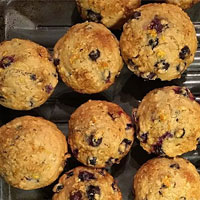
Ingredients
- 1 1/2 cups oat flour (I ground my own in the Vitamix using steel-cut oats)
- 1/2 cup coconut sugar plus a little extra to sprinkle on the top before baking
- 1 very ripe banana
- 3/4 cup non-dairy milk, your choice
- 1 tablespoon baking powder
- 1 teaspoon vanilla extract
- 1/2 cup frozen saskatoon berries
Directions
- Preheat the oven to 350 degrees Fahrenheit/ 177 degrees Celsius
- Combine the following in the blender and blend on high: banana, non-dairy milk, vanilla, and coconut sugar
- Stir the flour and baking powder together in a large mixing bowl
- Add the wet blender mix to the dry mix and stir to combine
- Fold in the saskatoon berries very gently
- Spoon the mix into paper liners in your muffin pan (or you could lightly oil the cups, or do what I do, use a silicone muffin pan.)
- Sprinkle coconut sugar on the tops of muffins
- Bake for 22 to 24 minutes.
- Cool in pans on the rack for at least 10 minutes before removing the muffins from the cups.
Saskatoon Berry Apple Insalata
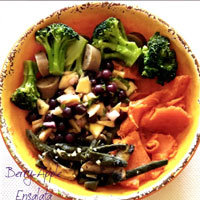
Ingredients
- 2 tablespoons peeled and chopped fresh ginger
- 1 teaspoon lime skin, grated (zest)
- 1/4 cup fresh lime juice
- 2 tablespoons maple syrup (or sweetener of choice)
- 1/4 teaspoon chipotle powder (or use your favorite hotness)
- 2 cups Saskatoon berries, frozen
- 2 cups Granny Smith apple, peeled and diced
- 1/2 cup red onion, between minced and diced
- 2 tablespoons fresh parsley, chopped
- 1/4 cup Camelina oil or other oil (optional)
Directions
- Mix together in a medium-size salad bowl and serve.
Saskatoon Berry Rosemary Scones
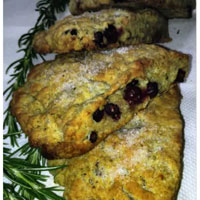
Ingredients
- 1 chia seed egg (Mix together 1 tablespoon of ground chia seed—grind in a coffee grinder—and 2 1/2 tablespoons of water. Stir until fairly viscous, and set aside.)
- 3/4 cup unsweetened almond milk, or other non-dairy milk
- 3/4 cup spelled flour
- 1 1/4 cups unbleached, all-purpose flour
- 1 tablespoon baking powder
- 1/4 cup organic cane sugar (plus more for topping)
- 1/2 teaspoon sea salt
- 1 tablespoon rosemary (just the needles, roughly chopped)
- 6 tablespoons of scoopable coconut oil or vegan butter (not liquid or frozen)
- 1/3 cup saskatoon berries (organic if possible)
Directions
- Preheat oven to 400 degrees Fahrenheit/204 degrees Celsius.
- Line a baking sheet with parchment paper
- In the small mixing bowl that contains the chia seed egg, whisk in the almond milk.
- Combine dry ingredients by whisking well in a mixing bowl: spelled flour, all-purpose flour, baking powder, organic cane sugar, salt, rosemary.
- Add coconut oil to the above mix, cutting with a fork or special pastry cutter until the mix is about the size of small peas throughout.
- Whisk the almond milk-chia seed egg again, and with a wooden spoon, mix a little at a time into the dry ingredients. Add the saskatoon berries and gently fold in. (Overworked dough results in tougher scones).
- Gently transfer the dough to a floured board and form it into a disk with your hands that is about 1 inch high and the size of a regular pie in circumference. With a sharp knife, cut the “pie” into six equal-sized wedges.
- Transfer the wedges to the baking sheet. Sprinkle the remaining sugar over the tops of the wedges.
- Bake until golden brown and fluffy for about 22 – 27 minutes. Cool slightly before eating. They are best fresh, but leftovers can be stored in an air-tight container for about 3 days. Yummy plain with tea, or with a little whatever you desire on top. Inspiration for the adaptations to a recipe by The Minimalist Baker.
Other Facts
- Plants have a spreading, suckering root system and are used in windbreaks for erosion control.
- Young branches can be twisted to make a rope.
- Wood can be made even harder by heating it over a fire and it is easily molded whilst still hot.
- The young stems are used to make rims, handles and as a stiffening in basket making.
- Shoots and young stems were used to make basket rims and handle, arrows, combs, digging sticks, salmon spreaders, and pipes.
- Saskatoon berries provide a purple dye.
- It can be used as a wind-break plant.
- Its wood is hard, strong, fine-grained, and used for tool handles, canes, canoe crossbars, tipi stakes, tipi closure pins, and small implements.
References
- https://www.ncbi.nlm.nih.gov/pmc/articles/PMC3649719/
- https://www.ncbi.nlm.nih.gov/pmc/articles/PMC6315720/
- https://www.ncbi.nlm.nih.gov/pmc/articles/PMC3419346/
- https://www.ncbi.nlm.nih.gov/books/NBK11795/
- https://www.ncbi.nlm.nih.gov/pmc/articles/PMC5291486/
- https://fruits.edpsciences.org/articles/fruits/abs/2012/05/fruits120033/fruits120033.html
- http://www.fao.org/3/cb2395en/CB2395EN.pdf
- https://www.fao.org/in-action/inpho/crop-compendium/fruits-vegetables/en/
- https://www.fao.org/3/cb2395en/online/src/html/fruit-and-vegetables.html
- http://www.fao.org/3/cb2395en/CB2395EN.pdf
- https://en.wikipedia.org/wiki/Fruit
- https://en.wikipedia.org/wiki/List_of_food_plants_native_to_the_Americas
- https://en.wikipedia.org/wiki/List_of_culinary_fruits
- https://www.hsph.harvard.edu/nutritionsource/what-should-you-eat/vegetables-and-fruits/
- https://www.betterhealth.vic.gov.au/health/healthyliving/fruit-and-vegetables
- https://www.cdc.gov/healthyweight/healthy_eating/fruits_vegetables.html
- https://www.botanical-online.com/en/botany/fruits-types-characteristics
- https://www.fda.gov/food/laboratory-methods-food/mpm-v-9-fruits-and-fruit-products-v-51-v-78
- https://www.fda.gov/food/food-labeling-nutrition/nutrition-information-raw-fruits-vegetables-and-fish
- https://onlinelibrary.wiley.com/doi/abs/10.1111/mcn.12208
- https://www.cabi.org/isc/datasheet/
- https://www.science.org/
- https://www.sciencedirect.com/topics/agricultural-and-biological-sciences/fruit-vegetable
- https://www.researchgate.net/publication/
- https://www.ams.usda.gov/grades-standards/fruits
- https://www.aphis.usda.gov/aphis/resources/traveler/intl-travel/fruits-vegetables/fruits-vegetables
- https://snaped.fns.usda.gov/seasonal-produce-guide
- https://www.nass.usda.gov/Publications/Highlights/2015/FruitsNutsBerries_AgCensusHighlights.pdf
- https://plants.usda.gov/home/plantProfile?
- https://www.fs.fed.us/wildflowers/ethnobotany/food/nuts.shtml
- https://downloads.usda.library.cornell.edu/usda-esmis/files/zs25x846c/sf269213r/6t054c23t/ncit0521.pdf
- https://agr.wa.gov/departments/business-and-marketing-support/farm-to-school-toolkit/
- https://health.gov/sites/default/files/2020-01/DGA2000.pdf
- https://www.farmers.gov/archived/cfap2/specialty
- https://www.hsph.harvard.edu/nutritionsource/
- https://www.foodsafety.gov/food-safety-charts/food-safety-during-power-outage
- https://clinicaltrials.gov/ct2/show/
- https://botany.org/home/careers-jobs/careers-in-botany/what-is-botany.html
- https://www.healthbenefitstimes.com/category/fruits
- http://www.hear.org/pier/species/
- https://www.itis.gov/servlet/SingleRpt/SingleRpt?
- http://www.theplantlist.org/tpl1.1/record/
- https://www.fs.fed.us/database/feis/plants/tree/
- https://www.itis.gov/servlet/SingleRpt/SingleRpt?search_topic=TSN&search_value=25109#null
- https://npgsweb.ars-grin.gov/gringlobal/taxon/taxonomydetail?id=2870
- https://pfaf.org/user/plant.aspx?latinname=Amelanchier+alnifolia
- http://www.missouribotanicalgarden.org/PlantFinder/PlantFinderDetails.aspx?taxonid=286527&isprofile=1&
- https://plants.usda.gov/core/profile?symbol=amal2
- https://en.wikipedia.org/wiki/Amelanchier_alnifolia
- https://www.ncbi.nlm.nih.gov/pmc/articles/PMC7120188/
- https://www.fs.fed.us/database/feis/plants/shrub/amealn/all.html
- https://www.cabi.org/isc/datasheet/4820
- http://gringlobal.iita.org/gringlobal/taxonomydetail.aspx?id=2870
- https://gd.eppo.int/taxon/AMEAL
- http://www.theplantlist.org/tpl1.1/record/rjp-4731
- https://www.for.gov.bc.ca/rsi/fnb/saskatoon.pdf

