
Kodo Millet /Koda Millet/Paspalum scrobiculate, commonly called Kodo millet or Koda millet, is an annual grain that is grown primarily in Nepal (not to confuse with Kodo (Finger millet, Eleusine coracana) and also in India, Philippines, Indonesia, Vietnam, Thailand, and in West Africa from where it originated. It is grown as a minor crop in most of these areas, with the exception of the Deccan plateau in India where it is grown as a major food source.[rx] It is a very hardy crop that is drought tolerant and can survive on marginal soils where other crops may not survive and can supply 450–900 kg of grain per hectare.[7] Kodo millet has large potential to provide nourishing food to subsistence farmers in Africa and elsewhere.
| Kodo millet Quick Facts | |
|---|---|
| Name: | Kodo millet |
| Scientific Name: | Paspalum scrobiculatum |
| Origin | Sub-Saharan Africa from Senegal east to Ethiopia and south to South Africa |
| Colors | Vary in color from being light brown to a dark grey (Seed) |
| Shapes | Very small and ellipsoidal, being approximately 1.5 mm in width and 2 mm in length (Seed) |
| Taste | Sweet, Bitter, Astringent |
| Health benefits | Anti-diabetic, Anti-obesity, Anti-cholesterol, and anti-hypertension, Helps in weight management, Cholesterol reduction |
Kodo millet scientifically known as Paspalum scrobiculate is an annual grain that is grown in primarily in India, but also in the Philippines, Indonesia, Vietnam, Thailand, and West Africa where it originates. It is grown as a minor crop in most of these areas, with the exception of the Deccan plateau in India where it is grown as a major food source. Some of the popular common names of the plant are Indian paspalum, Creeping paspalum, Ditch millet, Scrobic paspalum, Water couch, Scorbic, Mau’u-like, rice grass, rice grass paspalum, Veld paspalum, and native paspalum. Kodo is a popular fast or up as food in some parts of India. The millet is certainly superior to rice, gluten-free, and rich in fiber, vitamins, and minerals. It has large potential to provide nourishing food to subsistence farmers in Africa and elsewhere.
Plant Description
Kodo Millet is a monocot tufted annual or perennial grass that grows up to 150 cm tall. The plant typically occurs in seasonally flooded areas and wet depressions, often associated with cultivation and settlements, such as along roadsides, ditches, and waste ground and rice fields. The plant has wide adaptability to different soil from very poor to very fertile and can tolerate a certain degree of alkalinity. The best soils are alluvial, loamy, and sandy soil with good drainage. Kodo millet can be grown in gravelly and stony soil such as in the hilly region. The plant has a shallow root system which may be ideal for intercropping. Stems are rather stout, not or sparingly branched, glabrous or thinly furnished with rather long hairs. Blades are 15-40 cm long, 5-12 mm wide, pale green. Leaf-sheaths and leaves are glabrous. The flower is unisexual, sessile; with 5 mucronate tepals 2-3 mm long; male flowers with 5 stamens c. 1 mm long; female flowers with superior, 1-celled ovary crowned by 3 stigmas. The seeds it produces are very small and ellipsoidal, being approximately 1.5 mm in width and 2 mm in length; they vary in color from being light brown to dark grey.
Health Benefits of Kodo millet
Kodo millet is a good substitute for rice or wheat. Protein, fiber, and mineral content are much higher than the major cereals like rice. It can be cooked just like rice or ground into flour. It provides balanced nutrition, unlike polished white rice. Listed below are some of the popular health benefits of Kodo Millet
1. Anti-diabetic
Kodo millet intake is found to reduce fasting blood glucose levels and promotes a significant increase in serum insulin levels. Anti-diabetic compounds in Kodo are quercetin, ferulic acid, p-hydroxybenzoic acid, vanillic acid, and syringic acid. Thus regular use is recommended for diabetic patients.
2. Antioxidant and anti-microbial activity
Kodo millet grains consist of polyphenols and antioxidants. The polyphenols possess antimicrobial action against certain bacterias (Staphylococcus aureus, Leuconostoc mesenteroides, Bacillus cereus, and Enterococcus faecalis).
3. Anti-obesity
Kodo is high in fiber and prevents gain in weight. It also helps to prevent the rise in cholesterol and triglyceride levels and is a functional food to manage weight and promotes weight loss.
4. Anti-cholesterol and anti-hypertension
Kodo is very beneficial for post-menopausal women suffering from signs of cardiovascular disease, high blood pressure, and high cholesterol levels. Hence, regular consumption of Kodo millets is recommended for all.
5. Helps in weight management
Kodo millet consists of low-fat content and fiber content is higher and makes to feel fuller after consuming less quantity itself, therefore it avoids overeating and lessens the weight, thereby controlling obesity. An obese person should include this cereal in their diet and see the difference in their weight.
6. Cholesterol reduction
Regular consumption of Kodo millet helps to lower the triglycerides and C-reactive protein, thus it lowers the bad cholesterol and is ideal for your heart. Thus heart-protective food too.
Traditional uses and benefits of Kodo Millet
- Regular consumption of Kodo millet is very beneficial for postmenopausal women suffering from signs of cardiovascular disease, like high blood pressure and high cholesterol levels.
- Kodo Millet helps hydrate your colon to keep your system regular and keep you from being constipated.
- Kodo Millet helps in controlling Blood sugar and Cholesterol.
- It is easy to digest, contains a high amount of lecithin, and is excellent for strengthening the nervous system.
- It is rich in photo chemicals, phytate that helps in the reduction of cancer risks.
- It helps to reduce body weight and is beneficial for postmenopausal women.
- It is good for those suffering from signs of cardiovascular disease, like high blood pressure and high cholesterol levels.
- Also, it is good for diabetics, its anti-diabetic compounds like quercetin, ferulic acid, p – hydroxybenzoic acid, vanillic acid, and syringic acid from Varagu prevent obesity.
- Kodo millets contain no gluten and are good for people who are gluten intolerant.
- Kodo millets can be used for traditional as well as novel foods.
- Unprocessed or processed grain can be cooked whole or decorticated and if necessary ground to flour by traditional or industrial methods.
- In tribal sectors, it is cooked as rice also and out of flour tribal population prepares different recipes.
- Traditionally the grains of Paspalum scrobiculate are used in the management of diabetes mellitus.
- Grains are also useful in the treatment of inflammation, hemorrhages, and general debility.
Culinary uses
- It is eaten as a famine food in Africa.
- Kodo millet is ground into flour and used to make pudding in India.
- In Africa it is cooked like rice.
Recipes
Kodo millet (Varagu) pulao
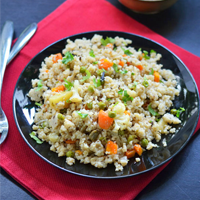
Ingredients
- Varagu/ Kodo millet – 1cup
- Water – 1 & 1/2 cups
- Chopped Carrot, beans, green peas – 1 cup
- Onion – 1
- Ginger garlic paste – 1 tsp
- Green chili – 2
- Mint leaves – 12
- Salt – As needed
- Ghee/ oil – 3 tbsp
- Cinnamon – 1-inch piece
- Fennel seeds – 1 tsp
- Bay leaf – 1
Instruction
- Heat a small pressure cooker with oil/ ghee.
- In medium flame, add cinnamon, fennel, bay leaf.
- Do not let the fennel change its color.
- Add onion and give it a stir. Add ginger-garlic paste.
- Fry for a minute in medium flame.
- Add the chopped veggies, mint leaves.
- Fry in medium flame for about 2 mins.
- You can add a little salt for the veggies.
- Add washed, drained millet to it and mix well. Let it dry. The flame should always be in the medium.
- Add water, salt and bring to boil. mix well and cook for a whistle in medium or low flame or in low flame possibly for 12 mins.
Other facts
- In the Southern United States and Hawaii, it is considered to be a noxious weed.
- It may also have the potential to be used as grass ties on hillside plots to prevent soil erosion, while also providing famine food as a secondary purpose.
- It has been noted that it makes a good cover crop.
- Kodo millet is a nutritious grain and a good substitute for rice or wheat.
- It is also a good choice of animal fodder for cattle, goats, pigs, sheep, and poultry.
References
- https://www.ncbi.nlm.nih.gov/pmc/articles/PMC3257681/
- https://www.ncbi.nlm.nih.gov/pmc/articles/PMC5748761/
- https://www.ncbi.nlm.nih.gov/pmc/articles/PMC4711439/
- https://www.ncbi.nlm.nih.gov/pmc/articles/PMC3257681/
- https://www.ncbi.nlm.nih.gov/pmc/articles/PMC7294352/
- https://www.ncbi.nlm.nih.gov/pmc/articles/PMC4608274/
- https://www.ncbi.nlm.nih.gov/pmc/articles/PMC7915747/
- https://www.ncbi.nlm.nih.gov/pmc/articles/PMC7294352/
- https://www.ncbi.nlm.nih.gov/pmc/articles/PMC5066953/
- https://www.ncbi.nlm.nih.gov/books/NBK76060/
- https://www.ncbi.nlm.nih.gov/pmc/articles/PMC4188247/
- https://www.elsevier.com/books/nuts-and-seeds-in-health-and-disease-prevention/preedy/978-0-12-818553-7
- https://www.elsevier.com/books/nuts-and-seeds-in-health-and-disease-prevention/preedy/978-0-12-375688-6
- https://www.amazon.com/Nuts-Seeds-Improving-Your-Health/dp/1526725886
- https://books.google.com/books/about/Nuts_and_Seeds_in_Health_and_Disease_Pre.html?id=C6lYoH8rwywC
- https://www.sciencedirect.com/book/9780123756886/nuts-and-seeds-in-health-and-disease-prevention
- https://www.sciencedirect.com/book/9780128185537/nuts-and-seeds-in-health-and-disease-prevention
- https://link.springer.com/article/10.1007/s42452-019-1576-z
- https://www.tandfonline.com/doi/full/10.1080/10408398.2019.1657062
- https://academic.oup.com/nutritionreviews/article/73/6/335/1845023
- https://www.researchgate.net/publication/289036515_Nuts_and_seeds
- https://www.nature.com/articles/s43016-019-0026-9
- https://www.cambridge.org/core/journals/british-journal-of-nutrition/article/nuts-source-of-energy-and-macronutrients/AAAEDDA038B08C0A00C802F00A7F4171
- https://onlinelibrary.wiley.com/doi/full/10.1111/1541-4337.12730
- https://doi.org/10.1128/9781555818463.ch9
- https://en.wikipedia.org/wiki/Nut_(fruit)
- https://en.wikipedia.org/wiki/Cereal
- https://en.wikipedia.org/wiki/List_of_breakfast_cereals
- https://www.frontiersin.org/articles/10.3389/fchem.2016.00032/full
- https://www.nejm.org/doi/full/10.1056/nejmoa130735
- https://www.betterhealth.vic.gov.au/health/healthyliving/nuts-and-seeds
- https://www.bhf.org.uk/informationsupport/heart-matters-magazine/nutrition/ask-the-expert/nuts-as-a-healthy-snack
- https://www.bbcgoodfood.com/howto/guide/health-benefits-nuts
- https://www.olivemagazine.com/recipes/vegetarian/sticky-miso-nuts-and-seeds/
- https://www.researchgate.net/publication/232710843_Health_Benefits_of_Nut_Consumption
- https://www.itis.gov/servlet/SingleRpt/SingleRpt?search_topic=TSN&search_value=41040#null
- https://www.smithakalluraya.com/kodo-millet-idli-dosa-recipe-varugu-idli-dosa-millet-recipes/
- http://www.hear.org/pier/species/paspalum_scrobiculatum.htm
- https://npgsweb.ars-grin.gov/gringlobal/taxonomydetail.aspx?id=26917
- https://www.cabi.org/isc/datasheet/38955
- https://www.amazon.com/kodo-millet/s?k=kodo+millet
- https://plants.usda.gov/core/profile?symbol=PASC6
- http://www.theplantlist.org/tpl/record/kew-432275
- https://en.wikipedia.org/wiki/Paspalum_scrobiculatum
- https://pristineorganics.com/top-6-health-benefits-kodo-millets/
- https://www.bigbasket.com/pd/40077487/bb-royal-organic-kodo-milletvaragu-rice-500-g/

