Quadratus Lumborum Block approaches use a fascial plane through which the abdominal branches of the lumbar arteries course. The anterior quadratus lumborum block is a deep block, close to the lumbar plexus and risks retroperitoneal spread of hematoma.
Anatomy and Physiology of Quadratus Lumborum Block
The QLB differs from the TAP. It is a block of the posterior abdominal wall. It is also referred to as an interfascial plane block because it requires the injection of a local anesthetic into the thoracolumbar fascia (TLF), which is a posterior extension of the abdominal wall muscle fascia and encompasses the back muscles (quadratus lumborum [QL], psoas major [PM], and the erector spinae [ES] muscles). The TLF extends posteriorly to connect with the lumbar paravertebral region. It has 3 layers – anterior, middle, and posterior – based on its relation to the back muscles it encapsulates. The TLF extends from the lumbar spine to the thoracic spine in a craniocaudal direction.[rx]
The TLF contains mechanoreceptors, nociceptors, and sympathetic fibers. The spread of local anesthetic to the paravertebral space and inhibition of these sympathetic fibers is believed to be responsible for the visceral pain coverage provided by this block.[rx]
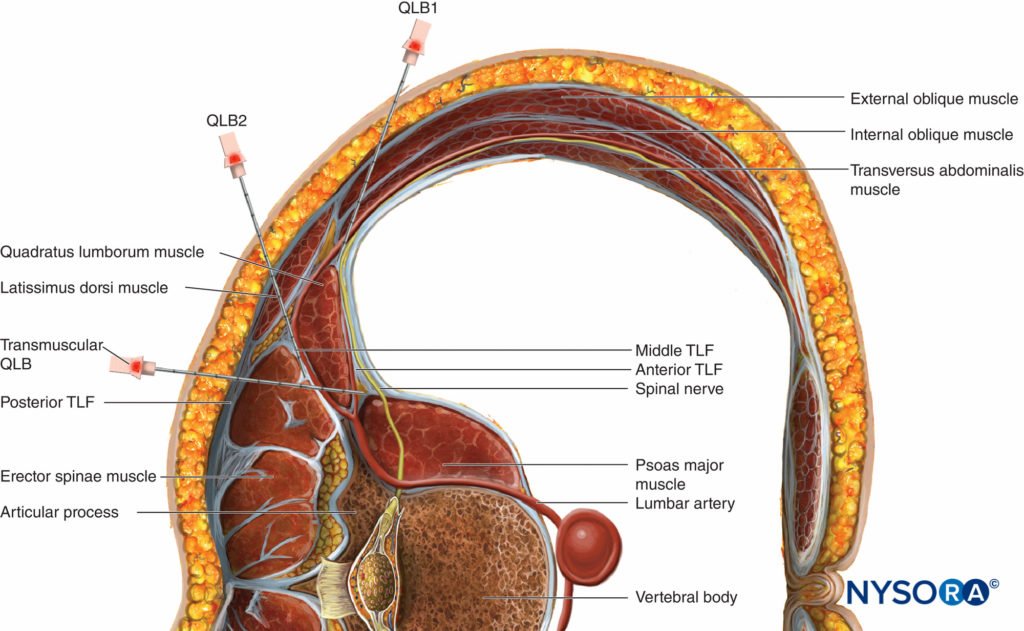
Variants of this block have been described, each involving a different injection site relative to the quadratus lumborum muscle. QL1 or lateral QLB refers to the deposition of local anesthetic lateral to the QL muscle. QL2 or posterior QLB refers to injection posterior to the QL muscle (anterior to the TLF separating QL muscle from erector spinae and latissimus dorsi muscles) in an area termed the “lumbar interfascial triangle.” QL3 or anterior QLB also referred to as the transmuscular approach due to the typical needle approach, refers to injection anterior to the QL muscle at the level of the L4 vertebral body. To acquire the ultrasound view for this block, the clinician should obtain the “shamrock sign,” which consists of the transverse process of L4 as the “stem” and psoas major, QL and erector spinae as “3 cloves of the shamrock.”[rx] QL4 or intramuscular QL block involves an injection into the muscle itself.
Types of Block Quadratus Lumborum
Subcostal TAP Block
- A linear transducer is placed alongside the lower margin of the rib cage as medial and cranial as possible for the subcostal TAP block. The rectus abdominis muscle and its posterior rectus sheath are visualized along with the transversus abdominis muscle deep to the posterior rectus sheath.
- The target is the fascial plane between the posterior rectus sheath and the transversus abdominis muscle. The needle is inserted above the rectus abdominis close to the midline and advanced from medial to lateral (alternatively, lateral to medial).
- The endpoint of injection is the spread of local anesthetic between the posterior rectus sheath and the anterior margin of the transversus abdominis muscle. Follow the link to Truncal and Cutaneous Blocks to learn about how to perform a rectus sheath block.
Lateral TAP Block
- For the lateral TAP block, a linear transducer is placed in the axial plane on the midaxillary line between the subcostal margin and the iliac crest. The three layers of abdominal wall muscles are visualized: external and internal oblique as well as the transversus abdominis muscles.
- The target is the fascial plane between the internal oblique and the transversus abdominis muscles. The needle is inserted in the anterior axillary line, and the needle tip is advanced until it reaches the fascial plane between the internal oblique and transversus abdominis muscles approximately in the midaxillary line.
Anterior TAP Block
- A linear transducer is placed medial to the anterior superior iliac spine pointing toward the umbilicus with a caudad tilt for the anterior TAP block. The three abdominal wall muscles are visualized (see discussion for the lateral TAP block).
- The target is the same fascial plane at the level of the deep circumflex iliac artery. The needle is inserted medial to the anterior superior iliac spine. The needle tip is advanced until it is placed between the internal oblique and transversus abdominis muscles adjacent to the deep circumflex iliac artery.
Posterior TAP Block
- For the posterior TAP block, the linear transducer is placed in the axial plane in the midaxillary line and moved posteriorly to the most posterior limit of the TAP between the internal oblique and transversus abdominis muscles. The target is the most posterior end of the TAP.
- The needle is inserted in the midaxillary line and advanced posteriorly until it reaches the posterior end of the TAP.
Transmuscular QL Block
- A curved array transducer for the transmuscular QL (TQL) block is placed in the axial plane on the patient’s flank just cranial to the iliac crest. The “shamrock sign” is visualized: The transverse process of vertebra L4 is the stem, whereas the erector spinae posteriorly, QL laterally, and psoas major anteriorly represent the three leaves of the trefoil. The target for injection is the fascial plane between the QL and psoas major muscles.
- The needle is inserted using an in-plane technique from the posterior end of the transducer through the QL muscle. The injectate should ideally spread from the injection site inside the fascial plane between the QL and psoas major muscles to the thoracic paravertebral space with a goal to accomplish segmental somatic and visceral analgesia from T4 to L1. The needle approaches of the QLBs are shown in.
Type 1 QL Block
- For the type 1 QL (QL1) block, a linear transducer is placed in the axial plane in the midaxillary line and moved posteriorly until the posterior aponeurosis of the transversus abdominis muscle becomes visible as a strong specular reflector. The target is just deep to the aponeurosis but superficial to the TF at the lateral margin of the QL muscle.
- This is just lateral to the pararenal fat compartment. The QL1 block is identical to the fascia transversalis plane block. The needle is inserted from either the anterior or the posterior end of the transducer and advanced until the needle tip just penetrates the posterior aponeurosis of the transversus abdominis muscle.
- A local anesthetic is injected between the aponeurosis and the TF at the lateral margin of the QL muscle. The main effect is the anesthesia of the lateral cutaneous branches of the iliohypogastric, ilioinguinal, and subcostal nerves (T12–L1).
Type 2 QL Block
- In the type 2 QL (QL2) block, a linear transducer is placed in the axial plane in the midaxillary line and moved posteriorly as in the QL1 block, until the LIFT, which encapsulates the paraspinal muscles, becomes visible between the latissimus dorsi and QL muscles.
- The target is the deep layer (the PRS) of the middle layer of the TLF. The needle is inserted from the lateral end of the transducer. The needle tip is advanced until it is inside the middle layer of the TLF close to the LIFT. The local anesthetic is injected intrafascially and apparently provides analgesia equivalent to TQL block but with faster onset. The mechanism of action is not well understood.
DOSE AND VOLUME OF LOCAL ANESTHETIC
- The TAP blocks as well as the TQL block and QLB1 are “tissue plane” blocks and thus require large volumes of local anesthetic to obtain reliable blockade. For each of the TAP blocks, a minimum volume of 15 mL is recommended. The local anesthetic dose needs to be considered for the size of the patient to ensure that a maximum safe dose is not exceeded, especially with dual bilateral TAP blocks.
- The QL region is relatively vascular as the lumbar arteries lie posterior to the muscle. Absorption of the local anesthetic into the circulation depends primarily on the vascularity of the site of deposition. As the QL muscle is well vascularized and a large volume of local anesthetic is needed, the dose should be calculated accurately to prevent high peak plasma concentrations of local anesthetics in this type of block.
Indications
- The QLB produces a broad distribution of local anesthetic resulting in a large area of sensory inhibition of (T7 through L1 in most cases). Therefore, QLBs may be used to provide postoperative analgesia for abdominal and pelvic regions.
- For this reason, the QLB is often used in the treatment of pain after abdominal, obstetric, gynecologic, and urologic surgeries. There are also case reports of QLBs being used successfully in the hip, femur, and lumbar vertebrae surgeries.[rx][rx]
Contraindications
The QLB has similar contraindications to other fascia plane blocks such as the transversus abdominis plane block or the fascia iliaca block. These absolute contraindications include the following[rx][rx]:
-
Patient refusal
-
True local anesthetic allergy
-
Risk of local anesthetic toxicity, in other words, the patient has already received the maximum recommended dose of local anesthesia
-
Local infection at the procedure site
There is controversy to whether the QLB or other plane blocks can be safely performed during a coagulopathy or in a patient receiving anticoagulants.[rx] Some practitioners suggest that plane blocks may be safe with altered coagulation.[rx] The most recently published American Society of Regional Anesthesia and Pain Medicine evidence-based guidelines for regional anesthesia use in patients receiving antithrombotic or thrombolytic therapy caution against deep regional anesthetic procedures in anticoagulated patients because multiple case reports found that such situations resulted in significant morbidity.[rx]
Equipment
Equipment includes:
-
Skin antiseptic
-
Sterile towels
-
Sterile gauze
-
100 to 150 cm 22-gauge needle for local anesthetic injection
-
Local anesthetic
-
Sterile gloves
-
Ultrasound machine
-
Lateral, posterior and intramuscular approaches: High frequency (6 to 15 MHz) linear ultrasound probe transducer
-
Anterior (QL3) approach: Lower frequency (2 to 6 MHz) curvilinear ultrasound transducer
-
ECG monitor
-
Blood pressure monitor
-
Pulse oximetry
Generally, a long-acting local anesthetic such as 0.2% ropivacaine or 0.25% bupivacaine is chosen to maximize pain control. Maximum allowable dosage should be calculated, especially if the performance of bilateral blocks is anticipated.
Preparation
- The provider must discuss the risks, benefits, and alternatives with the patient, and then obtain informed consent. The practitioner should position the patient for the block: supine position for lateral or posterior QLB, lateral decubitus for intramuscular QLB or anterior QLB. The practitioner should identify of correct location and anatomy under ultrasound, then clean the patient’s the skin with chlorhexidine or povidone iodine.
Technique
For the lateral QLB, the patient is positioned supine or lateral position)with an ultrasound probe applied to the flank between the costal margin and the iliac crest in the anterior axillary line (triangle of Petit). The 3 abdominal muscle layers (external oblique, internal oblique, transversus abdominis) are identified and traced posteriorly to identify the TLF and the back muscles – QL, PM, ES, and latissimus dorsi). The provider inserts the needle in an in-plane approach and advances it through the anterior abdominal muscles until it reaches the anterolateral edge of QL. Proper placement results in the spread of local anesthetic between QL and the middle layer of the TLF.
For the anterior QLB, the patient is placed in the lateral decubitus position with the ultrasound probe placed above the iliac crest at the mid-axillary line. The provider moves the probe posteriorly to identify the “shamrock sign.” They then insert the needle in an in-plane approach through the QL muscle and the middle TLF layer between QL and PM. Correct needle placement and injection results in the spread of local anesthetic between these 2 muscles.
For the posterior QLB, the patient is positioned supine as with the lateral QLB. The provider identifies the posterior border of QL and places the needle tip at that point. Proper placement should result in a spread of local anesthetic through the middle TLF layer and into the interfascial triangle.
For the Intramuscular QLB, the patient should be placed in the supine or lateral decubitus position. Following identification of QL, the practitioner inserts the needle in an in-plane approach and an anterolateral to posteromedial direction with an injection of local anesthetic directly into the muscle.
References
- https://www.ncbi.nlm.nih.gov/books/NBK535407/
- https://www.ncbi.nlm.nih.gov/books/NBK537212/
- https://pubmed.ncbi.nlm.nih.gov/11415651/
- https://www.ncbi.nlm.nih.gov/books/NBK482385/
- https://www.ncbi.nlm.nih.gov/books/NBK551649/
- https://pubmed.ncbi.nlm.nih.gov/11415651/
- https://www.ncbi.nlm.nih.gov/books/NBK537212/
Explore this medical topic
Continue through verified related conditions, investigations, medicines, and patient guides. These links are educational and do not replace professional medical advice.