
What Is Coracobrachialis Muscle?/Coracobrachialis Muscle is the smallest of the three muscles that attach to the coracoid process of the scapula. (The other two muscles are pectoralis minor and the short head of the biceps brachii.) It is situated at the upper and medial part of the arm. It arises from the apex of the coracoid process, in common with the short head of the biceps brachii, and from the intermuscular septum between the two muscles. It is inserted by means of a flat tendon into an impression at the middle of the medial surface and border of the body of the humerus (shaft of the humerus) between the origins of the triceps brachii and brachialis.
At a Glance Coracobrachialis
-
Function – Flexion and adduction of the arm
-
Origin – a Coracoid process
-
Insertion – Middle of the humerus, on its medial aspect
-
Innervation – Musculocutaneous nerve (C5, C6, C7)
|
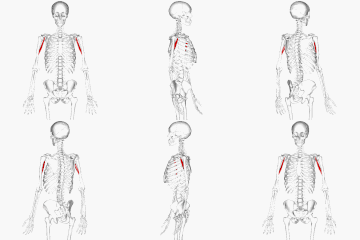
Position of coracobrachialis muscle (shown in red)
|
|
| Details | |
|---|---|
| Origin | Coracoid process of the scapula |
| Insertion | The anteromedial surface of humerus distal to the crest of the lesser tubercle |
| Artery | Brachial artery |
| Nerve | Musculocutaneous nerve (C5, C6, and C7) |
| Actions | adducts humerus flexes the arm at glenohumeral joint |
| Identifiers | |
| Latin | musculus coracobrachialis |
| TA | A04.6.02.017 |
| FMA | 37664 |
| Anatomical terms of muscle | |
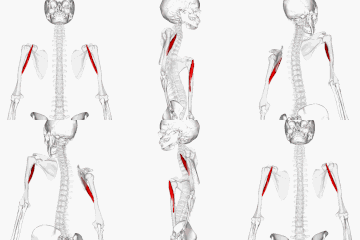
It arises from the apex of the coracoid process, in common with the short head of the biceps brachii, and from the intermuscular septum between the two muscles. It is inserted by means of a flat tendon into an impression at the middle of the medial surface and border of the body of the humerus (shaft of the humerus) between the origins of the triceps brachii and brachialis.
Nerve Supply of Coracobrachialis Muscle
- It is perforated by and innervated by the musculocutaneous nerve which arises from the anterior division of the upper (C5, C6) & middle trunks (C7) of the brachial plexus.
Functions of Coracobrachialis Muscle
- The action of the coracobrachialis is to flex and adduct the arm at the glenohumeral joint. Also, the coracobrachialis resists deviation of the arm from the frontal plane during the abduction.[rx] Therefore, the contraction of the coracobrachialis leads to two distinct movements at the shoulder joint.
- It both draws the humerus forward, causing shoulder flexion, and draws the humerus toward the torso, causing shoulder adduction. To a smaller extent, it also turns the humerus inwards, causing internal rotation.[rx]
- Another important function of the coracobrachialis is the stabilization of the humeral head within the shoulder joint, especially when the arm is hanging freely at a person’s side.[rx]
References
- https://www.ncbi.nlm.nih.gov/books/NBK531475/
- https://www.ncbi.nlm.nih.gov/books/NBK459343/
- https://www.ncbi.nlm.nih.gov/books/NBK538319/
- https://www.ncbi.nlm.nih.gov/books/NBK539746/
- https://www.ncbi.nlm.nih.gov/books/NBK531457/
- https://www.ncbi.nlm.nih.gov/books/NBK537216/
- https://www.ncbi.nlm.nih.gov/books/NBK539746/
- https://www.ncbi.nlm.nih.gov/books/NBK542313/
- https://www.ncbi.nlm.nih.gov/books/NBK541005/
- https://en.wikipedia.org/wiki/Serratus_anterior_muscle

