
RX Patient Tools
Use these quick guides before reading the article, or return to them when you need help preparing questions for a doctor.
Short Muscles Of Hand/The thenar muscles are three short muscles located at the base of the thumb. The muscle bellies produce a bulge, known as the thenar eminence. They are responsible for the fine movements of the thumb. The median nerve innervates all the thenar muscles.
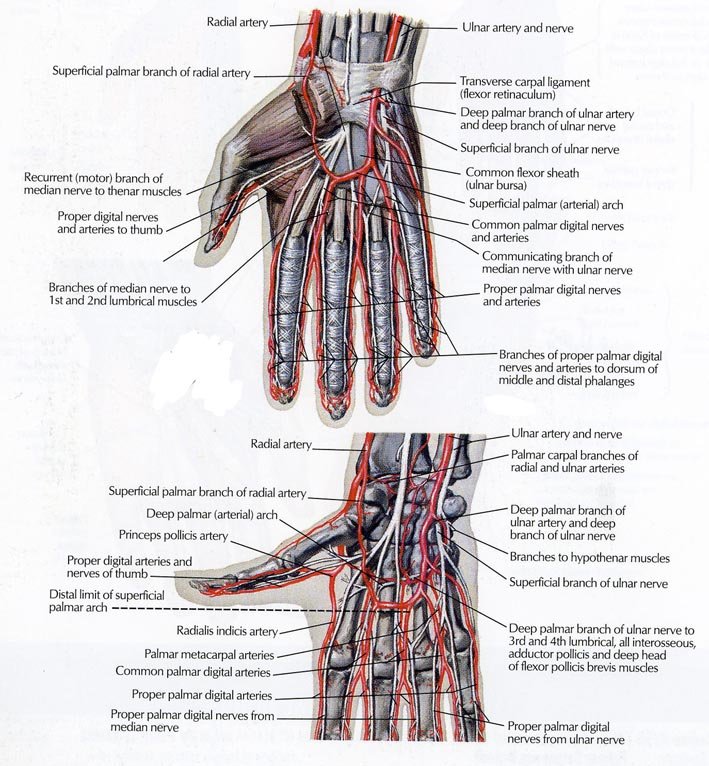
Thenar Muscles of Hand
Opponents policies
-
Function: Opposition of the thumb
-
Origin: Flexor retinaculum and tubercle of trapezium
-
Insertion: Lateral aspect of the first metacarpal
-
Innervation: Recurrent branch of the median nerve (C8, T1)
Abductor policies Brevis
-
Function: Abduction of the thumb at the metacarpophalangeal joint
-
Origin: Flexor retinaculum and tubercle of the scaphoid
-
Insertion: Lateral aspect of proximal phalanx of the first finger
-
Innervation: Recurrent branch of the median nerve (C8, T1)
Flexor policies Brevis
-
Function: Flexion of the thumb at the metacarpophalangeal joint
-
Origin: Flexor retinaculum and tubercle of trapezium
-
Insertion: Lateral aspect of proximal phalanx of the first finger
-
Innervation: Recurrent branch of the median nerve (C8, T1)
Adductor Compartment
Adductor pollicus
-
Function: Adduction of the thumb
-
Origin: Second, third metacarpal, and capitate
-
Insertion: Proximal phalanx and extensor expansion of 1st finger
-
Innervation: Deep branch of ulnar nerve (C8, T1)
Hypothenar Muscles of Hand
Abductor digiti minimi
-
Function: Abduction of the little finger at the metacarpophalangeal joint
-
Origin: Pisiform
-
Insertion: Medial aspect of proximal phalanx of fifth finger
-
Innervation: Deep branch of ulnar nerve (C8, T1)
Flexor digiti minimi brevis
-
Function: Flexion of the little finger at the metacarpophalangeal joint
-
Origin: Flexor retinaculum and hook of hamate
-
Insertion: Medial aspect of proximal phalanx of fifth finger
-
Innervation: Deep branch of ulnar nerve (C8, T1)
Opponens digiti minimi
-
Function: Opposition of the little finger
-
Origin: Flexor retinaculum and hook of hamate
-
Insertion: Medial aspect of fifth metacarpal
-
Innervation: Deep branch of ulnar nerve (C8, T1)
Short Muscles Of Hand
Lubricants
-
Function: Flexion of the metacarpophalangeal joints with extension of the interphalangeal joints
-
Origin: Arise from tendons of flexor digitorum profundus. First 2 are unipennate, and the third and fourth are bipennate
-
Insertion: Extensor expansions of second, third, fourth, and fifth finger
-
Innervation: Median nerve (C8, T1) for the lateral 2 lumbricals, deep branch of ulnar nerve (C8, T1) for the medial 2 lumbricals
Dorsal interossei
-
Function: Abduction of the second, third, and fourth finger away from the axial line
-
Origin: Adjacent metacarpals
-
Insertion: Extensor expansions and proximal phalanges of the second, third, and fourth fingers
-
Innervation: Deep branch of ulnar nerve (C8, T1)
Palmar interossei
-
Function: Adduction of the second, third, and fourth finger towards the axial line
-
Origin: Palmar surfaces of second, fourth, and fifth metacarpals
-
Insertion: Extensor expansions and proximal phalanges of the second, fourth, and fifth fingers
-
Innervation: Deep branch of ulnar nerve (C8, T1)
| Intrinsic Muscles of the Hand | ||||
| Muscle | Origin | Insertion | Action | Innervation |
| Muscles acting on the Second through Fifth Digits | ||||
| Dorsal interossei (4) | the ulnar side of 1st MC; both sides of 2nd-4th MC; radial side of 5th MC | Tubercle of the proximal phalanx and dorsal aponeurosis: radially on 2nd and 3rd digits, clearly on 3rd and 4th digit | Abduct 2nd-4th digits from midline; flex MCP joint, extend PIP and DIP joints | Ulnar nerve (C8-T1, anterior) |
| Palmar interossei (3) | the ulnar side of 2nd and radial side of 4th-5th MC | Tubercle of the proximal phalanx and dorsal aponeurosis: ulnarly on 2nd digit, radially on 4th and 5th digits | Adduct 2nd, 4th, and 5th digits to the midline of the hand. Flex MCP joint and extend PIP and DIP joints | Ulnar nerve (C8-T1, anterior) |
| Lubricants (1 and 2) | Tendons of FDP in deep palm | radial side of dorsal expansion of 2nd and 3rd digits | Flex MCP, extend DIP, PIP | Median nerve (C8-T1, anterior) |
| Lubricants (3 and 4) | Tendons of FDP in deep palm | radial side of dorsal expansion of 4th and 5th digits | Flex MCP, extend DIP, PIP | Ulnar nerve (c8-T1, anterior) |
| Palmaris Brevis | ulnar border of palmar aponeurosis | The skin over the hypothenar region | Corrugates palmar skin | Ulnar nerve (C8-T1, anterior) |
| Abductor digiti minimi | Pisiform bone | The ulnar side of the base of the 5th proximal phalanx | Abduct 5th digit | Ulnar nerve (C8-T1, anterior) |
| Flexor digiti minimi brevis | Flexor retinaculum and hamulus | The ulnar side of the base of the 5th proximal phalanx | Flex 5th MCP joint | Ulnar nerve (C8-T1, anterior) |
| Opponents digiti minimi | Flexor retinaculum and hamulus | The ulnar side of the base of the 5th MC | Flexion and opposition | Ulnar nerve (C8-T1, anterior) |
| Muscles acting on the Thumb | ||||
| Abductor pollicis brevis (APB) | Anterior surface of trapezium, scaphoid | the radial aspect of the base of proximal phalanx | Abducts thumb | Median n. (C8-T1, anterior) |
| Opponent pollicis | Trapezium | The anterolateral surface of 1st MC | Medially rotates (opposes) thumb | Median n. (C8-T1, anterior) |
| Flexor pollicis brevis | ||||
| Superficial head | Transverse carpal ligament and trapezium | radial side of the base of proximal phalanx | Flexes thumb | Median n. (C8-T1, anterior) |
| Deep head | radial side of 2nd MC | Ulnar nerve (C8-T1, anterior) | ||
| Adductor pollicis | ||||
| Oblique head | The anterior surface of capitate and 2nd and 3rd MC | the ulnar side of the base of proximal phalanx | Adducts thumb | Ulnar nerve (C8-T1, anterior) |
| Transverse head | Distal half of 3rd MC | |||
|
| Extrinsic Muscles of the Hand | ||||
| Muscle | Origin | Insertion | Action | Innervation |
| Muscles acting on the Second through Fifth Digits | ||||
| Extensor digitorum cominus (EDC) | Lateral epicondyle of humerus | middle and distal phalanges of index, middle, and ring fingers | Extends digits and wrist when the fist is clenched | Radial nerve (C7-C8, posterior) |
| Extensor digiti minimi (EDM) | Common extensor tendon | All phalanges of the fifth digit | Extends the fifth digit | Radial nerve (C7-C8, posterior) |
| Extensor indicis proprius (EIP) | Interosseus membrane and ulna | middle and distal phalanges of the index finger | extends first digit and wrist | Radial nerve (C8-T1, posterior) |
| Flexor digitorum superficialis (FDS) | Medial epicondyle | The base of the middle phalanx of each digit | Flexes PIP, MCP, and wrist joint | Median nerve (C8-T1, anterior) |
| Flexor digitorum profundus (FDP) | Anterior proximal ulna and IOM | Base of distal phalanx of each digit | Flexes DIP, PIP, MCP, and wrist joints | -Median n. (C7-T1, anterior) for 2nd-3rd digit -Ulnar n. (C7-T1, anterior) for 4th-5th |
| Muscles acting on the thumb | ||||
| Abductor pollicis longus (APL) | Posterior IOM and ulna | Base of1st MC, laterally | Abducts thumb and wrist | Radial n. (C8-T1, posterior) |
| Extensor pollicis brevis (EPB) | Posterior midshaft of radius and IOM | Base of proximal phalanx | Extends thumb and abducts wrist | Radial n. (C8-T1, posterior) |
| Extensor pollicis Longus (EPL) | Posterior surface of IOM and posteriior ulna | Base of middle phalanx | Extend thumb and abducts wrist | Radial n. (C8-T1, posterior) |
| Flexor pollicis longus (FPL) | Anterior mid-radius and IOM | Lateral aspect of base of proximal phalanx | Flexe thumb, MCP joint, and wrist | Median n. (C7-T1, anterior) |
Surgical Considerations
The deltoid is a significant factor when considering the anterior surgical approach to gain access to the shoulder joint. Some of these technical procedures include, but are not limited to the following:
-
Open Bankart repair/capsular reconstructions – indicated in the setting of recurrent anterior (or other directional) instability of the shoulder
-
Shoulder arthroplasty – indicated for cases of post-traumatic deformity, advanced degenerative pain, swelling, stiffness, or reduced movement. সহজ বাংলা: জয়েন্টের প্রদাহ।" data-rx-term="arthritis" data-rx-definition="Arthritis means joint inflammation causing pain, swelling, stiffness, or reduced movement. সহজ বাংলা: জয়েন্টের প্রদাহ।">arthritis, and/or avascular necrosis includes hemiarthroplasty, total shoulder arthroplasty (TSA), reverse total shoulder arthroplasty (TSA)
-
Rotator cuff repair contemporary – indications remain somewhat controversial although most of these procedures are now being performed arthroscopically popular approaches (as opposed to the deltopectoral approach) include the mini-open approach (lateral deltoid-splitting approach)
References
- https://www.ncbi.nlm.nih.gov/books/NBK507892/
- https://www.ncbi.nlm.nih.gov/books/NBK525990/
- https://www.ncbi.nlm.nih.gov/books/NBK537258/
- https://www.ncbi.nlm.nih.gov/books/NBK499858/
- https://www.ncbi.nlm.nih.gov/books/NBK545221/
- https://www.ncbi.nlm.nih.gov/books/NBK537056/
- https://www.ncbi.nlm.nih.gov/books/NBK482410/
- https://teachmeanatomy.info/upper-limb/bones/clavicle/
- https://www.kenhub.com/en/library/anatomy/the-clavicle

