
Nucleus – What About You Need To Know

Patient Tools

Read, save, and share this guide

Use these quick tools to make this medical article easier to read, print, save, or share with a family member.

Patient Mode

Understand this article easily

Switch between simple English and easy Bangla patient notes. This is for education and does not replace a doctor consultation.

The nucleus is a membrane-bound organelle that contains the genetic material (DNA) of eukaryotic organisms. As such, it serves to maintain the integrity of the cell by facilitating transcription and replication processes. It's the largest organelle inside the cell taking up about a tenth of the...

For severe symptoms, danger signs, pregnancy, child illness, or sudden worsening, seek urgent medical care.

বাংলা রোগী নোট এখনো যোগ করা হয়নি। পোস্ট এডিটরে “RX Bangla Patient Mode” বক্স থেকে সহজ বাংলা সারাংশ যোগ করুন।

এই তথ্য শিক্ষা ও সচেতনতার জন্য। এটি ডাক্তারি পরীক্ষা, রোগ নির্ণয় বা প্রেসক্রিপশনের বিকল্প নয়।

Article Summary

The nucleus is a membrane-bound organelle that contains the genetic material (DNA) of eukaryotic organisms. As such, it serves to maintain the integrity of the cell by facilitating transcription and replication processes. It's the largest organelle inside the cell taking up about a tenth of the entire cell volume. Found within eukaryotic cells, the nucleus contains the genetic material that determines the entire structure and function...

Key Takeaways

  • This article explains Characteristics of Eukaryotic Cells in simple medical language.
Educational health guideWritten for patient understanding and clinical awareness.
Reviewed content workflowUse writer and reviewer profiles for stronger trust.
Emergency safety firstUrgent warning signs are highlighted below.

Seek urgent medical care if you notice

These warning signs are general safety guidance. Local emergency numbers and clinical judgment should always come first.

  • Severe symptoms, breathing difficulty, fainting, confusion, or rapidly worsening illness.
  • New weakness, severe pain, high fever, or symptoms after a serious injury.
  • Any symptom that feels urgent, unusual, or unsafe for the patient.
1

Emergency now

Use emergency care for severe, sudden, rapidly worsening, or life-threatening symptoms.

2

See a doctor

Book a professional medical evaluation if symptoms persist, worsen, recur often, affect daily activities, or occur in a high-risk patient.

3

Learn safely

Use this article to understand possible causes, tests, treatment options, prevention, and questions to ask your clinician.

Before reading

RX Patient Tools

Use these quick guides before reading the article, or return to them when you need help preparing questions for a doctor.

Start here Choose the right pathway for symptoms, reports, medicines, or urgent warning signs. Disease article roadmap Read this topic step by step: meaning, symptoms, warning signs, diagnosis, treatment, prevention, and follow-up. Treatment planner Prepare questions about treatment choices, benefits, risks, side effects, and follow-up. Family & caregiver guide Organize symptoms, reports, medicines, questions, and follow-up safely. Nutrition & diet guide Prepare food, hydration, supplement, and medicine-timing questions safely. Prevention guide Organize risk factors, protective habits, screening, and warning signs. Recovery guide Prepare a safe plan for activity, rehabilitation, warning signs, and follow-up.
Definition

The nucleus is a membrane-bound organelle that contains the genetic material (DNA) of eukaryotic organisms. As such, it serves to maintain the integrity of the cell by facilitating transcription and replication processes. It’s the largest organelle inside the cell taking up about a tenth of the entire cell volume.

Found within eukaryotic cells, the nucleus contains the genetic material that determines the entire structure and function of that cell.

Key Points

The nucleus contains the cell‘s DNA and directs the synthesis of ribosomes and proteins.

Found within the nucleoplasm, the nucleolus is a condensed region of chromatin where ribosome synthesis occurs.

Chromatin consists of DNA wrapped around histone proteins and is stored within the nucleoplasm.

Ribosomes are large complexes of protein and ribonucleic acid (RNA) responsible for protein synthesis when DNA from the nucleus is transcribed.

Key Terms

histone: any of various simple water-soluble proteins that are rich in the basic amino acids lysine and arginine and are complexed with DNA in the nucleosomes of eukaryotic chromatin

nucleolus: a conspicuous, rounded, non-membrane bound body within the nucleus of a cell

chromatin: a complex of DNA, RNA, and proteins within the cell nucleus out of which chromosomes condense during cell division

The Nucleus

One of the main differences between prokaryotic and eukaryotic cells is the nucleus. As previously discussed, prokaryotic cells lack an organized nucleus while eukaryotic cells contain membrane-bound nuclei (and organelles ) that house the cell’s DNA and direct the synthesis of ribosomes and proteins.

The nucleus stores chromatin (DNA plus proteins) in a gel-like substance called the nucleoplasm. To understand chromatin, it is helpful to first consider chromosomes. Chromatin describes the material that makes up chromosomes, which are structures within the nucleus that are made up of DNA, the hereditary material. You may remember that in prokaryotes, DNA is organized into a single circular chromosome. In eukaryotes, chromosomes are linear structures. Every eukaryotic species has a specific number of chromosomes in the nuclei of its body’s cells. For example, in humans, the chromosome number is 46, while in fruit flies, it is eight. Chromosomes are only visible and distinguishable from one another when the cell is getting ready to divide. In order to organize the large amount of DNA within the nucleus, proteins called histones are attached to chromosomes; the DNA is wrapped around these histones to form a structure resembling beads on a string. These protein-chromosome complexes are called chromatin.

Nucleus - What About You Need To Know

DNA is highly organized: This image shows various levels of the organization of chromatin (DNA and protein). Along the chromatin threads, unwound protein-chromosome complexes, we find DNA wrapped around a set of histone proteins.
Nucleus - What About You Need To Know

The nucleus stores the hereditary material of the cell: The nucleus is the control center of the cell. The nucleus of living cells contains the genetic material that determines the entire structure and function of that cell.

The nucleoplasm is also where we find the nucleolus. The nucleolus is a condensed region of chromatin where ribosome synthesis occurs. Ribosomes, large complexes of protein and ribonucleic acid (RNA), are the cellular organelles responsible for protein synthesis. They receive their “orders” for protein synthesis from the nucleus where the DNA is transcribed into messenger RNA (mRNA). This mRNA travels to the ribosomes, which translate the code provided by the sequence of the nitrogenous bases in the mRNA into a specific order of amino acids in a protein.

Nucleus - What About You Need To Know

Ribosomes are responsible for protein synthesis: Ribosomes are made up of a large subunit (top) and a small subunit (bottom). During protein synthesis, ribosomes assemble amino acids into proteins.

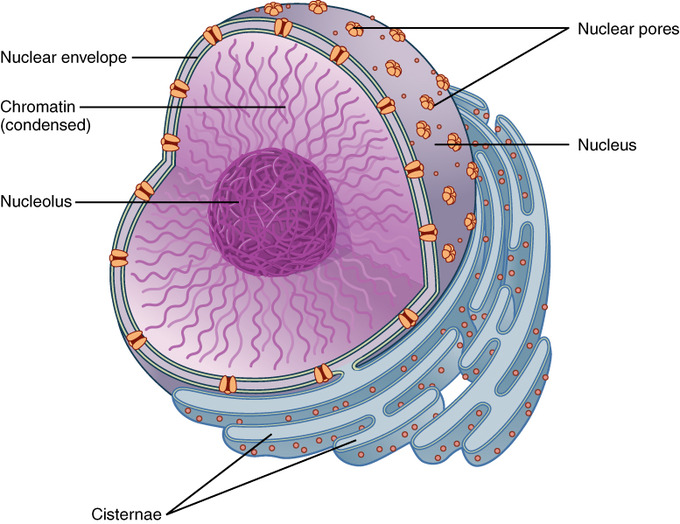
Lastly, the boundary of the nucleus is called the nuclear envelope. It consists of two phospholipid bilayers: an outer membrane and an inner membrane. The nuclear membrane is continuous with the endoplasmic reticulum, while nuclear pores allow substances to enter and exit the nucleus.

Characteristics of Eukaryotic Cells

A eukaryotic cell has a true membrane-bound nucleus and has other membranous organelles that allow for compartmentalization of functions.

Key Points

Eukaryotic cells are larger than prokaryotic cells and have a “true” nucleus, membrane-bound organelles, and rod-shaped chromosomes.

The nucleus houses the cell’s DNA and directs the synthesis of proteins and ribosomes.

Mitochondria are responsible for ATP production; the endoplasmic reticulum modifies proteins and synthesizes lipids, and the Golgi apparatus is where the sorting of lipids and proteins takes place.

Peroxisomes carry out oxidation reactions that break down fatty acids and amino acids and detoxify poisons; vesicles and vacuoles function in storage and transport.

Animal cells have a centrosome and lysosomes while plant cells do not.

Plant cells have a cell wall, a large central vacuole, chloroplasts, and other specialized plastids, whereas animal cells do not.

Key Terms

eukaryotic: Having complex cells in which the genetic material is organized into membrane-bound nuclei.

organelle: A specialized structure found inside cells that carries out a specific life process (e.g. ribosomes, vacuoles).

photosynthesis: the process by which plants and other photoautotrophs generate carbohydrates and oxygen from carbon dioxide, water, and light energy in chloroplasts

Eukaryotic Cell Structure

Like a prokaryotic cell, a eukaryotic cell has a plasma membrane, cytoplasm, and ribosomes. However, unlike prokaryotic cells, eukaryotic cells have:

  • a membrane-bound nucleus
  • numerous membrane-bound organelles (including the endoplasmic reticulum, Golgi apparatus, chloroplasts, and mitochondria)
  • several rod-shaped chromosomes

Because a eukaryotic cell’s nucleus is surrounded by a membrane, it is often said to have a “true nucleus.” Organelles (meaning “little organ”) have specialized cellular roles, just as the organs of your body have specialized roles. They allow different functions to be compartmentalized in different areas of the cell.

The Nucleus & Its Structures

Typically, the nucleus is the most prominent organelle in a cell. Eukaryotic cells have a true nucleus, which means the cell’s DNA is surrounded by a membrane. Therefore, the nucleus houses the cell’s DNA and directs the synthesis of proteins and ribosomes, the cellular organelles responsible for protein synthesis. The nuclear envelope is a double-membrane structure that constitutes the outermost portion of the nucleus. Both the inner and outer membranes of the nuclear envelope are phospholipid bilayers. The nuclear envelope is punctuated with pores that control the passage of ions, molecules, and RNA between the nucleoplasm and cytoplasm. The nucleoplasm is the semi-solid fluid inside the nucleus where we find the chromatin and the nucleolus. Furthermore, chromosomes are structures within the nucleus that are made up of DNA, the genetic material. In prokaryotes, DNA is organized into a single circular chromosome. In eukaryotes, chromosomes are linear structures.

Nucleus - What About You Need To Know

Eukaryotic Nucleus: The nucleus stores chromatin (DNA plus proteins) in a gel-like substance called the nucleoplasm. The nucleolus is a condensed region of chromatin where ribosome synthesis occurs. The boundary of the nucleus is called the nuclear envelope. It consists of two phospholipid bilayers: an outer membrane and an inner membrane. The nuclear membrane is continuous with the endoplasmic reticulum. Nuclear pores allow substances to enter and exit the nucleus.

Other Membrane-Bound Organelles

Mitochondria are oval-shaped, double-membrane organelles that have their own ribosomes and DNA. These organelles are often called the “energy factories” of a cell because they are responsible for making adenosine triphosphate (ATP), the cell’s main energy-carrying molecule, by conducting cellular respiration. The endoplasmic reticulum modifies proteins and synthesizes lipids, while the Golgi apparatus is where the sorting, tagging, packaging, and distribution of lipids and proteins takes place. Peroxisomes are small, round organelles enclosed by single membranes; they carry out oxidation reactions that break down fatty acids and amino acids. Peroxisomes also detoxify many poisons that may enter the body. Vesicles and vacuoles are membrane-bound sacs that function in storage and transport. Other than the fact that vacuoles are somewhat larger than vesicles, there is a very subtle distinction between them: the membranes of vesicles can fuse with either the plasma membrane or other membrane systems within the cell. All of these organelles are found in each and every eukaryotic cell.

Animal Cells Versus Plant Cells

While all eukaryotic cells contain the aforementioned organelles and structures, there are some striking differences between animal and plant cells. Animal cells have a centrosome and lysosomes, whereas plant cells do not. The centrosome is a microtubule-organizing center found near the nuclei of animal cells while lysosomes take care of the cell’s digestive process.

Nucleus - What About You Need To Know

Animal Cells: Despite their fundamental similarities, there are some striking differences between animal and plant cells. Animal cells have centrioles, centrosomes, and lysosomes, whereas plant cells do not.

In addition, plant cells have a cell wall, a large central vacuole, chloroplasts, and other specialized plastids, whereas animal cells do not. The cell wall protects the cell, provides structural support and gives shape to the cell while the central vacuole plays a key role in regulating the cell’s concentration of water in changing environmental conditions. Chloroplasts are the organelles that carry out photosynthesis.

Doctor visit helper

Prepare before seeing a doctor

A simple rural-patient checklist to help you explain symptoms clearly, ask better questions, and avoid unsafe self-treatment.

Safety note: This is not a prescription or diagnosis. For severe symptoms, pregnancy danger signs, children with serious illness, chest pain, breathing difficulty, stroke-like weakness, or major injury, seek urgent care.

Which doctor may help?

Start with a registered doctor or the nearest qualified health center.

What to tell the doctor

  • Write when the problem started and how it changed.
  • Bring old prescriptions, investigation reports, and current medicines.
  • Write allergies, pregnancy status, diabetes, kidney/liver disease, and major past illnesses.
  • Bring one family member if the patient is weak, elderly, confused, or a child.

Questions to ask

  • What is the most likely cause of my symptoms?
  • Which danger signs mean I should go to hospital quickly?
  • Which tests are necessary now, and which can wait?
  • How should I take medicines safely and what side effects should I watch for?
  • When should I come for follow-up?

Tests to discuss

  • Vital signs: temperature, pulse, blood pressure, oxygen saturation
  • Basic physical examination by a clinician
  • CBC, urine test, blood sugar, or imaging only when clinically needed

Avoid these mistakes

  • Do not use antibiotics, steroid tablets/injections, or strong painkillers without proper medical advice.
  • Do not hide pregnancy, kidney disease, ulcer, allergy, or blood thinner use.
  • Do not delay emergency care when danger signs are present.

Medicine safety and first-aid guide

This section is for patient education only. It does not replace a doctor, pharmacist, or emergency care.

Safe first steps

  • Avoid heavy lifting, sudden bending, and prolonged bed rest.
  • Use comfortable posture and gentle movement as tolerated.
  • Discuss physiotherapy, X-ray, or MRI only when clinically needed.

OTC medicine safety

  • For mild back pain, pain-relief medicine may be discussed with a doctor or pharmacist.
  • Avoid repeated painkiller use if you have kidney disease, stomach ulcer, uncontrolled blood pressure, or are taking blood thinners.

Avoid these mistakes

  • Do not start antibiotics without a proper medical decision.
  • Do not use steroid tablets or injections casually for quick relief.
  • Do not delay emergency care because of home remedies.

Get urgent help if

  • Back pain with leg weakness, numbness around private area, loss of urine/stool control, fever, cancer history, or major injury needs urgent care.
Medicine names, dose, and timing must be decided by a qualified clinician or pharmacist after checking age, pregnancy, allergy, other diseases, and current medicines.

For rural patients and family caregivers

Patient health record and symptom diary

Write your symptoms, medicines already taken, test results, and questions before visiting a doctor. This note stays on your device unless you print or copy it.

Doctor to discuss: Doctor / qualified healthcare provider
Tests to discuss with doctor
  • Basic vital signs: temperature, pulse, blood pressure, oxygen level if needed
  • Relevant blood, urine, imaging, or specialist tests only after clinical assessment
Questions to ask
  • What is the most likely cause of my symptoms?
  • Which warning signs mean I should go to emergency care?
  • Which tests are really needed now?
  • Which medicines are safe for my age, pregnancy status, allergy, kidney/liver/stomach condition, and current medicines?

Emergency warning signs such as chest pain, severe breathing difficulty, sudden weakness, confusion, severe dehydration, major injury, or loss of bladder/bowel control need urgent medical care. Do not wait for online information.

Safe pathway to proper treatment

Care roadmap for: Nucleus – What About You Need To Know

Use this simple roadmap to understand the next safe steps. It is educational and does not replace examination by a doctor.

Go to emergency care if you notice:
  • Severe or rapidly worsening symptoms
  • Breathing difficulty, chest pain, fainting, confusion, severe weakness, major injury, or severe dehydration
Doctor / service to discuss: Qualified healthcare provider; specialist depends on symptoms and examination.
  1. Step 1

    Check danger signs first

    If danger signs are present, seek emergency care and do not wait for online information.

  2. Step 2

    Record the symptom story

    Write when symptoms started, severity, medicines already taken, allergies, pregnancy status, and test results.

  3. Step 3

    Visit a qualified clinician

    A doctor, nurse, or qualified healthcare provider can examine you and decide which tests or treatment are needed.

  4. Step 4

    Do only useful tests

    Do tests after clinical assessment. Avoid unnecessary tests, random antibiotics, or repeated medicines without diagnosis.

  5. Step 5

    Follow up and return early if worse

    If symptoms worsen, new warning signs appear, or treatment is not helping, return for review quickly.

Rural patient practical tips
  • Take a written symptom diary and all previous prescriptions/test reports.
  • Do not hide medicines already taken, even herbal or over-the-counter medicines.
  • Ask which warning signs mean urgent referral to hospital.

This roadmap is for education. A real diagnosis and treatment plan requires history, examination, and clinical judgment.

RX Patient Help

Ask a health question safely

Write your symptom story. A health professional or site editor can review it before any answer is prepared. This box is not for emergency care.

Emergency first: Severe chest pain, breathing trouble, unconsciousness, stroke signs, severe injury, heavy bleeding, or rapidly worsening symptoms need urgent local medical care now.

Frequently Asked Questions

Is this article a replacement for a doctor?

No. It is educational content only. Patients should consult a qualified clinician for diagnosis and treatment.

When should I seek urgent care?

Seek urgent care for severe symptoms, rapidly worsening condition, breathing difficulty, severe pain, neurological changes, or any emergency warning sign.

References

Add references, clinical guidelines, textbooks, journal articles, or trusted medical sources here. You can edit this area from the RX Article Professional Blocks panel.