
Nerves Supply of Femur/The femur or thigh bone is the proximal bone of the hindlimb in tetrapod vertebrates (for example, the largest bone of the human thigh). The head of the femur articulates with the acetabulum in the pelvic bone forming the hip joint, while the distal part of the femur articulates with the tibia and kneecap, forming the knee joint. By most measures, the two (left and right) femurs are the strongest bones of the body, and in humans, the longest.
The femur, also called the thighbone, the upper bone of the leg or hind leg. The head forms a ball-and-socket joint with the hip (at the acetabulum), being held in place by a ligament (ligamentum teres femoris) within the socket and by strong surrounding ligaments. In humans the neck of the femur connects the shaft and head at a 125° angle, which is efficient for walking. The prominence of the femur at the outside top of the thigh provides attachment for the gluteus medius and minimus muscles. The shaft is somewhat convex forward and strengthened behind by a pillar of bone called the Linea Aspera. Two large prominences, or condyles, on either side of the lower end of the femur, form the upper half of the knee joint, which is completed below by the tibia (shin) and patella (kneecap). Internally, the femur shows the development of arcs of bone called trabeculae that are efficiently arranged to transmit pressure and resist stress. Human femurs have been shown to be capable of resisting compression forces of 800–1,100 kg (1,800–2,500 pounds).
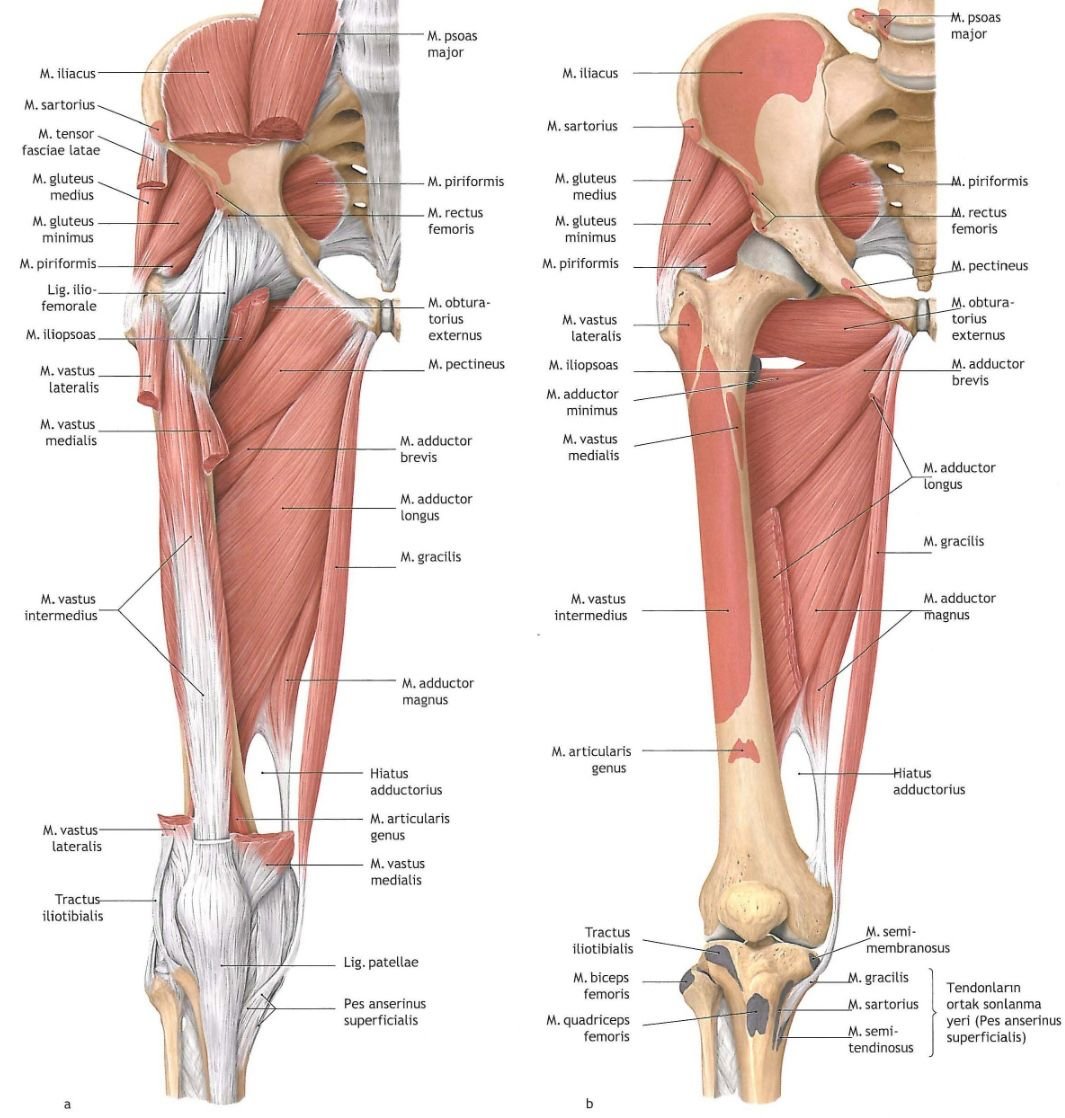
Muscle Attachment of Femur
Biceps Femoris Long Head
-
Origin: Common (conjoint) tendon from the superior medial quadrant of the posterior ischial tuberosity (with semitendinosus)
-
Insertion: Majority onto the fibular head; also the lateral collateral ligament of the knee and lateral tibial condyle
-
Action: Flexion of the knee, and lateral rotation of the tibia; extension of the hip joint
-
Innervation: Tibial nerve (a portion of the sciatic nerve)
-
Arterial Supply: Perforating (muscular) branches of profunda femoris artery, inferior gluteal artery, and the superior muscular branches of the popliteal artery
Biceps Femoris Short Head
-
Origin: Lateral lip of linea aspera, the lateral intermuscular septum of the thigh, and lateral supracondylar ridge of femur
-
Insertion: Majority on the fibular head; and lateral collateral ligament of the knee, and lateral tibial condyle
-
Action: Flexion of the knee, and lateral rotation of the tibia
-
Innervation: Common peroneal nerve (a portion of the sciatic nerve)
-
Arterial Supply: Perforating (muscular) branches of profunda femoris artery, inferior gluteal artery, and the superior muscular branches of the popliteal artery
Semimembranosus
-
Origin: Superior lateral aspect of the ischial tuberosity
-
Insertion: The posterior surface of the medial tibial condyle
-
Action: Extension of the hip, flexion of the knee, and medial rotation of the tibia (specifically with knee flexion)
-
Innervation: Tibial nerve (a portion of the sciatic nerve)
-
Arterial Supply: Perforating (muscular) branches of profunda femoris artery, inferior gluteal artery, and the superior muscular branches of the popliteal artery
Semitendinosus
-
Origin: The common (conjoint) tendon from the superior medial quadrant of the posterior ischial tuberosity (with biceps femoris long head)
-
Insertion: Superior aspect of the medial tibial shaft (into the distal portion of the pes anserinus along with the gracious and sartorius muscles)
-
Action: Extension of the hip and flexion of the knee, medial rotation of the tibia (specifically with knee flexion)
-
Innervation: Tibial nerve (a portion of the sciatic nerve)
-
Arterial Supply: Perforating (muscular) branches of profunda femoris artery, inferior gluteal artery, and the superior muscular branches of the popliteal artery
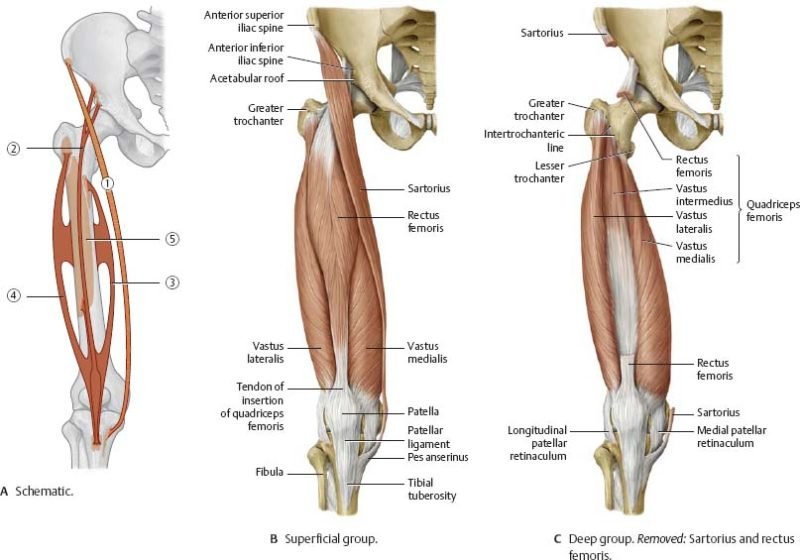
The rectus femoris is responsible for thigh flexion at the hip and knee extension.[rx]
-
Vastus Lateralis – The largest of the four muscles. Origin is from the greater trochanter and lateral lip of linea Aspera. It inserts at the lateral base and border of the patella, forming the lateral patellar retinaculum and the lateral side of the quadriceps femoris tendon.[rx]
-
Vastus Medialis – Originates at the inferior portion of the intertrochanteric line and medial lip of the linea Aspera. Inserts at the medial base and border of the patella, forming the medial patellar retinaculum and the medial side of the quadriceps femoris tendon.[rx]
-
Vastus Intermedius – Originates at the anterior and lateral surfaces of the femoral shaft. It inserts at the lateral border of the patella, forming the deep portion of the quadriceps tendon.[rx]
-
Rectus Femoris – Comprised of two proximal heads: The straight head consists of the anterior inferior iliac spine (ASIS) of the ilium. The reflected head consists of the ilium superior to the acetabulum. Inserts at the quadriceps femoris tendon.[rx]
Hip Flexors
Psoas major
-
Origin: T12-L5 vertebrae
-
Insertion: Lesser trochanter
-
Innervation: Femoral nerve
Psoas minor (present in 50% of the population)
-
Origin: T12-L1 vertebrae
-
Insertion: Iliopubic eminence
-
Innervation: L1 ventral ramus
Pectineus (flexes and adducts thigh)
-
Origin: Pectineal line of the pubis
-
Insertion: Pectineal line of femur
-
Innervation: Femoral nerve
Iliacus
-
Origin: Iliac fossa/ Sacral ala
-
Insertion: Lesser trochanter
-
Innervation: Femoral nerve
-
Hip Extensors and External Rotators-
Gluteus maximus
-
Origin: Ilium, dorsal sacrum
-
Insertion: ITB, gluteal tuberosity
-
Innervation: Inferior gluteal nerve
Obturator externus
-
Origin: Ischiopubic rami, obturator membrane
-
Insertion: Trochanteric fossa
-
Innervation: Obturator nerve
Short External Rotators
Piriformis
-
Origin: Anterior sacrum
-
Insertion: Superior greater trochanter
-
Innervation: Nerve to Piriformis (S2, posterior division of lumbosacral plexus)
Superior gemellus
-
Origin: Ischial spine
-
Insertion: Medial greater trochanter
-
Innervation: Nerve to obturator internus (L5-S2, anterior division of lumbosacral plexus)
Obturator internus
-
Origin: Ischiopubic rami, obturator membrane
-
Insertion: Medial greater trochanter
-
Innervation: Nerve to obturator internus (L5-S2, anterior division of lumbosacral plexus)
Inferior gemellus
-
Origin: Ischial tuberosity
-
Insertion: Medial greater trochanter
-
Innervation: Nerve to quadratus femoris (L4-S1, anterior division of lumbosacral plexus)
Quadratus femoris
-
Origin: Ischial tuberosity
-
Insertion: Intertrochanteric crest
-
Innervation: Nerve to quadratus femoris (L4-S1, anterior division of lumbosacral plexus)
Hip Abductors
Tensor fascia latae
-
Origin: Iliac crest, ASIS
-
Insertion: Iliotibial band/proximal tibia
-
Innervation: Superior gluteal nerve
Gluteus medius
-
Origin: Ilium between anterior and posterior gluteal lines
-
Insertion: Greater trochanter
-
Innervation: Superior gluteal nerve
Gluteus minimus
-
Origin: Ilium between anterior and posterior gluteal lines
-
Insertion: Greater trochanter
-
Innervation: Superior gluteal nerve
Hip Adductors
Adductor Magnus
-
Origin: Pubic ramus, ischial tuberosity
-
Insertion: Linea Aspera, adductor tubercle
-
Innervation: Obturator nerve, the sciatic nerve
Adductor longus
-
Origin: Body of pubis
-
Insertion: Linea Aspera
-
Innervation: Obturator nerve
Adductor Brevis
-
Origin: Body and inferior pubic ramus
-
Insertion: Pectineal line, Linea Aspera
-
Innervation: Obturator nerve
Gracilis
-
Origin: Body and inferior pubic ramus
-
Insertion: Proximal medial tibia (pes anserinus)
-
Innervation: Obturator nerve
There are many muscles involved in the movement of the hip joint, these include (in alphabetical order) the
-
Adductor longus, brevis, and magnus
-
Gluteus maximus, medius, and minimus
-
Gracilis
-
Hamstring muscles: semimembranosus, semitendinosus, and the biceps femoris
-
Iliacus
-
Obturator
-
Pectineus
-
Piriformis
-
Psoas major
-
Quadriceps muscles: rectus femoris, vastus intermedius, vastus lateralis, and vastus medialis
-
Quadratus femoris
-
Sartorius
-
Tensor fascia latae
Nerves Supply of Femur
- Obturator nerve – Originates from nerve roots L2-L4 and exits through the obturator canal before splitting into an anterior division that runs anterior to obturator externus and a posterior division which runs posterior to obturator externus. The obturator nerve supplies sensory innervation to the inferomedial thigh via the cutaneous branch of the obturator nerve and motor innervation to gracilis (anterior division), adductor longus (anterior division), adductor brevis (anterior/posterior divisions), and adductor Magnus (posterior division).
- Genitofemoral nerve – Originates from nerve roots L1-L2. It pierces the psoas muscle and continues down the anteromedial surface of psoas before dividing it into femoral and genital branches. The femoral branch provides sensory innervation to the proximal anterior thigh over the femoral triangle.
- Lateral femoral cutaneous nerve – Originates from nerve roots L2-L3. Crosses inferior to the anterior superior iliac spine (ASIS) and provides sensory innervation to the lateral thigh. It has no motor function.
- The femoral nerve – originates from nerve roots (L2-L4). It lies between the psoas major and iliacus and branches in the femoral triangle. The femoral nerve provides sensory innervation to the anteromedial thigh via anterior cutaneous branches and motor innervation to the psoas, pectineus, Sartorius, quadriceps (rectus femoris, vastus lateralis, vastus intermedius, vastus medialis).
- Sciatic nerve – originates from the sacral plexus and projects through the greater sciatic foramen descending down the posterior thigh deep to the hamstrings and superficial to adductor Magnus. The sciatic nerve has two distinct divisions: tibial division and common peroneal division.
- Posterior femoral cutaneous nerve – Originates from nerve roots S1-S3 and passes through the greater sciatic foramen medial to the sciatic nerve. The posterior femoral cutaneous nerve provides sensory innervation to the posterior thigh and has no motor function.
References
- https://www.ncbi.nlm.nih.gov/books/NBK537024/
- https://www.ncbi.nlm.nih.gov/books/NBK526019/
- https://www.ncbi.nlm.nih.gov/books/NBK470555/
- https://www.ncbi.nlm.nih.gov/books/NBK519534/
- https://www.ncbi.nlm.nih.gov/books/NBK459319/
- https://www.ncbi.nlm.nih.gov/books/NBK537097/
- https://www.ncbi.nlm.nih.gov/books/NBK542174/
- https://www.ncbi.nlm.nih.gov/books/NBK538193/
- https://www.ncbi.nlm.nih.gov/books/NBK551675/
- https://en.wikipedia.org/wiki/Hip
- https://www.sciencedirect.com/topics/medicine-and-dentistry/hip-joint
- https://www.arthritis.org/health-wellness/about-arthritis/where-it-hurts/anatomy-of-the-hip

