
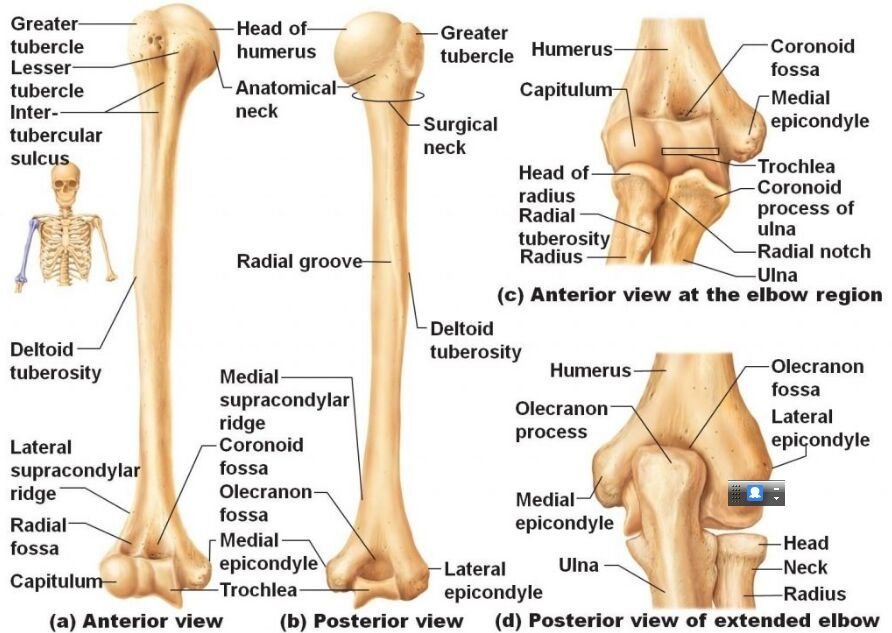
Nerves of Humerus /The humerus is a long bone in the arm that runs from the shoulder to the elbow. It connects the scapula and the two bones of the lower arm, the radius, and ulna, and consists of three sections. The humeral upper extremity consists of a rounded head, a narrow neck, and two short processes (tubercles, sometimes called tuberosities). The body is cylindrical in its upper portion, and more prismatic below. The lower extremity consists of 2 epicondyles, 2 processes (trochlea & capitulum), and 3 fossae (radial fossa, coronoid fossa, and olecranon fossa). As well as its true anatomical neck, the constriction below the greater and lesser tubercles of the humerus is referred to as its surgical neck due to its tendency to fracture, thus often becoming the focus of surgeons.
Humerus, long bone of the upper limb or forelimb of land vertebrates that forms the shoulder joint above, where it articulates with a lateral depression of the shoulder blade (glenoid cavity of the scapula), and the elbow joint below, where it articulates with projections of the ulna and the radius.
Parts of the Humerus
Head of the humerus
The head of the humerus is a hemisphere that faces medially and articulates with the glenoid fossa of the shoulder joint.

Head of Humerus
The neck of the humerus
- The anatomical neck is the groove that surrounds the articular surface of the head of the humerus. This is where the joint capsule is attached. The surgical neck, however, is a segment present inferior to the humeral head. This acts as a connection between the head and the shaft of the humerus.
The greater tubercle
- The greater tubercle is a large, posteriorly placed projection that is placed laterally. The greater tubercle is where supraspinatus, infraspinatus, and teres minor muscles are attached. The crest of the greater tubercle forms the lateral lip of the bicipital groove and is the site for the insertion of the pectoralis major.
- It serves as an attachment site for three of the rotator cuff muscles – supraspinatus, infraspinatus, and teres minor – they attach to superior, middle, and inferior facets (respectively) on the greater tubercle.
The lesser tubercle
- The lesser tubercle is smaller, anterolaterally placed to the head of the humerus. The lesser tubercle provides insertion to subscapularis muscle. Both these tubercles are found in the proximal part of the shaft.
- The crest of the lesser tubercle forms the medial lip of the bicipital groove and is the site for the insertion of teres major and latissimus dorsi muscles. The lesser tubercle is much smaller and more medially located on the bone. It only has an anterior surface. It provides attachment for the last rotator cuff muscle – the subscapularis.
The bicipital sulcus
- The intertubercular groove or also known as the bicipital sulcus is a deep groove that begins between the two tubercles and extends longitudinally down the proximal shaft of the humerus.
- The long head of biceps brachii muscle runs along this groove. The transverse humeral ligament connects the lesser and greater tubercles and bridges this groove to form a canal. Separating the two tubercles is a deep groove, known as the intertubercular sulcus.
- The edges of the intertubercular sulcus are known as lips. Pectoralis major, teres major, and latissimus dorsi insert on the lips of the intertubercular sulcus. This can be remembered with the mnemonic “a lady between two majors”, with latissimus dorsi attaching between teres major on the medial lip and pectoralis major laterally.
- The theological neck runs from just distal to the tubercles to the shaft of the humerus. The axillary nerve and circumflex humeral vessels lie against the bone here.
Shaft of Humerus
The shaft of the humerus is the site of attachment for various muscles. Cross-section views reveal it to be circular proximally and flattened distally.
On the lateral side of the humeral shaft is a roughened surface where the deltoid muscle attaches. This is known is as the deltoid tuberosity.
The radial (or spiral) groove is a shallow depression that runs diagonally down the posterior surface of the humerus, parallel to the deltoid tuberosity. The radial nerve and profound brachial artery lie in this groove. The following muscles attach to the humerus along its shaft:
- Anteriorly – coracobrachialis, deltoid, brachialis, brachioradialis.
- Posteriorly – medial and lateral heads of the triceps (the spiral groove demarcates their respective origins).
Lower End /Distal Region of Humerus
The lateral and medial borders of the distal humerus form medial and lateral supracondylar ridges. The lateral supracondylar ridge is more roughened, providing the site of the common origin of the forearm extensor muscles.
- Immediately distal to the supracondylar ridges are extracapsular projections of bone, the lateral and medial epicondyles. Both can be palpated at the elbow. The medial is the larger of the two and extends more distally. The ulnar nerve passes in a groove on the posterior aspect of the medial epicondyle where it is palpable.
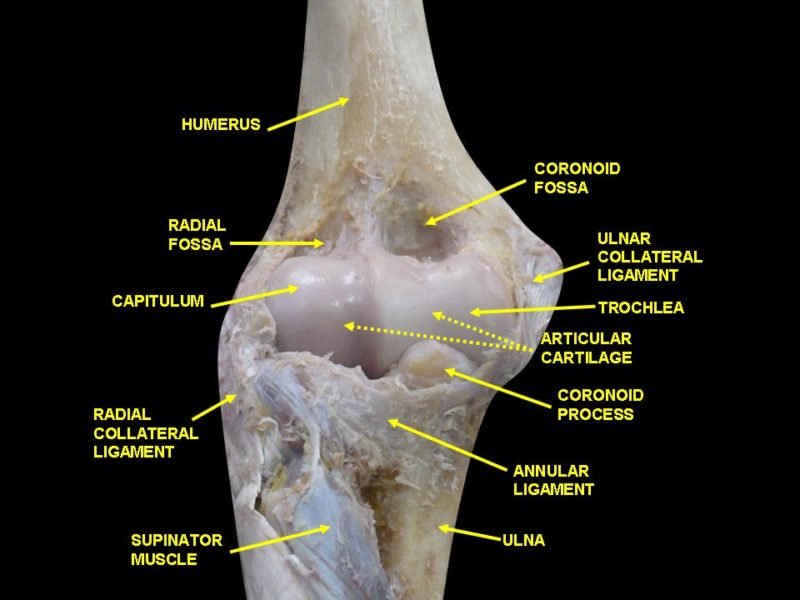
- Distally, the trochlea is located medially and extends onto the posterior aspect of the bone. Lateral to the trochlea is the capitulum, which articulates with the radius.
- Also located on the distal portion of the humerus are three depressions, known as the coronoid, radial, and olecranon fossae. They accommodate the forearm bones during flexion or extension at the elbow.
Nerves of Humerus
Most of the brachial plexus branches pass through the arm; the following nerves pass through the upper arm[rx][rx]:
- Musculocutaneous nerve – which innervates the biceps, coracobrachialis, and brachialis muscles. Plus, it gives a sensory branch to the lateral forearm and articular branch to the elbow. Its origin is the lateral cord of the brachial plexus (C5,6,7). The nerve runs downward and laterally piercing the coracobrachialis muscle then runs between the biceps and brachialis muscles. It terminates as the lateral cutaneous nerve of the forearm.
- Median nerve – originates from the medial and lateral cord of the brachial plexus. It runs downward and lateral to the brachial artery in the upper arm halfway its course crosses the artery to reside on its medial side. The median nerve gives no branches to the arm except for small vasomotor branches to the brachial artery.
- Ulnar nerve – this nerve gives no branches in the arm, mainly innervates the hand. The origin of the ulnar nerve is from the eighth cervical and first thoracic roots of the brachial plexus. The ulnar nerve runs downward at the medial side of the brachial artery. At the level of the insertion of the coracobrachialis, it pierces the medial fascial septum to enter the posterior compartment then the nerve runs posteriorly to the medial epicondyle of the humerus.
- Radial nerve – originates from the posterior cord of the brachial plexus. The nerve rotates around the humerus in the spinal groove accompanied by the profunda artery, and it lies directly in contact with the humerus shaft. It goes through the lateral fascial septum downward and in front of the cubital fossa between the brachialis and brachioradialis. It gives cutaneous branches as the posterior cutaneous nerve of the arm, inferior lateral cutaneous nerve of the arm and posterior cutaneous nerve of the forearm. And muscular branches to triceps brachii, anconeus, brachioradialis, and extensor carpi radialis longus.

Articulations of Humerus
proximal (refer to shoulder joint article for more details) – head of the humerus: articulates with the glenoid cavity of the scapula.
Distal (refer to elbow joint article for more detail): condyle of the humerus:
- Trochlea – articulates with the trochlear notch of the ulna
- Radial fossa – receives the anterior border of the radial head in forearm flexion
- Capitulum – articulates with the head of the radius
- Olecranon fossa – receives the olecranon process of the ulna with forearm extension
- Coronoid fossa – receives the coronoid process of the ulna with forearm flexion
- The humeroulnar articulation – Distal humerus (trochlea) and the proximal ulna (trochlear notch)
- The humeroradial articulation – Distal humerus (capitellum) and the proximal radius (radial head)
- The proximal radioulnar articulation – The proximal ulna (radial notch) and the proximal radius (radial head)
The elbow joint is both a uniaxial, hinge joint (humeroulnar articulation) and a pivot joint (radiocapitellar articulation).
Muscle Attachments of Humerus
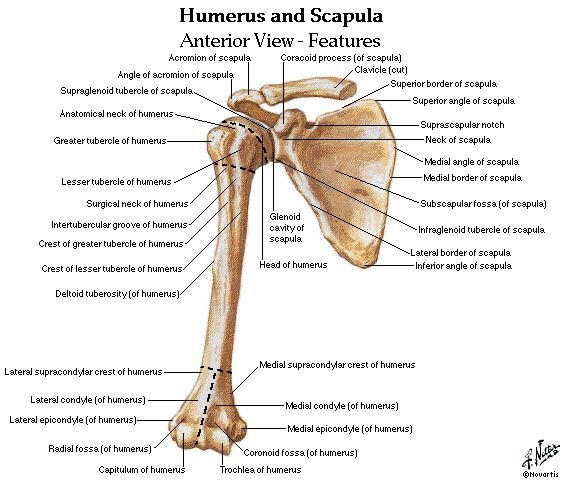
- Greater tubercle – insertion of the supraspinatus superiorly, infraspinatus intermediately, and the teres minor inferiorly
- Lesser tubercle – insertion of the subscapularis
- Bicipital groove – located between the greater and lesser tubercles, is the insertion of the latissimus dorsi and contains the long head of the biceps brachii. It is enclosed by the small broad transverse humeral ligament.
- Deltoid tuberosity – insertion of the deltoid
- Anterior-medial surface – insertion of the latissimus dorsi superiorly, partial insertion of the coracobrachialis intermediately, and origin of the brachialis inferiorly
- Lateral border – partial insertion site of the teres minor and partial origin to the triceps brachii
- Medial border – insertion of the teres major and coracobrachialis
- Lateral supracondylar ridge – the origin of the brachioradialis, extensor carpi radialis longus, triceps brachii, and attachment of the lateral intermuscular septum
- Medial supracondylar ridge – the origin of the brachialis, pronator teres, triceps brachii, and attachment of the medial intermuscular septum
- Lateral epicondyle – origin of the supinator and some extensor muscles of the forearm, also attachment to the radial collateral ligament of the elbow
- Medial epicondyle – the origin of some flexor muscles of the forearm, pronator teres and attachment to the ulna collateral ligament of the elbow
Muscle Attachment Of Humerus and Radioulnar Joints
The radius and ulna serve as insertion sites for several muscles originating more proximally in the arm[rx][rx]:
-
Biceps brachii – inserts on the radial tuberosity, a bony prominence on the medial aspect of the proximal end of the radius; allows for flexion and supination of the forearm.
-
Brachialis – inserts on the coronoid process of the ulna and the ulnar tuberosity; allows for flexion of the forearm.
-
Triceps and anconeus – insert on the olecranon process of the ulna allowing for the extension of the forearm.
Within the forearm, muscles are classically grouped into anterior and posterior compartments[rx][rx]:
Anterior Compartment
-
Flexor carpi radialis, palmaris longus, and the humeral heads of the pronator teres and flexor carpi ulnaris – originate from the common flexor origin. The ulnar head of the pronator teres originates from the coronoid process. The ulnar head of the flexor carpi ulnaris arises from the olecranon. The pronator teres inserts to the lateral surface of the radius and is responsible for pronation and flexion of the forearm.
-
Flexor digitorum superficialis – arises from the anterior border of the radius, the medial epicondyle of the humerus, and the coronoid process and inserts on the middle phalanges of the medial four digits.
-
Flexor digitorum profundus – arises from the ulna and interosseous membrane and inserts on the distal phalanges.
-
Flexor pollicis longus – originates from the radius and the interosseous membrane and inserts on the distal phalanx of the thumb.
-
Pronator quadratus – originates from the distal end of the ulna and inserts on the distal end of the radius. Responsible for forearm pronation.
Posterior Compartment
-
Brachioradialis, extensor carpi radialis longus, extensor carpi radialis brevis, extensor digitorum, extensor digiti minimi, and extensor carpi ulnaris – originate from the distal lateral edge of the humerus. The brachioradialis inserts just proximal to the styloid process of the radius and is responsible for flexion of the forearm, especially in pronation.
-
Supinator – originates from the lateral epicondyle, radial collateral and annular ligaments, supinator fossa and the crest of the ulna with insertion on the lateral side of the radius. It is responsible for forearm supination.
-
Abductor pollicis longus and extensor pollicis longus – originates from the posterior surface of the ulna and interosseous membrane with attachments in the hand.
-
Extensor indicis – originates from the posterior surface of the distal third of the ulna and the interosseous membrane with attachment in the hand.
-
Extensor pollicis brevis – originates from the posterior surface of the distal third of the radius and the interosseous membrane with attachment in the hand.
Functions of Humerus of UpperEnd or Glenohumeral Joint
The glenohumeral joint possesses the capability of allowing an extreme range of motion in multiple planes.[12]
-
Flexion – Defined as bringing the upper limb anterior in the sagittal plane. The usual range of motion is 180 degrees. The main flexors of the shoulder are the anterior deltoid, coracobrachialis, and pectoralis major. Biceps brachii also weakly assists in this action.
-
Extension—Defined as bringing the upper limb posterior in a sagittal plane. The normal range of motion is 45 to 60 degrees. The main extensors of the shoulder are the posterior deltoid, latissimus dorsi, and teres major.
-
Internal rotation—Defined as rotation toward the midline along a vertical axis. The normal range of motion is 70 to 90 degrees. The internal rotation muscles are the subscapularis, pectoralis major, latissimus dorsi, teres major, and the anterior aspect of the deltoid.
-
External rotation – Defined as rotation away from the midline along a vertical axis. The normal range of motion is 90 degrees. Primarily infraspinatus and teres minor are responsible for the motion.
-
Adduction – Defined as bringing the upper limb towards the midline in the coronal plane. Pectoralis major, latissimus dorsi, and teres major are the muscles primarily responsible for shoulder adduction.
-
Abduction – Defined as bringing the upper limb away from the midline in the coronal plane. The normal range of motion is 150 degrees. Due to the ability to differentiate several pathologies by the range of motion of the glenohumeral joint in this plane of motion, it is essential to understand how different muscles contribute to this action.[rx]
References
- https://www.ncbi.nlm.nih.gov/books/NBK482281/
- https://www.ncbi.nlm.nih.gov/books/NBK507841/
- https://www.ncbi.nlm.nih.gov/books/NBK536996/
- https://www.ncbi.nlm.nih.gov/books/NBK537148/
- https://www.ncbi.nlm.nih.gov/books/NBK534836/
- https://www.ncbi.nlm.nih.gov/books/NBK537018/
- https://www.ncbi.nlm.nih.gov/books/NBK554420/
- https://www.ncbi.nlm.nih.gov/books/NBK536933/
- https://www.ncbi.nlm.nih.gov/books/NBK545260/
- https://www.ncbi.nlm.nih.gov/books/NBK441844/
- https://www.ncbi.nlm.nih.gov/books/NBK441976/
- https://www.ncbi.nlm.nih.gov/books/NBK506998/
- https://www.ncbi.nlm.nih.gov/books/NBK538494/
- https://www.ncbi.nlm.nih.gov/books/NBK542228/
- https://www.ncbi.nlm.nih.gov/books/NBK470574/
- https://www.ncbi.nlm.nih.gov/books/NBK549817/
- https://en.wikipedia.org/wiki/Humerus
- https://radiopaedia.org/articles/humerus
- https://www.britannica.com/science/humerus
- https://teachmeanatomy.info/upper-limb/bones/humerus/

