
RX Patient Tools
Use these quick guides before reading the article, or return to them when you need help preparing questions for a doctor.
Nerves is an enclosed, cable-like bundle of nerve fibers called axons, in the peripheral nervous system. A nerve transmits electrical impulses and is the basic unit of the peripheral nervous system. A nerve provides a common pathway for the electrochemical nerve impulses called action potentials that are transmitted along each of the axons to peripheral organs or, in the case of sensory nerves, from the periphery back to the central nervous system. Each axon within the nerve is an extension of an individual neuron, along with other supportive cells such as some Schwann cells that coat the axons in myelin.
Nerves are a part of the nervous system. They are primarily involved in the control and coordination of all the parts of the body. The nervous system not only sends and receives messages but also processes them into chemical signals called impulses in the human body.
Types of Nerves
There are three types of nerves in the human body which are classified based on their functions. These are the sensory nerves, motor nerves, and mixed nerves.
Sensory Nerves
These are the nerves that send messages to the brain or the spinal cord from the sense organs. These are enclosed in the form of bundle structures or nerve fibers in the peripheral nervous system. They carry information from the PNS to the CNS( Central Nervous System).
Motor Nerves
Motor nerves are those nerves that carry the messages in the form of a response from the brain or the spinal cord to other parts of the body such as the muscles and glands. They are responsible for carrying the information from the CNS to the PNS.
Mixed Nerves
Mixed nerves are the nerves that perform both the action of sensory nerves as well as motor nerves. They transform electrical impulses from the central nervous system to the muscles of the body. Generally, the mixed nerves transmit impulses at the rate of 120 meters per second or 432 kilometers per hour.
Structure of a Nerve
A nerve is the primary structure of the peripheral nervous system and is composed of bundles of axons.
Nerves are the organs that make up the peripheral nervous system. It consists of a cord-like structure with multiple nerve fibers (also called axons) wrapped in layers of tissue and fat. This axon has layers of connective tissue around it. This connective tissue is called the endoneurium. This entire nerve is further enclosed in another layer of connective tissue called the epineurium.
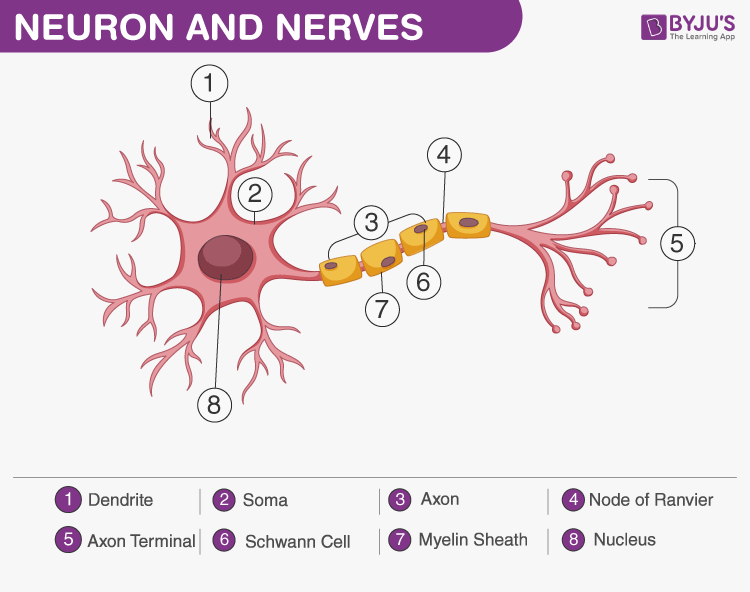
Neuron Structure
The structure of a nerve is explained below:
- A group of neurons is organized into bundles inside the nerves. This bundle is known as fascicles.
- The perineurium surrounds and holds together each fascicle.
- The perineurium is concentrically laminated and composed of flattened cells collagen fibers and basement membranes.
- Neurons and blood vessels are held inside the fascicles by a loose connective tissue known as endoneurium. It covers and holds the outer surface of the nerves together.
- Arteries and veins are present between the fascicles. These blood vessels supply nutrients and gases to the neurons inside the fascicles.
Key Points
A nerve is the primary structure of the peripheral nervous system (PNS) that encloses the axons of peripheral neurons.
A nerve provides a structured pathway that supports neuron function.
A nerve consists of many structures including axons, glycocalyx, endoneurial fluid, endoneurium, perineurium, and epineurium.
The axons are bundled together into groups called fascicles, and each fascicle is wrapped in a layer of connective tissue called the perineurium.
Magnetic resonance neurography is a technology used to detect nerve damage.
Key Terms
endoneurial fluid: A low protein liquid that is the peripheral nervous system equivalent to cerebrospinal fluid in the central nervous system.
perineurium: A protective sheath covering nerve fascicles.
glycocalyx: A glycoprotein-polysaccharide covering that surrounds cell membranes.
endoneurium: A layer of connective tissue that surrounds axons.
fascicles: A small bundle of nerve fibers enclosed by the perineurium.
epineurium: The outermost layer of dense, irregular connective tissue surrounding a peripheral nerve.
Nerve Anatomy

Nerves: An illustration of the main nerves of the arm.
A nerve is an enclosed, cable-like bundle of axons (the projections of neurons) in the peripheral nervous system (PNS). A nerve provides a structured pathway that supports the electrochemical nerve impulses transmitted along each of the axons.
In the central nervous system, the analogous structures are known as tracts. Neurons are sometimes referred to as nerve cells, although this term is misleading since many neurons do not occupy nerves, and nerves also include non-neuronal support cells (glial cells) that contribute to the health of enclosed neurons.
Each nerve contains many axons that are sometimes referred to as fibers. Within a nerve, each axon is surrounded by a layer of connective tissue called the endoneurium. The axons are bundled together into groups called fascicles. Each fascicle is wrapped in a layer of connective tissue called the perineurium.
Finally, the entire nerve is wrapped in a layer of connective tissue called the epineurium. See the following illustrations of these structures.
The endoneurium consists of an inner sleeve of material called the glycocalyx and a mesh of collagen. Nerves are bundled along with blood vessels, which provide essential nutrients and energy to the enclosed and metabolically demanding, neurons.
Within the endoneurium, individual nerve fibers are surrounded by a liquid called the endoneurial fluid. The endoneurium has properties analogous to the blood-brain barrier. It prevents certain molecules from crossing from the blood into the endoneurial fluid.
In this respect, endoneurial fluid is similar to cerebrospinal fluid in the central nervous system. During nerve irritation or injury, the amount of endoneurial fluid may increase at the site of damage. This increase in fluid can be visualized using magnetic resonance neurography to diagnose nerve damage.

(a) Anatomy of a nerve and (b) Cross-section of a nerve: The primary structures of a nerve. An illustration of a cross-section of a nerve highlighting the epineurium and perineurium. Individual axons can also be seen as tiny circles within each perineurium.
Basic Function
A nerve conveys information in the form of electrochemical impulses (known as nerve impulses or action potentials) carried by the individual neurons that make up the nerve. These impulses are extremely fast, with some myelinated neurons conducting at speeds up to 120 m/s. The impulses travel from one neuron to another by crossing a synapse, and the message is converted from electrical to chemical and then back to electrical.
Nerves can be categorized into two groups based on function:
- Sensory nerves conduct sensory information from their receptors to the central nervous system, where the information is then processed. Thus they are synonymous with afferent nerves.
- Motor nerves conduct signals from the central nervous system to muscles. Thus they are synonymous with efferent nerves.
Neurologists usually diagnose disorders of the nerves by a physical examination, including the testing of reflexes, walking and other directed movements, muscle weakness, proprioception, and the sense of touch. This initial exam can be followed with tests such as nerve conduction study, electromyography, or computed tomography.
Classification of Nerves
Nerves are primarily classified based on their direction of travel to or from the CNS, but they are also subclassified by other nerve characteristics.
Key Points
Nerves can be categorized as afferent, efferent, and mixed based on the direction of signal transmission within the nervous system. Nerves can be further categorized as spinal nerves or cranial nerves based on where they connect to the central nervous system.
Individual peripheral nerve fibers are classified based on the diameter, signal conduction velocity, and myelination state of the axons, as well as by the type of information transmitted and the organs they innervate.
Key Terms
mixed nerve: Nerves that contain both afferent and efferent axons, and thus conduct both incoming sensory information and outgoing muscle commands in the same bundle.
Afferent nerve: Carries nerve impulses from sensory receptors or sense organs toward the central nervous system.
Schwann cell: The principal glia of the peripheral nervous system.
efferent nerve: Nerves that conduct signals from the central nervous system along motor neurons to their target muscles and glands.
spinal nerve: The term generally refers to a mixed nerve that carries motor, sensory, and autonomic signals between the spinal cord and the body.
Nerve Classifications
The direction of Signal Transmission
Nerves are categorized into three, primary groups based on the direction of signal transmission within the nervous system.
- Afferent nerves conduct signals from sensory neurons to the central nervous system, for example from mechanoreceptors in skin.
- Efferent nerves conduct signals away from the central nervous system to target muscles and glands.
- Mixed nerves contain both afferent and efferent axons, and thus conduct both incoming sensory information and outgoing muscle commands in the same nerve bundle.

Afferent and efferent nerve transmission: Schematic of efferent and afferent nerve transmission to and from peripheral tissue and spinal cord.
Central Nervous System Connection
Nerves can be further categorized based on where they connect to the central nervous system. Spinal nerves innervate much of the body and connect through the spinal column to the spinal cord. Spinal nerves are assigned letter-number designations according to the vertebra where they connect to the spinal column. Cranial nerves innervate parts of the head and connect directly to the brain. Cranial nerves are typically assigned Roman numerals from 0 to 12.
Diameter, Conduction Velocity, Myelination State
Peripheral nerve fibers are grouped based on the diameter, signal conduction velocity, and myelination state of the axons. These classifications apply to both sensory and motor fibers. Fibers of the A group have a large diameter, high conduction velocity, and are myelinated.
The A group is further subdivided into four types (A-alpha, A-beta, A-delta, and A-gamma fibers) based on the information carried by the fibers and the tissues they innervate.
- A-alpha fibers are the primary receptors of the muscle spindle and golgi tendon organ.
- A-beta fibers act as secondary receptors of the muscle spindle and contribute to cutaneous mechanoreceptors.
- A-delta fibers are free nerve endings that conduct painful stimuli related to pressure and temperature.
- A-gamma fibers are typically motor neurons that control the intrinsic activation of the muscle spindle.
Fibers of the B group are myelinated with a small diameter and have a low conduction velocity. The primary role of B fibers is to transmit autonomic information. Fibers of the C group are unmyelinated, have a small diameter, and low conduction velocity. The lack of myelination in the C group is the primary cause of their slow conduction velocity.

Saltatory conduction: Demonstrates the faster propagation of an action potential in myelinated neurons than that of unmyelinated neurons.
C fiber axons are grouped together into what is known as Remak bundles. These occur when an unmyelinated Schwann cell bundles the axons close together by surrounding them. The Schwann cell keeps them from touching each other by squeezing its cytoplasm between the axons.
C fibers are considered polymodal because they can often respond to combinations of thermal, mechanical, and chemical stimuli.
A-delta and C fibers both contribute to the detection of diverse painful stimuli. Because of their higher conduction velocity, A-delta fibers are responsible for the sensation of sharp, initial pain and respond to a weaker intensity of the stimulus.
These nerve fibers are associated with acute pain and therefore constitute the afferent portion of the reflex arc that results in pulling away from noxious stimuli. An example is a retraction or your hand from a hot stove. Slowly conducting, unmyelinated C fibers, by contrast, carry slow, longer-lasting pain sensations.
References
- https://www.ncbi.nlm.nih.gov/books/NBK442010/
- https://www.ncbi.nlm.nih.gov/books/NBK551652/
- https://www.ncbi.nlm.nih.gov/books/NBK539845/
- https://www.ncbi.nlm.nih.gov/books/NBK542218/
- https://www.ncbi.nlm.nih.gov/books/NBK470353/
- https://www.ncbi.nlm.nih.gov/books/NBK279390/
- https://www.ncbi.nlm.nih.gov/books/NBK539846/
- https://www.ncbi.nlm.nih.gov/books/NBK542195/
- https://www.ncbi.nlm.nih.gov/books/NBK538516/
- https://www.ncbi.nlm.nih.gov/books/NBK542195/
- https://en.wikipedia.org/wiki/Nerve

