
Joint / Articulation of Joints – Types, Classifications, Functions

Patient Tools

Read, save, and share this guide

Use these quick tools to make this medical article easier to read, print, save, or share with a family member.

Patient Mode

Understand this article easily

Switch between simple English and easy Bangla patient notes. This is for education and does not replace a doctor consultation.

A joint or articulation (or articular surface) is the connection made between bones in the body which link the skeletal system into a functional whole. They are constructed to allow for different degrees and types of movement. Some joints, such as the knee, elbow, and shoulder, are self-lubricating, almost frictionless, and are able to withstand compression and maintain...

For severe symptoms, danger signs, pregnancy, child illness, or sudden worsening, seek urgent medical care.

বাংলা রোগী নোট এখনো যোগ করা হয়নি। পোস্ট এডিটরে “RX Bangla Patient Mode” বক্স থেকে সহজ বাংলা সারাংশ যোগ করুন।

এই তথ্য শিক্ষা ও সচেতনতার জন্য। এটি ডাক্তারি পরীক্ষা, রোগ নির্ণয় বা প্রেসক্রিপশনের বিকল্প নয়।

Article Summary

A joint or articulation (or articular surface) is the connection made between bones in the body which link the skeletal system into a functional whole. They are constructed to allow for different degrees and types of movement. Some joints, such as the knee, elbow, and shoulder, are self-lubricating, almost frictionless, and are able to withstand compression and maintain heavy loads while still executing smooth and precise movements.[3] Other joints such as sutures between the bones of the skull permit very little movement (only...

Key Takeaways

  • This article explains Structural Classification of Joints in simple medical language.
  • This article explains Functional Classification of Joints in simple medical language.
Educational health guideWritten for patient understanding and clinical awareness.
Reviewed content workflowUse writer and reviewer profiles for stronger trust.
Emergency safety firstUrgent warning signs are highlighted below.

Seek urgent medical care if you notice

These warning signs are general safety guidance. Local emergency numbers and clinical judgment should always come first.

  • Severe symptoms, breathing difficulty, fainting, confusion, or rapidly worsening illness.
  • New weakness, severe pain, high fever, or symptoms after a serious injury.
  • Any symptom that feels urgent, unusual, or unsafe for the patient.
1

Emergency now

Use emergency care for severe, sudden, rapidly worsening, or life-threatening symptoms.

2

See a doctor

Book a professional medical evaluation if symptoms persist, worsen, recur often, affect daily activities, or occur in a high-risk patient.

3

Learn safely

Use this article to understand possible causes, tests, treatment options, prevention, and questions to ask your clinician.

Before reading

RX Patient Tools

Use these quick guides before reading the article, or return to them when you need help preparing questions for a doctor.

Start here Choose the right pathway for symptoms, reports, medicines, or urgent warning signs. Disease article roadmap Read this topic step by step: meaning, symptoms, warning signs, diagnosis, treatment, prevention, and follow-up. Treatment planner Prepare questions about treatment choices, benefits, risks, side effects, and follow-up. Family & caregiver guide Organize symptoms, reports, medicines, questions, and follow-up safely. Nutrition & diet guide Prepare food, hydration, supplement, and medicine-timing questions safely. Prevention guide Organize risk factors, protective habits, screening, and warning signs. Recovery guide Prepare a safe plan for activity, rehabilitation, warning signs, and follow-up.
Definition

joint or articulation (or articular surface) is the connection made between bones in the body which link the skeletal system into a functional whole. They are constructed to allow for different degrees and types of movement. Some joints, such as the knee, elbow, and shoulder, are self-lubricating, almost frictionless, and are able to withstand compression and maintain heavy loads while still executing smooth and precise movements.[3] Other joints such as sutures between the bones of the skull permit very little movement (only during birth) in order to protect the brain and the sense organs.[3] The connection between a tooth and the jawbone is also called a joint, and is described as a fibrous joint known as a gomphosis. Joints are classified both structurally and functionally.[rx]

Structural Classification of Joints

There are three structural classifications of joints: fibrous, cartilaginous, and synovial.

Key Points

The type
and characteristics of a given joint determine the degree and type of movement.

Structural classification categorizes joints based on the type of
tissue involved in their formations.

There are three structural
classifications of joints: fibrous, cartilaginous, and synovial.

Of the three types of fibrous joints, syndesmoses are the most movable.

Cartilaginous
joints allow more movement than fibrous joints
but less than synovial joints.

Synovial joints ( diarthroses ) are the most movable joints of the body and contain synovial fluid.

Key Terms

periosteum: A membrane that covers the outer surface of all bones.

manubrium: The broad upper part of the sternum.

synovial fluid: A viscous fluid found in the cavities of synovial
joints that reduces friction between the articular cartilage during movement.

A joint, also known as an articulation or articular surface, is a connection that occurs between bones in the skeletal system. Joints provide the means for movement. The type and characteristics of a given joint determines its degree and type of movement. Joints can be classified based on structure and function.

Structural classification of joints categorizes them based on the type of tissue involved in formation. There are three structural classifications of joints: fibrous, cartilaginous, and synovial.

Fibrous Joints

Fibrous joints are connected by dense, tough connective tissue that is rich in collagen fibers. These fixed or immovable joints are typically interlocked with irregular edges. There are three types of fibrous joints.

Sutures are the types of joint found in the cranium (skull). The bones are connected by Sharpey’s fibres. The nature of cranial sutures allows for some movement in the fetus. However, they become mostly immovable as the individual ages, although very slight movement allows some necessary cranial elasticity. These rigid joints are referred to as synarthrodial.

Syndesmoses are found between long bones of the body, such as the radio-ulnar and tibio-fibular joints. These moveable fibrous joints are also termed amphiarthrodial. They have a lesser range of movement than synovial joints.

Gomphosis is a type of joint found at the articulation between teeth and the sockets of the maxilla or mandible (dental-alveolar joint). The fibrous tissue that connects the tooth and socket is called the periodontal ligament.

 Joint / Articulation of Joints - Types, Classifications, Functions

Fibrous joints: Image demonstrating the three types of fibrous joints. (a) Sutures (b) Syndesmosis  (c) Gomphosis.

Cartilaginous Joints

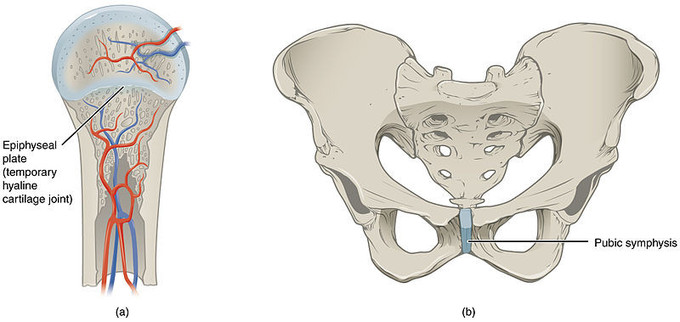
Cartilaginous joints are connected by fibrocartilage or hyaline cartilage. They allow more movement than fibrous joints but less than that of synovial joints. These types of joints are further subdivided into primary (synchondroses) and secondary (symphyses) cartilaginous joints. The epiphyseal (growth) plates are examples of synchondroses. Symphyses are found between the manubrium and sternum (manubriosternal joint), intervertebral discs, and the pubic symphysis.
 Joint / Articulation of Joints - Types, Classifications, Functions

Cartilaginous Joints: Image demonstrates a synchondrosis joint with epiphyseal plate (temporary hyaline cartilage joint) indicated (a) and a symphysis joint (b).

 Joint / Articulation of Joints - Types, Classifications, Functions 

Synovial Joint: This diagram of a synovial joint delineates the articular cartilage, articular capsule, bone, synovial membrane, and joint cavity containing synovial fluid.

Synovial Joints

This is the most common and movable joint type in the body. These joints (also called diarthroses) have a synovial cavity. Their bones are connected by dense irregular connective tissue that forms an articular capsule surrounding the bones’ articulating surfaces.

A synovial joint connects bones with a fibrous joint capsule that is continuous with the bones’ periosteum. This joint capsule constitutes the outer boundary of a synovial cavity and surrounds the bones’ articulating surfaces.

Synovial cavities are filled with synovial fluid. The knees and elbows are examples of synovial joints.

Clinical, numerical classification

  • monoarticular – concerning one joint
  • oligoarticular or pauciarticular – concerning 2–4 joints
  • polyarticular – concerning 5 or more joints

Structural classification (binding tissue)

Types of joints based upon their structure (L to R): Cartilaginous joint, Fibrous joint, and Synovial joint.

Structural classification names and divides joints according to the type of binding tissue that connects the bones to each other.[rx] There are four structural classifications of joints:[rx]

  • fibrous joint – joined by dense regular connective tissue that is rich in collagen fibers[rx]
  • cartilaginous joint – joined by cartilage. There are two types: primary cartilaginous joints composed of hyaline cartilage, and secondary cartilaginous joints composed of hyaline cartilage covering the articular surfaces of the involved bones with fibrocartilage connecting them.
  • synovial joint – not directly joined – the bones have a synovial cavity and are united by the dense irregular connective tissue that forms the articular capsule that is normally associated with accessory ligaments.[rx]
  • facet joint – joint between two articular processes between two vertebrae.[rx][rx]

Functional Classification of Joints

Functional classification of joints is based on the type and degree of movement permitted.

Key Points

Synarthrosis joints are immobile or have limited mobility and include fibrous joints.

Amphiarthrosis joints allow a small amount of mobility and include cartilaginous joints.

Diarthrosis joints are the freely movable synovial joints.

Synovial joints can also be classified as nonaxial, monoaxial, biaxial, and multiaxial.

The various movements permitted by synovial joints are abduction, adduction, extension, flexion, and rotation.

Key Terms

fibrous joints: Fixed or immobile joints that are connected by dense, tough connective tissue that
is rich in collagen fibers.

cartilaginous joints: Joints connected by fibrocartilage or hyaline cartilage. They allow more movement than fibrous joints but less than synovial joints.

gomphosis joints: Joints of very limited mobility. These are found at the articulation
between teeth and the sockets of maxilla or mandible (dental-alveolar joint).

Joints or articulations (connections between bones) can be classified in a number of ways. The primary classifications are structural and functional. Functional classification is based on the type and degree of movement permitted.
 Joint / Articulation of Joints - Types, Classifications, Functions

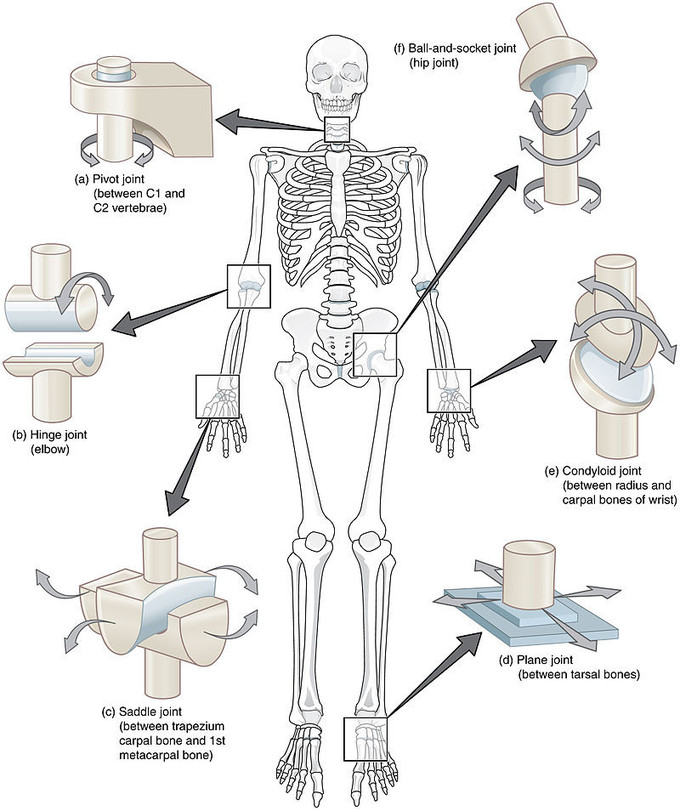
Types of Synovial Joints.jpg: Image of a skeleton and skematics of the different classes of synovial joints.

Three Categories of Functional Joints

  • Synarthrosis: These types of joints are immobile or allow limited mobility. This category includes fibrous joints such as suture joints (found in the cranium) and gomphosis joints (found between teeth and sockets of the maxilla and mandible).
  • Amphiarthrosis: These joints allow a small amount of mobility. Most joints in this category
    include cartilaginous joints such as those found between vertebrae and the pubic symphysis.
  • Diarthrosis: These are the freely-movable synovial joints. Synovial joints are further classified based on the different types of movement they provide, including:
    • Plane joint
    • Ball and socket joint
    • Hinge joint
    • Pivot joint
    • Condyloid joint
    • Saddle joint

Biomechanical classification

Joints can also be classified based on their anatomy or on their biomechanical properties. According to the anatomic classification, joints are subdivided into simple and compound, depending on the number of bones involved, and into complex and combination joints:[rx]

  1. Simple joint: two articulation surfaces (e.g. shoulder joint, hip joint)
  2. Compound joint: three or more articulation surfaces (e.g. radiocarpal joint)
  3. Complex joint: two or more articulation surfaces and an articular disc or meniscus (e.g. knee joint)

Anatomical

Joints of the human body

The joints may be classified anatomically into the following groups:

  • Joints of hand
  • Elbow joints
  • Wrist joints
  • Axillary joints
  • Sternoclavicular joints
  • Vertebral articulations
  • Temporomandibular joints
  • Sacroiliac joints
  • Hip joints
  • Knee joints
  • Articulations of foot

Unmyelinated nerve fibers are abundant in joint capsules and ligaments as well as in the outer part of intraarticular menisci. These nerve fibers are responsible for pain perception when a joint is strained.[rx]

Movement of Synovial Joints

Joints can also be classified by the number of axes of movement they permit:

  • Nonaxial (gliding): Found between the proximal ends of the ulna and radius.
  • Monoaxial (uniaxial): Movement occurs in one plane. An example is the elbow joint.
  • Biaxial: Movement can occur in two planes. An example is the wrist.
  • Multiaxial: Includes the ball and socket joints. An example is the hip joint.

The movements possible with synovial joints are:

  • Abduction: movement away from the body’s midline
  • Adduction: movement toward the body’s midline
  • Extension: straightening limbs at a joint
  • Flexion: bending the limbs at a joint
  • Rotation: a circular movement around a fixed point
Doctor visit helper

Prepare before seeing a doctor

A simple rural-patient checklist to help you explain symptoms clearly, ask better questions, and avoid unsafe self-treatment.

Safety note: This is not a prescription or diagnosis. For severe symptoms, pregnancy danger signs, children with serious illness, chest pain, breathing difficulty, stroke-like weakness, or major injury, seek urgent care.

Which doctor may help?

Start with a registered doctor or the nearest qualified health center.

What to tell the doctor

  • Write when the problem started and how it changed.
  • Bring old prescriptions, investigation reports, and current medicines.
  • Write allergies, pregnancy status, diabetes, kidney/liver disease, and major past illnesses.
  • Bring one family member if the patient is weak, elderly, confused, or a child.

Questions to ask

  • What is the most likely cause of my symptoms?
  • Which danger signs mean I should go to hospital quickly?
  • Which tests are necessary now, and which can wait?
  • How should I take medicines safely and what side effects should I watch for?
  • When should I come for follow-up?

Tests to discuss

  • Vital signs: temperature, pulse, blood pressure, oxygen saturation
  • Basic physical examination by a clinician
  • CBC, urine test, blood sugar, or imaging only when clinically needed

Avoid these mistakes

  • Do not use antibiotics, steroid tablets/injections, or strong painkillers without proper medical advice.
  • Do not hide pregnancy, kidney disease, ulcer, allergy, or blood thinner use.
  • Do not delay emergency care when danger signs are present.

Medicine safety and first-aid guide

This section is for patient education only. It does not replace a doctor, pharmacist, or emergency care.

Safe first steps

  • Avoid heavy lifting, sudden bending, and prolonged bed rest.
  • Use comfortable posture and gentle movement as tolerated.
  • Discuss physiotherapy, X-ray, or MRI only when clinically needed.

OTC medicine safety

  • For mild back pain, pain-relief medicine may be discussed with a doctor or pharmacist.
  • Avoid repeated painkiller use if you have kidney disease, stomach ulcer, uncontrolled blood pressure, or are taking blood thinners.

Avoid these mistakes

  • Do not start antibiotics without a proper medical decision.
  • Do not use steroid tablets or injections casually for quick relief.
  • Do not delay emergency care because of home remedies.

Get urgent help if

  • Back pain with leg weakness, numbness around private area, loss of urine/stool control, fever, cancer history, or major injury needs urgent care.
Medicine names, dose, and timing must be decided by a qualified clinician or pharmacist after checking age, pregnancy, allergy, other diseases, and current medicines.

For rural patients and family caregivers

Patient health record and symptom diary

Write your symptoms, medicines already taken, test results, and questions before visiting a doctor. This note stays on your device unless you print or copy it.

Doctor to discuss: Doctor / qualified healthcare provider
Tests to discuss with doctor
  • Basic vital signs: temperature, pulse, blood pressure, oxygen level if needed
  • Relevant blood, urine, imaging, or specialist tests only after clinical assessment
Questions to ask
  • What is the most likely cause of my symptoms?
  • Which warning signs mean I should go to emergency care?
  • Which tests are really needed now?
  • Which medicines are safe for my age, pregnancy status, allergy, kidney/liver/stomach condition, and current medicines?

Emergency warning signs such as chest pain, severe breathing difficulty, sudden weakness, confusion, severe dehydration, major injury, or loss of bladder/bowel control need urgent medical care. Do not wait for online information.

Safe pathway to proper treatment

Care roadmap for:  Joint / Articulation of Joints – Types, Classifications, Functions

Use this simple roadmap to understand the next safe steps. It is educational and does not replace examination by a doctor.

Go to emergency care if you notice:
  • Severe or rapidly worsening symptoms
  • Breathing difficulty, chest pain, fainting, confusion, severe weakness, major injury, or severe dehydration
Doctor / service to discuss: Qualified healthcare provider; specialist depends on symptoms and examination.
  1. Step 1

    Check danger signs first

    If danger signs are present, seek emergency care and do not wait for online information.

  2. Step 2

    Record the symptom story

    Write when symptoms started, severity, medicines already taken, allergies, pregnancy status, and test results.

  3. Step 3

    Visit a qualified clinician

    A doctor, nurse, or qualified healthcare provider can examine you and decide which tests or treatment are needed.

  4. Step 4

    Do only useful tests

    Do tests after clinical assessment. Avoid unnecessary tests, random antibiotics, or repeated medicines without diagnosis.

  5. Step 5

    Follow up and return early if worse

    If symptoms worsen, new warning signs appear, or treatment is not helping, return for review quickly.

Rural patient practical tips
  • Take a written symptom diary and all previous prescriptions/test reports.
  • Do not hide medicines already taken, even herbal or over-the-counter medicines.
  • Ask which warning signs mean urgent referral to hospital.

This roadmap is for education. A real diagnosis and treatment plan requires history, examination, and clinical judgment.

RX Patient Help

Ask a health question safely

Write your symptom story. A health professional or site editor can review it before any answer is prepared. This box is not for emergency care.

Emergency first: Severe chest pain, breathing trouble, unconsciousness, stroke signs, severe injury, heavy bleeding, or rapidly worsening symptoms need urgent local medical care now.

Frequently Asked Questions

Is this article a replacement for a doctor?

No. It is educational content only. Patients should consult a qualified clinician for diagnosis and treatment.

When should I seek urgent care?

Seek urgent care for severe symptoms, rapidly worsening condition, breathing difficulty, severe pain, neurological changes, or any emergency warning sign.

References

Add references, clinical guidelines, textbooks, journal articles, or trusted medical sources here. You can edit this area from the RX Article Professional Blocks panel.
