
RX Patient Tools
Use these quick guides before reading the article, or return to them when you need help preparing questions for a doctor.
Hearing allows one to identify and recognize objects in the world based on the sound they produce, and hearing makes communication using sound possible. Sound is derived from objects that vibrate producing pressure variations in a sound-transmitting medium, such as air. A pressure wave is propagated outward from the vibrating source. When the pressure wave encounters another object, the vibration can be imparted to that object and the pressure wave will propagate in the medium of the object. The sound wave may also be reflected from the object or it may diffract around the object. Thus, a sound wave propagating outward from a vibrating object can reach the eardrum of a listener causing the eardrum to vibrate and initiate the process of hearing.
Sound
Sound waves, characterized by frequency and amplitude, are perceived uniquely by different organisms.
Key Points
Sound waves are mechanical pressure waves that must travel through a medium and cannot exist in a vacuum.
There are four main characteristics of a sound wave: frequency, wavelength, period, and amplitude.
Frequency is the number of waves per unit of time and is heard as pitch; high-frequency sounds are high-pitched, and low-frequency sounds are low-pitched.
Most humans can perceive sounds with frequencies between 30 and 20,000 Hz; other animals, such as dolphins, can detect sounds at far higher frequencies.
Amplitude, the dimension of a wave from peak to trough, is heard as volume; louder sounds have greater amplitudes than those of softer sounds.
Key Terms
frequency: characterized as a periodic vibration that is audible; property of sound that most determines pitch and is measured in hertz
amplitude: measure of a wave from its highest point to its lowest point; heard as volume
ultrasound: sound frequencies above the human detectable ceiling of approximately 20,000 Hz
Sound
Auditory stimuli are sound waves, which are mechanical pressure waves that move through a medium, such as air or water. There are no sound waves in a vacuum since there are no air molecules for the waves to move through. The speed of sound waves differs based on altitude, temperature, and medium. At sea level and a temperature of 20º C (68º F), sound waves travel in the air at about 343 meters per second.
As is true for all waves, there are four main characteristics of a sound wave: frequency, wavelength, period, and amplitude. Frequency is the number of waves per unit of time; in sound, it is heard as pitch. High-frequency (≥15.000Hz) sounds are higher-pitched (short wavelength) than low-frequency (long wavelengths; ≤100Hz) sounds. Frequency is measured in cycles per second. For sound, the most commonly used unit is hertz (Hz), or cycles per second. Most humans can perceive sounds with frequencies between 30 and 20,000 Hz. Women are typically better at hearing high frequencies, but everyone’s ability to hear high frequencies decreases with age. Dogs detect up to about 40,000 Hz; cats, 60,000 Hz; bats, 100,000 Hz; dolphins, 150,000 Hz; and the American shad (Alosa sapidissima), a fish, can hear 180,000 Hz. Those frequencies above the human range are called ultrasound.
The amplitude or the dimension of a wave from peak to trough, in sound is heard as volume. The sound waves of louder sounds have greater amplitude than those of softer sounds. For sound, volume is measured in decibels (dB). The softest sound that a human can hear is the zero point. Humans speak normally at 60 decibels.
The Vestibular System
Gravity, acceleration, and deceleration are detected by evaluating the inertia on receptive cells in the vestibular system.
Key Points
The vestibular system uses hair cells, as does the auditory system, but it excites them in different ways.
There are five vestibular receptor organs in the inner ear (the vestibular labyrinth): the utricle, the saccule, and three semicircular canals; the utricle and saccule respond to acceleration in a straight line, such as gravity. The bending of the stereocilia stimulates specific neurons that signal to the brain that the head is tilted, allowing the maintenance of balance.
The fluid-filled semicircular canals are tubular loops set at oblique angle, arranged in three spatial planes; the base of each canal contains a cluster of hair cells that monitor angular acceleration and deceleration from rotation.
Neuronal projections to the temporal cortex account for feelings of dizziness; projections to autonomic nervous system areas in the brainstem account for motion sickness; and projections to the primary somatosensory cortex monitor subjective measurements of the external world and self-movement.
Key Terms
vestibulocochlear: of or pertaining to the vestibular and cochlear nerves
vestibular system: the sensory system in mammals that contributes to movement, sense of balance, and spatial orientation
stereocilium: any of many nonmotile cellular structures resembling long microvilli; those of the inner ear are responsible for auditory transduction
Vestibular Information
The stimuli associated with the vestibular system are linear acceleration (gravity) and angular acceleration/deceleration. Gravity, acceleration, and deceleration are detected by evaluating the inertia on receptive cells in the vestibular system. Gravity is detected through head position, while angular acceleration and deceleration are expressed through turning or tilting of the head.
The vestibular system has some similarities with the auditory system. It utilizes hair cells just like the auditory system, but it excites them in different ways. There are five vestibular receptor organs in the inner ear, all of which help to maintain balance: the utricle, the saccule, and three semicircular canals. Together, they make up what is known as the vestibular labyrinth. The utricle and saccule are most responsive to acceleration in a straight line, such as gravity. The roughly 30,000 hair cells in the utricle and 16,000 hair cells in the saccule lie below a gelatinous layer, with their stereocilia (singular: stereocilium) projecting into the gelatin. Embedded in this gelatin are calcium carbonate crystals, similar to tiny rocks. When the head is tilted, the crystals continue to be pulled straight down by gravity, but the new angle of the head causes the gelatin to shift, thereby bending the stereocilia. The bending of the stereocilia stimulates specific neurons that signal to the brain that the head is tilted, allowing the maintenance of balance. It is the vestibular branch of the vestibulocochlear cranial nerve that deals with balance.

Vestibular labyrinth: The structure of the vestibular labyrinth is made up of five vestibular receptor organs in the inner ear: the utricle, the saccule, and three semicircular canals.
The fluid-filled semicircular canals are tubular loops set at oblique angles, arranged in three spatial planes. The base of each canal has a swelling that contains a cluster of hair cells. The hairs project into a gelatinous cap, the cupula, where they monitor angular acceleration and deceleration from rotation. They would be stimulated by driving your car around a corner, turning your head, or falling forward. One canal lies horizontally, while the other two lie at about 45-degree angles to the horizontal axis. When the brain processes input from all three canals together, it can detect angular acceleration or deceleration in three dimensions. When the head turns, the fluid in the canals shifts, thereby bending stereocilia and sending signals to the brain. Upon cessation of acceleration or deceleration, the movement of the fluid within the canals slows or stops. For example, imagine holding a glass of water. When moving forward, water may splash backward onto the hand; when motion has stopped, water may splash forward onto the fingers. While in motion, the water settles in the glass and does not splash. Note that the canals are not sensitive to velocity itself but to changes in velocity. In this way, moving forward at 60 mph with your eyes closed would not give the sensation of movement, but suddenly accelerating or braking would stimulate the receptors.
Higher Processing
Hair cells from the utricle, saccule, and semicircular canals also communicate through bipolar neurons to the cochlear nucleus in the medulla. Cochlear neurons send descending projections to the spinal cord and ascending projections to the pons, thalamus, and cerebellum. Connections to the cerebellum are important for coordinated movements. There are also projections to the temporal cortex, which accounts for feelings of dizziness; projections to autonomic nervous system areas in the brainstem, which account for motion sickness; and projections to the primary somatosensory cortex, which monitors subjective measurements of the external world and self-movement. People with lesions in the vestibular area of the somatosensory cortex see vertical objects in the world as being tilted. Finally, the vestibular signals project to certain optic muscles to coordinate eye and head movements.
Reception of Sound
The outer, middle, and inner structures of the ear collect sound energy, converting it to audible sound.
Key Points
The human ear can be divided into three functional segments: the outer ear, the middle ear, and the inner ear.
Sound waves are collected by the pinna, travel through the auditory canal, and cause a vibration of the tympanum (eardrum).
The three ossicles of the middle ear ( malleus, incus, and stapes ) transfer energy from the vibrating eardrum to the inner ear.
The incus connects the malleus to the stapes, which allows vibrations to reach the inner ear.
Key Terms
malleus: small hammer-shaped bone of the middle ear
incus: small anvil-shaped bone in the middle ear; connects the malleus to the stapes
stapes: small stirrup-shaped bone of the middle ear
pinna: the visible, cartilaginous part of the ear that resides outside of the head and collects sound waves
tympanum: the innermost part of the outer ear; the eardrum
Reception of Sound
In order to hear a sound, the auditory system must accomplish three basic tasks. First, it must deliver the acoustic stimulus to the receptors; second, it must convert the stimulus from pressure changes into electrical signals; and third, it must process these electrical signals so that they can efficiently indicate the qualities of the sound source, such as frequency (pitch), amplitude (loudness, volume), and location.
The human ear can be divided into three functional segments:
- the outer ear: collects sound energy from the environment and sends it to the eardrum
- the middle ear: transduces the mechanical pressure signals from the ear drum into electrical signals
- the inner ear: interprets the electrical signals from the middle ear using hair cells
In mammals, sound waves are collected by the external, cartilaginous outer part of the ear called the pinna. They then travel through the auditory canal, causing vibration of the thin diaphragm called the tympanum, or ear drum, the innermost part of the outer ear. Interior to the tympanum is the middle ear, which holds three small bones called the ossicles (“little bones”), that transfer energy from the moving tympanum to the inner ear. The three ossicles are the malleus (also known as the hammer), the incus (the anvil), and stapes (the stirrup). The three ossicles are unique to mammals; each plays a role in hearing. The malleus attaches at three points to the interior surface of the tympanic membrane. The incus attaches the malleus to the stapes. In humans, the stapes is not long enough to reach the tympanum. If we did not have the malleus and the incus, then the vibrations of the tympanum would never reach the inner ear. These bones also function to collect force and amplify sounds. The ear ossicles are homologous to bones in a fish mouth; the bones that support gills in fish are thought to be adapted for use in the vertebrate ear over evolutionary time. Many animals (frogs, reptiles, and birds, for example) use the stapes of the middle ear to transmit vibrations to it.
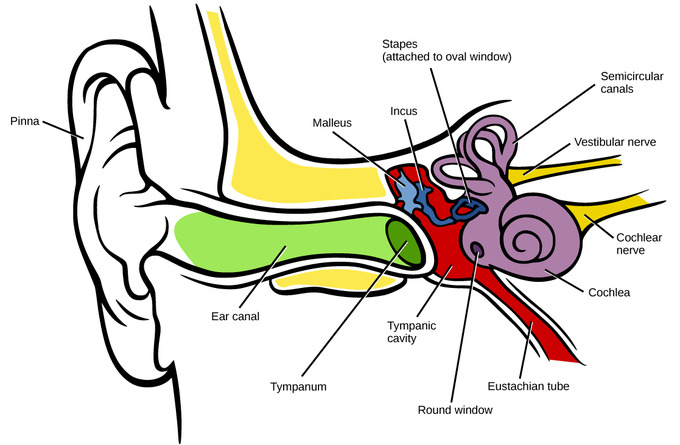
Human ear: Sound travels through the outer ear to the middle ear, which is bounded on its exterior by the tympanic membrane. The middle ear contains three bones called ossicles that transfer the sound wave to the oval window, the exterior boundary of the inner ear.
Transduction of Sound
When sound waves reach the ear, the ear transduces this mechanical stimulus (pressure) into a nerve impulse (electrical signal) that the brain perceives as sound.
Key Points
The human ear has three distinct functional regions: the outer ear, which collects sound waves; the middle ear, which represents the sound waves as pressure, and the inner ear, which converts those pressure signals into electrical signals that the brain perceives as sound.
The outer ear involves the pinna (the external shell-shaped structure on the outside of the head), which assists in collecting sound waves; the meatus (the external canal); and the tympanic membrane, also known as the eardrum.
The middle ear exists between the eardrum and the oval window (the external border with the inner ear) and consists of three separate bones: the malleus, the incus, and the stapes.
While the middle ear cavity is filled with air, the inner ear is filled with fluid.
The inner ear exists on the other side of the oval window from the middle ear, by the temple of the human head, and consists of three parts: the semicircular canals, the vestibule, and the cochlea.
Within the cochlea, the inner hair cells are most important for conveying auditory information to the brain.
Key Terms
ossicle: a small bone (or bony structure), especially one of the three of the middle ear
cochlea: the complex, spirally coiled, tapered cavity of the inner ear in which sound vibrations are converted into nerve impulses
transduce: to convert energy from one form to another
Vibrating objects, such as vocal cords, create sound waves or pressure waves in the air. When these pressure waves reach the ear, the ear transduces this mechanical stimulus (pressure wave) into a nerve impulse (electrical signal) that the brain perceives as sound. The pressure waves strike the tympanum, causing it to vibrate. The mechanical energy from the moving tympanum transmits the vibrations to the three bones of the middle ear. The stapes transmits the vibrations to a thin diaphragm called the oval window, which is the outermost structure of the inner ear.

Diagram of the middle ear: The middle ear exists between the tympanic membrane (the boundary with the outer ear) and the oval window (the boundary with the inner ear) and consists of three bones: the malleus (meaning hammer), the incus (meaning anvil), and the stapes (meaning stirrup).
The structures of the inner ear are found in the labyrinth, a bony, hollow structure that is the most interior portion of the ear. Here, the energy from the sound wave is transferred from the stapes through the flexible oval window and to the fluid of the cochlea. The vibrations of the oval window create pressure waves in the fluid (perilymph) inside the cochlea. The cochlea is a whorled structure, like the shell of a snail, and it contains receptors for the transduction of the mechanical wave into an electrical signal. Inside the cochlea, the basilar membrane is a mechanical analyzer that runs the length of the cochlea, curling toward the cochlea’s center.

Inner ear: The inner ear can be divided into three parts: the semicircular canals, the vestibule, and the cochlea, all of which are located in the temporal bone.
The mechanical properties of the basilar membrane change along its length, such that it is thicker, tauter, and narrower at the outside of the whorl (where the cochlea is largest), and thinner, floppier, and broader toward the apex, or center, of the whorl (where the cochlea is smallest). Different regions of the basilar membrane vibrate according to the frequency of the sound wave conducted through the fluid in the cochlea. For these reasons, the fluid-filled cochlea detects different wave frequencies (pitches) at different regions of the membrane. When the sound waves in the cochlear fluid contact the basilar membrane, it flexes back and forth in a wave-like fashion. Above the basilar membrane is the tectorial membrane.

Transduction: In the human ear, sound waves cause the stapes to press against the oval window. Vibrations travel up the fluid-filled interior of the cochlea. The basilar membrane that lines the cochlea gets continuously thinner toward the apex of the cochlea. Different thicknesses of membrane vibrate in response to different frequencies of sound. Sound waves then exit through the round window. In the cross-section of the cochlea (top right figure), note that in addition to the upper canal and lower canal, the cochlea also has a middle canal. The organ of the Corti (bottom image) is the site of sound transduction. The movement of stereocilia on hair cells results in an action potential that travels along the auditory nerve.
The site of transduction is in the organ of Corti (spiral organ). It is composed of hair cells held in place above the basilar membrane like flowers projecting up from the soil, with their exposed short, hair-like stereocilia contacting or embedded in the tectorial membrane above them. The inner hair cells are the primary auditory receptors and exist in a single row, numbering approximately 3,500. The stereocilia from inner hair cells extend into small dimples on the tectorial membrane’s lower surface. The outer hair cells are arranged in three or four rows. They number approximately 12,000, and they function to fine-tune incoming sound waves. The longer stereocilia that project from the outer hair cells actually attach to the tectorial membrane. All of the stereocilia are mechanoreceptors, and when bent by vibrations they respond by opening a gated ion channel (refer to [link]). As a result, the hair cell membrane is depolarized, and a signal is transmitted to the cochlear nerve. The intensity (volume) of sound is determined by how many hair cells at a particular location are stimulated.
The hair cells are arranged on the basilar membrane in an orderly way. The basilar membrane vibrates in different regions, according to the frequency of the sound waves impinging on it. Likewise, the hair cells that lay above it are most sensitive to a specific frequency of sound waves. Hair cells can respond to a small range of similar frequencies, but they require stimulation of greater intensity to fire at frequencies outside of their optimal range. The difference in response frequency between adjacent inner hair cells is about 0.2 percent. Compare that to adjacent piano strings, which are about six percent different. Place theory, which is the model for how biologists think pitch detection works in the human ear, states that high-frequency sounds selectively vibrate the basilar membrane of the inner ear near the entrance port (the oval window). Lower frequencies travel farther along the membrane before causing appreciable excitation of the membrane. The basic pitch-determining mechanism is based on the location along the membrane where the hair cells are stimulated. The place theory is the first step toward an understanding of pitch perception. Considering the extreme pitch sensitivity of the human ear, it is thought that there must be some auditory “sharpening” mechanism to enhance the pitch resolution.
When sound waves produce fluid waves inside the cochlea, the basilar membrane flexes, bending the stereocilia that attach to the tectorial membrane. Their bending results in action potentials in the hair cells, and auditory information travels along the neural endings of the bipolar neurons of the hair cells (collectively, the auditory nerve) to the brain. When the hairs bend, they release an excitatory neurotransmitter at a synapse with a sensory neuron, which then conducts action potentials to the central nervous system. The cochlear branch of the vestibulocochlear cranial nerve sends information on hearing. The auditory system is very refined, and there is some modulation or “sharpening” built in. The brain can send signals back to the cochlea, resulting in a change of length in the outer hair cells, sharpening or dampening the hair cells’ response to certain frequencies.
Higher Processing
The inner hair cells are most important for conveying auditory information to the brain. About 90 percent of the afferent neurons carry information from inner hair cells, with each hair cell synapsing with 10 or so neurons. Outer hair cells connect to only 10 percent of the afferent neurons, and each afferent neuron innervates many hair cells. The afferent, bipolar neurons that convey auditory information travel from the cochlea to the medulla, through the pons and midbrain in the brainstem, finally reaching the primary auditory cortex in the temporal lobe.
References
- https://www.ncbi.nlm.nih.gov/books/NBK430809/
- https://www.ncbi.nlm.nih.gov/books/NBK551658/
- https://www.ncbi.nlm.nih.gov/books/NBK557713/
- https://www.ncbi.nlm.nih.gov/books/NBK536955/
- https://www.ncbi.nlm.nih.gov/books/NBK538285/
- https://www.ncbi.nlm.nih.gov/books/NBK531483/
- https://www.ncbi.nlm.nih.gov/books/NBK560671/
- https://www.ncbi.nlm.nih.gov/books/NBK207834/
- https://www.ncbi.nlm.nih.gov/books/NBK542323/
- https://www.ncbi.nlm.nih.gov/books/NBK20366/
- https://www.ncbi.nlm.nih.gov/books/NBK385314/

