
RX Patient Tools
Use these quick guides before reading the article, or return to them when you need help preparing questions for a doctor.
Anatomy and Bone Landmarks of Ulna/The ulna is a long bone found in the forearm that stretches from the elbow to the smallest finger, and when in anatomical position, is found on the medial side of the forearm. It runs parallel to the radius, the other long bone in the forearm, and is the bigger and longest (by about an inch) of the two.
Anatomy and Bone Landmarks of Ulna
Proximal ulna
The ulna is a long bone that helps stabilize the antebrachial region from the medial side of the forearm. Its proximal end consists of the following processes (2) and notches (2):
- Olecranon: A hook-shaped process, located on the posterior aspect of the proximal ulnar end,
- Trochlear notch: A C-shaped notch, located anterior to the olecranon. It articulates with the trochlea of the humerus at the elbow joint.
- Coronoid process
- Radial notch: The articular facet of the radioulnar joint which can be found on the lateral aspect of its head.
You’re almost ready to test what you’ve learned about the radius and ulna! Discover why exactly anatomy quiz questions are the secret to your success. Cadaveric radius, ulna and humerus with labeled landmarks of the elbow joint
Ulnar shaft
The shaft of the ulna is tapered distally and thicker around the neck and proximal portion. Its lateral side is sharp and gives rise to the interosseous membrane between the two bones of the forearm, hence the name – interosseous border.
- From a posterior aspect, the ulna is rounded and smooth and can be palpated subcutaneously for the entire length of the antebrachial region. Just below the coronoid process at the highest point of the shaft, the ulnar tuberosity forms the muscular attachment of the brachialis muscle.
- On the lateral side and inferior to the radial notch, the supinator fossa is a concavity that is limited by the supinator crest and holds the originating fibers of the supinator muscle. Just below this muscle attachment, a second, smaller one can be found for the flexor pollicis longus.
- Anteriorly, midway down the ulnar bony shaft, there exists a nutrient foramen, which governs bone growth from the time of the seventh intrauterine week up until the eleventh year of life. This is covered by the flexor digitorum profundus muscle which spans the majority of the ulnar shaft.
- Posteriorly, on the distal side of the olecranon, the anconeus muscle finds its distal attachment or insertion. The origin for the flexor carpi ulnaris muscles and ulnar head of the supinator muscle are also located on the proximal posterior surface.
Three consecutive muscle attachments can be seen in descending order just below the attachment of the interosseous membrane as it travels down the shaft and they are:
- The abductor pollicis longus muscle,
- The extensor pollicis longus muscle and
- The extensor indicis muscle.
Distal ulna
- The distal head of the ulna is comprised of the articular circumference which articulates with the wrist bones and posteriorly, a bony projection known as the styloid process. Just above it on the medial aspect of the bone, the attachment of the pronator quadratus which runs between the radius and the ulna is positioned.
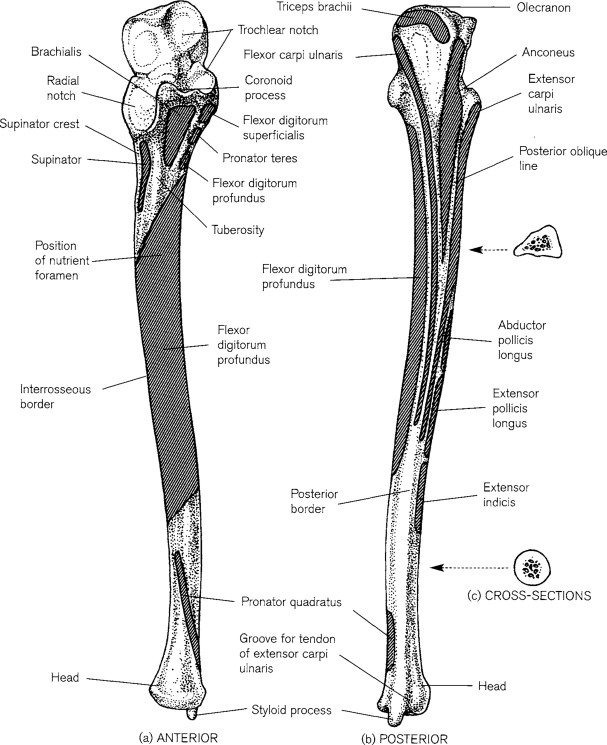
Muscles Attachment of Ulna
The radius and ulna serve as insertion sites for several muscles originating more proximally in the arm[rx][rx]:
-
Biceps brachii – inserts on the radial tuberosity, a bony prominence on the medial aspect of the proximal end of the radius; allows for flexion and supination of the forearm.
-
Brachialis – inserts on the coronoid process of the ulna and the ulnar tuberosity; allows for flexion of the forearm.
-
Triceps and anconeus – insert on the olecranon process of the ulna allowing for the extension of the forearm.
Within the forearm, muscles are classically grouped into anterior and posterior compartments[rx][rx]:
Anterior Compartment:
-
Flexor carpi radialis, palmaris longus, and the humeral heads of the pronator teres and flexor carpi ulnaris – originate from the common flexor origin. The ulnar head of the pronator teres originates from the coronoid process. The ulnar head of the flexor carpi ulnaris arises from the olecranon. The pronator teres inserts to the lateral surface of the radius and is responsible for pronation and flexion of the forearm. Each of the other muscles inserts in the wrist or hand and is responsible for more distal movements.
-
Flexor digitorum superficialis – arises from the anterior border of the radius, the medial epicondyle of the humerus, and the coronoid process and inserts on the middle phalanges of the medial four digits.
-
Flexor digitorum profundus – arises from the ulna and interosseous membrane and inserts on the distal phalanges.
-
Flexor pollicis longus – originates from the radius and the interosseous membrane and inserts on the distal phalanx of the thumb.
-
Pronator quadratus – originates from the distal end of the ulna and inserts on the distal end of the radius. Responsible for forearm pronation.
Posterior Compartment
-
Brachioradialis, extensor carpi radialis longus, extensor carpi radialis brevis, extensor digitorum, extensor digiti minimi, and extensor carpi ulnaris – originate from the distal lateral edge of the humerus. The brachioradialis inserts just proximal to the styloid process of the radius and is responsible for flexion of the forearm, especially in pronation. The remainder of the muscles originating from this area insert distally and are responsible for movements within the wrist and hand.
-
Supinator – originates from the lateral epicondyle, radial collateral and annular ligaments, supinator fossa and the crest of the ulna with insertion on the lateral side of the radius. It is responsible for forearm supination.
-
Abductor pollicis longus and extensor pollicis longus – originates from the posterior surface of the ulna and interosseous membrane with attachments in the hand.
-
Extensor indicis – originates from the posterior surface of the distal third of the ulna and the interosseous membrane with attachment in the hand.
-
Extensor pollicis brevis – originates from the posterior surface of the distal third of the radius and the interosseous membrane with attachment in the hand.
The following muscles insert into the ulna
Triceps brachii – posterior section of the superior surface of the olecranonAnconeus – olecranonBrachialis – the volar surface of the coronoid process
The following muscles originate from the ulna[rx][rx]:
-
Pronator teres – the medial surface of the coronoid process
-
Flexor carpi ulnaris – olecranon process
-
Flexor digitorum superficialis – coronoid process
-
Flexor digitorum profundus – anteromedial surface
-
Pronator quadratus – distal anterior shaft
-
Extensor carpi ulnaris – posterior border
-
Supinator – proximal ulna
-
Abductor pollicis longus – posterior surface
-
Extensor pollicis longus – dorsal shaft
-
Extensor indicis – posterior distal shaft
Nerves of Ulna
The nerves of the brachial plexus provide motor and sensory innervation to the antebrachium.
The wrist joint receives innervation from the three major nerves of the forearm.[rx]
-
Median nerve: Via the anterior interosseous branch
-
Radial nerve: Via the posterior interosseous branch
-
Ulnar nerve: Directly through its deep motor branches
The radial nerve provides sensory innervation for the posterior forearm and motor innervation to the brachioradialis, extensor carpi radialis brevis, extensor carpi radialis longus, supinator, extensor carpi ulnaris, abductor pollicis longus, abductor pollicis brevis, extensor pollicis longus, extensor pollicis brevis, extensor indicis, extensor digitorum, and extensor digiti minimi muscles.
The medial and lateral antebrachial cutaneous nerves provide sensory innervation to the anteromedial and anterolateral forearm respectfully.
The musculocutaneous nerve is the source of motor innervation to the biceps brachii.
The median nerve provides motor innervation to the pronator teres, flexor carpi radialis, palmaris longus, flexor digitorum superficialis, flexor pollicis longus, pronator quadratus, and the lateral half of the flexor digitorum profundus muscles.
The ulnar nerve supplies motor innervation to the flexor carpi ulnaris and flexor digitorum profundus muscles.[rx]
Functions of Ulna
Joints
The ulna forms part of the wrist joint and elbow joints. Specifically, the ulna joins (articulates) with:
- trochlea of the humerus, at the right side elbow as a hinge joint with the semilunar trochlear notch of the ulna.
- the radius, near the elbow as a pivot joint, allows the radius to cross over the ulna in pronation.
- the distal radius, where it fits into the ulnar notch.
- the radius along its length via the interosseous membrane that forms a syndesmosis joint
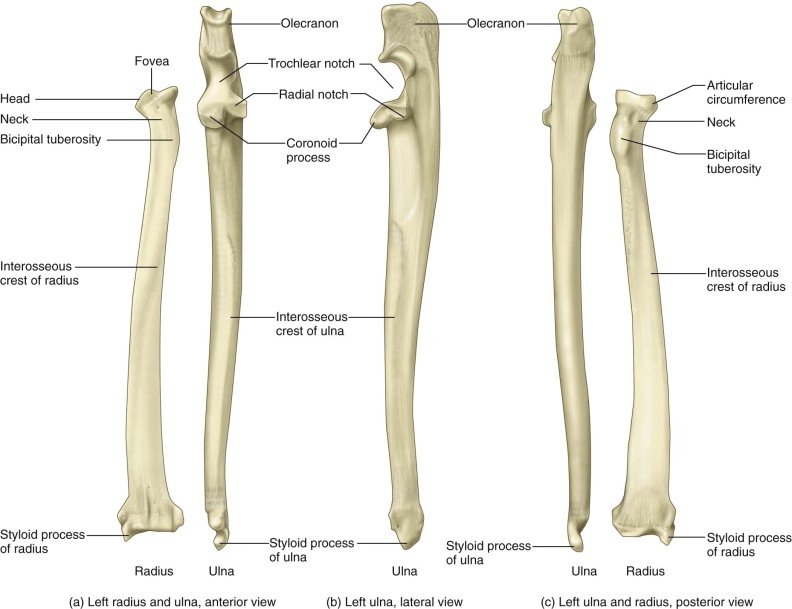
Musculotendinous Attachment of Ulna
Anteriorly
Proximal
- brachialis: ulnar tuberosity
- pronator teres (ulnar head): coronoid process
- flexor digitorum superficialis (humeroulnar head): coronoid process
Shaft
- flexor digitorum profundus: proximal anterior surface ulna
- pronator quadratus: anterior surface of the distal quarter of the ulnar shaft
Posteriorly
Proximal
- triceps brachii: proximal olecranon process
- anconeus: olecranon process
Shaft
- supinator: posterior proximal shaft of ulna
- flexor carpi ulnaris (ulnar head): medial border olecranon + posterior border of ulna
- extensor carpi ulnaris: posterior border of ulna
- abductor pollicis longus: posterior surface of ulna
- extensor pollicis longus: middle third of the posterior surface of ulna
- extensor indicis: posterior surface of ulna
Ligamentous
Proximal
- medial collateral ligaments of the elbow
-
- anterior band: inferior medial epicondyle to the sublime tubercle
- posterior band: medial epicondyle to the medial olecranon
- middle band (Transverse or Cooper’s ligament): medial olecranon to the medial coronoid process
-
- anterior and posterior capsular ligaments of the elbow.
Medial
- anterior and posterior attachments of the annular ligament
- quadrate ligament
- oblique cord
- interosseous membrane
Distal
- triangular fibrocartilage
- ulnar collateral ligament of the wrist
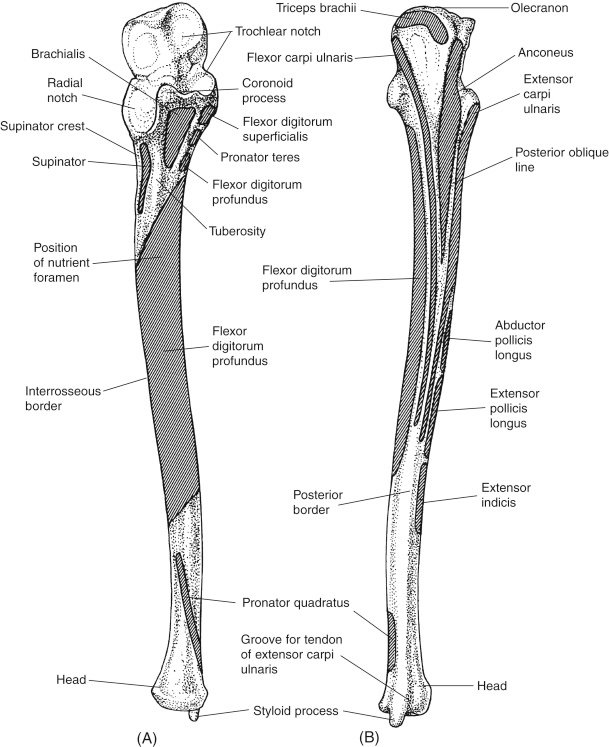
Bones of the left forearm. Anterior aspect.
| Muscle | Direction | Attachment |
| Triceps brachii muscle | Insertion | posterior part of the superior surface of Olecranon process (via common tendon) |
| Anconeus muscle | Insertion | olecranon process (lateral aspect) |
| Brachialis muscle | Insertion | the anterior surface of the coronoid process of the ulna |
| Pronator teres muscle | Origin | the medial surface on the middle portion of the coronoid process (also shares an origin with medial epicondyle of the humerus) |
| Flexor carpi ulnaris muscle | Origin | olecranon process and posterior surface of the ulna (also shares an origin with medial epicondyle of the humerus) |
| Flexor digitorum superficialis muscle | Origin | coronoid process (also shares an origin with medial epicondyle of the humerus and shaft of the radius) |
| Flexor digitorum profundus muscle | Origin | the anteromedial surface of the ulna (also shares an origin with the interosseous membrane) |
| Pronator quadratus muscle | Origin | distal portion of the anterior ulnar shaft |
| Extensor carpi ulnaris muscle | Origin | the posterior border of ulna (also shares an origin with lateral epicondyle of the humerus) |
| Supinator muscle | Origin | proximal ulna (also shares an origin with lateral epicondyle of the humerus) |
| Abductor pollicis longus muscle | Origin | the posterior surface of the ulna (also shares an origin with the posterior surface of the radius bone) |
| Extensor pollicis longus muscle | Origin | dorsal shaft of the ulna (also shares an origin with the dorsal shaft of the radius and the interosseous membrane) |
| Extensor indicis muscle | Origin | the posterior surface of the distal ulna (also shares an origin with the interosseous membrane) |
Clinical Significance of Ulna
Regardless of the site of the fracture, management should begin with a history and physical followed by plain films of the affected site, and if possible the joint above and below, orthogonal radiographic views of each site are mandatory to appropriately manage each fracture within the guidelines of the standard of care management. Common fractures include[rx]:
-
Dorsally displaced distal radius fractures (commonly referred to as “Colle fractures”) – One of the most common forearm fractures. It involves a complete transverse fracture of the distal 2 cm of the radius. The distal fragment is displaced posteriorly resulting in the classic “dinner fork” deformity. The etiology is usually a fall on an outstretched hand with concomitant hyperextension. The fracture site can often be comminuted, and avulsion of the ulnar styloid process is also a feature.
-
Reverse Colles fracture (Smith fracture) – A complete transverse fracture of the distal 2 cm of the radius with anterior displacement of the distal fragment. Usually secondary to a fall on a flexed hand.
-
Monteggia fracture – A fracture within the proximal third of the ulna with concomitant dislocation of the radial head.[rx]
-
Galeazzi’s fracture – A fracture of the distal third of the radius with accompanying dislocation of the distal radioulnar joint.
-
Barton’s fracture – An intraarticular fracture of the distal radius with concomitant dislocation of the radiocarpal joint.[rx]
-
Essex-Lopresti fracture-dislocation – Fracture of the radial head with dislocation of the distal radioulnar joint and rupture of the interosseous membrane.[rx]
-
“Both Bone” forearm fractures – descriptive term to describe many different types of patterns involving fractures of the radius and ulnar shaft long bone
Incomplete fracture patterns of the forearm
-
Isolated ulnar shaft fracture -(greenstick fracture of the ulna)
-
Isolated “buckle” or “torus” fracture pattern of the radius
-
Seen in pediatric patients as a manifestation of a pathologic force compromising one cortex of the bone (resulting in compression on one side depending on the direction of the force).
References
- https://www.ncbi.nlm.nih.gov/books/NBK545260/
- https://www.ncbi.nlm.nih.gov/books/NBK547749/
- https://www.ncbi.nlm.nih.gov/books/NBK544512/
- https://www.ncbi.nlm.nih.gov/books/NBK534779/
- https://www.ncbi.nlm.nih.gov/books/NBK499980/
- https://www.ncbi.nlm.nih.gov/books/NBK536991/
- https://www.ncbi.nlm.nih.gov/books/NBK535382/
- https://www.ncbi.nlm.nih.gov/books/NBK470575/
- https://www.ncbi.nlm.nih.gov/books/NBK499972/
- https://www.ncbi.nlm.nih.gov/books/NBK536907/
- https://en.wikipedia.org/wiki/Ulna
- https://www.britannica.com/science/ulna
- https://radiopaedia.org/cases/ulnar-hemimelia?lang=gb
- https://www.sciencedirect.com/topics/medicine-and-dentistry/ulna
- https://www.kenhub.com/en/library/anatomy/the-radius-and-the-ulna
- https://theodora.com/anatomy/the_ulna.html
- https://www.getbodysmart.com/upper-limb-bones/radius-ulna
- https://radiopaedia.org/articles/ulna

