RX Patient Tools
Use these quick guides before reading the article, or return to them when you need help preparing questions for a doctor.
Snow Fungus, botanically classified as Tremella fuciformis, is a wild, edible fungus that belongs to the Tremellaceae family. The plant is native to tropical and subtropical regions around the world, but extends into temperate areas in Asia and North America. It is known throughout South and Central America, the Caribbean, parts of North America, sub-Saharan Africa, southern and eastern Asia, Australia, New Zealand, and the Pacific Islands. Also known as the snow ear, silver ear fungus, white jelly mushroom, bai mu erh, shirokikurage, silver tree-ear fungus, white jelly-leaf, white muer, white tree-ear, wood ear fungus, Silver Ear mushroom, Tremella mushroom, White Jelly fungus, White fungus, White Tree fungus, White Brain Jelly Fungus, snow mushroom, Chrysanthemum Mushroom and White brain jelly fungus, Snow Fungus grow in tropical climates on dead branches of broadleaf trees and are also cultivated in China for their medicinal properties. Found in fresh, dried, and canned form, Snow fungus is used to add texture to a wide variety of culinary applications.
Plant description
Snow Fungus is a white, nearly translucent, trembling fungus or parasitic yeast up to 7.5 cm (3.0 in) across and not more than 12 mm tall and is composed of thin but erect, seaweed-like, branching fronds, often crisped at the edges. It produces white, frond-like, gelatinous basidiocarps (fruiting bodies) that are 43–63 mm long and 35–42 mm broad, firm shapeless, gelatinous fruit bodies, translucent, mucilaginous when fresh, becoming horny, thin, grey to yellowish-grey colored when dry, repeatedly lobed or forked with margins flexuous to folded, sessile. It is widespread, especially in the tropics, where it can be found on the dead branches of broadleaf trees. This fungus is commercially cultivated and is one of the most popular fungi in the cuisine and medicine of China.
Snow Fungus Facts
| Name | Snow Fungus |
|---|---|
| Scientific Name | Tremella fuciformis |
| Native | Mainly tropical and subtropical regions around the world, but extends into temperate areas in Asia and North America. It is known throughout South and Central America, the Caribbean, parts of North America, sub-Saharan Africa, southern and eastern Asia, Australia, New Zealand, and the Pacific Islands |
| Common Names | Snow fungus, snow ear, silver ear fungus, white jelly mushroom, bai mu erh, shirokikurage, silver tree-ear fungus, white jelly-leaf, white muer, white tree-ear, wood ear fungus, Silver Ear mushroom, Tremella mushroom, White Jelly fungus, White fungus, White Tree fungus, White Brain Jelly Fungus, snow mushroom, Chrysanthemum Mushroom, White brain jelly fungus |
| Name in Other Languages | Chinese: Yin Er (银耳), xuai air (雪耳), Báimù’ěr (白木耳) Czech: Rosolovka řasotvará Dutch: Sneeuw schimmel English: Snow fungus, white jelly fungus, snow ear, silver ear fungus, white jelly mushroom, White Brain Jelly Fungus, white jelly leaf, silver ear mushroom, snow mushroom, Chrysanthemum Mushroom, White brain jelly fungus French: Trémelle fucus, Trémelle en fuseau German: Silberohr Indonesian: Jamur kuping putih Japanese: Shirokikurage (シロキクラゲ) Javanese: Jamur kuping putih Spanish: Hongo blanco, Hongo de la oreja plateada, Hongo gelatinoso blanco Sundanese: Lémbér bodas Tibetan: Mog dkar (མོག་དཀར།) Ukrainian: Snizhnyy hryb (Сніжний гриб) Vietnamese: Mộc nhĩ trắng, nấm tuyết or ngân nhĩ Zhuang: Raetngaenz |
| Plant Growth Habit | Parasitic yeast |
| Growing Climates | Found growing on undersides of branches, on dead and decayed dicotyledonous wood |
| Plant Size | Up to 7.5 cm (3.0 in) across and not more than 12 mm tall |
| Fruit Shape & Size | 43–63 mm long and 35–42 mm broad, firm shapeless, gelatinous fruit bodies, translucent, mucilaginous when fresh, becoming horny, thin, grey to yellowish-grey colored when dry, repeatedly lobed or forked with margins flexuous to folded, sessile |
| Fruit Color | White becoming grey to yellowish-grey colored when dry |
| Flavor/Aroma | Slightly fishy |
| Taste | Sweet, Bland |
| Plant Parts Used | Mycelium and Fruiting Bodies |
| Available Forms | Fresh, dried, and canned form |
| Health Benefits |
|
| Other Facts |
|
Snow Fungus Scientific Classification
Scientific Name: Tremella fuciformis
| Rank | Scientific Name & (Common Name) |
|---|---|
| Kingdom | Plantae (Plants) |
| Subkingdom | Tracheobionta (Vascular plants) |
| Infrakingdom | Streptophyta (land plants) |
| Class | Tremellomycetes |
| Order | Tremellales |
| Family | Tremellaceae |
| Genus | Tremella Linnaeus |
| Species | Tremella fuciformis Berk |
| Synonyms |
|
Microscopically, the hyphae are clamped and occur in a dense gelatinous matrix. Haustorial cells arise on the hyphae, producing filaments that attach to and penetrate the hyphae of the host. The basidia are tremelloid (ellipsoid, with oblique to vertical septa), 10–13 by 6.5–10 μm, sometimes stalked. The basidiospores are ellipsoid, smooth, 5–8 by 4–6 μm, and germinate by hyphal tube or by yeast cells.
The fungus gets the common name of wood ear for the way it looks on the decaying logs on which it grows. Good-quality snow fungus has a pale, yellowish-white color and mucilage like texture. Chinese and Japanese herbalists have used snow fungus for more than 2,000 years, mostly to increase fluids in the body, for dry coughs, and for palpitations. It has been used as a tonic herb and as a beauty enhancer to improve the complexion. Its collagen content is comparable to bird’s nest. Hence, it’s also why white fungus is dubbed as the ‘poor man’s bird nest’.
History
Snow Fungus is native to subtropical and tropical regions around the world including Brazil, Taiwan, China, Japan, and other Asian countries. Cultivation of the fungus began around 1914 in China and new cultivation techniques began in 1968, leading to the mass production of the variety and the ability to export the mushroom in dried form worldwide. Up until this time, Snow Mushrooms were for the exclusive use of royalty and the very wealthy. Today Snow mushrooms are found fresh at local markets or in dried form in Asia, Southeast Asia, South America, Central America, Australia, New Zealand, Africa, and North America.
Health benefits of Snow Fungus
Snow Fungus consists of good amount of iron, vitamin C, calcium and phosphorus. The fat and gum like protein in it is particularly beneficial for the body. It is considered a good supplement to the body. Stew white fungus with rock sugar lubricates the colon and stimulates peristalsis. Thus, it is a mild laxative for constipation patients. Listed below are few of the popular health benefits of Snow Fungus
1. Atherosclerosis and high cholesterol
In Japan, snow fungus is used to prevent atherosclerosis, in which cholesterol gathers into plaques within the arteries. It does this by lowering total blood cholesterol levels. To date, however only one initial research has confirmed the value for snow fungus for this purpose. However, research on snow fungus polysacchairdes as infection-fighters has confirmed that hey help maintain cholesterol levels within the linings of cells, where cholesterol is needed, possibly helping to draw it out of the bloodstream.
2. Cancer
Scientific studies in cells and animals have found that the mucilage-like polysaccharides found in snow fungus fit like keys into receptor sites on certain immune cells. Snow fungus also increases the activity of natural killer (NK) cells and improves the effectiveness of antibodies. In addition, snow fungus reduces the rate at which cancers spread in a laboratory setting. In order to grow and spread, tumors have to establish their own blood vessel systems. Snow fungus compounds counteract a blood chemical platelet-activating factor (PAF), which makes the blood less likely to clots and spins a fibrin “net” on which blood vessels to serve the tumor can form. None of these actions have been confirmed in humans.
3. Healthy Skin
With a gelatinous structure and high amounts of polysaccharides, Snow Fungus has been hitting the headlines in cutting edge skincare due to its surprising ability to boost skin hydration. The Snow Mushroom also has the ability to generate a flexible hydration film that helps to restore dry skin to its optimally hydrated state. This helps to restore elasticity, and with over 18 amino acids, infection, or irritation, often causing pain, swelling, heat, or redness. সহজ বাংলা: শরীরের প্রদাহ; ব্যথা, ফোলা বা লালভাব হতে পারে।" data-rx-term="inflammation" data-rx-definition="Inflammation is the body’s response to injury, infection, or irritation, often causing pain, swelling, heat, or redness. সহজ বাংলা: শরীরের প্রদাহ; ব্যথা, ফোলা বা লালভাব হতে পারে।">inflammation, pain, or swelling. সহজ বাংলা: প্রদাহ/ফোলা/ব্যথা কমায়।" data-rx-term="anti-inflammatory" data-rx-definition="Anti-inflammatory means reducing inflammation, pain, or swelling. সহজ বাংলা: প্রদাহ/ফোলা/ব্যথা কমায়।">anti-inflammatory and antioxidant properties, Snow Fungus helps to accelerate wound healing, aids in collagen production for plumper skin and boosts overall skin health.
4. Heart Health
Recent research has determined Snow Fungus to be beneficial in healing atherosclerosis by stimulating DNA synthesis in vascular endothelial cells – cells that line the interior surface of blood vessels. The dysfunction of these cells is a major factor in the pathogenesis of atherosclerosis, hypertension (high blood pressure) and thrombophlebitis (a circulatory problem caused when a blood clot slows circulation). Snow Fungus has also been shown to protect endothelium cells from histamine damage and increase clotting time.
5. Treat fatigue
Fatigue is a symptom of tiredness caused by stresses (physical and/or psychological). Polysaccharides and other antioxidants found in snow ear mushroom can help to prolong the time for skeletal muscles to become fatigued. It encourages protein and RNA synthesis, which helps to maintain the normal function of the liver and avoid fatigue. Thus consumption of white jelly mushroom improves muscle function and treats fatigue.
6. Immune Boosting
Snow Fungus is rich in polysaccharides, compounds which have potent immune boosting qualities. The particular polysaccharides contained in this fungus improve the secretion of interferon and interleukin, vital immune system components which provoke the manufacture of germ consuming macrophages.
Snow Fungus also improves and enhances the action of NK (natural killer) cells, a type of white blood cell that safeguards the body from viruses and bacteria. It also improves the effectiveness of antibodies which are also used by the immune system to fight bacteria and viruses. Snow Fungus is considered to be especially effective for old people with a weakened respiratory system, and for dry coughs in traditional Chinese medicines.
7. Brain Boosting
The gelatinous structure of the Snow Fungus is remarkably similar to that of the brain and it does certainly contain compounds that can protect this important organ. Research has discovered that Snow Fungus has neuro-protective and neuro-trophic effects. It promotes neurite outgrowth and helps prevent b-amyloid toxicity, making it a probable precautionary agent in neuro-degenerative diseases such as Alzheimer’s.
Snow Fungus also increases super-oxide dismutase (SOD) activity in the brain. SOD is an important protective enzyme of the brain that forms the first line of defense against pathogens to the brain.
8. Manage insulin is low or not working well. সহজ বাংলা: রক্তে চিনি বেশি থাকার রোগ।" data-rx-term="diabetes" data-rx-definition="Diabetes is a condition where blood sugar stays too high because insulin is low or not working well. সহজ বাংলা: রক্তে চিনি বেশি থাকার রোগ।">diabetes
Polysaccharide (glucuronoxylomannan) contained in Snow Fungus helps in reducing plasma glucose levels (52%). Increase glucose disposal, improving glucose tolerance and systemic insulin sensitivity without affecting body weight.
Thus, snow fungus acts as potential oral hypoglycemic agents or functional foods for the management of non-insulin-dependent diabetes mellitus
9. Treat Alzheimer’s disease
Snow Fungus has polysaccharide which prevents and treats neurodegenerative diseases like Alzheimer’s. As it improves neurite outgrowth, which was encouraged by the nerve growth factor, reduced the neurotoxic effect and prevent reactive oxygen species accumulation.
10. Enhances Skin Elasticity
Snow fungus offers additional hydration to the skin; it helps keep wrinkles at bay. By encouraging your skin to retain as much moisture as possible, it ends up smoothing the skin’s surface and making you look younger. This increased elasticity is likely what makes snow mushroom so popular right now. Hydration is great, but the anti-aging effect of the ingredient is what will give it staying power in the beauty business.
11. Reduces infection, or irritation, often causing pain, swelling, heat, or redness. সহজ বাংলা: শরীরের প্রদাহ; ব্যথা, ফোলা বা লালভাব হতে পারে।" data-rx-term="inflammation" data-rx-definition="Inflammation is the body’s response to injury, infection, or irritation, often causing pain, swelling, heat, or redness. সহজ বাংলা: শরীরের প্রদাহ; ব্যথা, ফোলা বা লালভাব হতে পারে।">Inflammation
For those with more sensitive skin, snow mushroom is really a life-saver. Because it naturally breaks down harmful free radicals in the skin and decreases infection, or irritation, often causing pain, swelling, heat, or redness. সহজ বাংলা: শরীরের প্রদাহ; ব্যথা, ফোলা বা লালভাব হতে পারে।" data-rx-term="inflammation" data-rx-definition="Inflammation is the body’s response to injury, infection, or irritation, often causing pain, swelling, heat, or redness. সহজ বাংলা: শরীরের প্রদাহ; ব্যথা, ফোলা বা লালভাব হতে পারে।">inflammation, it can recover your overall complexion. It also doesn’t typically cause skin reactions, making it milder than some of the harsher chemicals often found in traditional beauty products.
12. Heals Wounds
Snow mushroom has the power to encourage cell growth, which allows the substance to help with wound healing. Because it also has a high vitamin D quotient, another factor that aids in alleviating skin abrasions, the mushroom would be super useful for soothing stubborn blemishes, or ones you might have popped or picked at. Using this super beauty ingredient may help smooth and soothe the irritation and help it go away faster.
Traditional uses and benefits of Snow Fungus
- It is rich in dietary fiber and helps to nourishes lungs, kidneys and stomach.
- It is very beneficial for the skin. It makes the skin moist and soft. It improves the skin tone.
- It strengthens the bones and helps to maintain ideal weight.
- It fights tumor growth.
- It prevents the depletion of White blood cells in the Body during chemotherapy.
- It reduces harmful cholesterol and protects the Liver.
- It heals Atherosclerosis.
- It promotes the metabolism of protein and nucleic acid in the Liver.
- It combats swelling and irritation.
- It reduces wrinkles, freckles and stress marks on the face.
- It heals the epidermal layer of the Skin.
- The Chinese have traditionally used it to cure dry coughs and also heart palpitations, and to help stabilize the nervous system.
- If someone consumes snow fungus consistently the wrinkles, freckles and stress marks on his/her face will vanish.
- It is especially useful in healing atherosclerosis, high blood pressure and even certain cancerous growths.
- Physicians in Japan use snow fungus to heal as well as thwart atherosclerosis, a disease where cholesterol accumulates into the plaques inside the arteries.
Culinary uses
- In Chinese cuisine, Snow Fungus is traditionally used in sweet dishes.
- Most commonly, it is used to make a dessert soup called luk Mei in Cantonese, often in combination with jujubes, dried longan, and other ingredients.
- It is also used as a component of a drink and as an ice cream.
- It is now additionally used in some savory dishes.
Different Uses Snow Fungus
There are many ways to take Snow Fungus, from using it on the skin to consuming it as a food. Because fresh, whole Snow Fungus is not easily available outside of Asian countries, here are some convenient ways to use these nutrient-dense fungi.
Skincare Products
Chances are it’s going to become easier to find Snow Fungus in skincare products, particularly those offering anti-aging benefits. Look for natural products that are free from synthetic chemicals, parabens, phthalates, sulfates, and other questionable ingredients that can worsen dry skin or cause irritation.
Snow Fungus Powder
Probably the most common and convenient way to find Snow Fungus is in a finely ground powder. Thanks to its mild, delicately sweet flavor profile, it’s easy to add Snow Fungus powder to smoothies, acai bowls, parfaits, yogurt, even tea.
Snow Fungus Extract
You can find liquid Snow Fungus extract that can be squeezed into water, drinks, or food. Only buy from reputable brands and start small—consider starting with just 1/4 tsp. for a week before increasing dosage if necessary and pay attention to how your body feels.
Recipes
Snow Fungus Soup
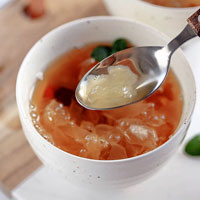
Ingredients
- Red Dates 6-8 pcs
- Snow Fungus 25-30 g
- Wolf berries /Goji 10 g
- Rock sugar 30 g
- Water 1500 ml
- Dried Longan (optional)
Directions
- Wash & soak the snow fungus in cold water till it becomes soft and translucent (around 2-3 hrs). Change the water once or twice. Drain, cut off the stem (hard yellowish part) and cut into smaller pieces.
- Wash the Goji berries.
- Wash the red dates and remove the seeds and cut into half.
- Boil the water and put in the ingredients. Boil for 40 mins. Add the goji berries & rock sugar during last 10 mins.
- Serve warm or chilled.
Precautions
- Do not consume it during Pregnancy.
- Avoid using it if you are suffering from cough and cold.
- It is reported that consuming excessive amounts of these may lead to internal bleeding.
References
- https://www.itis.gov/servlet/SingleRpt/SingleRpt?
- http://www.hear.org/pier/species/pyrus_calleryana.htm
- https://npgsweb.ars-grin.gov/gringlobal/taxon/taxonomydetail?
- https://pfaf.org/user/Plant.aspx?
- https://www.wildflower.org/plants/result.php?
- http://www.missouribotanicalgarden.org/PlantFinder/PlantFinderDetails.aspx?
- https://plants.usda.gov/core/profile?
- https://www.invasive.org/browse/subinfo.cfm?
- https://www.cabi.org/isc/datasheet/46188
- https://www.cal-ipc.org/plants/profile/pyrus-calleryana-profile/
- http://www.efloras.org/florataxon.aspx?
- https://texasinvasives.org/plant_database/detail.php?
- http://www.iucngisd.org/gisd/species.php?
- http://www.theplantlist.org/tpl1.1/record/rjp-6009
- https://en.wikipedia.org/wiki/vegetables
- https://gd.eppo.int/taxon/PYUCA
- https://www.illinoiswildflowers.info/savanna/plants/
- https://uses.plantnet-project.org/en/
- https://www.theplantlist.org/tpl1.1/record/
- https://training.ars-grin.gov/gringlobal/taxon/taxonomydetail?
- http://hort.ufl.edu/database/documents/pdf/tree_fact_sheets/
- https://www.illinoiswildflowers.info/trees/plants/callery_pear.htm
- https://www.ncbi.nlm.nih.gov/books/NBK218749/
- https://www.ncbi.nlm.nih.gov/books/NBK551014/
- https://www.ncbi.nlm.nih.gov/books/NBK551727/
- https://www.ncbi.nlm.nih.gov/books/NBK65874/
- https://www.ncbi.nlm.nih.gov/books/NBK304428/
- https://www.ncbi.nlm.nih.gov/books/NBK218759/
- https://www.ncbi.nlm.nih.gov/books/NBK556048/
- https://www.ncbi.nlm.nih.gov/books/NBK218749/
- https://www.niehs.nih.gov/health/topics/agents/vegetables/index.cfm
- https://www.sciencedirect.com/book/9780443062414/vegetable
- https://www.amazon.com/Essential-Oils-Fully-Revised-Updated/dp/1787752291
- https://www.healthbenefitstimes.com/category/herbs-and-spices/
- https://www.frontiersin.org/articles/257193
- https://www.tandfonline.com/toc/tjeo20/current
- https://www.intechopen.com/chapters/68027
- https://onlinelibrary.wiley.com/doi/full/10.1002/ptr.6854
- https://www.nature.com/articles/s41598-020-68823-4
- https://www.cancer.gov/about-cancer/treatment/cam/patient/aromatherapy-pdq
- https://www.researchgate.net/publication/254247133_
- https://link.springer.com/article/10.1365/s10337-010-1680-0
- https://fdc.nal.usda.gov/ndb/foods/show/herb
- https://www.nccih.nih.gov/health/herbsataglance
- https://portal.nifa.usda.gov/web/crisprojectpages/0092887
- https://academic.oup.com/database/article/doi/10.1093/database/bau120
- https://www.cambridge.org/core/journals/weed-science/article/herbicide-effects-of-vegetable/
- https://www.fs.fed.us/wildflowers/ethnobotany/vegetable
- https://www.karger.com/Article/Abstract/501062
- https://en.wikipedia.org/wiki/List_of_plant
- https://en.wikipedia.org/wiki/Types_of_plant_harb
- https://www.britannica.com/topic/cereals
- https://www.planttherapy.com/
- https://academic.oup.com/plphys/article/54/4/560/
- https://www.healthbenefitstimes.com/category/oils/
- https://www.aromaweb.com/essentialoils/default.asp
- https://books.google.com/books/about/Herbs_And_Essential_Oils_Book.html?
- https://books.google.com/books/about/Herbal_herb_for_Health_Beauty.html?id=C_MX9tKpttMC
- https://books.google.com/books/about/Herbal_vegetable_for_Health_Beauty.html?id=C_MX9tKpttMC
- https://www.niehs.nih.gov/health/topics/agents/
- https://www.botanical.com/botanical/mgmh/l/
- https://www.nccih.nih.gov/health/atoz
- https://clinicaltrials.gov/ct2/show/NCT02764567
- https://fda.report/Company/Young-Living-Essential-Oils-Lc
- http://www.fao.org/3/ad420e/ad420e.pdf
- https://www.healthywa.wa.gov.au/Articles/A_E/
- https://www.niehs.nih.gov/health/topics/agents/
- https://www.consumerreports.org/health-product-recalls/
- https://www.itis.gov/servlet/SingleRpt/SingleRpt?search_topic=TSN&search_value=42325#null
- https://www.cabi.org/isc/datasheet/46654
- https://www.itis.gov/servlet/SingleRpt/SingleRpt?search_topic=TSN&search_value=506060#null
- https://www.itis.gov/servlet/SingleRpt/SingleRpt?search_topic=TSN&search_value=784875#null
- https://www.itis.gov/servlet/SingleRpt/SingleRpt?
- https://en.wikipedia.org/wiki/Scaphium_affine
- http://www.theplantlist.org/tpl/record/kew-2580291
- http://tropical.theferns.info/viewtropical.php?id=Scaphium+affine&redir=Sterculia+lychnophora
- https://uses.plantnet-project.org/en/Scaphium_macropodum_(PROSEA)