Eryngium maritimum, commonly called sea holly, is a coarse, perennial plant that features a summer bloom of steel-blue, thistle-like flower heads on branched stems rising from a rosette of dark green basal leaves. It is in fact a member of the Carrot family (the Umbellifers; Apiaceae), which includes plants such as Cow Parsley and Fennel. The plant is native to coastal sands and gravel in Europe, North Africa, and southwest Asia. Some of the well-known common names of the plant are Sea Holly, Seaside eryngo, eryngo, sea holme, sea hulver, Eringo and Ringo-roots. Genus name comes from an ancient Greek name used by Theophrastus for a plant that grew in Greece (probably Eryngium Campestre) or is a Greek reference to the prickly or spiny nature of plants in this genus. The specific epithet is in no doubt: maritimum means ‘of the sea’.
Sea Holly is very useful as an ornamental plant when growing, and as a cut plant it can be effectively used for decorating the dining-room table and other parts of the house, even to the sick-room. After it has been used for these decorative purposes it may be kept and used medicinally, as it is one of the most useful medicinal plants known, and one which has been found very useful in curing disease in certain forms. Although widespread, it is considered endangered in many areas, such as Germany where its occurrence has been importantly reduced throughout and has become locally extinct in several districts.
Sea Holly Facts
| Name | Sea Holly |
|---|---|
| Scientific Name | Eryngium maritimum |
| Native | Coastal sands and gravel in Europe, North Africa and South West Asia |
| Common Names | Sea Holly, Seaside eryngo, eryngo, sea holme, sea hulver, Eringo, Ringo-roots |
| Name in Other Languages | Albanian: gjemsbardhë Arabic: Qarsaenatan bahria (قرصعنة بحرية), lahiat almueaza (لحية المعزة) Basque: Itsas armika Bulgarian: Primorski vetrogon (Приморски ветрогон) Catalan: Card de platja, Card d’arenal, Card marí, Panical marí Corsican: Cardu marinu Croatian: Primorski kotrljan Czech: Máčka přímořská Danish: Strand-mandstro Dutch: Blauwe zeedistel, blauwe kruisdistel English: Sea-holly, Eryngo, Seaside eryngo, Maritime eryngo, Sea holly, Seaside coyote-thistle Estonian: Rand-ogaputk Finnish: Meripiikkiputki French: Panicaut de mer, Panicaut des dunes, Panicaut maritime, Chardon des dunes, Chardon bleu, Panicaut des dunes Galician: Cardo da ribeira German: See-Mannstreu, Strand-Mannstreu, Stranddistel, Stranddistel, Strandmannstreu, blaue Dünendistel Greek: Galanóchorto (γαλανόχορτο) Hebrew: Charchahavinah chofit, חַרְחֲבִינָה חוֹפִית Hindi: Krishna Saraiyaka Hungarian: Tengerparti iringó Irish: Cuileann trá Italian: Calcatreppola marittima, Erba di San Pietro, eringo marino Japanese: Hiiragisaiko (ヒイラギサイコ), eringiumu (エリンギウム), higotaisaiko Kashubian: Òstropùs Latvian: Jurmalas zilpodze Lithuanian: Pajūrinė zunda Maltese: Xewk ir-ramel Norwegian: Strandtorn North Frisian: Dünemfisel Persian: ارینگیوم ماریتیمم Polish: Mikołajek nadmorski, cardo-rolador Portuguese: Cardo-marítimo Romanian: Scaiul dracului Russian: Sinegolovnik primorskiy (синеголовник приморский) Scottish Gaelic: Cuileann trá, Sea holly Slovak: Kotúč prímorský Slovene: Obmorska možina Spanish: Cardo marítimo, Panical marítimo, Cardo de mar, Cardo marino, Eringio marítimo Swedish: Martorn, Martorna, Vanlig martorn, Äkta martorn, Turkish: Deniz cakir dikeni, Goz dikeni, kum boğadikeni Ukrainian: Mykolaychyky prymorsʹki (Миколайчики приморські) Welsh: Celynnen y môr |
| Plant Growth Habit | Long‐lived, medium height, stiffly branched, clump-forming architectural perennial herb |
| Growing Climates | Sea shores, preferring sand and shingle, sand, shingle beaches, fore dunes, yellow dunes, semi‐fixed grey dunes, coastal areas, maritime, wildlife and rock gardens |
| Soil | Requires a deep well-drained soil and a sunny position. Prefers a light sandy saline soil but tolerates most soil types including lime and poor gravels |
| Plant Size | Around 60 cm in height |
| Root | Long, well‐developed taproot and thick and fleshy rhizomes extending laterally from buried stems |
| Stem | Reproductive stems are 0.15–0.60 m tall. Lower part often root‐like and buried in the sand while aerial part pale below |
| Leaf | Radical leaves are on stalks, 2 to 7 inches long, the blades cut into three broad divisions at the apex, coarsely toothed, the teeth ending in spines and undulated |
| Flowering season | July to October |
| Flower | Each flower head is a spherical-cylindrical umbel that is packed with tiny, stem less, violet-blue flowers |
| Fruit Shape & Size | Schizocarp, 8–14 (15) mm, with persistent sepals, consisting of two mericarps each containing one seed |
| Varieties |
|
| Propagation | By seeds |
| Taste | Bitter, sweet |
| Plant Parts Used | Stem, bark, seeds, young shoots, roots |
| Available Forms | Powder, tincture, infusion, decoction, fluid extract, solid extract, syrup, pills |
| Season | October |
| Other Facts |
|
Plant Description
Sea Holly is a steel blue gray colored long‐lived, medium height, stiffly branched, clump-forming, architectural perennial herb that normally grows around 60 cm in height. The plant is found growing in sea shores, sand, and shingle beaches, fore dunes, yellow dunes, semi‐fixed grey dunes, coastal areas, maritime, wildlife and rock gardens. The plant requires a deep well-drained soil and a sunny position. Similarly it prefers a light sandy saline soil but tolerates most soil types including lime and poor gravels. The plant has long, well‐developed taproot and thick and fleshy rhizomes spreading laterally from buried stems.
Stem
Reproductive stems are 0.15–0.60 m tall. Lower part often root‐like and buried in the sand while aerial part pale below but with bluish tinge above, erect, robust, terete or sulcate, glabrous, solid and widely branched above so that the plant forms an open cushion.
Leaves
The radical leaves are on stalks, 2 to 7 inches long, the blades cut into three broad divisions at the apex, coarsely toothed, the teeth ending in spines and undulated. The margin of the leaf is thickened and cartilaginous. The lower stem-leaves are shortly stalked, resembling the radical ones, but the upper ones are sessile and half embracing the stem, which terminates in a shortly-stalked head, below which it gives off two or three spreading branches, all from one point, which is surrounded by a whorl of three leaves, spreading like the rays of the sun.
Flowers
Stiff, branched, violet-blue stems, bear abundant, egg-shaped, thistle-like, violet-blue flower heads, rise from each basal rosette in summer. Each flower head is a spherical-cylindrical umbel that is packed with tiny, stem less, violet-blue flowers. Each flower head is subtended by a narrow, spiky collar of spiny, blue-green bracts. Summer bloom is often plentiful. The calyx tube is thickly covered with soft, cartilaginous bristles; the calyx teeth end in a spine. E. maritimum starts blooming on the 4th–5th year. It blooms in July-August. The honey is secreted by a disk with 10 rays at the base, and is concealed.
Fruit
Fertile flowers are followed by schizocarp, 8–14 (15) mm long , with persistent sepals, consisting of two mericarps each containing one seed; mericarps are 6–7 mm long, densely covered in narrow white scales and five ridges, the three dorsal ridges are indistinct, the two lateral ridges are more prominent and with air‐filled cells. Fruit when ripe are assisted in dispersal by the wind or passing herds, being detached and jerked to a distance. Fruits ripen during October.
More Varieties of Sea Holly
Several species of Eryngium have been cultivated as garden plants and are commonly available in most nurseries. Some of the most common sea holly plants include:
1. Alpine sea holly
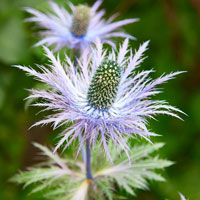
The plant is native to alpine pastures of Switzerland, and has deeply serrated bracts (petals) surrounding a central cone, giving the flower a lacy appearance. The plant grows 3 feet tall.
2. Amethyst sea holly
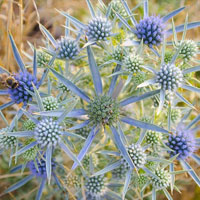
This European native is one of the coldest hardy of the genus. It is considered the hardiest species. It has beautiful amethyst blue flowers on plants 2-1/2 feet tall and a somewhat straggling nature.
3. Flat sea holly
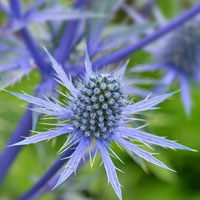
Eryngium planum has silver-blue flowers on plants that are 2-3 feet tall. Its leaves are scalloped rather than spiny.
4. Giant Sea Holly
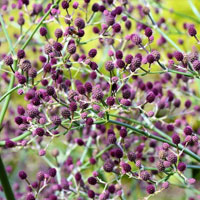
It is also known as Miss Wilmot’s Ghost (named for English gardener Ellen Wilmot), this Caucasus native makes an outstanding plant for grouping in a background, growing from 3 to 4 feet or higher. While it may require staking, its heart-shaped leaves and large flowers are worth the extra effort.
5. Mediterranean Sea Holly
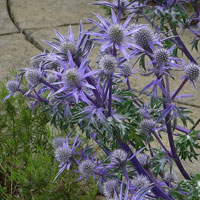
The plant is native to Pyrenees; this variety reaches about 1-2 feet and consists of lively blue-green flowers with silver bracts and white veins within its coarse, spiny leaves.
6. Miss Willmott’s Ghost sea holly
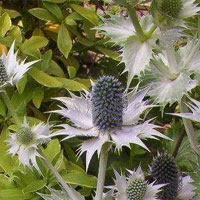
Eryngium giganteum gets its name from its dramatic ghostly gray-green to silvery blue flowers on plants up to 6 feet tall. It is also occasionally named giant sea holly.
7. Rattlesnake Master sea holly
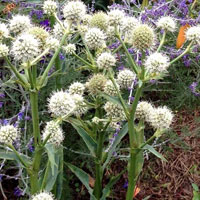
This variety of Eryngium yuccifolium is a native of the Great Plains. It is a stately plant which reaches 4-5 feet tall and bears silvery white balls on spiny foliage that look like that of yucca. Extracts of the plant were used by Native Americans as medicine.
8. Sapphire Blue sea holly
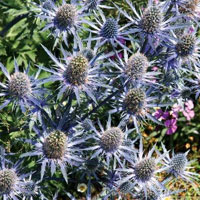
This Eryngium selection, also sometimes sold as ‘Jos Eijking’, is a sterile variety that does not self-sow.
Traditional uses and benefits of Sea Holly
- Sea holly roots were collected on a large scale in the 17th and 18th centuries in England and were candied then used as restorative, quasi-aphrodisiac lozenges.
- The plant is still used in modern herbalism where it is appreciated particularly for its diuretic action.
- Root is to be aphrodisiac, aromatic, diaphoretic, diuretic, expectorant, stimulant and tonic.
- Root encourages free expectoration and is very beneficial in the treatment of debility attendant on coughs of chronic standing in the advanced stages of pulmonary consumption.
- It is used in the treatment of cystitis, urethritis, as a means to alleviate kidney stones (it is unlikely that it dissolves the stones, but it probably helps to retard their formation), and to treat enlargement or inflammation of the prostate gland.
- Drunk freely, it is used to treat diseases of the liver and kidneys.
- It is used externally as a poultice, the dried powdered root aids tissue regeneration.
- Root should be harvested in the autumn from plants that are at least 2 years old.
- Roots and leaves are used for uterine irritations and bladder diseases, glandular deficiencies, used as a nervine and tonic.
- Decoction of the root in wine is very effective on the spleen and liver, helps jaundice, dropsy, treats French Pox, ague, swollen lymph glands, snake bites are healed rapidly, pains of the loins, colic, promotes urine, expels stones and promotes women’s menses.
- It is useful in paralysis and chronic nervous diseases, alike in simple nervousness and in delirium produced by diseases.
- It was also consumed as a means of preventing scurvy.
- It was considered helpful in the treatment of a wide array of neurological conditions, including paralysis and convulsions.
- It is prescribed as a treatment for cystitis and urethritis, and taken as a means to alleviate kidney stones.
Culinary Uses
- Young shoots can be consumed after cooked.
- Young shoot are normally blanched by excluding light from the growing plant, and are then used as an asparagus substitute.
- They are said to be palatable and nourishing.
- Root can be cooked and used as a vegetable or candied and used as a sweetmeat.
- Boiled or roasted roots are said to resemble parsnips or chestnuts in flavor.
- Roots are nutritious and can be candied for the confection.
- Sea holly roots are slightly sweet and smell of carrots – it can be used as a vegetable and can be cooked or candied.
- The young, tender flowering shoots can be eaten like Asparagus.
Precautions
- Excess use may cause vomiting.
- Combining herbs with certain drugs may alter their action or produce unwanted side effects.
- Sea holly could increase the diuretic’s effect on your body’s chemical balance.
- Don’t use sea holly if you’re pregnant or breast-feeding.
- Avoid this herb if you’re taking a diuretic.
- Know that long-term use of sea holly can cause an imbalance in body fluids and chemicals.
References
- https://www.itis.gov/servlet/SingleRpt/SingleRpt?
- http://www.hear.org/pier/species/pyrus_calleryana.htm
- https://npgsweb.ars-grin.gov/gringlobal/taxon/taxonomydetail?
- https://pfaf.org/user/Plant.aspx?
- https://www.wildflower.org/plants/result.php?
- http://www.missouribotanicalgarden.org/PlantFinder/PlantFinderDetails.aspx?
- https://plants.usda.gov/core/profile?
- https://www.invasive.org/browse/subinfo.cfm?
- https://www.cabi.org/isc/datasheet/46188
- https://www.cal-ipc.org/plants/profile/pyrus-calleryana-profile/
- http://www.efloras.org/florataxon.aspx?
- https://texasinvasives.org/plant_database/detail.php?
- http://www.iucngisd.org/gisd/species.php?
- http://www.theplantlist.org/tpl1.1/record/rjp-6009
- https://en.wikipedia.org/wiki/vegetables
- https://gd.eppo.int/taxon/PYUCA
- https://www.illinoiswildflowers.info/savanna/plants/
- https://uses.plantnet-project.org/en/
- https://www.theplantlist.org/tpl1.1/record/
- https://training.ars-grin.gov/gringlobal/taxon/taxonomydetail?
- http://hort.ufl.edu/database/documents/pdf/tree_fact_sheets/
- https://www.illinoiswildflowers.info/trees/plants/callery_pear.htm
- https://www.ncbi.nlm.nih.gov/books/NBK218749/
- https://www.ncbi.nlm.nih.gov/books/NBK551014/
- https://www.ncbi.nlm.nih.gov/books/NBK551727/
- https://www.ncbi.nlm.nih.gov/books/NBK65874/
- https://www.ncbi.nlm.nih.gov/books/NBK304428/
- https://www.ncbi.nlm.nih.gov/books/NBK218759/
- https://www.ncbi.nlm.nih.gov/books/NBK556048/
- https://www.ncbi.nlm.nih.gov/books/NBK218749/
- https://www.niehs.nih.gov/health/topics/agents/vegetables/index.cfm
- https://www.sciencedirect.com/book/9780443062414/vegetable
- https://www.amazon.com/Essential-Oils-Fully-Revised-Updated/dp/1787752291
- https://www.healthbenefitstimes.com/category/herbs-and-spices/
- https://www.frontiersin.org/articles/257193
- https://www.tandfonline.com/toc/tjeo20/current
- https://www.intechopen.com/chapters/68027
- https://onlinelibrary.wiley.com/doi/full/10.1002/ptr.6854
- https://www.nature.com/articles/s41598-020-68823-4
- https://www.cancer.gov/about-cancer/treatment/cam/patient/aromatherapy-pdq
- https://www.researchgate.net/publication/254247133_
- https://link.springer.com/article/10.1365/s10337-010-1680-0
- https://fdc.nal.usda.gov/ndb/foods/show/herb
- https://www.nccih.nih.gov/health/herbsataglance
- https://portal.nifa.usda.gov/web/crisprojectpages/0092887
- https://academic.oup.com/database/article/doi/10.1093/database/bau120
- https://www.cambridge.org/core/journals/weed-science/article/herbicide-effects-of-vegetable/
- https://www.fs.fed.us/wildflowers/ethnobotany/vegetable
- https://www.karger.com/Article/Abstract/501062
- https://en.wikipedia.org/wiki/List_of_plant
- https://en.wikipedia.org/wiki/Types_of_plant_harb
- https://www.britannica.com/topic/cereals
- https://www.planttherapy.com/
- https://academic.oup.com/plphys/article/54/4/560/
- https://www.healthbenefitstimes.com/category/oils/
- https://www.aromaweb.com/essentialoils/default.asp
- https://books.google.com/books/about/Herbs_And_Essential_Oils_Book.html?
- https://books.google.com/books/about/Herbal_herb_for_Health_Beauty.html?id=C_MX9tKpttMC
- https://books.google.com/books/about/Herbal_vegetable_for_Health_Beauty.html?id=C_MX9tKpttMC
- https://www.niehs.nih.gov/health/topics/agents/
- https://www.botanical.com/botanical/mgmh/l/
- https://www.nccih.nih.gov/health/atoz
- https://clinicaltrials.gov/ct2/show/NCT02764567
- https://fda.report/Company/Young-Living-Essential-Oils-Lc
- http://www.fao.org/3/ad420e/ad420e.pdf
- https://www.healthywa.wa.gov.au/Articles/A_E/
- https://www.niehs.nih.gov/health/topics/agents/
- https://www.consumerreports.org/health-product-recalls/
- https://www.itis.gov/servlet/SingleRpt/SingleRpt?search_topic=TSN&search_value=29496#null
- https://pfaf.org/USER/Plant.aspx?LatinName=Eryngium+maritimum
- http://www.missouribotanicalgarden.org/PlantFinder/PlantFinderDetails.aspx?kempercode=h810
- http://www.floracatalana.net/eryngium-maritimum-l-
- https://plants.usda.gov/core/profile?symbol=ERMA7
- https://besjournals.onlinelibrary.wiley.com/doi/full/10.1111/1365-2745.12243
- http://luirig.altervista.org/flora/taxa/index1.php?scientific-name=eryngium+maritimum
- https://gd.eppo.int/taxon/ERXMA
- http://www.theplantlist.org/tpl1.1/record/kew-2799418
- https://en.wikipedia.org/wiki/Eryngium_maritimum
- http://medicinalherbinfo.org/000Herbs2016/1herbs/sea-holly/
- https://botanical.com/botanical/mgmh/h/holsea29.html
- https://www.henriettes-herb.com/eclectic/hool1922/sea-holly.html