Plectranthus amboinicus, once recognized as Coleus amboinicus, is a semi-succulent perennial plant in the family Lamiaceae which includes common herbs such as basil, mint, oregano, sage, rosemary, and thyme with a pungent oregano-like flavor and odor. The plant is native to Southern and Eastern Africa, from South Africa (KwaZulu-Natal) and Swaziland to Angola and Mozambique and north to Kenya and Tanzania. It is widely cultivated and naturalized elsewhere in the tropics where it is used as traditional medicine, spice, and ornamental plant. Few of the popular common names of Indian Borage includes Cuban oregano, Country borage, French thyme, Indian borage, Indian mint, Mexican mint, Soup mint, Spanish thyme, Thick leaf thyme, broad leaf thyme, Mexican Mint, Coleus amboinicus, poor man pork or broad leaf thyme, queen of herbs, three-in-one herb, allherb, mother of herbs and orielle.
The name Plectranthus derives from the Greek words “plectron”, meaning spur, and “Anthos”, meaning flower, in reference to the spur-shaped flowers of some members of the genus. Due to lack of precise morphological features to differentiate species within the genus Plectranthus and its closely associated genera, numerous taxonomic problems with the naming of species have resulted in misplacement of species in some closely linked genera such as Coleus, Solenostemon and Englerastrum. The species epithet “amboinicus” is derived from Ambon, an island in the East Indies where Rumphius, a well-known botanist, is from. It is not true oregano in the family, Origanum, but has a scent characteristic of the true oreganos.
Plant Description
Indian Borage is a sprawling and somewhat succulent attractive, aromatic evergreen perennial herb that grows about 1 m (3.3 ft.) tall and even more in width in the wild. The plant is found growing in woodland or coastal bush, on rocky slopes, loamy or sandy flats, roadsides, waste places and river banks. It is known to grow in rocky, loamy or sandy soil. The species is tolerant of some shade, preferring fertile, well-drained soils in partially shaded areas. The plant has fibrous root. Stem is fleshy, about 30–90 cm (12–35 in), either with long rigid hairs (hispidly villous) or densely covered with soft, short and erect hairs. Old stems are usually smooth. This sprawling large succulent herb is fleshy and highly aromatic.
Leaves
Leaves are undivided (simple), broadly ovate to sub orbicular with a tapering tip (ovate) and very thick. They are 5–7 cm (2.0–2.8 in) long and 4–6 cm (1.6–2.4 in) wide. The margins are coarsely crenate to dentate-crenate except in the base. They are pubescent (thickly studded with hairs), with the lower surface possessing the most numerous glandular hairs, giving a frosted appearance. The petiole is 2–4.5 cm (0.79–1.77 in) long. The taste of this leaf is pleasantly aromatic with an agreeable and refreshing odor.
Flowers
Flowers are on a short stem (shortly pedicelled), pale purplish in dense whorls at distant intervals in a long slender raceme. Flowers have a bell shaped calyx and the throat is smooth inside with two lips, the upper lip being ovate and thin, the lower lip having four narrow teeth. The corolla is pale purplish and five times longer than the calyx, with a short tube, inflated throat and short lips.
Flowers are on a short stem, pale purplish in dense, 10-20 (or more) flowered dense whorl (cymes) at distant intervals in a long slender spike-like raceme. Rachis is 10–20 cm (3.9–7.9 in), fleshy and pubescent. The bracts are broadly ovate, 3–4 cm (1.2–1.6 in) long, acute. The bell shaped calyx is campanulate, 2–4 mm (0.079–0.157 in) long, hirsute and glandular, sub equally 5-toothed, upper tooth broadly ovate-oblong, obtuse, abruptly acute, lateral and lower teeth acute. Corolla is blue, curved and declinate, 8–12 mm (0.31–0.47 in) long and tube is 3–4 mm (0.12–0.16 in) long. Trumpet-like widened; limb 2-lipped, upper lip short, erect, puberulent, lower lip long and concave. Flowering normally takes place from August till November.
Fruits
Fertile flowers are followed by smooth nut lets that are 0.7 mm long and 0.5 mm wide. Nutlets are initially green turning to pale brown as they mature. Seeds are smooth, pale-brown, roundish flattened, 0.7 mm (0.028 in) long and 0.5 mm (0.020 in) wide. P. amboinicus rarely flowers and seeds are difficult to collect.
History
Indian Borage plant is native to Southern and Eastern Africa, from South Africa (KwaZulu-Natal) and Swaziland to Angola and Mozambique and north to Kenya and Tanzania, where it grows in woodland or coastal bush, on rocky slopes and loamy or sandy flats at low elevations. From Southern Africa it would have been carried by Arabs and other traders to Arabia, India and Southeast Asia along the Indian Ocean maritime trade routes. The plant was later brought to Europe, and then from Spain to the Americas, hence the name Spanish thyme. Nowadays it is grown in several parts of the world due to its amazing look and health-promoting benefits.
Health Benefits of Indian Borage
Listed below are some of the well-known health benefits of consuming Indian borage:
1. Cures Respiratory Issues
If you are suffering from a cold, a sore throat, congestion, a stuffy nose, or painful sinuses, you can chew on the leaves of Indian borage or brew a tea from the leaves. The compounds contained in the herb act as a powerful expectorant to remove mucus and phlegm from your respiratory tracts and clear out your sinuses. This can also help to boost your immune system by avoiding bacteria or other pathogens from lodging and developing in your tracts. (1)
2. Treats Fever
If you are suffering from a cold or flu, one of the common symptoms is a fever. Typically, you don’t start getting better until your fever “breaks”, as a sign that your immune system is making some headway. Indian borage is a sudorific, meaning that it motivates sweating, which also helps to clear out toxins through the skin and speed the recovery process. (2)
3. Reduces Stress and Anxiety
Although it is the lesser-known benefits of Indian borage, some of the organic compounds and minerals found in this herb have been revealed to be mildly sedative in nature, so this herbal remedy, mostly in tea form, is often offered to people with high anxiety or chronic stress to encourage relaxation, peace of mind, and healthy, restful sleep. (3)
4. Skin Care
One of the most popular uses of Indian borage is an effective skin treatment. From bug bites and stings to eczema and psoriasis, Indian borage possesses the anti-inflammatory compounds that can rapidly reduce redness and swelling, while also eliminating itchiness and irritation. (4)
5. Anti-cancer Potential
Research has discovered that the stem of the Indian borage plant was rich in antioxidants and has the capability to scavenge free radicals. The extract of this plant helped inhibit proliferation of cancer cells and also, has displayed the potential for antiplatelet accumulation ability. (5)
6. Improves Kidney Health
Indian borage acts as a quite effective diuretic, which means that it can clean the body of toxins by stimulating urination. This also reduces the amount of excess salt, fat, and water in the body, keeping the kidneys and lymphatic system functioning smoothly. (6)
7. Irritable Bowel Syndrome
Since ancient time Indian borage was used traditionally to settle upset stomachs and relieve irritable bowel syndrome by regulating digestion and soothing stomach inflammation. Brewing tea from the leaves of Indian borage is the most effective way to take advantage of this health benefit.(7)
8. Beneficial For Females
Women will be glad to read that Indian borage reduces menstrual pains, delivery pains, and headaches. In India and some parts of Indonesia, the herb is given to lactating mothers to increase the milk flow.
9. Reduce arthritis
Content of omega-6 fatty acids present in the leaf of Indian borage is supposed to reduce arthritis. Additionally, athletes are also recommended to consume this leaf to prevent osteoporosis
10. Improve vision
Indian borage is also used to improve one’s sight. The plant consists of vitamin A that can reduce oxidative stress in the eyes and prevent macular degeneration.
Traditional uses and benefits of Indian Borage
- The herb is used as a folk remedy for burns and bites, internally as a carminative and anti-asthma, and applied externally as an insect repellant.
- It is used medicinally in Brazil for the treatment of skin ulcerations caused by Leishmania braziliensis.
- Juice of the leaves is used to treat skin allergies in India.
- Leaves have many traditional medicinal uses for the treatment of coughs, sore throats and nasal congestion, but also for a range of other problems such as infections, rheumatism and flatulence.
- It is also used to treat malarial fever, hepatopathy, renal and vesical calculi, cough, chronic asthma, hiccup, bronchitis, helminthiasis and convulsions.
- Indian traditional medicinal uses the herb for skin ulcerations, scorpion bite, skin allergy, wounds, diarrhea, with emphasis on the leaves being used as a hepato-protective and to promote liver health.
- Indian borage is a traditional food used in soup to stimulate lactation for the month or so following childbirth in Indonesia.
- Juice from the leaves is sweetened and then given to children as protection from colds; and leaves are applied to the lips in Cambodia.
- People use the plant to treat skin lesions caused by Leishmania braziliensis in Bahia, Brazil.
- Leaves are taken internally in the treatment of a range of digestive problems such as dyspepsia, indigestion, diarrhea and wind.
- An infusion or syrup made from the aromatic leaves is recommended to treat coughs.
- Leaves are also used to treat a wide range of other complaints including epilepsy, convulsions, meningitis, congestive heart failure, fevers, colds, bronchitis, asthma, cholera, menstrual pains, labor pains, delayed labor, post-partum pain and to aid expulsion of the afterbirth.
- Leaves are often utilized in the treatment of urinary diseases in the Amazon and India.
- It is also reported to relieve kidney troubles, treat vaginal discharges and is drunk after childbirth.
- Applied externally, the leaves are used to treat headaches, inflammations, skin allergies, wounds, burns, sores and ulcers.
- When rubbed on the skin, they will quickly bring relief to bites and stings.
- Seed oil is a treatment for acute edematous otitis acuta in Polynesia.
- In India its leaves are rubbed onto the eyes to alleviate conjunctivitis.
- The plant is used to treat snakebites.
- The plant is anti-inflammatory and is used for treating stiff neck and backache.
- For ear aches (otalgia) pure fresh juice is poured into the ear and keeps for 10 minutes.
- Juice of leaves mixed with sugar acts as a powerful aromatic carminative, given in colic and
- Crushed leaves are used as a local application to the head in headache.
- In Malaysia, bruised leaves are applied to burns and their poultice on centipede and scorpion bites.
- Leaf juice heals chapped lips and in java it is used to treat cracks at the corners of the mouth.
Herbal and Medicinal Uses of Indian Borage
- Coughs and sore throats: Leaves are commonly used to treat coughs. It is known to be an effective expectorant. The simplest method is to chew a leaf. You can also make a tea by boiling the leaves in water. You can also pound the leaves and mix with a little water.
- Blocked nose: Rub the leaves, and inhale the vapor.
- Burns, sores, insect bites and stings, and skin conditions such as eczema: Pound the leaves to a pulp, and then apply as a poultice.
- Dandruff: Wash hair with an infusion of the leaves (the infusion can also be used to rinse your clothes).
- Menstrual Pain/Delivery pain/Lactation: Drinking the leaf extract or a green tea with the leaf relieves menstrual pain or delivery pain. In many parts of India, Indian borage is given for lactation.
- Relieves stress and anxiety: Drinking the leaf extract or green tea made out of it relieves stress and anxiety.
- Diarrhea / Indigestion: Take some leaves and clean it. Chew for 5 minutes. Drink warm water after chewing. Do this once a day.
- Headache: Crush the leaves. Mix in any oil and massage it to the scalp.
- Burns/sores/pimples/psoriasis/herpes/nail fungus/eczema/Insect Bites: Crush the leaves and mix it with coconut oil. Apply on the affected area. It relieves from skin irritation and itching.
- Fever/Cough: Crush the leaves and extract the juice. Consume 2 tsp. of this extract twice a day.
- Blocked Nose: Crush the leaves and boil it in the water. Inhale the steam. OR rub the leaves and inhale the vapor.
- Asthma/Bronchitis: Drink 10 ml of leaf decoction of Indian borage once a day.
- Arthritis: Drink 30 ml of leaf decoction of Indian borage twice a day.
- Stomach Problems: Drink 5 ml of leaf decoction of Indian borage thrice a day.
- Rheumatoid arthritis (RA): Apply borage seed oil daily for up to 24 weeks.
Pharmacological properties of P. amboinicus (Indian Borage) different parts
| Plant Part Used | Pharmacological Activity |
| Leaf extract/Essential oil/Decoction | Antibacterial activity |
| Leaf extract/Essential oil | Anti-fungal activity |
| Leaf/Ethanolic extract | Antiviral activity |
| Leaf extract/Decoction or juice/Essential oil | Activity against Respiratory diseases |
| Leaf extract/Essential oil | Lavicidal potential |
| Essential oil | Oral Diseases |
| Leaf extract/Juice | Digestive diseases (Diarrhea, Constipation,
dyspepsia, indigestion & as carminative) |
| Leaf extract/Crude hydro alcoholic extracts | Anti-tumor activity |
| Aerial part/Ethanol, methanol & hexane
extract |
Anti-inflammatory activity |
| Leaf extract | Analgesic activity |
| Leaf & Root Aqueous extract | Wound healing activities |
| Leaf aqueous extract | Cardiovascular disorders |
| Leaf extract/Essential oil/Leaf juice/Paste | Skin disease (Anti-dandruff, Cuts,
Skin Allergy; Burns) |
| Leaf aqueous extracts | Insect bites |
| Leaf | Lactogenic properties |
| Leaf, stem, root Extract (aqueous & alcoholic) | Anti-epileptic activity |
| Leaf Decoction/Ethanolic & aqueous
leaf extract |
Activity against Genitourinary diseases |
| Leaf extracts/Essential oil | Antioxidant activity |
| Leaf | Other diseases |
Culinary Uses
- Aromatic leaves are used as a food additive or spice, flavoring meat, soups, fish, and local beer.
- Leaves are strongly flavored and used for stuffing of meat and poultry, beef, lamb and game.
- Herb is used as a substitute for oregano to mask the strong odors and flavors of fish, mutton, and goat.
- Herb is used as a substitute for oregano in the food trade and food labeled “oregano-flavor” may well contain this herb.
- Dried leaves are used to prepare marinade, stuffing or it can also be used as potherb.
- It adds punch to your dishes and can be used in condiments for sour soup and stews.
- It can be eaten raw with bread and butter, fried in batter, flavoring for wine, beer, salads and tea.
- Leaves can be chopped, made into flour balls and fried in oil.
Dosage
The perfect dose is one tablespoonful of the fresh juice every hour, for adult. For children, one teaspoonful every two hours, four times a day. As an infusion, 50 to 60 grams to a pint of boiling water, and drink the tea, 4 to 5 glasses a day. For Children, ½ cup 4 times a day. This treatment should be continued until the ailments are gone.
For deafness or pain and noises in the ear, just pour in the fresh, pure juice, and let it stop there for 10 minutes. For carbuncles, felons, boils, sprains, painful swellings, and in nervous cases, just make a poultice of the leaves and apply over the affected part. Change it 4 times a day.
As a heating compress, get several leaves, heat them and apply as a compress for a sore throat. For general doses, put two tablespoonful of dried leaves to a pint of boiling water. When fresh, double the amount of the leaves to a pint of boiling water. Drink one hour before or after the meals.
Recipes
Indian Borage Fritters
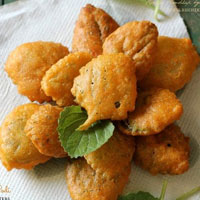
Ingredients
- 22-25 big Indian Borage leaves
- oil for deep frying
For the batter/coating:
- 1/2 cup gram flour/ chickpea flour/
- 1/2 tablespoon rice flour
- 1/2 tsp. chili powder (adjust to taste)
- 1 pinch asafetida
- 1 pinch carom seeds
- 1 pinch cumin
- 1 pinch turmeric powder
- 1 pinch baking soda
- Water as required (approx. 1/2 cup)
- Salt to taste (approx. 1/2 tsp. of table salt)
Directions
- Make sure that the leaves are plucked along with a part of the stem intact. Place them in a large bowl of water and gently cleanse them without breaking them. Do this until all the dirt is gone. Transfer onto a colander to drain off excess water. Then gently and carefully pat each one dry (don’t skip this step as any traces of water will lead to oil splattering all over during the deep frying stage)
- In a shallow bowl mix all the ingredients mentioned under ‘For the batter‘ except the water. Add the water in parts until you get a smooth, lump free and flowing consistency (see notes#2 and 3 before proceeding).
- Heat oil for deep frying in a kadai/wok and test the readiness of the oil by putting a drop of the batter into the oil, if it comes up within 4-5 seconds the oil is ready. If it comes up too quickly, the oil is too hot. We need oil that is medium hot.
- While the oil is heating up, dip the leaves (including the stem portion) into the prepared batter. Place as many leaves as you are going to fry in one batch (taking care to see that you don’t overcrowd the pan). You must keep a batch of leaves ready as you need to slip them into the oil one after the other. Don’t dip one at a time and then release them into the oil as those that went into the oil first will burn quickly. Also, make sure that the leaves don’t fold up after being dipped in the batter as they will remain that way when you release them into the oil.
- When all the leaves are into the oil let them fry for a few seconds before gently flipping them over. When they turn golden brown on both sides remove them using a large slotted ladle and shake to drain excess oil. Then transfer onto an absorbent kitchen tissue. Repeat the process till all the leaves are fried
- Serve hot immediately. They taste great without any accompaniment but ketchup or any dip of your choice will work well too.
(Notes: The addition of baking soda is optional but helps the fritters to puff up and the covering doesn’t stick to the leaf but forms a cavity).
Indian Borage Chutney
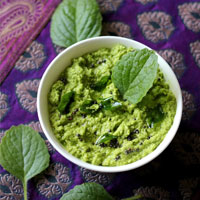
Ingredients
- 18-20 big Indian Borage leaves
- 1/2 teaspoon cumin seeds
- 1 cup grated coconut
- 1/2 a marble size ball of tamarind
- 1 green chili adjust to taste
- 1 inch piece of ginger
For the seasoning:
- 1/2 teaspoon mustard seeds
- 1 sprig 6-7 leaves curry leaves
- 2 teaspoons coconut oil or any other oil
Direction
- Wash the leaves well and pat them dry. Heat a skillet and dry roast the cumin lightly for a few seconds and remove it
- Next, roast the leaves till they wilt. Remove and allow to cool
- Transfer all the ingredients to a grinder and add 1-2 tablespoons of water and grind to a semi-coarse consistency. Remove the chutney into a serving bowl.
- For the seasoning, heat the coconut oil and toss in the mustard seeds. When they stop spluttering, add the curry leaves and reduce the heat. Let them sizzle for a few seconds before pouring this seasoning over the chutney
- Serve immediately with any South Indian rice bread like idli, dosa, appams, neer dosa, pundi (dumplings) or with plain white rice and curry.
Other Facts
- It is widely cultivated as a medicinal plant, potherb, ornamental, and condiment in tropical regions around the world.
- Leaves are also eaten as a vegetable, as well as for washing clothes, hair, and laundry due to its fragrance.
- It is also often grown as an ornamental plant for its attractive leaves and flowers.
- Plectranthus species are also used for dry season fodder.
- It is used to treat burns and as a poultice for centipedes and scorpion bites in Malaysia.
- The species is also used in magico-religious rituals to ward off spirits, as a food additive, vegetable, insect repellent, and for its essential oils.
- Spicy fresh leaves are used to scent laundry and the hair.
- Leaves are rubbed into the hair and body after bathing.
- Leaves are rubbed on the body to act as an insect repellent.
- Essential oil obtained from the leaves and stems is used as a skin conditioner in commercial cosmetic preparations.
- The plant rarely flowers and seeds are difficult to collect.
Precautions
- Because of its hairy and bristly leaves and stems Indian borage may cause irritation to sensitive skinned people.
- Indian borage is not recommended for pregnant women.
- Although Indian borage is used to increase milk in the lactating mother, it is recommended to consult a pediatrician before using this herb.
References
- https://www.itis.gov/servlet/SingleRpt/SingleRpt?
- http://www.hear.org/pier/species/pyrus_calleryana.htm
- https://npgsweb.ars-grin.gov/gringlobal/taxon/taxonomydetail?
- https://pfaf.org/user/Plant.aspx?
- https://www.wildflower.org/plants/result.php?
- http://www.missouribotanicalgarden.org/PlantFinder/PlantFinderDetails.aspx?
- https://plants.usda.gov/core/profile?
- https://www.invasive.org/browse/subinfo.cfm?
- https://www.cabi.org/isc/datasheet/46188
- https://www.cal-ipc.org/plants/profile/pyrus-calleryana-profile/
- http://www.efloras.org/florataxon.aspx?
- https://texasinvasives.org/plant_database/detail.php?
- http://www.iucngisd.org/gisd/species.php?
- http://www.theplantlist.org/tpl1.1/record/rjp-6009
- https://en.wikipedia.org/wiki/vegetables
- https://gd.eppo.int/taxon/PYUCA
- https://www.illinoiswildflowers.info/savanna/plants/
- https://uses.plantnet-project.org/en/
- https://www.theplantlist.org/tpl1.1/record/
- https://training.ars-grin.gov/gringlobal/taxon/taxonomydetail?
- http://hort.ufl.edu/database/documents/pdf/tree_fact_sheets/
- https://www.illinoiswildflowers.info/trees/plants/callery_pear.htm
- https://www.ncbi.nlm.nih.gov/books/NBK218749/
- https://www.ncbi.nlm.nih.gov/books/NBK551014/
- https://www.ncbi.nlm.nih.gov/books/NBK551727/
- https://www.ncbi.nlm.nih.gov/books/NBK65874/
- https://www.ncbi.nlm.nih.gov/books/NBK304428/
- https://www.ncbi.nlm.nih.gov/books/NBK218759/
- https://www.ncbi.nlm.nih.gov/books/NBK556048/
- https://www.ncbi.nlm.nih.gov/books/NBK218749/
- https://www.niehs.nih.gov/health/topics/agents/vegetables/index.cfm
- https://www.sciencedirect.com/book/9780443062414/vegetable
- https://www.amazon.com/Essential-Oils-Fully-Revised-Updated/dp/1787752291
- https://www.healthbenefitstimes.com/category/herbs-and-spices/
- https://www.frontiersin.org/articles/257193
- https://www.tandfonline.com/toc/tjeo20/current
- https://www.intechopen.com/chapters/68027
- https://onlinelibrary.wiley.com/doi/full/10.1002/ptr.6854
- https://www.nature.com/articles/s41598-020-68823-4
- https://www.cancer.gov/about-cancer/treatment/cam/patient/aromatherapy-pdq
- https://www.researchgate.net/publication/254247133_
- https://link.springer.com/article/10.1365/s10337-010-1680-0
- https://fdc.nal.usda.gov/ndb/foods/show/herb
- https://www.nccih.nih.gov/health/herbsataglance
- https://portal.nifa.usda.gov/web/crisprojectpages/0092887
- https://academic.oup.com/database/article/doi/10.1093/database/bau120
- https://www.cambridge.org/core/journals/weed-science/article/herbicide-effects-of-vegetable/
- https://www.fs.fed.us/wildflowers/ethnobotany/vegetable
- https://www.karger.com/Article/Abstract/501062
- https://en.wikipedia.org/wiki/List_of_plant
- https://en.wikipedia.org/wiki/Types_of_plant_harb
- https://www.britannica.com/topic/
- https://www.planttherapy.com/
- https://academic.oup.com/plphys/article/54/4/560/
- https://www.healthbenefitstimes.com/category/oils/
- https://www.aromaweb.com/essentialoils/default.asp
- https://books.google.com/books/about/Herbs_And_Essential_Oils_Book.html?
- https://books.google.com/books/about/Herbal_herb_for_Health_Beauty.html?id=C_MX9tKpttMC
- https://books.google.com/books/about/Herbal_vegetable_for_Health_Beauty.html?id=C_MX9tKpttMC
- https://www.niehs.nih.gov/health/topics/agents/
- https://www.botanical.com/botanical/mgmh/l/
- https://www.nccih.nih.gov/health/atoz
- https://www.inaturalist.org/taxa
- https://clinicaltrials.gov/ct2/show/NCT02764567
- https://fda.report/Company/Young-Living-Essential-Oils-Lc
- http://www.fao.org/3/ad420e/ad420e.pdf
- https://www.healthywa.wa.gov.au/Articles/A_E/
- https://www.niehs.nih.gov/health/topics/agents/
- https://www.consumerreports.org/health-product-recalls/
- https://www.itis.gov/servlet/SingleRpt/SingleRpt?search_topic=TSN&search_value=504444#nullhttps://davesgarden.com/guides/pf/go/56260/http://www.hear.org/pier/species/plectranthus_amboinicus.htmhttps://www.cabi.org/ISC/datasheet/119834https://npgsweb.ars-grin.gov/gringlobal/taxonomydetail.aspx?317147https://wikivisually.com/wiki/Plectranthus_amboinicushttps://plants.usda.gov/core/profile?symbol=PLAM2https://en.wikipedia.org/wiki/Plectranthus_amboinicushttps://ipfs.io/ipfs/QmXoypizjW3WknFiJnKLwHCnL72vedxjQkDDP1mXWo6uco/wiki/Plectranthus_amboinicus.htmlhttp://www.theplantlist.org/tpl/record/kew-157885https://gd.eppo.int/taxon/CXUAMhttps://indiabiodiversity.org/species/show/266266