RX Patient Tools
Use these quick guides before reading the article, or return to them when you need help preparing questions for a doctor.
Caucasian spinach scientifically known as Hablitzia tamnoides, the sole species in the genus Hablitzia, is an edible, herbaceous perennial plant belonging to family Amaranthaceae and subfamily Betoideae. Originating in the Caucasus region, it has been grown in Scandinavian countries as an ornamental before making a bit of a renaissance recently by author and plant expert Stephen Barstow. In fact it is one of the very few vines in its family as one source put it, Hablitzia is remarkable and altogether irregular in the order to which it belongs by its tall climbing habit. It is also probable one of the longest lived plants in its family – one plant growing in Norrtälje, Sweden is reported to be over 50 years old. Some of the popular common names of the plants are Caucasian spinach, Caucasus spinach, Climbing spinach, Hablitzia, Spinach Vine and Rank Spinach.
Hablitzia was first described and documented for the international scientific community, by Friedrich August Marschall von Bieberstein, in the Mémoires de la Société impériale des naturalistes de Moscou. It was Bieberstein, who gave it its botanical name. The generic epithet, Hablitzia, is a Latinized version of Hablitz, a reference to Carl Ludwig Hablitz, the 18th Century naturalist. Tamnoides mean like or resembling. Now Permaculturists and forest gardeners as well as those interested in perennial vegetables are beginning to give it a try as another possible staple that can happily grow in any garden with a shady spot. The young shoots can be eaten in early spring as well as pickings from the more mature leaves over the summer.
Plant Description
Caucasian Spinach is a long-lived, semi shade loving, herbaceous perennial climber that climbs up to 3 m or more tall in summer. The plant is found growing in mesic woodland habitats especially spruce and beech woods in its native environment, among rocks and in ravines and along rivers. The stems are generally green, with noticeable ridges running their length, but those of Black Bryony can sometime have a purple or copper tinge to them, and Hablitzia’s can be flushed red.
Caucasian Spinach Facts
| Name | Caucasian Spinach |
|---|---|
| Scientific Name | Hablitzia tamnoides |
| Native | Caucasus region |
| Common Names | Caucasian spinach, Caucasus spinach, Climbing spinach, Hablitzia, Spinach Vine, Rank Spinach |
| Name in Other Languages | Armenian: Hablits’ia (հաբլիցիա) Azerbaijani: Tamusşəkilli yalançı sarmaşıq Bokmal: Stjernemelde Bulgarian: Kavkazii shpinat (Кавказий шпинат) Chinese: Gao jia suo bo cai (高加索菠菜) Danish: Spinatranke Dutch: Kaukasus spinazie English: Caucasian spinach, Caucasus spinach, Climbing spinach, Hablitzia, Spinach Vine, Rank Spinach Finnish: Köynnöspinaatti French: Épinard grimpant du caucase German: Kaukasische Spinat Greek: Kuvkasos spanaki (Καύκασος σπανάκι) Italian : Spinacio del Caucaso, Spinaci di Caucasi Japanese: Kookasasu no horensou (コーカサスのホウレンソウ), Kookasasu no horensou (コーカサスのほうれんそう), Kookasasu no hourensou (コーカサスの菠薐草) Norwegian: Stjernemelde Polish: Szpinak kaukazki Portuguese: Espinafre de Cáucaso Russian: Gablitsiia tamusobidnaia (Габлиция тамусовидная) Spanish: Espinaca del Cáucasia, Espinaca del Cáucaso Swedish: Rankspenat Turkish: Ispanak Kafkasya, sarpancar |
| Plant Growth Habit | Long-lived, semi shade loving, herbaceous perennial climber |
| Growing Climates | Mesic woodland habitats especially spruce and beech woods in its native environment, among rocks and in ravines and along rivers |
| Stem | Generally green, with noticeable ridges running their length |
| Leaf | Green, heart-shaped leaves, often slightly crimped, but without serration or lobing, which taper to a narrow point, and sometimes have very soft, almost silky hairs on them |
| Flowering season | May through July |
| Flower | Individually quite small, a lighter green than the foliage, perhaps greenish-yellow, and like little five-pointed stars |
| Fruit Shape & Size | Plump, shiny berries |
| Fruit Color | Green when young turning to red |
| Seed | Tiny, kidney shaped, flattish, biconvex, edge rounded, smooth, glossy black. |
| Propagation | By seed or by vegetative propagation |
| Other Facts |
|
Caucasian spinach Scientific Classification
Scientific Name: Hablitzia tamnoides
| Rank | Scientific Name & (Common Name) |
|---|---|
| Kingdom | Plantae (Plants) |
| Subkingdom | Tracheobionta (Vascular plants) |
| Infrakingdom | Streptophyta (land plants) |
| Class | Magnoliopsida |
| Order | Caryophyllales |
| Family | Amaranthaceae |
| Sub Family | Betoideae |
| Genus | Hablitzia |
| Species | Hablitzia tamnoides |
| Synonyms |
|
Leaves
Caucasian Spinach has green, heart-shaped (cordate) leaves, often slightly crimped, but without serration or lobing, which taper to a narrow point (acumiate), and sometimes have very soft, almost silky hairs on them. Hablitzia’s leaf-surface is more or less matt, and the veins are arranged around a single, central axis. The leaves are edible, similar to those of the related spinach.
Flowers
Hablitzia flowers are individually quite small, a lighter green than the foliage, perhaps greenish-yellow, and like little five-pointed stars, a fact that is reflected in the Norwegian name, Stjernemelde, which means Star-chenopod. They are borne profusely in a racemose, paniculate and/or thyrsoid arrangement. The flowers appear from late May through July. The flowers have a noteworthy quality, and that is their scent. Individually it isn’t particularly pronounced. Even when flowers abound, you probably wouldn’t notice it from any great distance. But if you draw close to a particularly floriferous Hablitzia, you might notice the air filled with scent almost exactly like crushed Coriander (Cilantro) leaf – rather unpleasant.
Fruits
However, they have six rather than five petals, and are followed by plump, shiny green berries that ripen to red (and should be handled with care, as the pulp contains minute, needle-like calcium oxalate crystals, known as raphides). Hablitzia on the other hand produces tiny, glossy black seeds, sometimes in abundance.
Culinary uses
- Edible greens and shoots can be consumed raw or cooked.
- Leaves are also used in soups, pies, pizza, Indian and oriental food.
- Young shoots can be eaten.
- Leaves, the young shoots, the tender vine tips and the emerging inflorescence can be used as a vegetable, again raw or cooked.
Recipes
Homemade Caucasian Spinach Pizza
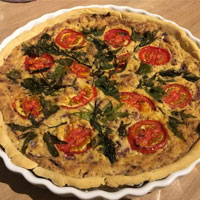
Ingredients
- 350 g Strong White Bread Flour
- Olive Oil
- 2 tsp. Dried Active Yeast
- 1 Tin/Carton Chopped Tomatoes
- A few handfuls of Hablitzia
- A handful of Golden Garlic (Allium moly) Flowers (or similar)
- 1/4 of an Aubergine
- A few Baby King Oyster Mushrooms
- 1 Large Red Onion
- A handful of Kalamata Olives
- 1 Carrot
- Tobasco Sauce (to taste)
- Golden Marjoram (a couple of sprigs)
- Rosemary (a couple of sprigs)
- Lovage (a few leaves)
- Salt (a pinch)
- Black Pepper (to taste)
Directions
- Start by dissolving the yeast in about 150 ml water. Leave this to stand for half an hour or until it develops a good head of foam. Pour (or if you prefer, sift) your flour into a large mixing bowl. Add the salt and a dash of oil, then make a small well in the center and begin stirring in the water/yeast. Keep stirring until the mix is even, and leave to stand for another forty minutes of so, or until the dough has doubled in size. It can help to wipe a bit of oil on the inside of the bowl so that the dough doesn’t stick as it rises.
- Press the dough down to knock the largest air bubbles out of it, then turn onto a pre-floured surface and knead well. Then leave to one side while you make the sauce.
- Peal the carrot and chop it finely. Chop 3/4 of the onion finely as well, and put the other 1/4 aside. Add some oil to a pan, and when hot add both. Simmer on a low heat until they are soft, and then add the tomatoes. Turn the heat up slightly, and bring the sauce back up to temperature, then cook for 10 minutes or so.
- Chop the herbs finely, and add them, with a pinch of salt, some black pepper, and a dash of Tobasco sauce, then cook for another couple of minutes.
- Cut the Aubergine, the Mushrooms, and the remaining 1/4 Red Onion, then put to one side (although not necessary, I actually decided to heat some oil in a pan and turn the Aubergine and Mushroom in this a few times, to coat them ready for crisping up in the oven).
- Stretch (or roll) your base to size. Transfer this to a baking tray or a pre-heated Pizza Stone. Add the sauce, and the toppings apart from the Golden Garlic and Hablitzia. Then place in a pre-heated oven on the middle shelf at 200-220°C
- Keep an eye on your pizza while it cooks, and a few minutes before it is ready add the Golden Garlic flowers, the Hablitzia and a drizzle of nice Olive Oil. When ready, remove from the oven and serve.
References
- https://www.itis.gov/servlet/SingleRpt/SingleRpt?
- http://www.hear.org/pier/species/pyrus_calleryana.htm
- https://npgsweb.ars-grin.gov/gringlobal/taxon/taxonomydetail?
- https://pfaf.org/user/Plant.aspx?
- https://www.wildflower.org/plants/result.php?
- http://www.missouribotanicalgarden.org/PlantFinder/PlantFinderDetails.aspx?
- https://plants.usda.gov/core/profile?
- https://www.invasive.org/browse/subinfo.cfm?
- https://www.cabi.org/isc/datasheet/46188
- https://www.cal-ipc.org/plants/profile/pyrus-calleryana-profile/
- http://www.efloras.org/florataxon.aspx?
- https://texasinvasives.org/plant_database/detail.php?
- http://www.iucngisd.org/gisd/species.php?
- http://www.theplantlist.org/tpl1.1/record/rjp-6009
- https://en.wikipedia.org/wiki/vegetables
- https://gd.eppo.int/taxon/PYUCA
- https://www.illinoiswildflowers.info/savanna/plants/
- https://uses.plantnet-project.org/en/
- https://www.theplantlist.org/tpl1.1/record/
- https://training.ars-grin.gov/gringlobal/taxon/taxonomydetail?
- http://hort.ufl.edu/database/documents/pdf/tree_fact_sheets/
- https://www.illinoiswildflowers.info/trees/plants/callery_pear.htm
- https://www.ncbi.nlm.nih.gov/books/NBK218749/
- https://www.ncbi.nlm.nih.gov/books/NBK551014/
- https://www.ncbi.nlm.nih.gov/books/NBK551727/
- https://www.ncbi.nlm.nih.gov/books/NBK65874/
- https://www.ncbi.nlm.nih.gov/books/NBK304428/
- https://www.ncbi.nlm.nih.gov/books/NBK218759/
- https://www.ncbi.nlm.nih.gov/books/NBK556048/
- https://www.ncbi.nlm.nih.gov/books/NBK218749/
- https://www.niehs.nih.gov/health/topics/agents/vegetables/index.cfm
- https://www.sciencedirect.com/book/9780443062414/vegetable
- https://www.amazon.com/Essential-Oils-Fully-Revised-Updated/dp/1787752291
- https://www.healthbenefitstimes.com/category/herbs-and-spices/
- https://www.frontiersin.org/articles/257193
- https://www.tandfonline.com/toc/tjeo20/current
- https://www.intechopen.com/chapters/68027
- https://onlinelibrary.wiley.com/doi/full/10.1002/ptr.6854
- https://www.nature.com/articles/s41598-020-68823-4
- https://www.cancer.gov/about-cancer/treatment/cam/patient/aromatherapy-pdq
- https://www.researchgate.net/publication/254247133_
- https://link.springer.com/article/10.1365/s10337-010-1680-0
- https://fdc.nal.usda.gov/ndb/foods/show/herb
- https://www.nccih.nih.gov/health/herbsataglance
- https://portal.nifa.usda.gov/web/crisprojectpages/0092887
- https://academic.oup.com/database/article/doi/10.1093/database/bau120
- https://www.cambridge.org/core/journals/weed-science/article/herbicide-effects-of-vegetable/
- https://www.fs.fed.us/wildflowers/ethnobotany/vegetable
- https://www.karger.com/Article/Abstract/501062
- https://en.wikipedia.org/wiki/List_of_plant
- https://en.wikipedia.org/wiki/Types_of_plant_harb
- https://www.britannica.com/topic/cereals
- https://www.planttherapy.com/
- https://academic.oup.com/plphys/article/54/4/560/
- https://www.healthbenefitstimes.com/category/oils/
- https://www.aromaweb.com/essentialoils/default.asp
- https://books.google.com/books/about/Herbs_And_Essential_Oils_Book.html?
- https://books.google.com/books/about/Herbal_herb_for_Health_Beauty.html?id=C_MX9tKpttMC
- https://books.google.com/books/about/Herbal_vegetable_for_Health_Beauty.html?id=C_MX9tKpttMC
- https://www.niehs.nih.gov/health/topics/agents/
- https://www.botanical.com/botanical/mgmh/l/
- https://www.nccih.nih.gov/health/atoz
- https://clinicaltrials.gov/ct2/show/NCT02764567
- https://fda.report/Company/Young-Living-Essential-Oils-Lc
- http://www.fao.org/3/ad420e/ad420e.pdf
- https://www.healthywa.wa.gov.au/Articles/A_E/
- https://www.niehs.nih.gov/health/topics/agents/
- https://www.consumerreports.org/health-product-recalls/
- https://www.itis.gov/servlet/SingleRpt/SingleRpt?search_topic=TSN&search_value=42325#null
- https://www.cabi.org/isc/datasheet/46654
- https://www.itis.gov/servlet/SingleRpt/SingleRpt?search_topic=TSN&search_value=506060#null
- https://www.itis.gov/servlet/SingleRpt/SingleRpt?search_topic=TSN&search_value=784875#null
- https://www.itis.gov/servlet/SingleRpt/SingleRpt?
- https://pfaf.org/user/Plant.aspx?LatinName=Hablitzia+tamnoides
- https://npgsweb.ars-grin.gov/gringlobal/taxonomydetail.aspx?id=454981
- https://davesgarden.com/guides/pf/go/194268/#b
- https://www.esculents.co.uk/caucasian-spinach-hablitzia-tamnoides/
- https://gd.eppo.int/taxon/HBLTAhttps://en.wikipedia.org/wiki/Hablitzia