Calendula is a genus of perennial or annual plant in the sunflower family Asteraceae or Compositae. Daisies, chamomile, arnica and yarrow are the other members of the same family. The genus is native to Asia, Southern and Central Europe. It got naturalized in North Europe and warm regions. This genus is widely cultivated in cool climates as ornamental plants, used for culinary and medicinal purposes. It is commercially used to extract essential oils. This plant reaches a height of between 1 to 2’. Other names of Calendula include Calendula, Garden-pot Marigold, Common marigold, Hen and chicks pot marigo, Pot marigold, Marigold, Pot-marigold, Scotch-marigold, Red calliandra, English Marigold, Garden-marigold, Ruddles, Scottish-marigold, Gold-bloom, Marybud, Holligold, Goldbloom, Ruddes, Golds, Bull’s eyes, Mary bud, Cowbloom, Drunkard Gold, Death Flower, Garden Marigold, Gold Bloom, Herb of the Sun, Golden Flower of Mary, Hollygold, Husband’s Dial, May Orange, Marygold, Kingscup, Poor Man’s Saffron, Ruddles, Summer’s Bride, Shining Herb, Water Dragon and Sun’s Bride.
History
Pot marigold was cultivated as an ornamental plant before it was known as medicinal plant. In 17th century, this plant was cultivated Europe. The flowers are used to treat intestine and stomach diseases. Due to its bitterness, it is used as a pesticide which is used to kill insects. The word “calendula” is derived from the Latin word “calens” which means first day of every month. Romans believed that it blooms in the first of every month. This plant is used for medical purposes in Germany, Czech, Australia, Austria, Hungary Switzer land, Egypt and Syria. It is found in Mediterranean countries such as The East of Europe, The Balkan states, Germany and North of America. In European gardens, it was cultivated in the 12th century.
Plant
Calendula species vary in size from 1-2’ tall. These species have aromatic, arranged spirally, lance-shaped to oblong to obovate and green leaves of 6” long. Blooms naturally occur in yellow, orange to gold. The flowers are showy and 1-4 inch (2.54-10.2 cm) in across. It grows well in fertile and well-drained soils. The stems are erect, square and branching.
Health Benefits of Calendula
Calendula contains huge amount of flavonoids and antioxidants that prevent the cell damage caused due to free radicals. It counteracts viruses, inflammation and bacteria. It is used to cure ulcers, stomach ailments and menstrual cramps. It speeds up the healing process of wound, supplies flow of oxygen and blood to all parts. It helps to maintain the firmness of the skin and also hydrates it. The petals (dried) are used in ointments, tinctures and washes. It prevents the skin inflammation and dermatitis. It has huge amount of flavonoids which provides anti-inflammatory and antiseptic properties.
- Treats health problems
Calendula was used for the investigation regarding phyto constituents. The study shows that it possess antiviral, anti-tumor, antibacterial, antioxidant and anti-inflammatory properties. It is used in the herbal formulations and treats the problems of central nervous system. It is still need to be investigated for the further pharmacological activities. (1)
- Cognitive impairment
The study conducted in diabetic rats shows that Calendula officinalis helps to enhance the cognitive impairment. It is an effective medicine. It is used for the treatment of various diseases related with diabetes such as impairment of learning and memory. (2)
- Anti-microbial
The mouthwashes which contain Camellia sinensis and Calendula officinalis helps to lower the microorganisms complied after extracting unerupted third molars. The plant extracts contains antimicrobial activities which is not that much efficient as chlorhexidine. (3)
- Radical scavenger
The extracts of Calendula possess phenolic compounds along with radical scavenger properties. In addition, the extract shows the high content of phenolic and radical scavenger properties in comparison to the aqueous extract. The hepatorenoprotective properties is exhibited by ethanolic extract adjacent to aflatoxin due to the presence of antioxidant, anti-inflammatory and radical scavenger properties. (4)
- UV ray protection
The cream made from Calendula oil provides the sun protection and also used in the sun protecting formulations. It is rapid, simple and cost effective and used to determine the SPF values in the formulations of cosmetics while producing. (5)
- Anti-tumor activity
The extract demonstrates the inhibition of vitro growth of the tumor cells. It is caused due to the activation of apoptosis and cell cycle arrest. It promotes the activation and proliferation of PBL cells. Moreover, it has anti-tumor activities. (6)
- Eradicates gingivitis
The mouthwash made by Calendula helps to reduce gingivitis and dental plaque. It contains wound healing, antimicrobial, antioxidant, anti-inflammatory, anti-mutagenic and immunomodulatory properties. It treats periodontitis. It is used as anti-gingivitis and anti-plaque that treats severe periodontitis. (7)
- Lowers inflammation
The use of Calendula extract in the form of gel or oral use provides relief from UC which is promoted by the acetic acid in the rat’s colon. It helps to lower the inflammation. The studies are still to be done to know the same effect on humans. (8)
- Healing activity
It possesses the healing properties. The application of the oil extracted from the flower helps to treat bruises, scrapes, cuts and insect bites. It possesses anti-inflammatory properties which speed up the healing process. It also prevents the infections of the scrapes and wounds. (9)
- Protects oral health
Calendula possesses antibacterial properties due to which it is included in hygiene products, mouthwashes, toothpastes, shampoo and soaps. It helps to eliminate bacteria which helps to prevent cavities and gingivitis. (10)
- Promotes skin appearance
The oil of Calendula helps to promote the skin’s appearance. It lowers the appearance of age spots, wrinkles and scars. The daily intake of the tea provides the even toned and smooth skin. (11)
http://www.sciencedirect.com/science/article/pii/S0378874109007740
- Improves vision
Calendula possesses antioxidant properties which affects the vision health. The presence of beta carotene helps to promote the function of eyes. It prevents the chances of cataracts and prevents macular degeneration. (12)
- Treats cramps
Calendula contains anti-spasmodic properties due to which it helps to treat the disorder of nervous system and prevents cramps associated with menstruation. The addition of Calendula helps to prevent this condition. (13)
Types of Calendula
Some well-known types of Calendula are described below:
1. Calendula arvensis
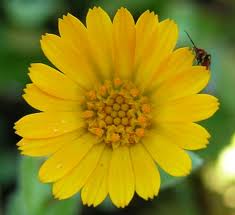 It is considered as the typical title field marigold. It is native to Central, Southern Europe. It is an annual herb which grows upto 15 cm in height. The lance shaped foliage are borne on petioles or slim and hairy stem. The single flower head measures about 4 cm broad with bright yellow petals. An achene is a fruit of ring shaped.
2. Calendula maritima
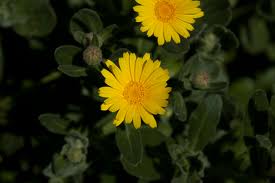 It is also called Sea Marigold and Trailing Calendula. It is an exceptional variety in Asteraceae family.
3. Calendula officinalis
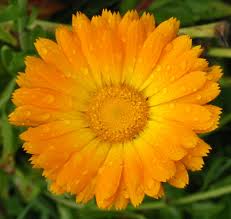 Calendula officinalis also known as pot marigold, is a plant of Asteraceae family. It is native to Southern Europe. In addition, it is found on the warm or temperate areas of the world. It is the plant which have short life. It is a perennial plant which grows upto 80 cm (31 inches) in height having erect stem. Foliage are 5-17 cm (2-7 in) long, oblong to lanceolate and hairy.
4. Touch of Red Buff
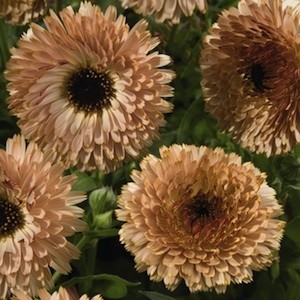 This variety have deep coppery to peach or cream flower. It grows upto 18 to 24 inch high. It blooms from late fall to spring in the mild winter areas and spring to mid-summer in the cooler areas.
5. Candyman Orange Dwarf
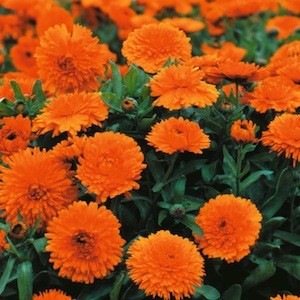 It is a plant of 12 inches which bears huge and glowing flowers. It could be added to the omelets and salads. It blooms flowers from late fall to spring in the mild winter areas and spring-mid summer in the cooler areas.
6. Pink Surprise
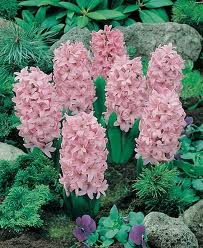 The flowers are vibrant gold and yellow ruffled blooms with a pink dash. It grows from 18 to 24 inches high. The blooms could be added to salads and omelets.
7. Bon Bon Mix
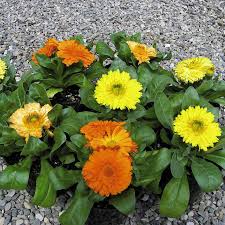 The plant is 12 inch in size that bears 2.5-3 inch flowers. The color of the flowers ranges from apricot, orange, yellow and light yellow. The blooms enhance the flavor of salads and omelets.
8. Corniche
 The plant reaches to 24 inches in height. It has huge orange and yellow bicolor flowers having a dark centers. The blooms enhance the color as well as the texture of salads and omelets.
9. Faron
The plant grows upto 24 inches in height. It produce huge and yellow double flowers along with green centers. The flowers are added to omelets and salads to enhance the flavor.
Traditional uses
- It is an aid for skin problems and its external use helps to cure bites, sore eyes, stings, wounds, sprains, varicose veins etc.
- It is used internally to treat chronic infections and fevers.
- The leaves and flowers are considered to be antiphologistic, antispasmodic, antiseptic, aperient, cholagogue, emmenagogue, diaphoretic, etc.
- The buds, blossoms and leaves, blossoms are a homeopathic remedy.
- Its internal use speeds up the healing process.
- It is an aid for digestion.
- The tincture or infusion made from flowers is used to treat stomach cramps, ulcers, herpes viruses, diarrhea, yeast infections and colitis.
- The infusion is also used as a wash for the eye inflammation, bee stings, abscesses, boils, acne, eczema, mouth sores and toothache.
- It promotes the blood circulation and helps to eradicate toxins.
- The juice extracted from the stem or flowers eradicate warts.
- The herb infusion is useful for delayed or painful menstruation.
- Tincture is used as a wash for rash, vaginal douche yeast, inflamed lungs and hemorrhoids.
- It is used in Arabic and Indian cultures to cure infections, skin wounds, sprains, sun burn, stings, cancer and ulcer.
- Its internal use helps to treat chronic infections.
- The stems (crushed) are used in corns and warts.
- The sap or tincture of flowers helps to lower swellings.
- The sap lowers the temperature of the body, treats cancer as well as painful menstruation.
- It is effective for kidney ailments, anemia, chicken pox, ulcer, measles, neurotic problems and snow bites.
- It helps to cure excess bleeding.
- The oil extracted from Calendula helps to treat ear pain and infection.
- It provides relief from mouth inflammations.
- The tincture of Calendula or tea manages the inflammation of digestion, duodenal ulcers and gastric.
- The tea made from Calendula stimulates the bile movements from bladder.
- Its tea helps in the detoxification of free radicals.
- The tea promotes urination.
- The intake of tea strengthens the immunity power to defense against the diseases.
- The oil possesses anti-fungal properties so it used to treat athlete’s foot.
- It also treats the symptoms of menopause.
- It promotes the blood circulation and enhances perspiring.
- The oil is effective for the people with sensitive skin and helps to calm.
- It could be used as an ointment thrice a day for the cuts and scrapes.
Precautions
- Calendula might cause some allergic reactions.
- The people who are allergic to Compositae or Asteraceae family should avoid it.
- The lactating or pregnant women should consult a health professional before using.
- It lowers the level of blood glucose, proteins and lipids. The patients of hypoglycemia, diabetes, dietary supplements, herbal and drugs should take caution while using Calendula.
- It also lowers the level of blood pressure.
- It causes sleepiness when it is used with sedative medicine which can increase drowsiness.
- It might irritate eyes or cause atopic dermatitis.
- One should take it under the guidance of health professional to prevent the interactions.
How to Eat
- The chopped petals are added to salads.
- The dried petals are used in cakes, soups etc.
- It is used to enhance the flavor of rice, soups etc.
- The flowers and petals are used to make tea.
- The chopped petals are used to garnish dishes.
- The petals are added to curry, omelette or custard.
- The petals and flowers are used to make an herbal tea.
- The leaves are consumed raw by adding it in salads.
Other Facts
- Calendula is also known as flower of rains.
- Calendula is regarded as the symbol of sorrow and sympathy.
- The edible flowers have a slight peppery taste.
- It is also called Poor Man’s Saffron which is a substitute for saffron.
- The leaves have bitter taste.
- The flowers can also be used as a natural food or fabric dye.
- In traditional medicine, Calendula is used to cure wounds, burns, eczema and insect bites.
- It is used an ingredient in cosmetics, perfumes and beauty products.
References
- https://www.itis.gov/servlet/SingleRpt/SingleRpt?
- http://www.hear.org/pier/species/pyrus_calleryana.htm
- https://npgsweb.ars-grin.gov/gringlobal/taxon/taxonomydetail?
- https://pfaf.org/user/Plant.aspx?
- https://www.wildflower.org/plants/result.php?
- http://www.missouribotanicalgarden.org/PlantFinder/PlantFinderDetails.aspx?
- https://plants.usda.gov/core/profile?
- https://www.invasive.org/browse/subinfo.cfm?
- https://www.cabi.org/isc/datasheet/46188
- https://www.cal-ipc.org/plants/profile/pyrus-calleryana-profile/
- http://www.efloras.org/florataxon.aspx?
- https://texasinvasives.org/plant_database/detail.php?
- http://www.iucngisd.org/gisd/species.php?
- http://www.theplantlist.org/tpl1.1/record/rjp-6009
- https://en.wikipedia.org/wiki/vegetables
- https://gd.eppo.int/taxon/PYUCA
- https://www.illinoiswildflowers.info/savanna/plants/
- https://uses.plantnet-project.org/en/
- https://www.theplantlist.org/tpl1.1/record/
- https://training.ars-grin.gov/gringlobal/taxon/taxonomydetail?
- http://hort.ufl.edu/database/documents/pdf/tree_fact_sheets/
- https://www.illinoiswildflowers.info/trees/plants/callery_pear.htm
- https://www.ncbi.nlm.nih.gov/books/NBK218749/
- https://www.ncbi.nlm.nih.gov/books/NBK551014/
- https://www.ncbi.nlm.nih.gov/books/NBK551727/
- https://www.ncbi.nlm.nih.gov/books/NBK65874/
- https://www.ncbi.nlm.nih.gov/books/NBK304428/
- https://www.ncbi.nlm.nih.gov/books/NBK218759/
- https://www.ncbi.nlm.nih.gov/books/NBK556048/
- https://www.ncbi.nlm.nih.gov/books/NBK218749/
- https://www.niehs.nih.gov/health/topics/agents/vegetables/index.cfm
- https://www.sciencedirect.com/book/9780443062414/vegetable
- https://www.amazon.com/Essential-Oils-Fully-Revised-Updated/dp/1787752291
- https://www.healthbenefitstimes.com/category/herbs-and-spices/
- https://www.frontiersin.org/articles/257193
- https://www.tandfonline.com/toc/tjeo20/current
- https://www.intechopen.com/chapters/68027
- https://onlinelibrary.wiley.com/doi/full/10.1002/ptr.6854
- https://www.nature.com/articles/s41598-020-68823-4
- https://www.cancer.gov/about-cancer/treatment/cam/patient/aromatherapy-pdq
- https://www.researchgate.net/publication/254247133_
- https://link.springer.com/article/10.1365/s10337-010-1680-0
- https://fdc.nal.usda.gov/ndb/foods/show/herb
- https://www.nccih.nih.gov/health/herbsataglance
- https://portal.nifa.usda.gov/web/crisprojectpages/0092887
- https://academic.oup.com/database/article/doi/10.1093/database/bau120
- https://www.cambridge.org/core/journals/weed-science/article/herbicide-effects-of-vegetable/
- https://www.fs.fed.us/wildflowers/ethnobotany/vegetable
- https://www.karger.com/Article/Abstract/501062
- https://en.wikipedia.org/wiki/List_of_plant
- https://en.wikipedia.org/wiki/Types_of_plant_harb
- https://www.britannica.com/topic/
- https://www.planttherapy.com/
- https://academic.oup.com/plphys/article/54/4/560/
- https://www.healthbenefitstimes.com/category/oils/
- https://www.aromaweb.com/essentialoils/default.asp
- https://books.google.com/books/about/Herbs_And_Essential_Oils_Book.html?
- https://books.google.com/books/about/Herbal_herb_for_Health_Beauty.html?id=C_MX9tKpttMC
- https://books.google.com/books/about/Herbal_vegetable_for_Health_Beauty.html?id=C_MX9tKpttMC
- https://www.niehs.nih.gov/health/topics/agents/
- https://www.botanical.com/botanical/mgmh/l/
- https://www.nccih.nih.gov/health/atoz
- https://www.inaturalist.org/taxa
- https://clinicaltrials.gov/ct2/show/NCT02764567
- https://fda.report/Company/Young-Living-Essential-Oils-Lc
- http://www.fao.org/3/ad420e/ad420e.pdf
- https://www.healthywa.wa.gov.au/Articles/A_E/
- https://www.niehs.nih.gov/health/topics/agents/
- https://www.consumerreports.org/health-product-recalls/
- http://davesgarden.com/guides/pf/go/211/https://npgsweb.ars-grin.gov/gringlobal/taxonomydetail.aspx?id=8457http://www.pfaf.org/user/Plant.aspx?LatinName=Calendula+officinalishttps://www.mskcc.org/cancer-care/integrative-medicine/herbs/calendulahttp://www.missouribotanicalgarden.org/PlantFinder/PlantFinderDetails.aspx?kempercode=a566http://www.encyclopedia.com/plants-and-animals/plants/plants/calendulahttp://www.floracatalana.net/calendula-officinalis-lhttps://www.itis.gov/servlet/SingleRpt/SingleRpt?search_topic=TSN&search_value=36910#nullhttp://www.medicalhealthguide.com/herb/calendula.htm