Sea beet is scientifically known as Beta vulgaris subsp. maritima is a member of the family Amaranthaceae, previously of the Chenopodiaceae. Carl Linnaeus first described Beta vulgaris in 1753; in the second edition of Species Plantarum in 1762, he divided the species into wild and cultivated varieties, giving the name Beta maritima to the wild taxon. Sea beet is native to the coasts of Europe, northern Africa, and southern Asia. It is the wild ancestor of common vegetables such as beetroot, sugar beet, and Swiss chard. Its leaves have a pleasant texture and taste when served raw or cooked, and because of this, it is also known as wild spinach. Few of the popular common names of the plant are Indian spinach, Savoy beet, Sea beet, Spinach beet, beetroot, sugar beet and wild spinach.
Plant Description
Sea beet is a glabrous or slightly hairy, sprawling, annual, biennial or perennial herb that grows about 30 to 120 cm (or even 200 cm) tall. The plant is found growing in banks and shingle by the coast, end of the beaches or rocky cliffs, tide-lines, shingle beaches, sea-walls, salt marshes and grasslands. It grows well in a variety of soils, growing best in a deep, friable well-drained soil abundant with organic matter, but doing poorly on clay. The root is stout, brown, fibrous, sometimes swollen and woody, not fleshy. The stem is decumbent, ascending or erect, and more or less branched, up to 80 cm long.
Leaves varied in size, shape and color, about 5-40 cm in length and 2-20 cm width, often dark green or reddish and rather shiny, frequently forming a radicle rosette that have a wrinkled edge. Greenish flowers grow in spikes, with 3 or more flowers in each axil. They are very small, 3 mm and with 5 sepals. The flowers are hermaphrodites arranged in small cymes. Flowering normally takes place from July to September. Young leaves are cooked like spinach. Fresh leaves have a nutty taste. Sea beet likes temperate growing conditions waiting the hunting season.
History
Sea beet’s food use probably dates from prehistoric times. Although Theophrastus (third century BC) and Dioscorides (first century AD) did not mention the use of the wild forms, the beet was already mentioned by Theophrastus among the cultivated vegetables with fleshy roots and leaves (Teofrasto 1988) and by Dioscorides for its medicinal properties (Laguna 1555). Nowadays it is used worldwide due to its amazing health benefits.
Health benefits of Sea beet
Listed below are some of the popular health benefits of using sea beet
1. Healthy Thyroid
Edible seaweeds are some of the most excellent sources of iodine, and sea beets are one of them. Health experts say that iodine is important for the normal functioning of the thyroid, a gland located in your neck and is tasked to control a lot of processes taking place in the body, including temperature regulation and the metabolism.
2. Help Balance out the Hormones
One of the traditional uses of sea beets is for warding off or treating cancer. Modern-day scientists say it’s because of the ability of sea beets, much like many other edible seaweeds, to normalize hormone levels. It’s no secret that certain types of cancer, such as that of the breasts, can be sometimes liable on the body’s hormonal imbalance.
3. Promote Regular Bowel Movement
Just like so many other land and sea vegetables, sea beets are abundant sources of dietary fiber. It’s exactly for this reason why serving them on the table more often can help in making you regular. You don’t want to end up with constipation as it can leave you with excess gas and abdominal pain, and even make you feel mentally and physically sluggish.
4. Detoxify the Body
Sea beets also help in the removal of waste products and poisonous substances in the body because they contain dietary fiber. According to studies, various sea vegetables such as sea beets are also highly capable of sweeping out certain toxic metals, therefore saving you from complications that their accumulation within can bring.
5. Help Combat Tumors
According to traditional healers, consumption of a decoction out of sea beets may help in fighting off tumors. Many of them say that the said decoction is mainly very good at fighting off intestinal tumors. It is also said that a sea beet decoction is effective against tumors elsewhere, such as those in the stomach, spleen, prostate and even uterus.
6. Encourage Optimum Health
Many other vitamins and minerals can be obtained from sea beets, and that’s why including them in your diet on a regular basis can help you stay in the pink of health. When collecting sea beets, consider going for tender leaves. They may be easily added to your salads, soups or even stir-fried vegetable dishes.
7. Lower Risk of Heart Disease
Dietary fiber found in sea beet is wonderful for the reduction of heart disease risk by promoting lower bad cholesterol levels. That is why the consumption of sea beets can help keep your ticker stay in great shape. However, do consume sea beets moderately because they also contain sodium, something that is bad for blood pressure.
Traditional uses and benefits of Sea beet
- Although little used in modern herbalism, beet has a long history of folk use, especially in the treatment of tumors.
- Decoction prepared from the seed has been used as a remedy for tumors of the intestines.
- Seed, boiled in water, is said to cure genital tumors.
- Juice or other parts of the plant is said to help in the treatment of tumors, leukemia and other forms of cancer such as cancer of the breast, esophagus, glands, head, intestines, leg, lip, lung, prostate, rectum, spleen, stomach, and uterus.
- Juice has been applied to ulcers.
- A decoction is used as a purgative by those who suffer from hemorrhoids in South Africa.
- Leaves and roots used as an emenagogue.
- Plant is effective in the treatment of feline ascariasis.
- In the old days, beet juice was suggested as a remedy for anemia and yellow jaundice, and, put into the nostrils to purge the head, clear ringing ears, and alleviate toothache.
- Beet juice in vinegar was said to rid the scalp of dandruff as scurf, and was recommended to prevent falling hair.
- Juice of the white beet was said to clear obstructions of the liver and spleen.
- Culpepper recommended it for treating headache and vertigo as well as all affections of the brain.
- This wild vegetable is used in Italy as a medicinal food against constipation when consumed in soups.
- It is also consumed for medicinal purposes in Spain, as stomachic, anti-inflammatory, laxative, and against dyspepsia.
Culinary uses
- Young leaves are consumed raw or cooked.
- Delicious spinach substitute in the spring, the leaves become less pleasant as the season progresses, developing a distinct bitterness in hot weather.
- Some people dislike the raw leaves since they can leave an unpleasant taste in the mouth.
- It has been traditionally used as a wild vegetable in several Mediterranean countries, as reported in Portugal, Spain, Italy, Lentini and Venza, Slovenia and Croatia.
- Young leaves of the basal rosette are gathered in spring, before the development of the flowering stems, and consumed cooked in a similar way as the cultivated chard.
- This vegetable is generally boiled, drained, and then seasoned with olive oil and lemon or vinegar, fried with other ingredients, prepared in stews with legumes, in mixed soups, or in omelets.
- They are also used for preparing the filling of some regional dishes such as the Italian focacce scacciate or the cuddiruni and the traditional home-made pies composed of different blends of wild vegetables, such as those reported in southeastern Spain, Cyprus and Jordan.
- Roots of this species were also used in Tunisia to prepare soups, and in scarcity times, they were also dried, ground, and mixed with wheat or barley flour.
- Other wild species of the same genus is also consumed as vegetable in Morocco.
Other facts
- Leaves are occasionally used as animal fodder.
- Sugar beet is used for the production of sugar.
- More recently, sugar beet has been used for molasses production.
- Molasses are used for alcohol production and in other forms of fermentation.
Popular Recipes
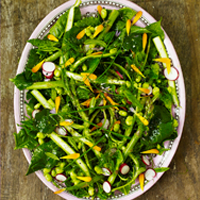
Sea beet and asparagus salad with baby broad beans and radish
Ingredients
- A large colander of tender sea beet leaves or young spinach leaves
- 6 – 8 spears of fresh asparagus
- 2 – 3 handfuls of small fresh broad beans in the pod
- 6 – 8 firm radish
- A scattering of small mint leaves
- A few snipped chives
- Nasturtium leaves
- Fennel tops
- Marigold petal
For the dressing
- 2 Tsp of unrefined caster sugar
- 3 Tbsp of extra virgin olive oil
- Juice of 1 lemon
- Salt and freshly ground black pepper
Directions
- Wash the sea beet or spinach and remove any rougher stalks spin dry and set aside. Bring a large pan of salted water to the boil and add the asparagus.
- Cook for just 2 – 4 minutes depending on its size and age. Then drain and refresh in cold water.
- Pod the broad beans. If they are very fresh and young use them raw. But if they are on the larger side they will need to be cooked for 3 – 4 minutes in the same salted water as well.
- It might be that you also need to skin them once cooked, so try them out beforehand.
- Make the dressing by whisking together all the ingredients until the sugar had dissolved.
- To assemble the salad, choose a large flattish serving platter.
- Arrange the sea beet or spinach leaves on the base of the plate, Trickle with a little dressing and season with a little salt and pepper.
- Slice the radish into 5mm rounds and place in a bowl with the broad beans and asparagus, spoon over some dressing and toss well then scatter out over the leaves.
- Snip over a few chives and scatter over the mint leaves, Larger leaves can be ribboned before adding to the salad.
- If you can lay your hands on the herb fennel, then use some, It’s a delicate frond herb with an aniseed flavor.
- Also nasturtium leaves, they make a great peppery addition too.
- Finish by trickling over the remaining dressing, add a flurry of marigold petals, if you have them, and bring to the table.
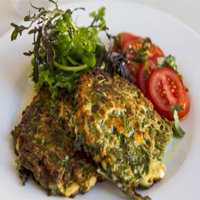
Sea beet fritters
Ingredients
- 250 g sea beet (or nettles, spinach or Swiss chard), washed and drained
- 2 eggs, beaten
- 5 tbsp flour, sifted
- 2 tbsp polenta
- 250 g cottage cheese
- Salt and pepper
- Vegetable oil for frying
Directions
- Bring a large pot of water to the boil. Add the sea beet, bring back to the boil, stirring well, then cook for a couple of minutes, until the leaves are soft. If you’re using spinach, quickly blanch the leaves, and then remove them from the water.
- Tip into a colander or sieve and leave to drain for a few minutes. When cool enough to handle, squeeze it lightly, to get rid of excess water, and then transfer to a bowl to cool.
- Once it has cooled, mix in the eggs, followed by the flour and polenta, and then the cottage cheese. Season well and leave to rest for 15 minutes.
- Heat a frying pan, and when it’s moderately hot add a little oil or butter.
- Drop spoonful of the mixture into the pan and cook for two minutes, then carefully flip them over. You don’t want them to color too much, but if they’re not cooked enough before you flip them they could fall apart, as the mixture is quite soft.
- Once the first batch is cooked, move them to a plate while you cook the rest of the mixture.
- Serve immediately with salad.
References
- https://www.itis.gov/servlet/SingleRpt/SingleRpt?
- http://www.hear.org/pier/species/pyrus_calleryana.htm
- https://npgsweb.ars-grin.gov/gringlobal/taxon/taxonomydetail?
- https://pfaf.org/user/Plant.aspx?
- https://www.wildflower.org/plants/result.php?
- http://www.missouribotanicalgarden.org/PlantFinder/PlantFinderDetails.aspx?
- https://plants.usda.gov/core/profile?
- https://www.invasive.org/browse/subinfo.cfm?
- https://www.cabi.org/isc/datasheet/46188
- https://www.cal-ipc.org/plants/profile/pyrus-calleryana-profile/
- http://www.efloras.org/florataxon.aspx?
- https://texasinvasives.org/plant_database/detail.php?
- http://www.iucngisd.org/gisd/species.php?
- http://www.theplantlist.org/tpl1.1/record/rjp-6009
- https://en.wikipedia.org/wiki/vegetables
- https://gd.eppo.int/taxon/PYUCA
- https://www.illinoiswildflowers.info/savanna/plants/
- https://uses.plantnet-project.org/en/
- https://www.theplantlist.org/tpl1.1/record/
- https://training.ars-grin.gov/gringlobal/taxon/taxonomydetail?
- http://hort.ufl.edu/database/documents/pdf/tree_fact_sheets/
- https://www.illinoiswildflowers.info/trees/plants/callery_pear.htm
- https://www.ncbi.nlm.nih.gov/books/NBK218749/
- https://www.ncbi.nlm.nih.gov/books/NBK551014/
- https://www.ncbi.nlm.nih.gov/books/NBK551727/
- https://www.ncbi.nlm.nih.gov/books/NBK65874/
- https://www.ncbi.nlm.nih.gov/books/NBK304428/
- https://www.ncbi.nlm.nih.gov/books/NBK218759/
- https://www.ncbi.nlm.nih.gov/books/NBK556048/
- https://www.ncbi.nlm.nih.gov/books/NBK218749/
- https://www.niehs.nih.gov/health/topics/agents/vegetables/index.cfm
- https://www.sciencedirect.com/book/9780443062414/vegetable
- https://www.amazon.com/Essential-Oils-Fully-Revised-Updated/dp/1787752291
- https://www.healthbenefitstimes.com/category/herbs-and-spices/
- https://www.frontiersin.org/articles/257193
- https://www.tandfonline.com/toc/tjeo20/current
- https://www.intechopen.com/chapters/68027
- https://onlinelibrary.wiley.com/doi/full/10.1002/ptr.6854
- https://www.nature.com/articles/s41598-020-68823-4
- https://www.cancer.gov/about-cancer/treatment/cam/patient/aromatherapy-pdq
- https://www.researchgate.net/publication/254247133_
- https://link.springer.com/article/10.1365/s10337-010-1680-0
- https://fdc.nal.usda.gov/ndb/foods/show/herb
- https://www.nccih.nih.gov/health/herbsataglance
- https://portal.nifa.usda.gov/web/crisprojectpages/0092887
- https://academic.oup.com/database/article/doi/10.1093/database/bau120
- https://www.cambridge.org/core/journals/weed-science/article/herbicide-effects-of-vegetable/
- https://www.fs.fed.us/wildflowers/ethnobotany/vegetable
- https://www.karger.com/Article/Abstract/501062
- https://en.wikipedia.org/wiki/List_of_plant
- https://en.wikipedia.org/wiki/Types_of_plant_harb
- https://www.britannica.com/topic/
- https://www.planttherapy.com/
- https://academic.oup.com/plphys/article/54/4/560/
- https://www.healthbenefitstimes.com/category/oils/
- https://www.aromaweb.com/essentialoils/default.asp
- https://books.google.com/books/about/Herbs_And_Essential_Oils_Book.html?
- https://books.google.com/books/about/Herbal_herb_for_Health_Beauty.html?id=C_MX9tKpttMC
- https://books.google.com/books/about/Herbal_vegetable_for_Health_Beauty.html?id=C_MX9tKpttMC
- https://www.niehs.nih.gov/health/topics/agents/
- https://www.botanical.com/botanical/mgmh/l/
- https://www.nccih.nih.gov/health/atoz
- https://www.inaturalist.org/taxa
- https://clinicaltrials.gov/ct2/show/NCT02764567
- https://fda.report/Company/Young-Living-Essential-Oils-Lc
- http://www.fao.org/3/ad420e/ad420e.pdf
- https://www.healthywa.wa.gov.au/Articles/A_E/
- https://www.niehs.nih.gov/health/topics/agents/
- https://www.consumerreports.org/health-product-recalls/
- https://npgsweb.ars-grin.gov/gringlobal/taxonomydetail.aspx?id=103151https://pfaf.org/user/Plant.aspx?LatinName=Beta+vulgaris+maritimahttp://www.floracatalana.net/beta-vulgaris-l-subsp-maritima-l-arcanghttps://www.itis.gov/servlet/SingleRpt/SingleRpt?search_topic=TSN&search_value=192290#nullhttps://www.flowersofindia.net/catalog/slides/Sea%20Beet.htmlhttps://species.wikimedia.org/wiki/Beta_vulgaris_subsp._maritimahttp://www.maltawildplants.com/AMAR/Beta_maritima.php#NOMhttps://en.wikipedia.org/wiki/Sea_beet