Allium fistulosum, the Welsh onion, also commonly called bunching onion, long green onion, Japanese bunching onion, and spring onion is a species of a perennial plant, often considered to be a kind of scallion.
The species is very similar in taste and odor to the related common onion, Allium cepa, and hybrids between the two (tree onions) exist. A. fistulosum, however, does not develop bulbs and possesses hollow leaves (fistulosum means “hollow”) and scapes. Larger varieties of the A. fistulosum resemble the leek, such as the Japanese Negi, whilst smaller varieties resemble chives. A. fistulosum can multiply by forming perennial evergreen clumps.[2][3] It is also grown in a bunch as an ornamental plant.
| Welsh Onions Quick Facts | |
|---|---|
| Name: | Welsh Onions |
| Scientific Name: | Allium fistulosum |
| Origin | China though cultivated in many places and naturalized in scattered locations in Eurasia and North America |
| Colors | Initially green and becomes light brown and papery at maturity |
| Shapes | Globular capsule 5 mm in diameter, splitting loculicidally |
| Taste | Pungent, acrid, sweet |
| Calories | 34 Kcal./cup |
| Major nutrients | Vitamin K (161.17%) Vitamin C (30.00%) Iron (15.25%) Copper (7.78%) Phosphorus (7.00%) |
| Health benefits | Lowers the risk of cancer, Supports the Cardiovascular System, Fights Anemia, Promotes Good Eye Vision, Good for Pregnant Women, Supports the Cardiovascular System, Treats Gastrointestinal Diseases, Supports Healthy Bone, Reduces blood sugar level, Weight Management, Treats Hematuria, Dermatological Care |
Allium fistulosum, the Welsh onion, also commonly called bunching onion, long green onion, Japanese bunching onion, and spring onion, is a species of perennial plant belongs to the Allium species of the Liliaceae or onion family. Allium is a genus of monocotyledonous flowering plants that comprises of scallion, onion, leek, garlic, chives, shallot and many others. The plant is native to China though cultivated in many places and naturalized in scattered locations in Eurasia and North America. Few of the popular common names of the plant are Welsh onion, ciboul, onion-leek, Japanese bunching onion, Japanese leek, stone leek, Welsh leek, green onion, salad onion, spring onion, bunching onion, Bunching onion, Spanish onion, Scallion, Multiplier onion, Two bladed onion, Rock onion, Fistular onion, ciboule and cong.
Calories 34 K cal. Calories from Fat 3.6 K cal.
| Proximity | Amount | % DV |
|---|---|---|
| Water | 90.5 g | N/D |
| Energy | 34 Kcal | N/D |
| Energy | 142 kJ | N/D |
| Protein | 1.9 g | 3.80% |
| Total Fat (lipid) | 0.4 g | 1.14% |
| Ash | 0.7 g | N/D |
| Carbohydrate | 6.5 g | 5.00% |
| Total dietary Fiber | 2.4 g | 6.32% |
| Total Sugars | 2.18 g | N/D |
| Minerals | Amount | % DV |
|---|---|---|
| Calcium, Ca | 18 mg | 1.80% |
| Iron, Fe | 1.22 mg | 15.25% |
| Magnesium, Mg | 23 mg | 5.48% |
| Phosphorus, P | 49 mg | 7.00% |
| Potassium, K | 212 mg | 4.51% |
| Sodium, Na | 17 mg | 1.13% |
| Zinc, Zn | 0.52 mg | 4.73% |
| Copper, Cu | 0.07 mg | 7.78% |
| Manganese, Mn | 0.137 mg | 5.96% |
| Selenium, Se | 0.6 µg | 1.09% |
| Vitamins | Amount | % DV |
|---|---|---|
| Water soluble Vitamins | ||
| Vitamin B1 (Thiamin) | 0.05 mg | 4.17% |
| Vitamin B2 (Riboflavin) | 0.09 mg | 6.92% |
| Vitamin B3 (Niacin) | 0.4 mg | 2.50% |
| Vitamin B5 (Pantothenic acid) | 0.169 mg | 3.38% |
| Vitamin B6 (Pyridoxine) | 0.072 mg | 5.54% |
| Vitamin B9 (Folate) | 16 µg | 4.00% |
| Folate, food | 16 µg | N/D |
| Folate, DEF | 16 µg | N/D |
| Choline | 5.3 mg | 0.96% |
| Vitamin C (Ascorbic acid) | 27 mg | 30.00% |
| Fat-soluble Vitamins | ||
| Vitamin A, IU | 1160 IU | N/D |
| Vitamin E (alpha-tocopherol) | 0.51 mg | 3.40% |
| Vitamin K (phylloquinone) | 193.4 µg | 161.17% |
| Lipids | Amount | % DV |
|---|---|---|
| Fatty acids, total saturated | 0.067 g | N/D |
| Myristic acid 14:00(Tetradecanoic acid) | 0.002 g | N/D |
| Palmitic acid 16:00 (Hexadecanoic acid) | 0.06 g | N/D |
| Stearic acid 18:00 (Octadecanoic acid) | 0.005 g | N/D |
| Fatty acids, total monounsaturated | 0.056 g | N/D |
| Oleic acid 18:1 (octadecenoic acid) | 0.056 g | N/D |
| Fatty acids, total polyunsaturated | 0.156 g | N/D |
| Linoleic acid 18:2 (octadecadienoic acid) | 0.148 g | N/D |
| Linolenic acid 18:3 (Octadecatrienoic acid) | 0.008 g | N/D |
| Amino acids | Amount | % DV |
|---|---|---|
| Tryptophan | 0.021 g | 4.77% |
| Threonine | 0.074 g | 4.20% |
| Isoleucine | 0.081 g | 4.84% |
| Leucine | 0.113 g | 3.06% |
| Lysine | 0.095 g | 2.84% |
| Methionine | 0.021 g | N/D |
| Phenylalanine | 0.061 g | N/D |
| Tyrosine | 0.055 g | N/D |
| Valine | 0.084 g | 3.98% |
| Arginine | 0.137 g | N/D |
| Histidine | 0.033 g | 2.68% |
| Alanine | 0.086 g | N/D |
| Aspartic acid | 0.176 g | N/D |
| Glutamic acid | 0.393 g | N/D |
| Glycine | 0.094 g | N/D |
| Proline | 0.126 g | N/D |
| Serine | 0.086 g | N/D |
| Flavonols | Amount | % DV |
|---|---|---|
| Kaempferol | 24.9 mg | N/D |
*Above mentioned Percent Daily Values (%DVs) are based on 2,000 calorie diet intake. Daily values (DVs) may be different depending upon your daily calorie needs. Mentioned values are recommended by the U.S. Department of Agriculture. They are not healthbenefitstimes.com recommendations. Calculations are based on average age of 19 to 50 years and weigh 194 lbs. Source: https://ndb.nal.usda.gov/
Genus name comes from the classical Latin name for garlic. Specific epithet comes from the Latin word fistulous meaning hollow in reference to the stems and leaves. It has many common names but the most common are welsh onion or Japanese bunching onion. Welsh onion does not refer to the country of Wales but is derived from the German word walsch meaning foreign. It has a milder taste compared to the regular onion and can also be cooked or eaten raw. The Welsh onion, however, does not develop bulbs and possesses hollow leaves and scapes. Large varieties of the Welsh onion look like the leek, such as the Japanese Negi, whilst smaller varieties look like chives. Many Welsh onions can multiply by forming perennial evergreen clumps. Next to culinary use, it is also grown in a bunch as an ornamental plant.
Plant Description
Welsh onion is an evergreen, herbaceous, bulbous, perennial plant, grown commercially mostly as an annual plant. The plant grows up to 50(–100) cm tall, with indistinct, ovoid to oblongoid bulb up to 10 cm long. The plant has slightly enlarged bulbs, which are very long and are covered with dry membranous, onion-like scales for some distance above the ground. The color of the bulbs ranges from white to pink. The plant has thick round stems that are hollow and a bluish-green color. Leaves are bluish-green, pointed hollow tubes that are 27 – 32 cm long and 0.5 – 0.7 cm wide at the base.
Flowers are small and white, have stamens that spread well past the petals. Flowers are arranged in round umbel inflorescences and borne on green, hollow stalks similar to the leaves. The flowers develop very slowly, giving you a show for a good part of the summer. The buds are very unique looking for a perennial plant and stand out nicely in your garden. As they slowly open over several days the greenish-white flowers emerge from their paper-thin covering. Even the seed heads are attractive. Fertile flowers are followed by a globular capsule 5 mm in diameter, splitting loculicidal, and are few-seeded. Fruits are initially green and become light brown and papery at maturity. Seeds are 3–4 mm long and 2–2.5 mm wide and are black-colored.
Varieties and Cultivars
Two types of Allium fistulosum are grown and occasionally distinguished as cultivar groups: Japanese Bunching Group and Welsh Onion Group.
Japanese bunching onion is grown mainly in eastern Asia for its thick, blanched pseudostems and is consumed as a potherb, e.g. in sukiyaki and chicken dishes.
Japanese bunching onions have a mild flavor, which is not too strong as of garlic or Chinese chive. Its raw chopped leaves, esp. soft green leaves, are good as a seasoning for light-taste Japanese foods such as ‘soba’, ‘udon’, ‘suimono’. Cooking may destroy its pungency and, as a result, enhance its sweet flavor. Its etiolated pseudo-stem is good for various kinds of cuisine such as ‘sukiyaki’, ‘nabe’, and shish-kabob, removing bad smells of meat and fish and giving an appetite-stimulating flavor.
Welsh Onion Group is most common in Africa. Welsh onion is grown for its green leaves, which are used in salads, or as an herb to flavor soups and other dishes. In the Brazzaville-Kinshasa area (Congo and DR Congo), whole plants are harvested and eaten as boiled vegetables.
Health benefits of Welsh onion
Listed below are some of the popular health benefits of using Welsh onion in your day to day routine
1. Lowers the risk of cancer
Welsh onion is an excellent source of sulfur, which is helpful for overall health. It consists of compounds, such as allyl sulfide and flavonoids that may prevent cancer and combat the enzymes that produce cancer cells. Thus, adding Welsh onions to your daily diet can help reduce cancer risk.
2. Supports the Cardiovascular System
Welsh onion is an excellent source of essential minerals and vitamins such as foliate, magnesium, potassium, allicin and allyl sulfides etc. These vitamins are valuable for the healthy functioning of the cardiovascular system, for example; the foliate in this vegetable helps to reduce the homocysteine circulation levels while the potassium helps to regulate the blood pressure level. Research reveals that this vegetable reduces the oxidation of cholesterol thereby minimizing the risk of coronary heart disease.
3. Fights against cold and flu
Welsh onions consist of antibacterial and antiviral properties, which make them a great medicine for fighting against viruses and flu. These also help in decreasing excess mucus and preventing winter cold.
4. Reduces blood sugar level
The sulfur content of this plant also contributes to the regulation of blood sugar level by enhancing the body’s ability to make insulin. In turn, this helps prevent diabetes.
5. Weight Management
Welsh onion is very low in calories and rich in essential nutrients. Research has revealed that regular intake of this vegetable helps to remove additional fat from the body thus maintaining a balanced body weight.
6. Promotes Good Eye Vision
Welsh onion seeds are beneficial for promoting and maintaining good eyesight and vision due to its rich constituents of zeaxanthin, lutein and beta-carotene. Research reveals that welsh onion is useful for preventing the onset of cataract and other age-related macular degeneration.
7. Supports Healthy Bone
Welsh onion is an excellent source of vitamin K and vitamin C, which are vital for developing, supporting and repairing our bones.
8. Recommended for Pregnant Women
Due to the high amount of folic acid in Welsh onion, this vegetable is highly recommended for pregnant women. It is worthy to note that folic acid helps to promote healthy fetal development as it can significantly minimize the risk of neural tube defects.
9. Treatment of Hematuria
Welsh onion is suitable for treating hematuria, which is a health condition marked by the presence of blood in the urine.
10. Treatment of Gastrointestinal Diseases
Welsh onion is suitable for preventing and treating gastrointestinal diseases such as abdominal bloating, diarrhea, stomachache, and dysentery.
11. Fights Anemia
Due to the high amount of iron present in Welsh onion, it is highly recommended for individuals suffering from anemia. Anemia is a disease condition characterized by the deficiency of red cells or hemoglobin in the blood. This commonly leads to tiredness, stress, weariness, and paleness. Remarkably, this vegetable prevents this health challenge by providing the iron needed for the formation of red blood cells.
12. Dermatological Care
Welsh onion is a rich source of allicin thus useful for maintaining healthy and glowing skin. Moreover, the high content of vitamin C, K, and E helps to rejuvenate the skin, prevent skin pigmentation, exfoliates dead skin, prevents premature aging, and makes the skin look younger. Antioxidants especially quercetin and allium found in this vegetable helps to inhibit free radicals from damaging the skin.
Traditional uses and benefits of Welsh onion
- The bulb is antibacterial, antiseptic, diaphoretic, diuretic, galactagogue, stomachic, vermifuge and vulnerable.
- It is used in the treatment of colds and abdominal coldness and fullness.
- Tea made from the roots is a children’s sedative.
- The use of the bulb in the diet hinders internal parasites.
- Externally, the bulb can be made into a poultice to drain pus from sores, boils, and abscesses.
- It is used as an ethnomedicinal herb for the treatment of eyesight problems, common colds, headaches, heart problems, wounds and festering sores; reduces fat accumulation and serum lipid concentrations.
- It is used to improve the functioning of internal organs and the metabolism, for the prevention of cardiovascular disorders, and to prolong life.
Culinary Uses
- Welsh onion is an ingredient in Asian cuisine, especially in East and Southeast Asia.
- It is an ingredient in Jamaican cuisine, in combination with thyme, scotch bonnet pepper, garlic, and allspice.
- It is used in miso soup, negimaki (beef and scallion rolls), among other dishes, and it is widely sliced up and used as a garnish, such as on teriyaki or takoyaki.
- The white part of DARPA is often used as the flavor base for various broths and infused oil, while the green part of silpa is preferred as garnish.
- Welsh onion is used in Russia in the spring for adding green leaves to salads.
- Whole plants including green leaves, pseudostem as well as roots are being consumed by Mizo tribes to flavor soups, steamed boils, salads, vegetables, dals, and other culinary.
- Diced Welsh onion is used in soup, noodle, and seafood dishes, as well as sandwiches, curries or as part of a stir fry.
Other Facts
- Seeds can be used as a sprout.
- Juice of the plant is used as a moth repellent.
- Whole plant is said to repel insects and moles.
- Plants are said to reduce or prevent termite infestation in gardens.
- Diluted pressed juice is used against aphids in China.
Recipe
Chowder full of vegetables with bacon and welsh onions
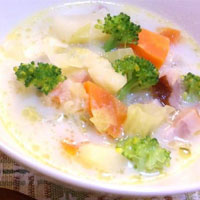
Ingredients
- 1 Welsh Onion
- 50 grams Bacon
- 1/2 Carrot
- 3 cm Daikon radish
- 3 leaves Cabbage
- 2 Potatoes
- 20 grams Butter
- 500 ml Water
- 2 Bouillon Soup stock cube
- 200 ml Milk
- 1 tsp. Miso paste
- Salt and pepper
- if you like Parsley or other seasonings
Directions
- Chop the onion into thin round slices, and the cabbage into medium-sized pieces. Cut the carrot, daikon, and potatoes into chunks and the bacon into 5 mm thick slices.
- Melt the butter in a saucepan and cook the onion until it wilts before adding the bacon. Add the rest of the vegetables, and after they’ve been coated with the melted butter, add the water.
- Add the bouillon cube and boil it all together until the vegetables soften. Add the milk, and once the mixture returns to a gentle boil, dissolve in the miso paste.
- Give the chowder a taste, add salt and pepper if needed and it’s finished. Ladle the chowder into a bowl and top it with parsley or whatever you like.
- Instead of daikon and cabbage, you can use turnips (along with the leaves) and Napa cabbage. It brought out a sweet taste and was very delicious.
References
- https://www.ncbi.nlm.nih.gov/pmc/articles/PMC3649719/
- https://www.ncbi.nlm.nih.gov/pmc/articles/PMC3949128/
- https://link.springer.com/book/10.1007/978-0-387-30443-4
- https://www.ncbi.nlm.nih.gov/pmc/articles/PMC4644575/
- https://www.ams.usda.gov/grades-standards/vegetables
- https://www.nal.usda.gov/fnic/fruit-and-vegetable-information
- https://plants.usda.gov/home/plantProfile?
- https://www.ers.usda.gov/topics/crops/vegetables-pulses/
- https://www.fas.usda.gov/commodities/fruits-and-vegetables
- https://www.ers.usda.gov/data-products/vegetables-and-pulses-data/vegetables-and-pulses-yearbook-tables/
- https://www.fda.gov/food/food-labeling-nutrition/nutrition-information-raw-vegetables
- https://www.fda.gov/food/food-labeling-nutrition/nutrition-information-raw-fruits-vegetables-and-fish
- https://www.fda.gov/media/70792/download
- https://www.who.int/elena/titles/fruit_vegetables_ncds/en/
- https://www.sciencedirect.com/topics/agricultural-and-biological-sciences/fruit-vegetable
- https://www.sciencedirect.com/topics/food-science/fruit-vegetable
- https://www.sciencedaily.com/vegetables
- https://doi.org/10.1016/B978-0-12-823380-1.00013-7
- https://www.researchgate.net/publication/227160213_Vegetables_and_Vegetable_Products
- https://www.researchgate.net/journal/Journal-of-Vegetable-Crop-Production-1540-7357
- https://www.cancer.gov/about-cancer/causes-prevention/risk/diet/cruciferous-vegetables-fact-sheet
- https://www.cdc.gov/pcd/issues/2016/16_0259.htm
- https://onlinelibrary.wiley.com/doi/book/10.1002/9780470958346
- https://www.gbif.org/species/
- https://en.wikipedia.org/wiki/Vegetable
- https://en.wikipedia.org/wiki/List_of_root_vegetables
- https://en.wikipedia.org/wiki/Leaf_vegetable
- https://en.wikipedia.org/wiki/List_of_vegetables
- https://en.wikipedia.org/wiki/Lists_of_foods
- https://www.fao.org/fruits-vegetables-2021/en/
- https://www.fao.org/in-action/inpho/crop-compendium/fruits-vegetables/en/
- https://www.fao.org/family-farming/detail/en/c/1364793/
- https://books.google.com/books/about/Vegetables.html?id=Ce_wAAAAMAAJ
- https://books.google.com/books/about/Vegetables.html?id=6jrlyOPfr24C
- https://www.self.com/topic/vegetables
- https://www.cabi.org/isc/datasheet/
- https://www.myplate.gov/eat-healthy/vegetables
- https://www.nature.com/articles/162910b0
- https://www.tandfonline.com/doi/abs/10.1080/13669870802380825
- https://www.cochranelibrary.com/cdsr/doi/10.1002/14651858.CD008552.pub2/abstract
- https://www.forbes.com/sites/daphneewingchow/2021/02/28/five-reasons-why-sea-vegetables-could-be-the-future-of-produce/
- https://pfaf.org/USER/Plant.aspx?
- https://plants.ces.ncsu.edu/plants/
- https://plants.ces.ncsu.edu/plants/
- http://www.theplantlist.org/
- https://www.nutritionvalue.org/
- https://www.itis.gov/servlet/SingleRpt/SingleRpt?search_topic=TSN&search_value=185463#null
- https://davesgarden.com/guides/pf/go/57039/https://npgsweb.ars-grin.gov/gringlobal/taxonomydetail.aspx?id=2276
- https://www.missouribotanicalgarden.org/PlantFinder/PlantFinderDetails.aspx?taxonid=256068&isprofile=0&
- https://plants.usda.gov/core/profile?symbol=ALFI4
- https://en.wikipedia.org/wiki/Allium_fistulosum
- https://ipfs.io/ipfs/QmXoypizjW3WknFiJnKLwHCnL72vedxjQkDDP1mXWo6uco/wiki/Allium_fistulosum.html
- http://www.theplantlist.org/tpl/record/kew-295569https://gd.eppo.int/taxon/ALLFI
- https://uses.plantnet-project.org/en/Allium_fistulosum_(PROTA)
- https://www.prota4u.org/database/protav8.asp?g=pe&p=Allium+fistulosum+L.