Alternative Names
Cerebrovascular disease; CVA; Cerebral infarction; Cerebral hemorrhage; Ischemic stroke; Stroke – ischemic; Cerebrovascular accident; Stroke – hemorrhagic
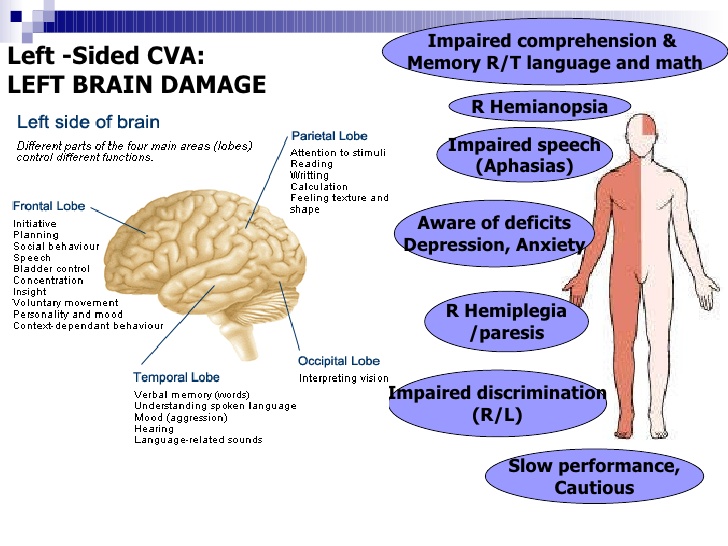
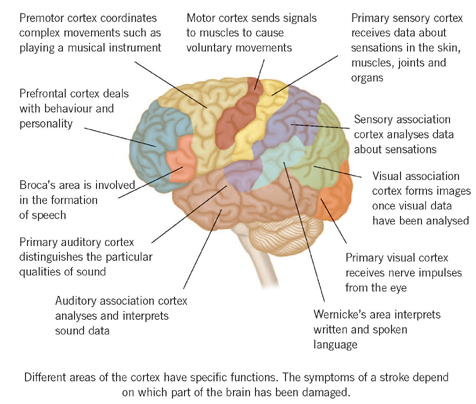
The possible affected area of the brain
Possible effectsBrain
| Area of damage | ||
|---|---|---|
| stem | A effects rain stem is uncommon but often fatal. Brain stem strokes may cause problems with breathing, heart function, balance and coordination, chewing, swallowing, speaking, and seeing, as well as weakness and paralysis on both sides of your body. | |
| Cerebellum | Strokes in the cerebellum are less common than in the cerebrum (the large part of the brain), but can cause severe effects including problems with balance and coordination, dizziness, headaches, nausea and vomiting. | |
| Cerebrum – Left hemisphere | Strokes in the left hemisphere typically cause weakness or paralysis on the right side of your body, and cognitive problems including difficulties with reading, talking and thinking, and learning and remembering new information. | |
| Cerebrum – Right hemisphere | Strokes in the right hemisphere typically cause problems with vision, depth perception, short-term memory loss, and judgement, as well as weakness or paralysis on the left side, and a tendency to ignore things on your left side including your own left arm and leg. |

Causes
- Hemorrhagic strokes are caused by bleeding in or around the brain.
- Bleeding occurs when a weakened blood vessel in the brain ruptures and leaks into the surrounding brain tissue.
- The leaked blood can put too much pressure on the blood cells in the brain, causing damage.
- Chronic high blood pressure is the most common reason for hemorrhagic stroke.
- Aneurysm, an abnormally shaped weak point in a blood vessel
- Arteriovenous malformations (AVMs), clusters of abnormally formed blood vessels
Major Risk Factors for Stroke
Certain environmental factors, medical conditions, and lifestyle habits increase your risk of stroke.
Some risk factors can be treated or controlled, while other risk factors cannot.
Factors that can’t be changed include:
- Family history: Stroke often runs in families. Your stroke risk may be higher if a grandparent, parent, or sibling has suffered a stroke in the past.
- Age: Stroke is most common in adults over the age of 65. The chance of having a stroke doubles for each decade of life after 55, according to the American Stroke Association.
- Gender: Women have more strokes than men, and strokes kill more women than men each year.
- Race: African Americans, Hispanics, American Indians, and Alaska Natives have a higher risk of stroke than non-Hispanic whites or Asians.
- Personal history of a previous stroke.
Stroke risk factors that can be prevented or controlled include:
- High blood pressure – High blood pressure is the main risk factor for stroke. It can damage and weaken arteries throughout the body so that they burst or clog more easily.
- High cholesterol – Cholesterol is a fatty substance that contributes to plaques in the arteries that can block blood flow to the brain.
- Heart disease – Coronary artery disease, the build-up of plaque in the arteries, can increase your risk of stroke. So can other heart conditions, including heart valve defects and irregular heartbeat (atrial fibrillation).
- Diabetes – People with diabetes are four times as likely to have a stroke as people without diabetes, according to the National Stroke Association.
- Sickle cell anemia.
- Heart disease – people with coronary heart disease are at more risk than people with normal functioning of the heart.
- Diabetes – people with diabetes have more chances to develop apoplexy
- Coronary artery disease – coronary arteries supply blood to the brain, they get narrowed by fatty deposition from artherosclerosis , and may become blocked by clot which results in to apoplexy or stroke.
- High blood cholesterol – high levels of low density cholesterol and triglycerides increase the risk of apoplexy.
- Physical inactivity and obesity – increases the risk of developing hypertension, diabetes, high blood cholesterol, which may ultimately result in to apoplexy.
- Liver disease – causes increased risk of bleeding
Risk Factors for Stroke
Certain lifestyle habits and conditions can also increase your risk of stroke.
These risk factors include
- Smoking
- Poor diet
- Obesity
- Low physical activity
- Stress and depression
- Heavy alcohol use
- Use of illicit drugs, including cocaine and amphetamines
Signs and Symptoms
The words BE FAST can help you recognize stroke signs:
- (B)Balance: Sudden loss of balance.
- (E)Eyes: Sudden loss of vision in one or both eyes
- (F)ACE. Ask the person to smile. Check to see if one side of the face droops.
- (A)RMS. Ask the person to raise both arms. See if one arm drifts downward.
- (S)PEECH. Ask the person to repeat a simple sentence. Check to see if words are slurred and if the sentence is repeated correctly.
- (T)IME. If a person shows any of these symptoms, time is essential. It is important to get to the hospital as quickly as possible.
Common Signs of Stroke
The type and severity of stroke symptoms depend on the area of the brain that is affected.
Signs and symptoms of stroke in both men and women may include:
- Sudden numbness, weakness, or inability to move the face, arm, or leg (especially on one side of the body)
- Confusion
- Trouble speaking or understanding speech
- Trouble seeing in one or both eyes
- Dizziness, trouble walking, or loss of balance or coordination
- Sudden, severe headache (often described as “the worst headache of my life”)
- Trouble breathing
- Loss of consciousness
Subtypes
If the area of the brain affected contains one of the three prominent central nervous system pathways—the spinothalamic tract, corticospinal tract, and dorsal column (medial lemniscus), symptoms may include:
- hemiplegia and muscle weakness of the face
- numbness
- reduction in sensory or vibratory sensation
- initial flaccidity (reduced muscle tone), replaced by spasticity (increased muscle tone), excessive reflexes, and obligatory synergies.
In most cases, the symptoms affect only one side of the body (unilateral). Depending on the part of the brain affected, the defect in the brain is usually on the opposite side of the body. However, since these pathways also travel in the spinal cord and any lesion there can also produce these symptoms, the presence of any one of these symptoms does not necessarily indicate a stroke.In addition to the above CNS pathways, the brainstem gives rise to most of the twelve cranial nerves. A brainstem stroke affecting the brainstem and brain, therefore, can produce symptoms relating to deficits in these cranial nerves
- altered smell, taste, hearing, or vision (total or partial)
- drooping of eyelid (ptosis) and weakness of ocular muscles
- decreased reflexes: gag, swallow, pupil reactivity to light
- decreased sensation and muscle weakness of the face
- balance problems and nystagmus
- altered breathing and heart rate
- weakness in sternocleidomastoid muscle with inability to turn head to one side
- weakness in tongue (inability to stick out the tongue or move it from side to side)
If the cerebral cortex is involved, the CNS pathways can again be affected, but also can produce the following symptoms:
- aphasia (difficulty with verbal expression, auditory comprehension, reading and writing; Broca’s or Wernicke’s area typically involved)
- dysarthria (motor speech disorder resulting from neurological injury)
- apraxia (altered voluntary movements)
- visual field defect
- memory deficits (involvement of temporal lobe)
- hemineglect (involvement of parietal lobe)
- disorganized thinking, confusion, hypersexual gestures (with involvement of frontal lobe)
- lack of insight of his or her, usually stroke-related, disability
If the cerebellum is involved, ataxia might be present and this includes:
- altered walking gait
- altered movement coordination
- vertigo and or disequilibrium
Stroke Symptoms in Women
Stroke is the third leading cause of death in women (and the fifth leading cause of death in men).
Each year stroke kills twice as many women as breast cancer, according to the National Stroke Association.
The stroke symptoms women may experience can be different from those experienced by men. These include:
- Fainting
- Difficulty or shortness of breath
- Sudden behavioral changes
- Agitation
- Hallucination
- Nausea or vomiting
- Seizures
- Hiccups
Ischemic Stroke

This slide shows a CT scan of an ischemic stroke, which is responsible for about 80% to 90% of all strokes. Ischemic strokes are caused by clots that reduce or stop blood flow to the brain. The clot may develop elsewhere in the body and circulate to become lodged in a blood vessel in the brain, or the clot may originate in the brain.
Symptoms/Symptoms, Diagnosis
The symptoms of a transient ischemic attack (TIA) and early ischemic stroke are similar. In the case of a TIA, however, the symptoms resolve within 24 hours. Symptoms depend on where the injury in the brain occurs. The origin of the stroke is usually either the carotid or basilar arteries.

Symptoms From Blockage in the Carotid Arteries.
The carotid arteries stem off of the aorta (the primary artery leading from the heart) and lead up through the neck, around the windpipe, and on into the brain. When TIAs or stroke occur from blockage in the carotid artery, which they often do, symptoms may occur in either the retina of the eye or the cerebral hemisphere (the large top part of the brain).
Symptoms include the following:
- When oxygen to the eye is reduced, people describe the visual effect as a shade being pulled down. People may develop poor night vision. About 35% of TIAs are associated with temporary lost vision in one eye.
- When the cerebral hemisphere is affected, a person can experience problems with speech and partial and temporary paralysis, drooping eyelid, tingling, and numbness, usually on one side of the body. The stroke victim may be unable to express thoughts verbally or to understand spoken words. If the stroke injuries are on the right side of the brain, the symptoms will develop on the left side of the body and vice versa.
- Uncommonly, patients may experience seizures.
Symptoms From Blockage in the Basilar Artery. The other major site of trouble, the basilar artery, is formed at the base of the skull from the vertebral arteries, which run up along the spine and join at the back of the head. When stroke or TIAs occur here, both hemispheres of the brain may be affected so that symptoms occur on both sides of the body. The following symptoms may develop:
- Temporarily dim, gray, blurry, or lost vision
- Tingling or numbness in the mouth, cheeks, or gums
- Headache, usually in the back of the head
- Dizziness
- Nausea and vomiting
- Difficulty swallowing
- Weakness in the arms and legs, sometimes causing a sudden fall
Such strokes usually occur in the brain stem, which can have profound affects on breathing, blood pressure, heart rate, and other vital functions, but have no affect on thinking or language.
Speed of Symptom Onset. The speed of symptom onset of a major ischemic stroke may indicate its source:
- If the stroke is caused by a large embolus (a clot that has traveled to an artery in the brain), the onset is sudden. Headache and seizures can occur within seconds of the blockage.
- When thrombosis (a blood clot that has formed within the brain) causes the stroke, the onset usually occurs more gradually, over minutes to hours. On rare occasions it progresses over days to weeks.
Ischemic strokes are usually divided into two main subtypes: thrombotic and embolic.
Thrombotic Stroke
Nearly half of all strokes are thrombotic strokes. Thrombotic strokes are caused when blood clots form in the brain due to a diseased or damaged cerebral artery.
Embolic Stroke
Blood clots also cause embolic strokes. However, in the case of embolic strokes, the blood clot forms in an artery outside the brain. Often these blood clots start in the heart and travel until they become lodged in an artery of the brain. The physical and neurological damage embolic strokes cause is nearly immediate.
Hemorrhagic Stroke

This picture shows a hemorrhagic stroke using an MRI image. The circle insert outlines what composes a hemorrhagic stroke. A blood vessel in the brain breaks open and blood escapes into the brain under pressure, compressing other blood vessels and brain cells causing damage and death. This bleeding into the brain is difficult to stop and is more likely to be fatal.
Symptoms of a Hemorrhagic Stroke
Intracerebral Hemorrhage Symptoms – Symptoms of an intracerebral, or parenchymal, hemorrhage typically begin very suddenly and evolve over several hours and include:
- Headache
- Nausea and vomiting
- Altered mental states
- Seizures
Subarachnoid Hemorrhage – When the hemorrhage is a subarachnoid type, warning signs may occur from the leaky blood vessel a few days to a month before the aneurysm fully develops and ruptures. Warning signs may include:
- Abrupt headaches
- Nausea and vomiting
- Sensitivity to light
- Various neurologic abnormalities. Seizures, for example, occur in about 8% of patients.
When the aneurysm ruptures, the stroke victim may experience
- A terrible headache
- Neck stiffness
- Vomiting
- Altered states of consciousness
- Eyes may become fixed in one direction or lose vision
- Stupor, rigidity, and coma
There are two types of hemorrhagic strokes: intracerebral and subarachnoid.
Intracerebral Stroke
“Intracerebral” means “within the brain,” and it refers to a stroke caused by a diseased blood vessel bursting within the brain. Intracerebral strokes are usually caused by high blood pressure.
Subarachnoid Stroke
A subarachnoid hemorrhage refers to bleeding immediately surrounding the brain in the area of the head called the subarachnoid space. The main symptom of a subarachnoid stroke is a sudden, severe headache, possibly following a popping or snapping feeling. Many factors can cause a subarachnoid stroke, including head injury, blood thinners, bleeding disorders and bleeding from a tangle of blood vessels known as an arteriovenous malformation.
Mini-Stroke (TIA)

“Mini-strokes” (also termed transient ischemic attacks or TIAs) are temporary blockages of blood vessels in the brain. TIAs can produce mild stroke symptoms that resolve. TIAs often occur before a stroke happens, so they serve as warning signs that the person may need stroke preventive therapy.
Stroke evaluated
The first step in assessing a stroke patient is to determine whether the patient is experiencing an ischemic or hemorrhagic stroke so that the correct treatment can begin. A CT scan or MRI of the head is typically the first test performed.
- Computed Tromography
-
Imaging
For diagnosing ischemic stroke in the emergency setting
- CT scans (without contrast enhancements)
- sensitivity= 16%
- specificity= 96%
- MRI scan
- sensitivity= 83%
- specificity= 98%
For diagnosing hemorrhagic stroke in the emergency setting:
- CT scans (without contrast enhancements)
- sensitivity= 89%
- specificity= 100%
- MRI scan
- sensitivity= 81%
- specificity= 100%
For detecting chronic hemorrhages, MRI scan is more sensitive
- CT scanning combines special x-ray equipment – with sophisticated computers to produce multiple images or pictures of the inside of the body. Physicians use CT of the head to detect a stroke from a blood clot or bleeding within the brain. To improve the detection and characterization of stroke, CT angiography (CTA) may be performed. In CTA, a contrast material may be injected intravenously and images are obtained of the cerebral blood vessels. Images that detect blood flow, called CT perfusion (CTP), may be obtained at the same time. The combination of CT, CTA and CTP can help physicians decide on the best therapy for a patient experiencing a stroke.
- Magnetic resonance angiography (MRA) – MRA is a noninvasive technology for imaging the cerebral blood vessels, and yields valuable information regarding blood supply to the brain. The use of intravenous contrast agents has provided great improvements in accurately viewing the cerebral blood vessels. Many such techniques have been pioneered by researchers at Stanford.

- Transcranial doppler (TCD) – TCD a new, noninvasive ultrasound procedure that allows the assessment of blood flow through the cerebral vessels via a small probe placed against the skull. TCD is a portable test that can be performed frequently at the patient’s bedside to follow the progress of medical treatment for stroke.
- Carotid duplex scanning – This is a noninvasive study to diagnose blockage in the carotid arteries. This technology involves recording sound waves that reflect the velocity of blood flow.
- Radionuclide SPECT scanning – This provides data on relative blood flow using the radionuclide Technetium99.
- Positron emission tomography (PET) scanning – A PET Scan measures brain cell metabolism, can determine if brain tissue is functioning even if blood flow to that area appears to be diminished.
- Cerebral angiography (angiogram) – This method requires the injection of a contrast dye through a major artery (usually the femoral artery in the thigh) for evaluation of blood flow to the brain. This procedure is completed in Stanford’s Cath/Angio lab. The procedure time is approximately two to three hours; bed rest for six hours is required after the procedure.
- Transesophageal echocardiography – This involves placing a flexible tube in the esophagus (tube to stomach) to directly image the heart and assess its function and structures.
- Ultrasound – An ultrasound is a diagnostic test that uses high frequency waves of sound to help examine the movement, size and shape of blood vessels.
To help determine the type, location, and cause of a stroke and to rule out other disorders, physicians may use
- Blood tests.
- CBC,ESR,Hb
- RBS,serum creatinine
- Serum cholesterol
- Electrocardiogram (ECG, EKG) – An electrocardiogram, which checks the hearts’ electrical activity, can help determine whether heart problems caused the stroke.
- Carotid ultrasound/Doppler ultrasound – Ultrasound imaging involves exposing part of the body to high-frequency sound waves to produce pictures of the inside of the body. Physicians use a special ultrasound technique called Doppler ultrasound to check for narrowing and blockages in the body’s two carotid arteries, which are located on each side of the neck and carry blood from the heart to the brain. Doppler ultrasound produces detailed pictures of these blood vessels and information on blood flow.
- Cerebral angiography –Angiography is a medical test that is performed with one of three imaging technologies—x-rays, CT or MRI, and in some cases a contrast material, to produce pictures of major blood vessels in the brain. Cerebral angiography helps physicians detect or confirm abnormalities such as a blood clot or narrowing of the arteries.

References
- https://www.ncbi.nlm.nih.gov/books/NBK499997/
- https://www.ncbi.nlm.nih.gov/pmc/articles/PMC4562827/
- https://www.ncbi.nlm.nih.gov/books/NBK279214/
- https://www.ncbi.nlm.nih.gov/pmc/articles/PMC3573516/
- https://www.ncbi.nlm.nih.gov/pmc/articles/PMC3152174/
- https://www.ncbi.nlm.nih.gov/pmc/articles/PMC1071073/