Scikit-learn model inference with ONNX Runtime

Patient Tools

Read, save, and share this guide

Use these quick tools to make this medical article easier to read, print, save, or share with a family member.

Patient Mode

Understand this article easily

Switch between simple English and easy Bangla patient notes. This is for education and does not replace a doctor consultation.

Scikit-learn is one of the most useful libraries for general machine learning in Python. To minimize the cost of deployment and avoid discrepancies, deploying scikit-learn models to production usually leverages Docker containers and pickle, the object serialization module of the Python standard library. Docker is...

For severe symptoms, danger signs, pregnancy, child illness, or sudden worsening, seek urgent medical care.

বাংলা রোগী নোট এখনো যোগ করা হয়নি। পোস্ট এডিটরে “RX Bangla Patient Mode” বক্স থেকে সহজ বাংলা সারাংশ যোগ করুন।

এই তথ্য শিক্ষা ও সচেতনতার জন্য। এটি ডাক্তারি পরীক্ষা, রোগ নির্ণয় বা প্রেসক্রিপশনের বিকল্প নয়।

Article Summary

Scikit-learn is one of the most useful libraries for general machine learning in Python. To minimize the cost of deployment and avoid discrepancies, deploying scikit-learn models to production usually leverages Docker containers and pickle, the object serialization module of the Python standard library. Docker is a good way to create consistent environments and pickle saves and restores models with ease. However, there are some limitations...

Key Takeaways

  • This article explains ONNX Runtime in simple medical language.
  • This article explains Scikit-learn to ONNX conversion in simple medical language.
  • This article explains Exceptional speedup on Scikit-learn models with ONNX Runtime in simple medical language.
  • This article explains Looking forward in simple medical language.
Educational health guideWritten for patient understanding and clinical awareness.
Reviewed content workflowUse writer and reviewer profiles for stronger trust.
Emergency safety firstUrgent warning signs are highlighted below.

Seek urgent medical care if you notice

These warning signs are general safety guidance. Local emergency numbers and clinical judgment should always come first.

  • Severe symptoms, breathing difficulty, fainting, confusion, or rapidly worsening illness.
  • New weakness, severe pain, high fever, or symptoms after a serious injury.
  • Any symptom that feels urgent, unusual, or unsafe for the patient.
1

Emergency now

Use emergency care for severe, sudden, rapidly worsening, or life-threatening symptoms.

2

See a doctor

Book a professional medical evaluation if symptoms persist, worsen, recur often, affect daily activities, or occur in a high-risk patient.

3

Learn safely

Use this article to understand possible causes, tests, treatment options, prevention, and questions to ask your clinician.

Before reading

RX Patient Tools

Use these quick guides before reading the article, or return to them when you need help preparing questions for a doctor.

Start here Choose the right pathway for symptoms, reports, medicines, or urgent warning signs. Disease article roadmap Read this topic step by step: meaning, symptoms, warning signs, diagnosis, treatment, prevention, and follow-up. Treatment planner Prepare questions about treatment choices, benefits, risks, side effects, and follow-up. Family & caregiver guide Organize symptoms, reports, medicines, questions, and follow-up safely. Nutrition & diet guide Prepare food, hydration, supplement, and medicine-timing questions safely. Prevention guide Organize risk factors, protective habits, screening, and warning signs. Recovery guide Prepare a safe plan for activity, rehabilitation, warning signs, and follow-up.

Scikit-learn is one of the most useful libraries for general machine learning in Python. To minimize the cost of deployment and avoid discrepancies, deploying scikit-learn models to production usually leverages Docker containers and pickle, the object serialization module of the Python standard library. Docker is a good way to create consistent environments and pickle saves and restores models with ease.

However, there are some limitations when going this route:

  • Users may not be able to load an old model saved with pickle when upgrading the version of scikit-learn. This limitation requires putting in place additional infrastructure to be able to retrain the model from a snapshot of the original training data, using the new version of Scikit-learn and its dependencies.
  • Scikit-learn is not optimized for performing predictions for one observation at a time, a common situation in web or mobile application scenarios. Like other machine learning frameworks, it is mainly designed for batch predictions. While the individual prediction latency of Scikit-learn estimators could be improved in the future, the Scikit-learn developers acknowledge that it wasn’t always much of a priority in the past.
  • Some deployment targets (e.g., mobile or embedded devices) do not support Docker or Python or impose a specific runtime environment, such as .NET or the Java Virtual Machine.
  • Scikit-learn and its dependencies (Python, numpy scipy) impose a large memory and storage overhead: at least 200 MB in memory usage, before loading the trained model and even more on the disk. While this is generally not a problem at model training time, this can be a blocker when deploying the prediction function of a single trained model to the target platform.

With framework interoperability and backward compatibility, the resource-efficient and high-performance ONNX Runtime can help address these limitations. This blog post introduces how to operationalize scikit-learn with ONNX, sklearn-onnx, and ONNX Runtime.

ONNX Runtime

ONNX (Open Neural Network Exchange) is an open standard format for representing the prediction function of trained machine learning models. Models trained from various training frameworks can be exported to ONNX. Sklearn-onnx is the dedicated conversion tool for converting Scikit-learn models to ONNX.

ONNX Runtime is a high-performance inference engine for both traditional machine learning (ML) and deep neural network (DNN) models. ONNX Runtime was open sourced by Microsoft in 2018. It is compatible with various popular frameworks, such as scikit-learn, Keras, TensorFlow, PyTorch, and others. ONNX Runtime can perform inference for any prediction function converted to the ONNX format.

ONNX Runtime is backward compatible with all the operators in the ONNX specification. Newer versions of ONNX Runtime support all models that worked with the prior version. By offering APIs covering most common languages including C, C++, C#, Python, Java, and JavaScript, ONNX Runtime can be easily plugged into an existing serving stack. With cross-platform support for Linux, Windows, Mac, iOS, and Android, you can run your models with ONNX Runtime across different operating systems with minimum effort, improving engineering efficiency to innovate faster.

Scikit-learn to ONNX conversion

If you are interested in performing high-performance inference with ONNX Runtime for a given scikit-learn model, here are the steps:

  • Train a model with or load a pre-trained model from Scikit-learn.
  • Convert the model from Scikit-learn to ONNX format using the sklearn-onnx tool.
  • Run the converted model with ONNX Runtime on the target platform of your choice.

Here is a tutorial to convert an end-to-end flow: Train and deploy a scikit-learn pipeline.

A pipeline can be exported to ONNX only when every step can. Most of the numerical models are now supported in sklearn-onnx. There are also some restrictions:

  • Sparse data is not supported yet. Therefore, it is still difficult to convert models handling text features where sparse vectors play an important role.
  • ONNX still offers limited options to perform iterative numerical optimization at inference time. As a result, sklearn-onnx does not support models such as NMF or LDA yet.

In addition to improving the model coverage, sklearn-onnx also extends its API to allow users to register any additional converter or even overwrite existing ones as custom transformers. The tutorial named Implement a new converter demonstrates how to convert a pipeline that includes an unsupported model class using a custom converter.

A prediction function may be converted in a way slightly different from the original scikit-learn implementation. It is therefore recommended to always compare the approximate equality of the predictions on a validation set prior to deploying the exported ONNX model. In particular, ONNX Runtime development prioritizes float over double, which is driven by performance for deep learning models. That’s why sklearn-onnx also uses single-precision floating-point values by default. However, in some cases, double precision is required to avoid significant discrepancies, specifically when the prediction computation involves the inverse of a matrix as in GaussianProcessRegressor or a discontinuous function as in Trees. An example named Issues when switching to float shows ways to solve the discrepancies introduced by using limited precision. The ONNX specification will be extended to resolve these discrepancies in the future.

Exceptional speedup on Scikit-learn models with ONNX Runtime

ONNX Runtime includes CPU state-of-the-art implementation for standard machine model predictions. In addition, with pure C++ implementations for both data verification and computation, ONNX Runtime only needs to acquire the GIL to return the output predictions (when called from Python) while scikit-learn needs it for every intermediate result. Therefore, ONNX Runtime is usually significantly faster than scikit-learn. The speed improvement depends on the batch size and the model class and hyper-parameters.

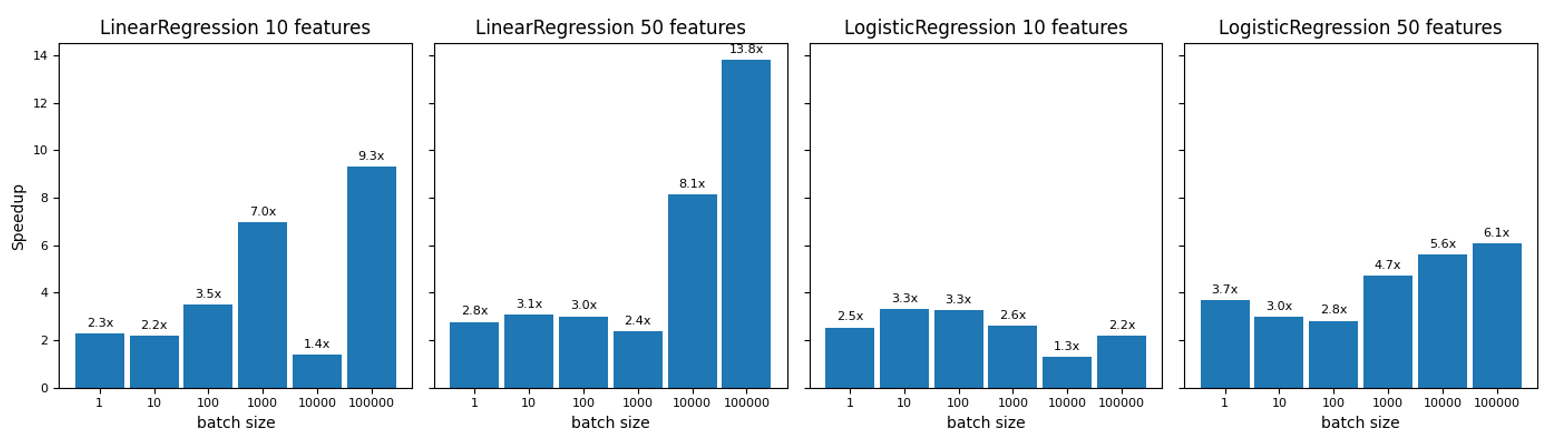
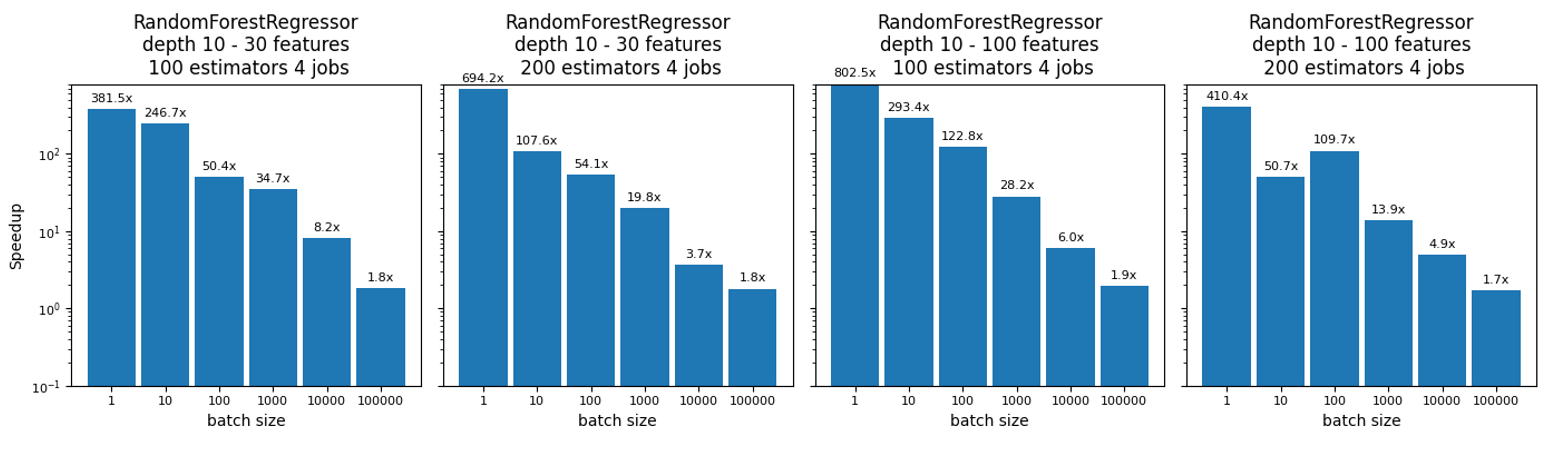
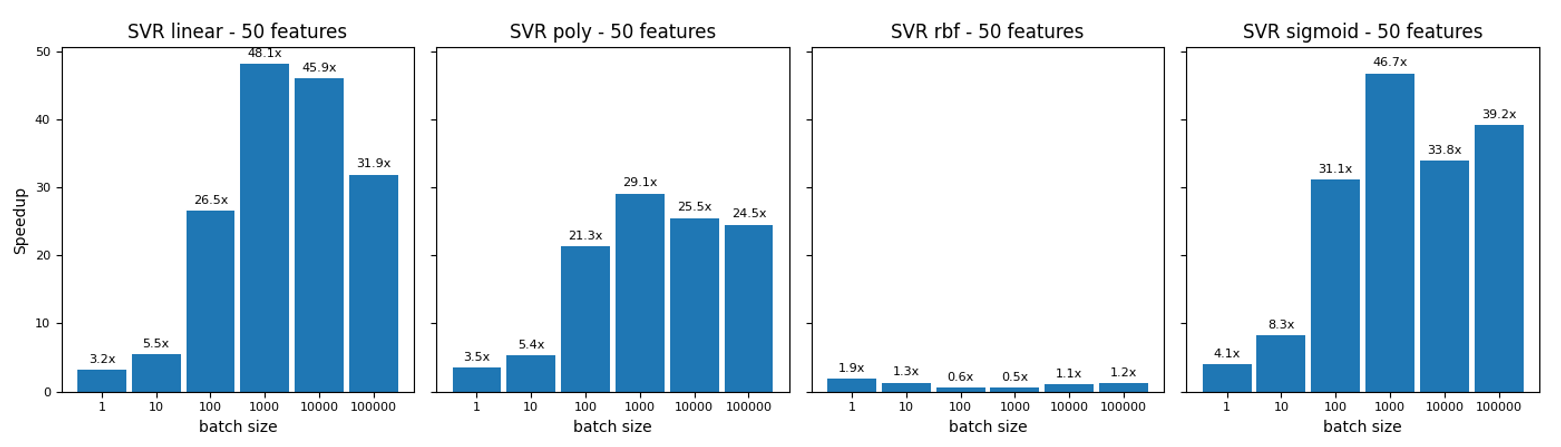
Let us consider a few popular scikit-learn models as examples. Below are performance benchmarks between scikit-learn 23.2 and ONNX Runtime 1.6 on Intel i7-8650U at 1.90GHz with eight logical cores. The y-axis is the model speedup with ONNX Runtime over the prediction speed of the scikit-learn model. The x-axis represents the number of observations for which we compute predictions in a single call (batch size). Different columns highlight the impact of changing some parameter values and the number of features used to train a given model.

  • Random Forest: ONNX Runtime runs much faster than scikit-learn with a batch size of one. We saw smaller but still noticeable performance gains for large batch sizes.
  • SVM Regression: ONNX Runtime outperforms scikit-learn with 3 function kernels, the small slow down observed for the RBF kernel is under investigation and will be improved in feature releases.
  • Linear Regression and Logistic Regression: ONNX Runtime is consistently better than scikit-learn across all the cases we tested.
Scikit-learn model inference with ONNX Runtime

Scikit-learn model inference with ONNX Runtime

Scikit-learn model inference with ONNX Runtime

The performance of RandomForestRegressor has been improved by a factor of five in the latest release of ONNX Runtime (1.6). The performance difference between ONNX Runtime and scikit-learn is constantly monitored. The fastest library helps to find more efficient implementation strategies for the slowest one. The comparison is more relevant on a large batch size as the intermediate steps scikit-learn calls to verify the inputs become insignificant compared to the overall computation time. Note that the poor speed of scikit-learn with a small batch size was reported on the scikit-learn issue tracker and will hopefully be improved in future releases of scikit-learn.

Looking forward

The list of supported models is still growing. This has led to some interesting discussions with core developers of scikit-learn. We will continue optimizing the performance in ONNX Runtime given this is a hard challenge and scikit-learn also continues to improve. This story of scikit-learn and ONNX began two years ago when Microsoft became a sponsor of the Scikit-learn consortium @ Inria Foundation and it is still going on.

Doctor visit helper

Prepare before seeing a doctor

A simple rural-patient checklist to help you explain symptoms clearly, ask better questions, and avoid unsafe self-treatment.

Safety note: This is not a prescription or diagnosis. For severe symptoms, pregnancy danger signs, children with serious illness, chest pain, breathing difficulty, stroke-like weakness, or major injury, seek urgent care.

Which doctor may help?

Start with a registered doctor or the nearest qualified health center.

What to tell the doctor

  • Write when the problem started and how it changed.
  • Bring old prescriptions, investigation reports, and current medicines.
  • Write allergies, pregnancy status, diabetes, kidney/liver disease, and major past illnesses.
  • Bring one family member if the patient is weak, elderly, confused, or a child.

Questions to ask

  • What is the most likely cause of my symptoms?
  • Which danger signs mean I should go to hospital quickly?
  • Which tests are necessary now, and which can wait?
  • How should I take medicines safely and what side effects should I watch for?
  • When should I come for follow-up?

Tests to discuss

  • Vital signs: temperature, pulse, blood pressure, oxygen saturation
  • Basic physical examination by a clinician
  • CBC, urine test, blood sugar, or imaging only when clinically needed

Avoid these mistakes

  • Do not use antibiotics, steroid tablets/injections, or strong painkillers without proper medical advice.
  • Do not hide pregnancy, kidney disease, ulcer, allergy, or blood thinner use.
  • Do not delay emergency care when danger signs are present.

Medicine safety and first-aid guide

This section is for patient education only. It does not replace a doctor, pharmacist, or emergency care.

Safe first steps

  • Avoid heavy lifting, sudden bending, and prolonged bed rest.
  • Use comfortable posture and gentle movement as tolerated.
  • Discuss physiotherapy, X-ray, or MRI only when clinically needed.

OTC medicine safety

  • For mild back pain, pain-relief medicine may be discussed with a doctor or pharmacist.
  • Avoid repeated painkiller use if you have kidney disease, stomach ulcer, uncontrolled blood pressure, or are taking blood thinners.

Avoid these mistakes

  • Do not start antibiotics without a proper medical decision.
  • Do not use steroid tablets or injections casually for quick relief.
  • Do not delay emergency care because of home remedies.

Get urgent help if

  • Back pain with leg weakness, numbness around private area, loss of urine/stool control, fever, cancer history, or major injury needs urgent care.
Medicine names, dose, and timing must be decided by a qualified clinician or pharmacist after checking age, pregnancy, allergy, other diseases, and current medicines.

For rural patients and family caregivers

Patient health record and symptom diary

Write your symptoms, medicines already taken, test results, and questions before visiting a doctor. This note stays on your device unless you print or copy it.

Doctor to discuss: Doctor / qualified healthcare provider
Tests to discuss with doctor
  • Basic vital signs: temperature, pulse, blood pressure, oxygen level if needed
  • Relevant blood, urine, imaging, or specialist tests only after clinical assessment
Questions to ask
  • What is the most likely cause of my symptoms?
  • Which warning signs mean I should go to emergency care?
  • Which tests are really needed now?
  • Which medicines are safe for my age, pregnancy status, allergy, kidney/liver/stomach condition, and current medicines?

Emergency warning signs such as chest pain, severe breathing difficulty, sudden weakness, confusion, severe dehydration, major injury, or loss of bladder/bowel control need urgent medical care. Do not wait for online information.

Safe pathway to proper treatment

Care roadmap for: Scikit-learn model inference with ONNX Runtime

Use this simple roadmap to understand the next safe steps. It is educational and does not replace examination by a doctor.

Go to emergency care if you notice:
  • Severe or rapidly worsening symptoms
  • Breathing difficulty, chest pain, fainting, confusion, severe weakness, major injury, or severe dehydration
Doctor / service to discuss: Qualified healthcare provider; specialist depends on symptoms and examination.
  1. Step 1

    Check danger signs first

    If danger signs are present, seek emergency care and do not wait for online information.

  2. Step 2

    Record the symptom story

    Write when symptoms started, severity, medicines already taken, allergies, pregnancy status, and test results.

  3. Step 3

    Visit a qualified clinician

    A doctor, nurse, or qualified healthcare provider can examine you and decide which tests or treatment are needed.

  4. Step 4

    Do only useful tests

    Do tests after clinical assessment. Avoid unnecessary tests, random antibiotics, or repeated medicines without diagnosis.

  5. Step 5

    Follow up and return early if worse

    If symptoms worsen, new warning signs appear, or treatment is not helping, return for review quickly.

Rural patient practical tips
  • Take a written symptom diary and all previous prescriptions/test reports.
  • Do not hide medicines already taken, even herbal or over-the-counter medicines.
  • Ask which warning signs mean urgent referral to hospital.

This roadmap is for education. A real diagnosis and treatment plan requires history, examination, and clinical judgment.

RX Patient Help

Ask a health question safely

Write your symptom story. A health professional or site editor can review it before any answer is prepared. This box is not for emergency care.

Emergency first: Severe chest pain, breathing trouble, unconsciousness, stroke signs, severe injury, heavy bleeding, or rapidly worsening symptoms need urgent local medical care now.

Frequently Asked Questions

Is this article a replacement for a doctor?

No. It is educational content only. Patients should consult a qualified clinician for diagnosis and treatment.

When should I seek urgent care?

Seek urgent care for severe symptoms, rapidly worsening condition, breathing difficulty, severe pain, neurological changes, or any emergency warning sign.

References

Add references, clinical guidelines, textbooks, journal articles, or trusted medical sources here. You can edit this area from the RX Article Professional Blocks panel.