
Kubernetes Clusters

Patient Tools

Read, save, and share this guide

Use these quick tools to make this medical article easier to read, print, save, or share with a family member.

Patient Mode

Understand this article easily

Switch between simple English and easy Bangla patient notes. This is for education and does not replace a doctor consultation.

Managing Kubernetes clusters at scale across a variety of infrastructures is—well—even harder. The Kubernetes community project Cluster API (CAPI) enables users to manage fleets of clusters across multiple infrastructure providers. The Cluster API Provider for Azure (CAPZ) is the solution for users who need to manage Kubernetes clusters on...

For severe symptoms, danger signs, pregnancy, child illness, or sudden worsening, seek urgent medical care.

বাংলা রোগী নোট এখনো যোগ করা হয়নি। পোস্ট এডিটরে “RX Bangla Patient Mode” বক্স থেকে সহজ বাংলা সারাংশ যোগ করুন।

এই তথ্য শিক্ষা ও সচেতনতার জন্য। এটি ডাক্তারি পরীক্ষা, রোগ নির্ণয় বা প্রেসক্রিপশনের বিকল্প নয়।

Article Summary

Managing Kubernetes clusters at scale across a variety of infrastructures is—well—even harder. The Kubernetes community project Cluster API (CAPI) enables users to manage fleets of clusters across multiple infrastructure providers. The Cluster API Provider for Azure (CAPZ) is the solution for users who need to manage Kubernetes clusters on Azure IaaS. In the past, we have recommended AKS Engine for this common scenario.  While we will continue to provide...

Key Takeaways

  • This article explains Do you manage your own Kubernetes clusters? in simple medical language.
  • This article explains Cluster API powers self-managed clusters on Azure in simple medical language.
  • This article explains But what about AKS Engine? in simple medical language.
  • This article explains Cluster API CAPZ: Getting started, getting help, and getting involved in simple medical language.
Educational health guideWritten for patient understanding and clinical awareness.
Reviewed content workflowUse writer and reviewer profiles for stronger trust.
Emergency safety firstUrgent warning signs are highlighted below.

Seek urgent medical care if you notice

These warning signs are general safety guidance. Local emergency numbers and clinical judgment should always come first.

  • Severe symptoms, breathing difficulty, fainting, confusion, or rapidly worsening illness.
  • New weakness, severe pain, high fever, or symptoms after a serious injury.
  • Any symptom that feels urgent, unusual, or unsafe for the patient.
1

Emergency now

Use emergency care for severe, sudden, rapidly worsening, or life-threatening symptoms.

2

See a doctor

Book a professional medical evaluation if symptoms persist, worsen, recur often, affect daily activities, or occur in a high-risk patient.

3

Learn safely

Use this article to understand possible causes, tests, treatment options, prevention, and questions to ask your clinician.

Before reading

RX Patient Tools

Use these quick guides before reading the article, or return to them when you need help preparing questions for a doctor.

Start here Choose the right pathway for symptoms, reports, medicines, or urgent warning signs. Disease article roadmap Read this topic step by step: meaning, symptoms, warning signs, diagnosis, treatment, prevention, and follow-up. Treatment planner Prepare questions about treatment choices, benefits, risks, side effects, and follow-up. Family & caregiver guide Organize symptoms, reports, medicines, questions, and follow-up safely. Nutrition & diet guide Prepare food, hydration, supplement, and medicine-timing questions safely. Prevention guide Organize risk factors, protective habits, screening, and warning signs. Recovery guide Prepare a safe plan for activity, rehabilitation, warning signs, and follow-up.

Managing Kubernetes clusters at scale across a variety of infrastructures is—well—even harder.

The Kubernetes community project Cluster API (CAPI) enables users to manage fleets of clusters across multiple infrastructure providers. The Cluster API Provider for Azure (CAPZ) is the solution for users who need to manage Kubernetes clusters on Azure IaaS. In the past, we have recommended AKS Engine for this common scenario.  While we will continue to provide regular, stable releases for AKS Engine, the Azure team is excited to share that CAPZ is now ready for users and will be our primary tool for enabling customers to operate self-managed Kubernetes clusters on Azure IaaS.

Do you manage your own Kubernetes clusters?

Kubernetes is the dominant cross-platform tool for managing containerized applications. Azure Kubernetes Service (AKS) is the managed service that makes it easy for users to run Kubernetes on Azure. AKS is mature, scalable, secure, and backed by Azure’s excellent support. But some users need to run clusters themselves and can’t take advantage of AKS. Some need functionality that is not available in AKS yet or might never be because they require user access to the control plane.

Some are running a service themselves on Azure that leverages Kubernetes and needs complete control, and others might need to run their own clusters for compliance or regulatory reasons (for example, financial services companies who can’t delegate management to another organization). Still, other users are developing new integrations with Kubernetes or Kubernetes features themselves, and need to be able to tweak, control, and test anything and everything. We call these clusters that users run themselves “self-managed” clusters.

If you need to run self-managed clusters on Azure, whatever your reason, you’ve come to the right place.

Cluster API powers self-managed clusters on Azure

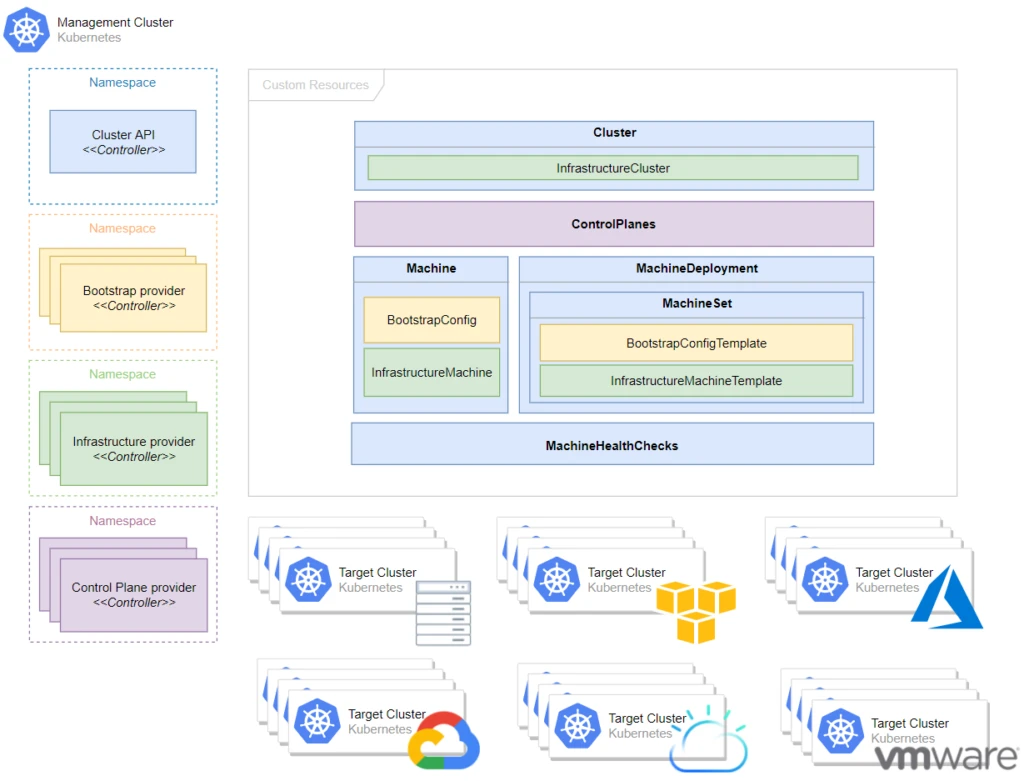
The Kubernetes community has long recognized the need for tooling to provide standardized lifecycle management of clusters independent of the infrastructure on which they run. In response SIG Cluster Lifecycle created the Cluster API sub-project:

Cluster API is a Kubernetes sub-project focused on providing declarative APIs and tooling to simplify provisioning, upgrading, and operating multiple Kubernetes clusters. – The Cluster API Book

Cluster API provides our team with a natural place to innovate in open source for users and expand community participation in solving Azure user problems at the same time. Thus, it made sense for us to spend the past 18 months investing in the Azure Provider for Cluster API (CAPZ) to make it a fully functional project ready to realize the vision of Cluster API for every user.
Kubernetes Clusters

The most recent CAPZ release, v0.4.10, includes new capabilities such as GPU support, private clusters, and Azure API call tracing. Some of you may be reluctant to adopt a tool whose API is labeled alpha (v1alpha3 to be exact). You should take comfort in the knowledge that CAPI enables forward and backward compatibility of API versions so that when the project moves to v1alpha4, and then v1beta1, you’ll be able to upgrade, and then use the API to output your objects with the new API version.

Our team is thrilled with the CAPZ work because more of you will be able to effectively manage your cluster’s entire lifecycle on Azure. It has also been fulfilling to drive innovations in the Cluster API community, like CAPI MachinePool, which enables users to take advantage of each infrastructure provider’s native VM scaling group capability. CAPI brings Kubernetes native cluster management and CAPZ enables this naturally on Azure infrastructure. Together in the community, we can deliver better capabilities for users more quickly.

Users are already taking advantage of CAPI and CAPZ on Azure. The Azure provider community consists of amazing people from Azure, VMware, Red Hat, Weaveworks, and more. Community members are realizing the power of the Cluster API by using CAPZ for use cases that span from building new platforms and products, like Tanzu Kubernetes Grid, to testing new hardware on multiple infrastructures.

Users are also discovering new use cases for CAPI. For example, a recent example uses CAPI and Helm to operate managed clusters. And our team is using CAPZ to validate new versions of, and features in, Kubernetes on Azure. Soon our upstream tests will move from using AKS Engine to CAPZ.

But what about AKS Engine?

Our team, Azure Container Compute Upstream, has the following mission:

  • Enable Azure to efficiently consume innovations from the Kubernetes ecosystem
  • Contribute innovations from Azure to the Kubernetes ecosystem

We maintain AKS Engine as an open source tool for Azure customers, but the narrow focus on Azure-specific APIs is inconsistent with our mission in the Kubernetes ecosystem.

AKS Engine works by creating ARM templates from a cluster model. ARM templates are a great Azure-specific solution for cluster creation, but this design falls short of empowering ongoing operational needs such as scaling, in-place upgrading, and extension management. And it isn’t useful for users who are focused on multi-cloud scenarios like managing fleets of Kubernetes clusters across cloud infrastructures that do not support ARM.

AKS Engine users will continue to receive excellent community support. As more maintainers have joined the AKS Engine community the Upstream team has shifted focus to CAPZ for new Kubernetes features. The community is committed to integrating and validating new versions of Kubernetes into AKS Engine. AKS Engine will remain the tool for creating Kubernetes clusters on Azure Stack Hub. We encourage other AKS Engine users to evaluate moving to CAPZ as it already provides stronger support for managing the cluster lifecycle compared to AKS Engine, and new investments from the Upstream team will be focused there. If you are committed to using AKS Engine longer term and would like to become a project maintainer, please reach out to us!

Cluster API CAPZ: Getting started, getting help, and getting involved

To get started building Kubernetes clusters on Azure with CAPZ, try the amazing CAPZ documentation. When you have issues, please look at the CAPZ issues and create new ones if needed. If you want to get more involved in developing CAPZ, our team is active during office hours and invite your participation. Many also find the #cluster-api-azure Slack channel to be a great source of advice, help, and collaboration.

In our next blog we’ll discuss in more detail how you can customize your CAPZ deployment to tune startup time for your application by baking your chosen operating system and patch level, and/or your application binaries and configurations into the virtual machine images. We plan to follow that with a discussion about how to leverage the GitOps principles by synchronizing a git repo with your management cluster.


Doctor visit helper

Prepare before seeing a doctor

A simple rural-patient checklist to help you explain symptoms clearly, ask better questions, and avoid unsafe self-treatment.

Safety note: This is not a prescription or diagnosis. For severe symptoms, pregnancy danger signs, children with serious illness, chest pain, breathing difficulty, stroke-like weakness, or major injury, seek urgent care.

Which doctor may help?

Start with a registered doctor or the nearest qualified health center.

What to tell the doctor

  • Write when the problem started and how it changed.
  • Bring old prescriptions, investigation reports, and current medicines.
  • Write allergies, pregnancy status, diabetes, kidney/liver disease, and major past illnesses.
  • Bring one family member if the patient is weak, elderly, confused, or a child.

Questions to ask

  • What is the most likely cause of my symptoms?
  • Which danger signs mean I should go to hospital quickly?
  • Which tests are necessary now, and which can wait?
  • How should I take medicines safely and what side effects should I watch for?
  • When should I come for follow-up?

Tests to discuss

  • Vital signs: temperature, pulse, blood pressure, oxygen saturation
  • Basic physical examination by a clinician
  • CBC, urine test, blood sugar, or imaging only when clinically needed

Avoid these mistakes

  • Do not use antibiotics, steroid tablets/injections, or strong painkillers without proper medical advice.
  • Do not hide pregnancy, kidney disease, ulcer, allergy, or blood thinner use.
  • Do not delay emergency care when danger signs are present.

Medicine safety and first-aid guide

This section is for patient education only. It does not replace a doctor, pharmacist, or emergency care.

Safe first steps

  • Avoid heavy lifting, sudden bending, and prolonged bed rest.
  • Use comfortable posture and gentle movement as tolerated.
  • Discuss physiotherapy, X-ray, or MRI only when clinically needed.

OTC medicine safety

  • For mild back pain, pain-relief medicine may be discussed with a doctor or pharmacist.
  • Avoid repeated painkiller use if you have kidney disease, stomach ulcer, uncontrolled blood pressure, or are taking blood thinners.

Avoid these mistakes

  • Do not start antibiotics without a proper medical decision.
  • Do not use steroid tablets or injections casually for quick relief.
  • Do not delay emergency care because of home remedies.

Get urgent help if

  • Back pain with leg weakness, numbness around private area, loss of urine/stool control, fever, cancer history, or major injury needs urgent care.
Medicine names, dose, and timing must be decided by a qualified clinician or pharmacist after checking age, pregnancy, allergy, other diseases, and current medicines.

For rural patients and family caregivers

Patient health record and symptom diary

Write your symptoms, medicines already taken, test results, and questions before visiting a doctor. This note stays on your device unless you print or copy it.

Doctor to discuss: Doctor / qualified healthcare provider
Tests to discuss with doctor
  • Basic vital signs: temperature, pulse, blood pressure, oxygen level if needed
  • Relevant blood, urine, imaging, or specialist tests only after clinical assessment
Questions to ask
  • What is the most likely cause of my symptoms?
  • Which warning signs mean I should go to emergency care?
  • Which tests are really needed now?
  • Which medicines are safe for my age, pregnancy status, allergy, kidney/liver/stomach condition, and current medicines?

Emergency warning signs such as chest pain, severe breathing difficulty, sudden weakness, confusion, severe dehydration, major injury, or loss of bladder/bowel control need urgent medical care. Do not wait for online information.

Safe pathway to proper treatment

Care roadmap for: Kubernetes Clusters

Use this simple roadmap to understand the next safe steps. It is educational and does not replace examination by a doctor.

Go to emergency care if you notice:
  • Severe or rapidly worsening symptoms
  • Breathing difficulty, chest pain, fainting, confusion, severe weakness, major injury, or severe dehydration
Doctor / service to discuss: Qualified healthcare provider; specialist depends on symptoms and examination.
  1. Step 1

    Check danger signs first

    If danger signs are present, seek emergency care and do not wait for online information.

  2. Step 2

    Record the symptom story

    Write when symptoms started, severity, medicines already taken, allergies, pregnancy status, and test results.

  3. Step 3

    Visit a qualified clinician

    A doctor, nurse, or qualified healthcare provider can examine you and decide which tests or treatment are needed.

  4. Step 4

    Do only useful tests

    Do tests after clinical assessment. Avoid unnecessary tests, random antibiotics, or repeated medicines without diagnosis.

  5. Step 5

    Follow up and return early if worse

    If symptoms worsen, new warning signs appear, or treatment is not helping, return for review quickly.

Rural patient practical tips
  • Take a written symptom diary and all previous prescriptions/test reports.
  • Do not hide medicines already taken, even herbal or over-the-counter medicines.
  • Ask which warning signs mean urgent referral to hospital.

This roadmap is for education. A real diagnosis and treatment plan requires history, examination, and clinical judgment.

RX Patient Help

Ask a health question safely

Write your symptom story. A health professional or site editor can review it before any answer is prepared. This box is not for emergency care.

Emergency first: Severe chest pain, breathing trouble, unconsciousness, stroke signs, severe injury, heavy bleeding, or rapidly worsening symptoms need urgent local medical care now.

Frequently Asked Questions

Do you manage your own Kubernetes clusters?

Kubernetes is the dominant cross-platform tool for managing containerized applications. Azure Kubernetes Service (AKS) is the managed service that makes it easy for users to run Kubernetes on Azure. AKS is mature, scalable, secure, and backed by Azure’s excellent support. But some users need to run clusters themselves and can’t take advantage of AKS. Some need functionality that is not available in AKS yet or might never be because they require user access to the control plane. Some are running a service…

Cluster API powers self-managed clusters on Azure The Kubernetes community has long recognized the need for tooling to provide standardized lifecycle management of clusters independent of the infrastructure on which they run. In response SIG Cluster Lifecycle created the Cluster API sub-project: Cluster API is a Kubernetes sub-project focused on providing declarative APIs and tooling to simplify provisioning, upgrading, and operating multiple Kubernetes clusters. – The Cluster API Book Cluster API provides our team with a natural place to innovate in open source for users and expand community participation in solving Azure user problems at the same time. Thus, it made sense for us to spend the past 18 months investing in the Azure Provider for Cluster API (CAPZ) to make it a fully functional project ready to realize the vision of Cluster API for every user. The most recent CAPZ release, v0.4.10, includes new capabilities such as GPU support, private clusters, and Azure API call tracing. Some of you may be reluctant to adopt a tool whose API is labeled alpha (v1alpha3 to be exact). You should take comfort in the knowledge that CAPI enables forward and backward compatibility of API versions so that when the project moves to v1alpha4, and then v1beta1, you’ll be able to upgrade, and then use the API to output your objects with the new API version. Our team is thrilled with the CAPZ work because more of you will be able to effectively manage your cluster’s entire lifecycle on Azure. It has also been fulfilling to drive innovations in the Cluster API community, like CAPI MachinePool, which enables users to take advantage of each infrastructure provider’s native VM scaling group capability. CAPI brings Kubernetes native cluster management and CAPZ enables this naturally on Azure infrastructure. Together in the community, we can deliver better capabilities for users more quickly. Users are already taking advantage of CAPI and CAPZ on Azure. The Azure provider community consists of amazing people from Azure, VMware, Red Hat, Weaveworks, and more. Community members are realizing the power of the Cluster API by using CAPZ for use cases that span from building new platforms and products, like Tanzu Kubernetes Grid, to testing new hardware on multiple infrastructures. Users are also discovering new use cases for CAPI. For example, a recent example uses CAPI and Helm to operate managed clusters. And our team is using CAPZ to validate new versions of, and features in, Kubernetes on Azure. Soon our upstream tests will move from using AKS Engine to CAPZ. But what about AKS Engine?

Our team, Azure Container Compute Upstream, has the following mission: Enable Azure to efficiently consume innovations from the Kubernetes ecosystem Contribute innovations from Azure to the Kubernetes ecosystem We maintain AKS Engine as an open source tool for Azure customers, but the narrow focus on Azure-specific APIs is inconsistent with our mission in the Kubernetes ecosystem. AKS Engine works by creating ARM templates from a cluster model. ARM templates are a great Azure-specific solution for cluster creation, but this design…

References

Add references, clinical guidelines, textbooks, journal articles, or trusted medical sources here. You can edit this area from the RX Article Professional Blocks panel.