
The Vancouver classification means the periprosthetic hip fractures, or post-operative periprosthetic femoral fracture diagnosis system proposed by Duncan and Masri is the most widely used classification system. It is a special type fracture managing method for classifying, investigating the fracture pattern, severity, degree, location, type, angulation, shortening – lengthening, comminution, rotation, displacement, the status of the femoral implant, the quality of surrounding femoral soft tissue injury and fracture angle are universally and widely accepted by orthopedic surgeons to assess the initial injury, plan management, and predict prognosis, to manage decision making, in determining whether a fracture requires an intramedullary nail or open reduction with internal fixation with steel screws, rods, plates, pins, or K-wires to hold the broken bones in the correct position even external fixation attaches a metal framework outside the limb and includes the Ilizarov method and an X-frame.
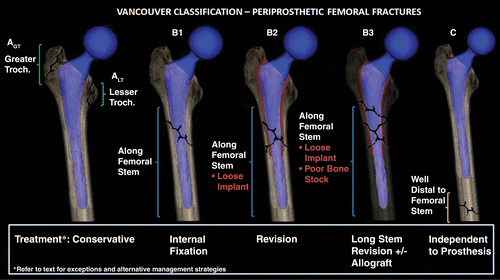
Vancouver Classification Periprosthetic Hip Fractures
- type A: fractures involve the trochanteric area
- A(G): greater trochanter
- A(L): lesser trochanter
- type B: around the stem or just below it
- B1: stem stable
- B2: stem loose
- B3: stem loss, bone stock inadequate
- type C: well below the stem
or
The Vancouver classification is a fracture grading system used by orthopedics to determine the management of post-operative periprosthetic femoral fractures in hip arthroplasty. It is named for the city Vancouver, home to the University of British Columbia is where the authors of the 1995 paper worked in the orthopedic department.
|
Vancouver Classification & Treatment – Intraoperative Periprosthetic Fracture
|
|||
|
Type
|
Description
|
Treatment
|
|
|
A1
|
Proximal metaphysis, cortical perforation
|
Bone graft alone (e.g. from acetabular reaming)
|
|
|
A2
|
Proximal metaphysis, nondisplaced crack
|
Cerclage wire before inserting stem (to prevent crack propagation)
Ignore the fracture if fully porous-coated stem is used (provided there is no distal propagation)
|
|
|
A3
|
Proximal metaphysis displaced unstable fracture
|
Fully porous-coated stem, or tapered fluted stem
Wires/cables/claw plate for isolated GT fractures
|
|
|
B1
|
Diaphyseal, cortical perforation (usually during cement removal)
|
Fully porous-coated stem (bypass by 2 cortical diameters) ± strut allograft
|
|
|
B2
|
Diaphyseal, nondisplaced crack (from increased hoop stress during broaching or implant placement)
|
Cerclage wire (if implant stable)
Fully porous-coated stem to bypass defect (if implant unstable) ± strut allograft
PWB and observation (if detected postop)
|
|
|
B3
|
Diaphyseal, displaced unstable fracture (usually during the hip dislocation, cement removal, stem insertion)
|
Fully porous-coated stem to bypass defect ± strut allograft
|
|
|
C1
|
Distal to stem tip, cortical perforation (during cement removal)
|
Morcellized bone graft, fully porous-coated stem to bypass defect, strut allograft
|
|
|
C2
|
Distal to stem tip, nondisplaced fracture
|
Cerclage wire, strut allograft
|
|
|
C3
|
Distal to stem tip, displaced unstable fracture
|
ORIF
|
|
|
Vancouver Classification & Treatment – Postoperative Periprosthetic Fracture
|
|||
|
Type
|
Description
|
Treatment
|
|
|
A
|
Fracture in the trochanteric region.
Commonly associated with osteolysis.
AG (greater trochanter) fractures caused by retraction, broaching, actual implant insertion, previous hip screws.
|
Often requires treatment that addresses the osteolysis.
AG fractures with < 2cm displacement, treat nonoperatively with partial WB and allow the fibrous union.
AG fractures >2cm needs ORIF (loss of abductor function leads to instability) with trochanteric claw/cables
|
|
|
B1
|
Fracture around the stem or just below it, with a well-fixed stem
|
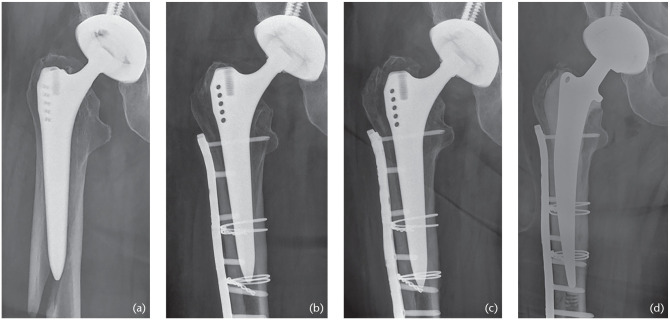
ORIF using cerclage cables and locking plates
|
|
|
B2
|
Fracture around the stem or just below it, with a loose stem but good proximal bone stock
|
Revision of the femoral component to a long porous-coated cementless stem and fixation of the fracture fragment.
Revision of the acetabular component if indicated
|
|
|
B3
|
Fracture around the stem or just below it, with proximal bone that is poor quality or severely comminuted
|
Femoral component revision with proximal femoral allograft (APC) or proximal femoral replacement (PFR)
|
|
|
C
|
The fracture occurs well below the prosthesis
|
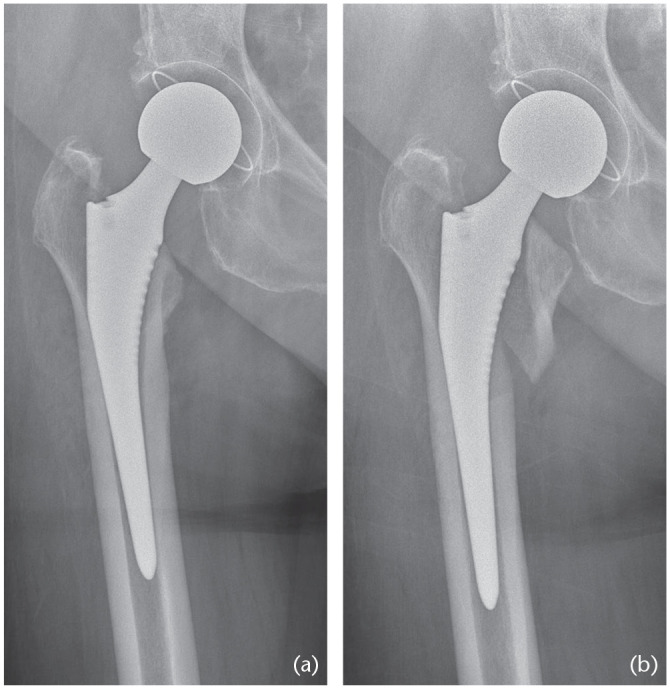
ORIF with plate (leave the hip and acetabular prosthesis alone)
|
|
or
Classification for operative process
| Type | Description | Treatment |
|---|---|---|
| A | Fracture in the trochanteric region | ORIF if displaced |
| B1 | Fracture around the stem or just below, with well-fixed stem | ORIF with cables and plate |
| B2 | Fracture around the stem or just below, with loose stem but good proximal bone | Revision of femoral component |
| B3 | Fracture around the stem or just below, with poor quality or severely comminuted proximal bone | Revision of femoral component with a proximal femoral replacement |
| C | Fracture below the prosthesis |

References
- https://www.ncbi.nlm.nih.gov/pmc/articles/PMC5154424/
- https://www.ncbi.nlm.nih.gov/pmc/articles/PMC3069264/
- https://www.ncbi.nlm.nih.gov/pmc/articles/PMC7407870/
- https://en.wikipedia.org/wiki/Vancouver_classification
- https://www.sciencedirect.com/science/article/pii/S0020138318306582
- https://www.ncbi.nlm.nih.gov/books/NBK556057/
- https://en.wikipedia.org/wiki/Winquist_and_Hansen_classification
- https://www.ncbi.nlm.nih.gov/pmc/articles/PMC2656872/
- https://www.ncbi.nlm.nih.gov/books/NBK544275/
- https://www.ncbi.nlm.nih.gov/pmc/articles/PMC6370083/
- https://www.ncbi.nlm.nih.gov/pmc/articles/PMC4562928/
- https://www.sciencedirect.com/science/article/pii/S2210261219301348
- https://www.ncbi.nlm.nih.gov/pmc/articles/PMC3163773/
- https://www.ncbi.nlm.nih.gov/pmc/articles/PMC7203210/
- https://www.ncbi.nlm.nih.gov/pmc/articles/PMC5154424/
- https://en.wikipedia.org/wiki/Danis%E2%80%93Weber_classification
- https://www.ncbi.nlm.nih.gov/pmc/articles/PMC4252160
- https://www.ncbi.nlm.nih.gov/pmc/articles/PMC5291558/
- https://journals.lww.com/md-journal/fulltext/
- https://pacs.de/term/pelvic-bucket-handle-fracture
- https://en.wikipedia.org/wiki/Young-Burgess_classification
- https://www.tandfonline.com/doi/abs/10.1080/10255842.2018.1553238?
- https://pubs.rsna.org/doi/10.1148/rg.345135113
- https://www.ncbi.nlm.nih.gov/pmc/articles/PMC1005359/pdf/annrheumd00494-0065.pdf
- https://www.ncbi.nlm.nih.gov/pmc/articles/PMC4531757/
- https://www.e-roj.org/journal/view.php?number=105
- https://www.researchgate.net/publication/16587969_Parasymphyseal_insufficiency_fractures_of_the_os_pubis
- https://en.wikipedia.org/wiki/Duverney_fracture
- https://www.ncbi.nlm.nih.gov/pmc/articles/PMC7265089/
- https://www.ncbi.nlm.nih.gov/pmc/articles/PMC4728702/
- https://www.ncbi.nlm.nih.gov/pmc/articles/PMC2588293/
- https://www.ncbi.nlm.nih.gov/pmc/articles/PMC5333948/
- https://www.ncbi.nlm.nih.gov/books/NBK493161/
- https://www.ncbi.nlm.nih.gov/books/NBK519005/
- https://pubmed.ncbi.nlm.nih.gov/18063712/
- https://apm.amegroups.com/article/view/10536/11577
- https://www.ncbi.nlm.nih.gov/pmc/articles/PMC3728390/
- https://academic.oup.com/jrr/article/54/6/1102/1132874
- https://bmjopen.bmj.com/content/9/7/e032111
- https://www.ncbi.nlm.nih.gov/books/NBK559168/
- https://www.ncbi.nlm.nih.gov/books/NBK507803/
- https://www.ncbi.nlm.nih.gov/pmc/articles/PMC7724026/
- https://www.ncbi.nlm.nih.gov/pmc/articles/PMC2903134/
- https://www.ncbi.nlm.nih.gov/pmc/articles/PMC6753548/
- https://www.ncbi.nlm.nih.gov/pmc/articles/PMC6904631/
- https://www.ncbi.nlm.nih.gov/pmc/articles/PMC6205015/
- https://www.ncbi.nlm.nih.gov/pmc/articles/PMC6583643/
- https://www.ncbi.nlm.nih.gov/pmc/articles/PMC3062872/
- https://www.ncbi.nlm.nih.gov/pmc/articles/PMC8013639/
- https://www.ncbi.nlm.nih.gov/pmc/articles/PMC6531999/
- https://www.mdpi.com/2076-3417/11/10/4395
- https://www.cambridge.org/core/journals/journal-of-glaciology/article/novel-method-for-predicting-fracture-in-floating-
- https://www.amazon.com/Biomechanics-Orthopaedic-Trauma-Fracture-Fixation/dp/1853171085
- https://www.amazon.com/Fracture-Management-Primary-Care-Updated/dp/0323546552
- https://online.boneandjoint.org.uk/journal/bjo
- https://www.sciencedirect.com/topics/medicine-and-dentistry/avulsion-fracture
- https://medlineplus.gov/
- https://en.wikipedia.org/wiki/Acetabular_fracture
- https://radiopaedia.org/articles/judet-and-letournel-classification-for-acetabular-fractures
- https://books.google.com.bd/books?id=XvbsDwAAQBAJ&pg
- https://en.wikipedia.org/wiki/Bone_fracture
- https://en.wikipedia.org/wiki/Fracture
- https://www.ncbi.nlm.nih.gov/books/NBK542250/
- https://www.ncbi.nlm.nih.gov/books/NBK549912/
- https://www.ncbi.nlm.nih.gov/pmc/articles/PMC3445231/
- https://www.ncbi.nlm.nih.gov/books/NBK542221/
- https://www.sciencedirect.com/science/article/pii/S1930043315301862
- https://www.ncbi.nlm.nih.gov/pmc/articles/PMC5903328/
- https://www.ncbi.nlm.nih.gov/pmc/articles/PMC5961267/
- https://www.ncbi.nlm.nih.gov/pmc/articles/PMC5721952/
Explore this medical topic
Continue through verified related conditions, investigations, medicines, and patient guides. These links are educational and do not replace professional medical advice.

