
If you have ever wondered about meaning, you are not alone in that quest for answers.
The question of meaning is not really one question but actually represents a cipher for a vast number of further questions. And it is by no means obvious whether these questions are answerable at all; neither do we know with any certainty into which area of expertise the responsibility for answering these questions falls.
– Author
In response to this observation, I would like to propose that the field of positive psychology is, more than any other field, responsible for dealing with all matters related to meaning.
So far, it has already done a remarkable job; however, it is a gross understatement to claim that we are still in the early stages of our ‘will to meaning.’
Before trying to determine what an answer to this question might look like (such as 42), and even before coming up with a better question to ask, let us decide what ‘meaning’ means.
What are we looking for?
On the Word ‘Meaning’
To dive into the concept of the meaning (of life), we have to deal with semantics first. That is, we have to make sure that we are on the same page.
First of all, the word ‘meaning’ in English is incredibly confusing. It simply means different things and those different things can mean different things as well. Confused yet? Good.
As Leontiev suggested, German and Russian are more convenient languages to use when we talk about meaning, because they have different words for different kinds of meaning.
(So does the Dutch language, by the way). I’ll be a doll and stick to English for now.
So What do We Mean?
The meaning we are focused on when discussing the meaning of life is its ‘relevance, significance, or value. Thus, to avoid confusion, a clearer version of these questions is: “What is life’s relevance, significance, or value?”
Later in this article, you will discover why that is not the right question either, but it suffices for now.
Philosophers, psychotherapists, and researchers have been dealing with this question for millennia and have identified different kinds of meaning.
Let’s take a look at some of them.
Terrestrial Meaning vs. Cosmic Meaning
In his book Existential Psychotherapy (1980), Yalom introduced cosmic and terrestrial meanings.
Cosmic meaning concerns itself with “whether life, in general, fits into some overall coherent pattern.” According to Yalom, cosmic meaning implies religious or spiritual connotations because it sees meaning as part of a grand scheme, or, a bigger picture superior to that of the individual.
The paradoxical thing is that a grand design seems to offer people comfort. But don’t we have enough to suffer from our consciousness of the inevitability of our impending death? Cosmic meaning suggests that if there was some sort of thought behind our messy human situation, maybe it would feel lighter. That, to me, is the definition of cruelty.
If there was such a thing as a grand design, the only meaning I would likely experience in a world like that would be from directly and passionately fighting its sadism.
I say that the ‘pattern’ we fit in is nature. Everything else is a comforting make-belief. You are free to believe what you think. That’s the beauty of it. (Leave a comment below this article if you feel like expressing your beliefs. I’d love to hear them.)
Terrestrial meaning, on the other hand, offers an answer to the question: what is the meaning of my life?
In doing so, it whittles the question down to a more manageable size. Essentially, the debate of cosmic verse terrestrial meaning is one of the ‘external world’versuss the ‘internal world.’
Do we believe that meaning is something imposed on us, or that we are free to create it ourselves? If we like the meaning we create and it guides us, is that enough?
‘The’ Meaning and ‘a’ Meaning
Leontiev differentiates between ‘the’ meaning and ‘a meaning.
‘The meaning’ is the single, ultimate integrative reference point inside the person. This type of meaning is similar to terrestrial meaning.
‘A meaning’ represents an element of ever-present mechanisms of the ongoing regulation of behavior and cognition. ‘A meaning’, therefore, is more concerned with affect regulation. It serves as a psychological panacea for successful living and as a tranquilizer against the existential uncertainty mentioned before.
Of course, it is purely subjective and tells us more about human psychology than about life itself.
Although it does not help us in our quest for meaning, meaning’ teaches us the importance of placing the meaning of something into some intentional context.
That is exactly what I find so scary about absolute systems/grand designs: they (try to) give context to everything.
Big vs. Small Meaning
I find these terms more poetic, which I appreciate. To me, life is boring when scientific lingo is all we use.
Kierkegaard explains the concept of big meaning with his quote:
The thing is to find a truth which is true for me, to find the idea for which I can live and die.
Big meaning, therefore, differs from cosmic meaning in the sense that it is 100% subjective.
Small meaning is experiential meaning (one of Wong’s 3 modalities of the meaning). Seeing your daughter smile, meaning, experienced at the moment.
I do not agree with Frankl that every moment contains meaning. I think every moment has the potential to be a meaningful moment if you let yourself experience it. The thing to watch out for is to not always look for meaning or feel pressured to experience it. One could start to feel stupid for not finding the meaning that is supposedly there, especially during dark times.
Suchness Meaning
Maslow would have agreed with the concept of meaning-making.
He even came up with a term for this phenomenon, ‘suchness meaning,’ and beautifully described it as follows:
What is the meaning of a leaf, a fugue, a sunset, a flower, a person? They “mean” themselves, explain themselves, and prove themselves. You can’t make sense of many basic experiences in life. You can’t be rational about them; they just are. About all you can do with them is simply to recognize their existence, to accept them, and, whenever possible, to enjoy them in their richness and mystery, at the same time realising that they constitute much of the answer to the question ‘What is the meaning of life?’
– Maslow, 1966
Well, there’s your tweet quote right there. If only it was short enough to fit into one tweet…
Somewhat more spiritually, Osho described the same suchness by saying:
In search for the meaning of life, look for life. Once you find life you will discover its meaning.
What thoughts or actions do these quotes stir for you? I would love to hear them in our comments section.
Global and Situational Meaning
In response to my LinkedIn article Why ‘What is the Meaning of Life? is a Silly Question, my friend David Penglase remarked:
The key difference I think is in the important but subtle difference between “meaning of” and “meaning in.” The “meaning of” my life suggests a summarization. Whereas, “meaning in” opens the possibility to why and how the various life roles we have can provide us with meaning.
This is the same distinction that Frankl made with global verse situational meaning, “meaning of” referring to the global meaning and “meaning in” to situational meaning.
What we can learn from Dave’s remark and Frankl’s distinction is that the ‘meaning of meaning changes depending on both its context and the perspective we take.
That is one reason, to me, that it seems absurd to consider ‘meaning’ as a word complete in itself with one answer.
Global Meaning
Global or ultimate meaning (aka ‘The Ultimate Meaning Hypothesis’) relates to the intrinsic meaning of life.
I do not believe that life has intrinsic value. Instead, I believe life to be intrinsically absurd—because of its suchness. That absurdity, along with everything else that can be said about life, is mere attribution.
Let’s make sure we don’t turn our death-denying illusions into life-denying illusions.
According to Wong, the advantage of the belief in the intrinsic value of life is that is more functional than alternative global beliefs by facilitating the discovery of the meaning of the moment.
That, to me, is committing philosophical suicide. It is taking the Matrix’s blue pill.
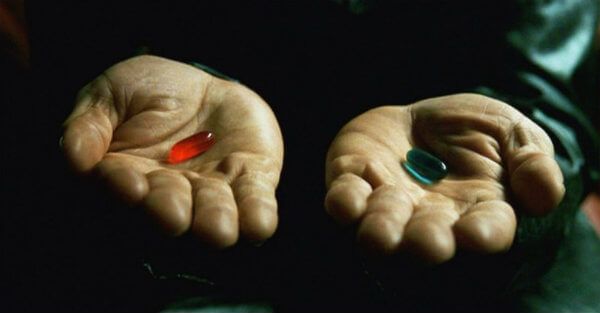
Cypher: You know, I know this steak doesn’t exist. I know that when I put it in my mouth, the Matrix is telling my brain that it is juicy and delicious. After nine years, you know what I realize?
*Takes a bite of his steak*
Cypher: Ignorance is bliss.
One of the points that the Matrix makes, similar to Nozick’s experience machine thought experiment, is that humans prefer life to be ‘real’ rather than to experience the greatest form of pleasure ad infinitum.
They would rather be, in the words of John Stuart Mill, a human being dissatisfied than a pig satisfied.
I choose not to subscribe to the notion that life has intrinsic value, even if it has proven to be functional, even if it can serve as a lubricant between daily life and the meaning I experience throughout it.
Situational Meaning
What Frankl meant with ‘situational meaning’ is the same as the concept of ‘small meaning’ explained earlier. Meaning that can be experienced from moment to moment in daily life.
Living Meaning, Personal Meaning, and Life Activity
Living meaning is 100% objective and relates to personal meaning. However, they are not the same.
For it’s not the things that feed his spirit, but rather the links between the things. Not the diamond, but some relations between people and the diamond may feed him. Not the sand, but some relations established between the sand and the tribes. Not the words in a book, but some relations existing in the book between and beyond words, relations that are love, poem and Lord’s wisdom.
– A. de Saint-Exupery
This quote reminds us of the central tenet of cognitive-behavioral theory, namely that there is:
- a given situation
- your interpretation of that situation
- your resulting thoughts, feelings, and actions
The situation does not directly influence your feelings and or actions; your interpretation of the situation does. Have you ever had bad food service while ordering coffee? If you interpret that situation with a thought like, “That server must be having a rough day, and their behavior has nothing to do with me,” then you might shake the situation quickly and move along with your day.
However, given the same situation, if you interpret that situation with thoughts like, “That server must hate me, I guess I should not come to my favorite cafe anymore,” then you are likely going to leave with a heavy heart (and no coffee).
It may be a silly example, but it conveys how our interpretations affect us, and more than the events themselves.
The same goes for meaning. Meaning is about your relationship with a subject or phenomenon, and not about the thing itself.
Living Meaning
Living meaning describes the relationship between objects, phenomena, happenings, and actions that are a part of one’s life. It contains the same suchness aspect as described before because it does not depend on being understood. It simply is.
This is a metaphysical rather than a psychological relationship between the individual and the things in their life.
Example: The chair in my room has meaning to the extent that it influences my life by its being because it is there.
Personal Meaning
Personal meaning is the form in which the subject knows and sees his living meanings, i.e. his interpretation of the situation.
This is Leontiev:
“The consciousness merely marks out and emphasizes what is significant for the subject, and sets before him the “task for meaning,” that of becoming aware of the concrete place that the corresponding objects or events occupy in his life, of the motives, needs, and values of the subject with which they are connected, and of the precise nature of the connection. The answer to this question, the resolution of this task requires the special inner activity of meaning-creation.”
In other words, what is significant for you about an object or situation will shape how you interpret meaning in certain events.
Life Activity
This personal meaning translates to meaning-based structures of the personality, which in their turn translate to a system that facilitates the regulation of the subject’s life activity by a specific meaning-based logic.
The individual’s beliefs about meaning regulate their actions and over time, their life activity.
Leontiev concludes that bearing in mind these three planes of the existence of meaning, we can define meaning as the relation between the subject.
Meaning as a Relationship
The resulting meaning is partly objective (living meaning) and partly subjective (personal meaning).
Thereby, it is more non-dual than the other forms of meaning we have discussed.
Life’s relevance, significance, or value are not of primary concern in a quest for its meaning. Rather, let us look at the relationship between an object and the subject.
One final example:
- Your daughter smiles. (fact, situation, living meaning, objective, suchness meaning)
- You see your daughter’s smile and interpret this as meaningful. (small meaning, situational meaning, personal meaning, interpretation of the situation)
- You return your daughter’s smile and experience a meaningful moment. (life activity, behavior)
or:
- The phenomenon in the life of an individual
- Goes through the (subjective) lens of the individual
- Result in a feeling or action dependant upon the personality structure of the individual that regulates behavior
Summing up
Meaning is the relationship between a phenomenon and a subject. It varies in scope and depends on context, personality, and beliefs, and is subjective.
Do you agree? Whether you do or do not, I would love to hear your thoughts in our comments section.
Recommended Reading
Over the years, the subject of meaning has become a true passion of mine. If you are also interested in this subject, I highly recommend you order a copy of the following books:
- Existential Psychotherapy by Irvin Yalom (and all other books by Irvin Yalom for that matter, but especially this one)
- Meaning in Positive and Existential Psychology (brilliant collection of articles by Springer)
- The Denial of Death by Ernest Becker (Becker’s best work, awarded with the Pulitzer price)
- Man’s Search for Meaning by Victor Frankl (currently very trending and often cited in the field of PP)
- Zona: A Book About a Film About a Journey to a Room by Geoff Dyer (a book about Tarkovski’s 1979 movie ‘Stalker’)
- Meanings of Life by Roy Baumeister (diving into empirical studies)
Besides books, check out these articles written by Baumeister, Wong, Leontiev, Emmons, and Mike Steger.
What I have found is that in asking the question ‘What is the meaning of life?’ and in finding possible answers to it, therein lies my primary sense of meaning.
- Batthyany, A. & Russo-Netzer, P., 2014, Meaning in Existential and Positive Psychology, Chapter 1: Psychologies of Meaning
- Frankl, V., 1946, Man’s Search for Meaning
- Stephen Downes (Jan 09, 2009). Types of meaning. Retrieved from http://halfanhour.blogspot.com.es/2009/01/types-of-meaning.html
- Leontiev, D.A., Three Facets of Meaning, Journal of Russian and East European Psychology, vol. 43, no. 6, November–December 2005, pp. 45–72.
- Leontiev, D.A., The Phenomenon of Meaning: How Psychology Can Make Sense of It
- Maslow, A., (1966). The Psychology of Science.
- Wong, T. P., Wong L., McDonald, M. J., & Klaassen, D. K. (2007). The Positive Psychology of Meaning and Spirituality. Abbotsford, BC: INPM Press, .33-44.
- Wong, T. P., Victor Frankl’s Meaning Seeking Model and Positive Psychology, Retrieved from http://www.drpaulwong.com/viktor-frankls-meaning-seeking-model-and-positive-psychology/
- Yalom, I. (1980). Existential psychotherapy.
