
Blepharophimosis, ptosis, and epicenters inverses syndrome (BEES) is a rare developmental condition affecting the four major features of eyelids and ovary, all present at birth: blepharophimosis, ptosis, epicenters inversus, and telecasts. Typically, four major facial features are present at birth: narrow eyes, droopy eyelids, an upward fold of skin of the inner lower eyelids, and widely set eyes. BPES type I includes the four major features and primary ovarian insufficiency; BPES type II includes only the four major features. Other ophthalmic manifestations that can be associated with BPES include dysplasia eyelids, lacrimal duct anomalies, strabismus, refractive errors, and amblyopia. These features cause difficulty in opening the eyes fully and may impact an affected individual’s quality of vision. BEES type I involves premature ovarian insufficiency (POI) in females as well as the characteristic facial features, whereas BEES type II is characterized by these facial features alone. Potential treatments include corrective eyelid surgery, hormone replacement therapy for premature ovarian insufficiency, and embryo/egg donation for consequent problems with fertility.
Symptoms
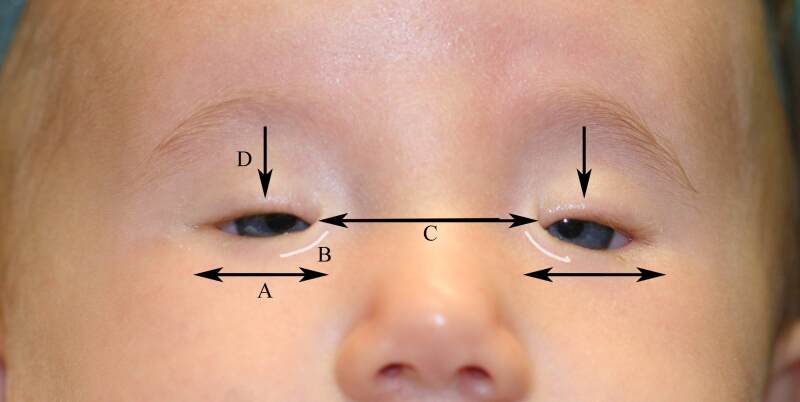
Blepharophimosis, ptosis, and epicanthus inversus syndrome (BPES) is defined by complex eyelid malformation characterized by four major features, all present at birth: blepharophimosis, ptosis, epicanthus inversus, and telecanthus.
The four major features that are characteristic symptoms of BPES are present at birth: narrowing of the eye-opening (blepharophimosis), droopy eyelids (ptosis), formation of an upward fold of the inner lower eyelid (epicenters inverses), and increased distance between the eyes (telecanthBEESus). There are two types of telecasts, type I and type II, which are both characterized by the typical eyelid malformation. However, BEES type I is also associated with loss of ovarian function or premature ovarian insufficiency (POI). Menstrual periods in women with POI become less frequent over time and stop before the age of 40 thus leading to either difficulty (subfertility) or inability to conceive (infertility). Other minor facial features frequently observed in both types include “lazy” eye (amblyopia), crossed eyes (strabismus), low-set ears, a short distance between the upper lip and nose, and a broad nasal bridge.
Two types of BPES have been described [rx]:
-
BPES type I includes the four major features and female infertility caused by primary ovarian insufficiency.
-
BPES type II includes only the four major features.
Complex eyelid malformation
-
Blepharophimosis. Narrowing of the horizontal aperture of the eyelids. In normal adults, the horizontal palpebral fissure measures 25-30 mm; in individuals with BPES, it generally measures 20-22 mm.
-
Ptosis. Drooping of the upper eyelid causing a narrowing of the vertical palpebral fissure. In individuals with BPES, ptosis is secondary to dysplasia of the musculus levator palpebrae superioris. To compensate for the ptosis, affected individuals:
-
Use the musculus frontalis, wrinkling the forehead to draw the eyebrows upward, which results in a characteristic facial appearance;
-
Tilt their head backward into a chin-up position.
-
-
Epicanthus inversus. A skin fold arising from the lower eyelid and running inward and upward
-
Telecanthus. Lateral displacement of the inner canthi with normal interpupillary distance
Associated ophthalmic manifestations
-
Dysplastic eyelids (lack of eyelid folds and thin skin)
-
S-shaped border of the upper eyelid and abnormal downward concavity of the lower eyelid with lateral ectropion
-
Nasolacrimal drainage problems caused by lateral displacement, duplication, or stenosis of the lacrimal punctaNote: A study of ten individuals with molecularly confirmed BPES showed that all had lateral displacement of the inferior punctum (i.e., in the lower eyelid) resulting from a temporal displacement of the entire lower eyelid. This proved to be an important anatomic hallmark in the diagnosis of BPES [rx].
-
Strabismus, refractive errors (anisometropic hypermetropia and myopia), and amblyopia are more common in individuals with BPES than in the general population [rx, rx, rx]. A retrospective study in 204 individuals with BPES showed manifest strabismus in 20%, a significant refractive error in 34%, and bilateral or unilateral amblyopia in 21% and 20%, respectively [rx].
Other craniofacial features frequently observed in BPES are a broad nasal bridge and low-set ears.
Primary ovarian insufficiency (POI)
-
Secondary sexual characteristics are usually normal in both BPES type I and BPES type II.
-
In BPES type I, menarche is usually normal, followed by oligomenorrhea and secondary amenorrhea.
-
Hypoplastic uterus and small ovaries may be found in some individuals with BPES type I on pelvic ultrasound.
-
Ovarian reserve is decreased (characterized by a low atrial follicle count of <4 and decreased serum levels of anti-müllerian hormone) [rx].
-
Endocrinologic findings of hypergonadotropic hypogonadism include: elevated serum concentrations of follicle-stimulating hormone (>25 IU/L, measured on 2 occasions >4 weeks apart); elevated luteinizing hormone [rx]; and decreased serum concentrations of estradiol and progesterone.
-
Cognitive development is expected to be normal in individuals with BPES unless the disorder occurs as part of a contiguous gene deletion with associated developmental delay / intellectual disability.
Pituitary hormone deficiency. A recent study showed that some individuals with BPES have hypopituitarism with no molecular explanation other than a FOXL2 pathogenic variant, suggesting a role for FOXL2 in human pituitary development [rx].
Causes
FOXL2 is the only gene known to cause BPS. This gene controls the production of the FOXL2 protein, which is involved in the development of the muscles in the eyelid as well as the growth and development of ovarian cells. Disease-causing changes (mutations) in the FOXL2 gene result in the signs and symptoms described above.
This syndrome is almost always inherited in an autosomal dominant manner. Most genetic diseases are determined by the status of the two copies of a gene, one received from the father and one from the mother. Dominant genetic disorders occur when only a single copy of an altered gene is necessary to cause a particular disease. The altered gene can be inherited from either parent, or can be the result of a new mutation in the affected individual. The risk of passing the altered gene from an affected parent to an offspring is 50% for each pregnancy. The risk is the same for males and females. In some individuals, the disorder is due to a spontaneous (de Nova) genetic mutation that occurs in the egg or sperm cell. In such situations, the disorder is not inherited from the parents.
Diagnosis
The diagnosis of BPES is based on four clinical findings which are present at the time of birth. The first of these findings is the narrowing of the eyelids (blepharophimosis). The second finding is drooping of the upper eyelid (ptosis). With this condition, affected individuals usually compensate by tilting their heads backward with their chin up and wrinkling their foreheads to pull the eyebrows upward to maintain full vision. These compensatory mechanisms result in a characteristic facial appearance. The third clinical finding is a skin fold that arises from the lower eyelid and runs inwards and upwards (epibenthos inversus). The final clinical finding used for diagnosis is widely set eyes (telecasters). There are two types of BPES. Type I is diagnosed based on the four major features mentioned as well as premature ovarian insufficiency causing infertility or subfertility in females. Type II is diagnosed based on the presence of the four major features alone.
Clinical Testing and Work-Up
Female BPES patients can also be tested for premature ovarian insufficiency. Clinical signs of this are endocrinologic or hormonal, including elevated serum levels of FSH and LH and decreased serum concentrations of estradiol and progesterone (important hormones in the female reproductive system). In addition, the size of the uterus and clinical features observable upon pelvic ultrasound can be telltale signs of POI.
To confirm the clinical diagnosis on the molecular level, several genetic tests can be performed. Molecular genetic testing of FOXL2 includes sequence analysis and deletion/duplication analysis. In addition, chromosome analysis may be performed to screen for cytogenetic rearrangements involving 3q23 (band 23 on the short arm of chromosome 3).
Treatment
Management requires the input of a multidisciplinary team with specialists including a clinical geneticist, genetic counselor, pediatric ophthalmologist, oculoplastic surgeon, (pediatric or adult) endocrinologist, reproductive endocrinologist, and gynecologist.
Treatment for BPES needs to address both the eyelid malformation and the premature ovarian insufficiency in type I patients. To manage the eyelid malformation, surgery is performed to correct the blepharophimosis, epicenters inversus, telepaths, and ptosis. These procedures are traditionally done in two stages, though it is possible to do them simultaneously. Traditionally, correction of blepharophimosis, epibenthos inversus, and telepaths is done between the ages of three to five years, followed by ptosis correction after about one year. Timing of surgery is important, as this determines the balance of maintaining visual function while also producing the best cosmetic outcome.
To manage premature ovarian insufficiency associated with BPES type I, hormone replacement therapy is recommended. More specifically, estrogen replacement is given to managing the insufficiency of hormones experienced with POI. It should however be noted that no therapies have been shown to restore fertility or ovarian function thus far. As such, other reproductive options may be explored including adoption, foster parenthood, embryo donation, and egg donation.
Follow-up is influential in the management of BPES. Ophthalmic follow-up is individualized based on the affected individual’s visual acuity testing results, past procedures, and age. Females who have BPES (type I especially) are encouraged for the endocrinologic and gynecologic follow-up to monitor ovarian function. This may include procedures such as pelvic ultrasounds, measuring serum FSH levels, and menstrual pattern assessment.
Investigational Therapies
A therapy under investigation for BPES type I is ovarian transplantation. This procedure has been performed for women who have an affected twin sister with normal ovarian function. Though successful, this treatment is only done in rare circumstances.
References
- https://www.ncbi.nlm.nih.gov/books/NBK430715/
- https://www.ncbi.nlm.nih.gov/books/NBK1441/
- https://en.wikipedia.org/wiki/Babesiosis
- https://www.cdc.gov/parasites/babesiosis/gen_info/faqs.html
- https://www.fda.gov/medical-devices/
- https://www.fda.gov/science-research/womens-health-research/owh-funded-research-autoimmune-diseases
- https://www.niams.nih.gov/health-topics/autoimmune-diseases
- https://www.ncbi.nlm.nih.gov/books/NBK459447/
- https://www.ncbi.nlm.nih.gov/books/NBK459452/
- https://www.ncbi.nlm.nih.gov/books/NBK1370/
- https://www.ncbi.nlm.nih.gov/books/NBK576418/
- https://www.ncbi.nlm.nih.gov/books/NBK459479/
- https://www.rarediseaseadvisor.com/disease-info-pages/
- https://www.clinicaltrials.gov/
- https://rarediseases.org/for-patients-and-families/information-resources/rare-disease-information/
- https://rarediseases.org/organizations/genetic-and-rare-diseases-gard-information-center/
- https://rarediseases.org/organizations/nihnational-institute-of-arthritis-and-musculoskeletal-and-skin-diseases/
- https://www.ncbi.nlm.nih.gov/books/NBK459433/
- https://www.ncbi.nlm.nih.gov/books/NBK580299/
- https://www.ncbi.nlm.nih.gov/books/NBK580299/
- https://www.ncbi.nlm.nih.gov/books/NBK10757/
- https://www.ncbi.nlm.nih.gov/books/NBK459459/
- https://en.wikipedia.org/wiki/Autoimmune_disease
- https://en.wikipedia.org/wiki/List_of_autoimmune_diseases
- https://en.wikipedia.org/wiki/Immune_disorder
- https://www.niaid.nih.gov/diseases-conditions
- https://www.niehs.nih.gov/health/topics/conditions/autoimmune/
- https://www.cancer.gov/publications/dictionaries/cancer-terms/def/autoimmune-disease
- https://medlineplus.gov/autoimmunediseases.html
- https://www.cancer.gov/publications/dictionaries/cancer-terms/def/autoimmune-disease
- https://clinicaltrials.gov/ct2/show/NCT04995783
- https://www.sciencedirect.com/topics/medicine-and-dentistry/autoimmune-disease
- https://www.gene.com/stories/autoimmune-disease-101
- https://www.genome.gov/Genetic-Disorders
- https://www.sciencedirect.com/book/9780123849298/the-autoimmune-diseases
- https://autoimmune.org/disease-information/
Explore this medical topic
Continue through verified related conditions, investigations, medicines, and patient guides. These links are educational and do not replace professional medical advice.

